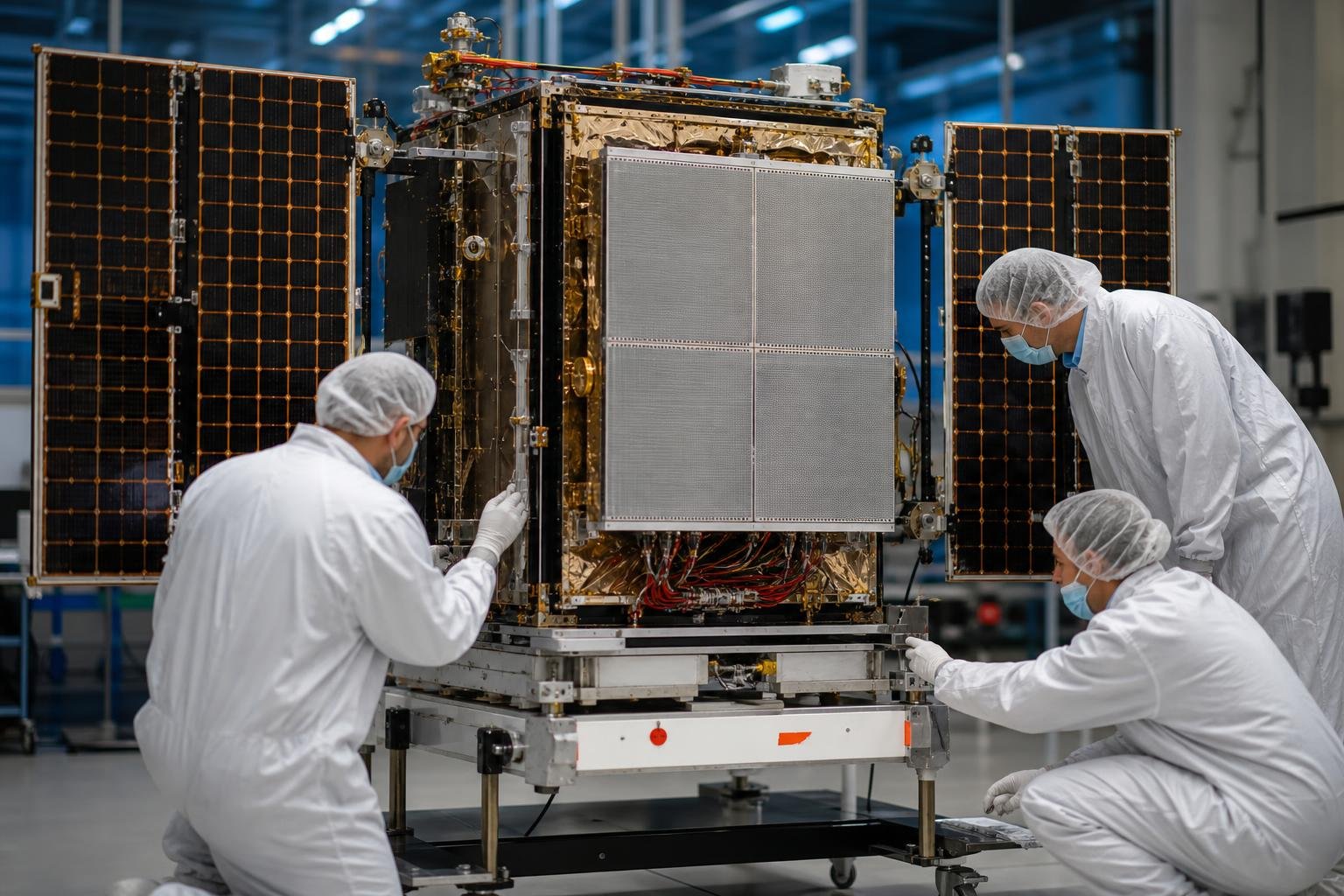
Los Angeles startup Orbital Compute Inc., operating as Orbital, has proposed a low Earth orbit constellation of as many as 100,000 satellites designed to run AI inference workloads. The company disclosed the plan on June 30 in connection with a U.S. Federal Communications Commission application; the filing is a request for authorization, not an FCC approval. No production Orbital satellite has launched. [1]
The proposal puts a striking number on a rapidly emerging idea: treating orbit as an extension of AI infrastructure. Orbital says its fully deployed network could supply about 10 gigawatts of computing capacity, with roughly 100 kilowatts assigned to each spacecraft. If it can work economically, the model would add compute capacity without drawing from terrestrial power grids or requiring new land and water-intensive cooling systems. Whether it can reach that point remains an open—and exceptionally difficult—question. [1]
A distributed data center in orbit
Orbital is not proposing a single large station assembled in space. Its architecture calls for independently deployable compute satellites, intended to let the company add capacity incrementally. The company says a full-scale spacecraft would have an approximately 100-meter footprint, weigh about two metric tons and provide computing comparable to roughly eight current-generation servers. [1]
Solar arrays would provide power in a suitable, continuously or near-continuously sunlit orbit. Heat would be removed by radiators that emit it into space as infrared radiation. That distinction matters: the vacuum of space does not cool electronics by itself. Heat must first move from chips and other components into thermal hardware, then be radiated away—a challenge that grows with compute density and power consumption. [1][8]
Orbital is initially targeting inference rather than frontier-model training. Large-scale training depends on tightly connected clusters of thousands of GPUs, where extremely high bandwidth and low latency between processors are central to performance. Inference is more divisible: separate satellites can potentially handle separate requests, making a distributed architecture more plausible for that class of workload. [3]
Early capital, distant deployment
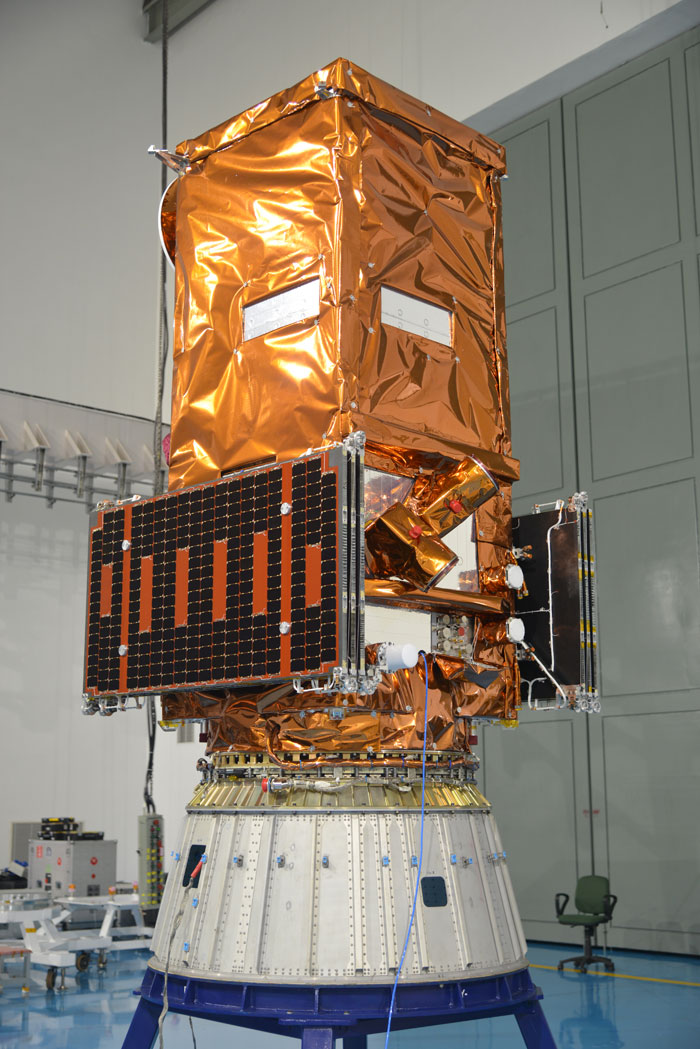
The announcement follows Orbital’s $5 million oversubscribed pre-seed financing, announced June 9 and led by a16z speedrun. The startup says the money will support a 2027 Pathfinder demonstration, its first purpose-built satellite and Factory-1, a planned Los Angeles-area manufacturing facility. Disclosed investors also include Basis Set, Human Element, Wayfinder, Antler, Anti Fund, Ascent, Rubik, Zero Knowledge Ventures, LYVC, Feld Ventures, New Legacy, FNDR, UpHonest and Asterisk. [2]
The 2027 demonstration is expected to fly as a hosted payload on a SpaceX Falcon 9 rideshare. Orbital plans to test GPU operation, radiation tolerance, thermal performance, shielding and downlink capabilities. Its first dedicated spacecraft, Orbital-1, is targeted for 2028. The company has said its design work is oriented around NVIDIA’s announced Space-1 Vera Rubin-class GPU architecture, while the initial demonstration has also been described as using an NVIDIA Blackwell GPU. [2]
Founder and CEO Euwyn Poon, previously founder of electric-scooter company Spin, has framed constrained grid access, cooling, land and permitting as the bottlenecks behind the proposal. But the gulf between a hosted demonstration and a 100,000-satellite fleet is substantial. TechCrunch reported that Orbital has roughly a dozen employees, including people with experience at Amazon’s satellite business, SpaceX and Northrop Grumman, while a constellation at this scale could require billions of dollars and more than a decade of development. [4]
Launch economics are the central dependency
Orbital itself has acknowledged that current launch economics do not support the full concept. Poon told TechCrunch that Falcon 9 pricing does not make a constellation of this scale economically viable, and that the company expects large-scale deployment to depend on commercially available, highly reusable heavy-lift launch capacity, particularly SpaceX’s Starship. [4]
That dependency is especially consequential because the system must pay not only to place satellites in orbit, but also to replace failed or obsolete hardware, sustain communications links and manage a large constellation safely over time. The proposed 10 GW figure is also not directly comparable to a terrestrial data center’s grid power draw: it is Orbital’s estimate of aggregate computing capacity based on its per-satellite target, rather than a deployed and independently verified operating measurement. [1]
A May 2026 Novaspace white paper found that large orbital data centers remained far from cost-competitive with ground-based facilities. In its modeled 1-GW comparison, a space-based system cost about $46 billion, compared with roughly $17 billion for a terrestrial data center, even using optimistic launch and manufacturing assumptions. The study identified satellite hardware as the largest cost driver and described cooling as one of the least mature parts of the architecture. [6]
Technical challenges extend beyond the GPU
Running individual processors in orbit is no longer the core question. The harder systems problem includes radiation exposure, repeated temperature cycling, power generation and storage, thermal control, networking, transport, maintenance and autonomous operations. Avi Shabtai, CEO of Ramon.Space, has identified those issues as major barriers even while describing orbital computing as a significant potential opportunity. [5]
James Mason, chief space officer at Planet, similarly said orbital compute is technically feasible but argued that power, heat rejection and economic deployment are the decisive questions. He also highlighted lower launch costs and stronger space-traffic management as prerequisites for scale. [5]
For a fleet measured in tens or hundreds of thousands of spacecraft, collision avoidance and debris mitigation become infrastructure requirements rather than secondary operational concerns. University at Buffalo aerospace researcher John Crassidis has warned that very large constellations can raise collision risk and contribute to cascade hazards in low Earth orbit. [8]
A crowded bet on space-based compute
Orbital is entering a field that is attracting companies across launch, cloud infrastructure and satellite manufacturing. As of July 2, SpaceX had proposed an orbital data-center system involving as many as one million satellites. Starcloud had demonstrated operation of an NVIDIA H100 GPU in orbit, while Google and Planet were pursuing early orbital-compute demonstrations. Blue Origin, Cowboy Space, Ramon.Space and Ingrasys were also pursuing related space-infrastructure or compute-platform efforts. [5]
The nearer-term market may be narrower than the vision of replacing terrestrial hyperscale campuses. Analysts see potential early uses in processing satellite data close to where it is collected, defense applications, sovereign storage and latency-tolerant inference. Novaspace likewise judged smaller systems for defense, Earth-observation processing and edge workloads more likely to become viable before orbital infrastructure for large AI-training systems. [5][6]
Orbital’s FCC application is therefore a significant statement of ambition, not evidence that an orbital AI utility is imminent. Its eventual case will rest on whether launch prices, satellite manufacturing, thermal systems, radiation protection, communications and orbital-safety operations can improve enough to make compute in space cheaper—or valuable enough—for workloads that do not need to remain on Earth. [1][4][6]
Editor’s Take
I like the direction of this bet, but the headline number—100,000 satellites and 10 GW—should be treated as a design target, not infrastructure. The credible near-term opportunity is much smaller: process Earth-observation data where it is collected, serve defense and sovereign workloads, and run inference jobs that can tolerate intermittent links and scheduling delay. Those are markets where avoiding a massive downlink can be worth more than trying to beat a terrestrial cloud region on raw cost per GPU-hour.
The engineering constraint is not whether a GPU can boot in orbit; that has already become demonstrable. It is whether the whole system can continuously reject heat, survive radiation, route workloads, replace aging hardware and avoid becoming a traffic-management burden at constellation scale. I would watch the 2027 Pathfinder for measured thermal performance, radiation-induced failure behavior, usable downlink throughput and power stability—not marketing claims about theoretical compute.
Starship-scale reusability is the financial hinge. If launch, deployment and replacement costs fall dramatically, orbital compute could become a useful specialized infrastructure layer. Until then, terrestrial data centers retain enormous advantages in repairability, networking and economics, and the Novaspace cost comparison is a useful reminder that solar power in space does not make hardware, thermal control or orbital operations free.
References
- Orbital – https://orbital.inc/press/orbital-100000-constellation.html
- GlobeNewswire – https://www.globenewswire.com/news-release/2026/06/09/3308756/0/en/Orbital-Raises-Oversubscribed-5M-Pre-Seed-Round-to-Build-AI-Data-Centers-in-Space.html
- GlobeNewswire – https://www.globenewswire.com/news-release/2026/04/14/3273430/0/en/orbital-sets-date-for-first-test-mission-to-put-ai-data-centers-in-low-earth-orbit.html
- TechCrunch – https://techcrunch.com/2026/06/09/how-an-e-scooter-founder-raised-5-million-to-build-space-data-centers/
- Satellite Today – https://www.satellitetoday.com/technology/2026/06/02/are-orbital-data-centers-the-next-frontier-of-ai-infrastructure/
- Novaspace – https://nova.space/wp-content/uploads/2026/05/Novaspace_Orbital-Data-Centers_White-Paper.pdf
- ABC News / Associated Press – https://abcnews.go.com/amp/US/wireStory/musk-vows-put-data-centers-space-run-solar-129860857