
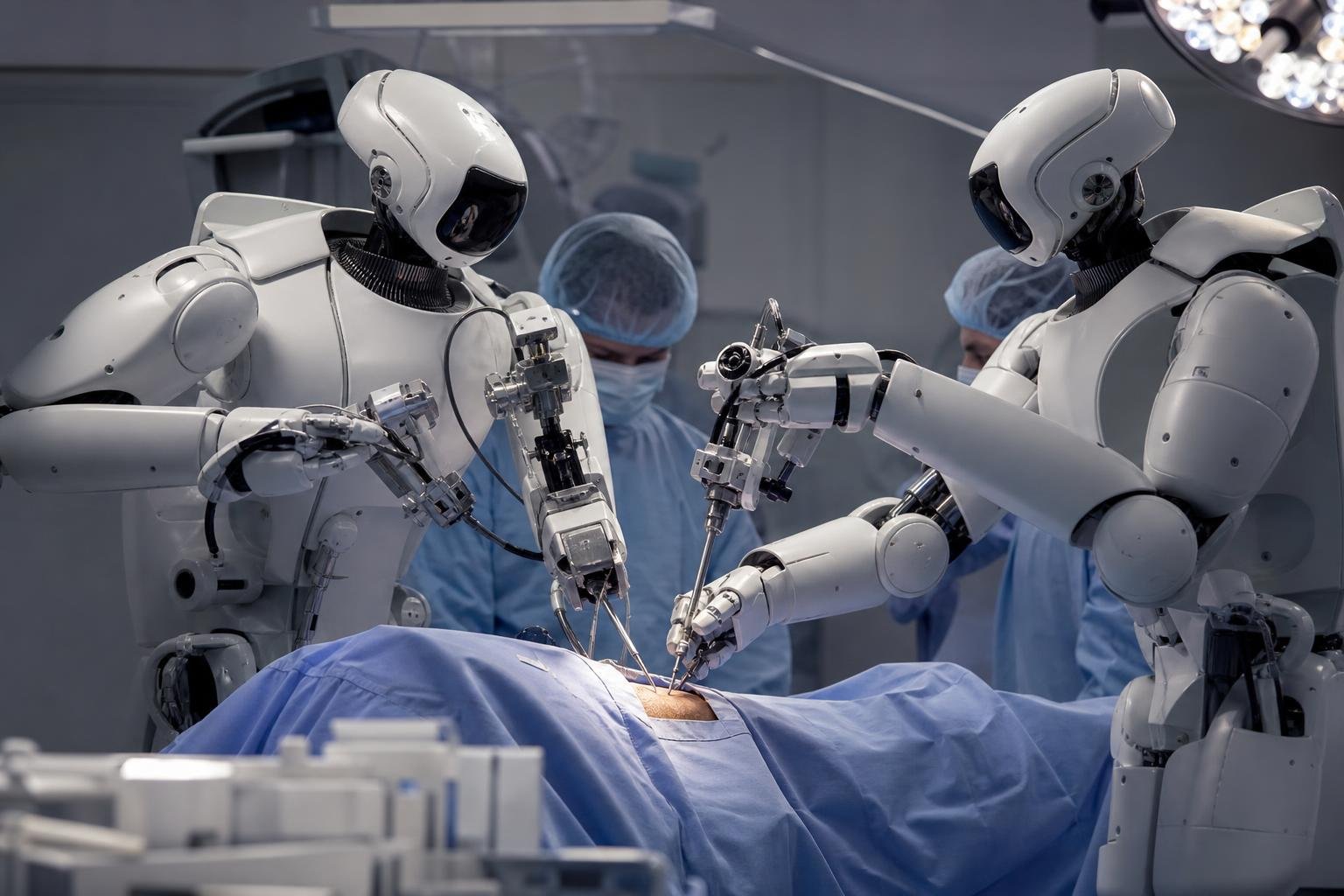
Researchers at the University of California San Diego have reported a preclinical demonstration in which teleoperated humanoid robots completed surgical procedures, including a gallbladder removal performed by a human-robot team and a procedure carried out jointly by two robots. The work, reported in Nature and described by Tech Briefs, was conducted on large non-primate animal models rather than human patients. [1]
The result is an important but early milestone for medical robotics. It does not show that autonomous humanoid surgeons are ready for operating rooms. Instead, it shows that a general-purpose, human-shaped robotic platform can be teleoperated through a constrained surgical workflow and can coordinate with another robot on a demanding preclinical task. The study also documents limits that matter: the systems required recalibration and operated more slowly than specialized surgical robots. [1]
By the numbers
- 2 humanoid robots: Used together in a coordinated preclinical surgical procedure. [1]
- 1 human-robot surgical team: Performed a gallbladder-removal procedure. [1]
- 0 human clinical patients: The reported tests used large non-primate animal models. [1]
- 1 major operational constraint: The robots required recalibration during the work. [1]
What the demonstration achieved
Conventional surgical robotics is built around purpose-designed systems: fixed patient-side arms, highly specialized instruments, and carefully engineered operating-room workflows. The UC San Diego work explores a different proposition. Rather than designing a robot solely for one procedure or one surgical specialty, the researchers tested a humanoid form factor that can work in spaces and workflows originally designed for people. [1]
In the reported trial, teleoperation remained central. A human operator controlled the robot rather than asking it to independently interpret anatomy, decide on a surgical plan, or handle complications. That distinction is essential. Surgical autonomy requires reliable perception, tissue identification, force control, planning, error recovery and safety validation across the variability of real patients. The reported work is a demonstration of remote robotic embodiment and controlled task execution, not autonomous clinical judgment. [1]
The gallbladder-removal case is particularly meaningful because it places the robot in a recognizable procedural workflow. Cholecystectomy is a common minimally invasive operation, but it requires careful dissection around sensitive anatomical structures. A preclinical success indicates that the human-robot team could perform the required motions in the test setting; it does not establish clinical equivalence, safety in patients, or superiority over established surgical systems. [1]
Why teleoperation may matter before autonomy
Teleoperation is sometimes treated as an interim feature on the path to autonomy. In surgery, it may be commercially and clinically valuable in its own right. A remote operator can retain responsibility for decisions while the robot supplies reach, positioning, endurance or physical presence. That model could eventually support expert assistance across distance, more flexible staffing, and surgical workflows in settings where specialist availability is limited.
For a humanoid platform, the immediate appeal is compatibility with human-centered environments. Hospitals, procedure rooms, instrument layouts and many clinical tasks were developed around the dimensions and movement patterns of clinicians. A robot with arms, hands and a humanlike working envelope could potentially use existing tools and interact with equipment without requiring every room to be rebuilt around a proprietary robotic installation.
That potential should not be confused with an established advantage. Specialized surgical robots are intentionally optimized for precision, stability, sterility, imaging integration, instrument control and specific minimally invasive access paths. A general-purpose humanoid must prove that its broader utility does not impose unacceptable compromises in accuracy, reliability, setup time or infection-control procedures.
Two-robot coordination is a notable technical step
The two-robot procedure is one of the study’s most consequential elements. Operating rooms are inherently collaborative: surgeons, assistants, anesthesiology staff and nurses coordinate continuously around the patient. Demonstrating that two teleoperated robots can work together begins to address a practical question that single-arm or single-robot demonstrations cannot: whether robotic systems can share a procedural workspace without creating collisions, delays or confusion over task ownership. [1]
Coordination is difficult because surgical work combines tight spatial constraints with changing anatomy and frequent handoffs. The robots must maintain awareness of their own arm positions, the location of instruments, the patient-side workspace and the actions of the other robot. Even when humans remain in control, the platform needs stable control loops, reliable communication and safety constraints that prevent unintended contact.
In a future clinical system, successful coordination could support a division of labor: one robot holding a camera or retracting tissue, another manipulating instruments, and a human supervising or taking over selected steps. But the UC San Diego demonstration should be viewed as a foundation for that possibility, not proof that a robotic operating-room team can yet match a skilled human surgical team under clinical conditions.
Recalibration and speed expose the gap to clinical deployment
The study’s operational limitations are as important as its successful procedures. Tech Briefs reports that the humanoid systems required recalibration and took longer than specialized surgical robots. [1] Recalibration can be necessary when a robot’s perception, positioning, instrument alignment or control state drifts from its expected reference frame. In an operating environment, every such interruption carries consequences for workflow, anesthesia time, sterility management and staff workload.
Speed is also not merely a productivity metric. Longer procedure times can increase operating-room costs and may affect patient risk, depending on the procedure and clinical context. A new surgical platform therefore has to show more than it can complete a task. It must demonstrate predictable setup, low failure rates, rapid recovery from faults, controlled instrument changes and performance that remains dependable over repeated cases.
Specialized surgical robots have a substantial head start because their hardware, software and tools are designed together for a relatively narrow set of procedures. The humanoid approach faces the harder engineering challenge of achieving medical-grade precision while retaining flexibility. That challenge includes sterilizable interfaces, surgical-grade end effectors, fail-safe behavior, validated teleoperation networks, cybersecurity, human-factors design and rigorous quality systems.
Market implications: a platform question, not an immediate replacement story
The near-term market significance is less about replacing established surgical robots and more about widening the design space for robotic care. If a humanoid system can safely perform multiple physical tasks with different tools in a clinical environment, it could eventually be deployed across perioperative work rather than being dedicated to one operation. Potential roles could include instrument handling, imaging support, room preparation, patient positioning assistance or remote specialist support, subject to separate validation for each use.
That platform ambition is attractive because hospitals often face capital constraints, workforce shortages and pressure to increase room utilization. A robot capable of handling multiple workflows could improve asset utilization in principle. Yet the business case will depend on reliability and total workflow cost, not on humanoid appearance. A hospital will compare acquisition, service, training, sterilization, room turnover, procedure duration and clinical outcomes against existing equipment and staffing models.
Regulatory requirements will also be a defining constraint. Preclinical animal work is an early research stage. Human use would require a carefully scoped clinical indication, evidence of safety and effectiveness, and a clear account of how the human operator, robot manufacturer and clinical institution share responsibilities. Remote operation adds further questions involving connectivity, latency, cybersecurity, credentialing and contingency procedures if communications fail.
What researchers and industry should prove next
The most useful follow-on studies would focus on repeatability rather than spectacle. Researchers will need to show how often recalibration is required, how long it takes, whether it can be automated, and whether the system can maintain accuracy across varied anatomy, room layouts and operators. Comparisons with specialized surgical systems should measure not only completion of a procedure but also error rates, tissue handling, setup time, operator workload, recovery from faults and total procedural duration.
The next technical threshold is likely not fully autonomous surgery. More credible intermediate goals include improved teleoperation interfaces, semi-autonomous camera control, collision avoidance, automated instrument positioning and supervised execution of bounded, repetitive subtasks. Each capability can be evaluated with defined safety limits while preserving clinician control over decisions that require judgment.
The UC San Diego result is therefore best understood as a demonstration that general-purpose humanoid robotics has entered a medically relevant test environment. The work suggests a potential path toward robots that fit human workflows rather than requiring workflows to fit a robot. Its recalibration needs and slower performance, however, make clear that this path remains an engineering, clinical-validation and regulatory project measured in many controlled steps. [1]
Editor’s Take
I think the practical signal here is stronger than the headline-grabbing idea of a humanoid “surgeon.” A teleoperated platform that can function in a surgical workflow and coordinate with a second robot is a useful systems milestone. Hospitals are built around people, tools and rooms that change from case to case; a capable general-purpose platform could eventually have value beyond one narrowly defined procedure.
The next evidence to watch is boring by design: uptime, recalibration frequency, setup time, repeat-case consistency, fault recovery and whether clinicians can use the system without adding friction to the room. The hype outruns the facts when this is described as autonomous surgery. The more interesting commercial question is whether teleoperated humanoids can become dependable clinical infrastructure before they become independent decision-makers.




.jpg)