
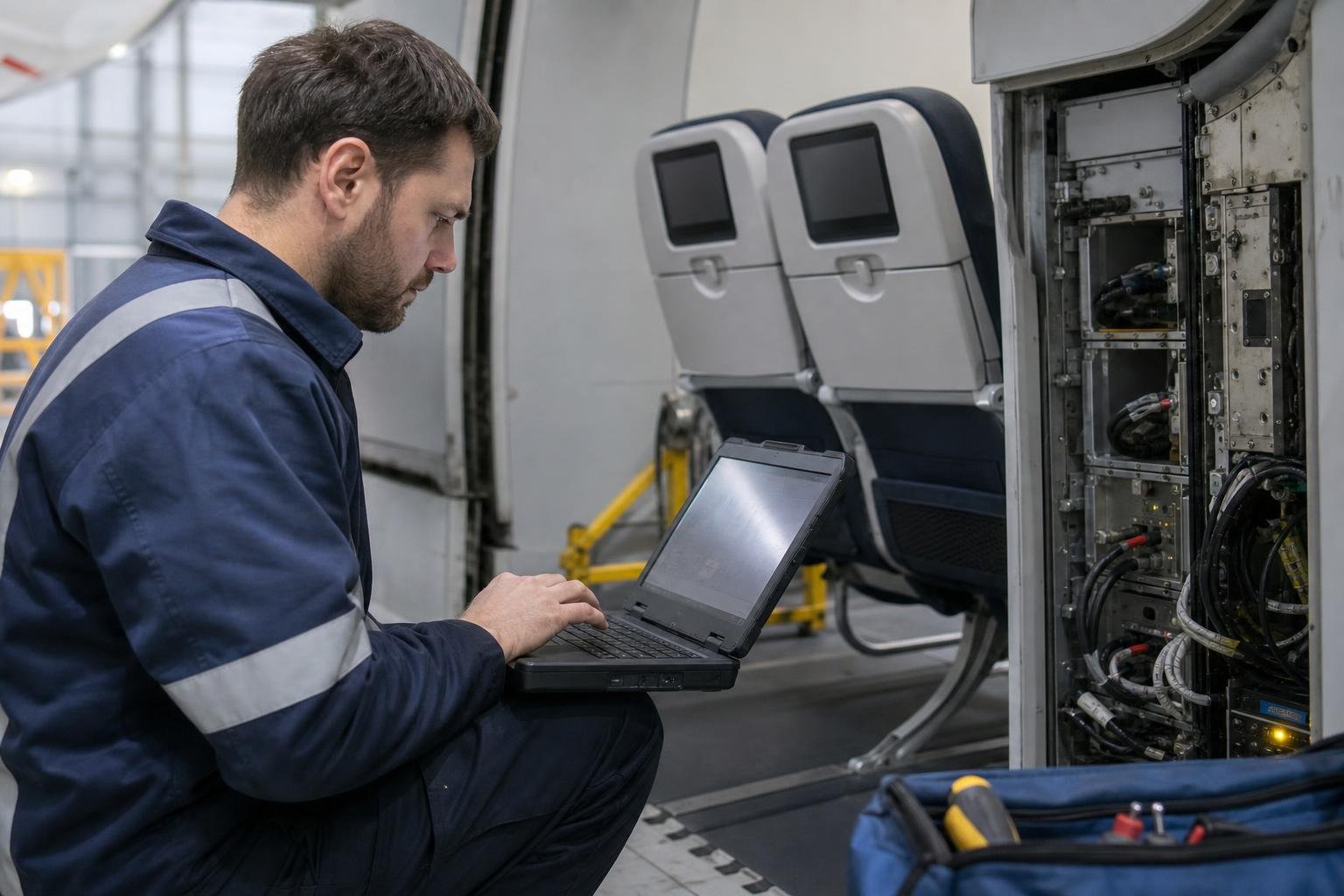
Panasonic Avionics and Amazon Web Services have built a multi-agent AI system intended to reduce the time engineers spend diagnosing problems in aircraft in-flight entertainment and connectivity (IFEC) equipment. The system analyzes fleet-wide performance information, links technical logs with service tickets and other operational records, and produces root-cause reports to guide investigation.
The significance is less about an AI system autonomously operating an aircraft than about a narrowly defined maintenance workflow. IFEC support teams already collect substantial operational evidence, but that evidence is often split among telemetry, device logs, incident records and fleet history. Panasonic Avionics and AWS are applying agents to assemble those fragments into an evidence-backed diagnostic path. AWS said targeted use cases improved operational efficiency by 20% to 40%, while reducing manual investigation work and improving mean time to detect and resolve issues.[1]
By the numbers
- 20% — lower end of AWS’s reported operational-efficiency improvement for targeted use cases.
- 40% — upper end of AWS’s reported operational-efficiency improvement for targeted use cases.
- Fleet-wide — the analysis is designed to consider performance data across aircraft rather than treating each incident as an isolated case.

A bounded use case for agentic AI
The deployment is a useful counterpoint to the broadest claims around agentic AI. Its job is not to set maintenance policy, approve aircraft release decisions or replace engineering judgment. It is to accelerate a specific knowledge-intensive task: finding, correlating and summarizing the evidence relevant to an IFEC or connectivity fault.
That distinction matters in aviation. A passenger-facing system can create substantial operational disruption when it fails, yet diagnosing it may require teams to compare symptoms across aircraft, software versions, hardware configurations, network conditions and prior service history. A recurring ticket title or an isolated log entry is rarely sufficient on its own. The value of the agent system is therefore in evidence integration: bringing likely related records together fast enough that an engineer can test a hypothesis rather than spend hours locating the underlying data.
AWS describes the work as a Panasonic Avionics and AWS effort, rather than solely an AWS-led demonstration.[1] Panasonic Avionics supplies the operational setting, fleet data and maintenance domain expertise; AWS supplies the cloud and AI capabilities used to implement the agent-based workflow. That division is important because industrial diagnostic tools depend as much on data definitions, service processes and expert validation as they do on model performance.
How the diagnostic workflow works
In broad terms, the system assigns different investigative functions to multiple agents. One can examine fleet-performance signals, another can retrieve and interpret technical logs, and another can search service-ticket history. Their outputs are combined into a root-cause report intended to identify relevant patterns, likely causes and supporting evidence.[1]
This architecture addresses a practical limitation of conventional search and dashboard workflows. A human investigator typically has to translate an incident into several queries, navigate disconnected systems, decide which historical events are comparable, and write a summary for the next team. A multi-agent workflow can make those retrieval and correlation steps more repeatable. It can also preserve the chain between a conclusion and the source records that motivated it, provided the implementation presents citations, timestamps, device context and confidence or uncertainty clearly to the engineer reviewing the case.
For fleet operations, cross-aircraft correlation is particularly valuable. A problem that looks like an isolated seatback-display issue on one aircraft may be associated with a particular software build, hardware component, route condition or maintenance event when viewed across the fleet. Conversely, the system can help distinguish a local fault from a broader pattern, reducing the risk that teams pursue a fleet-level explanation for a one-off issue.
A root-cause report should not be confused with proof of root cause. In complex operational environments, AI-generated output is best understood as an investigation brief: a structured account of what the available data suggests, what evidence supports it and what should be checked next. The final determination remains an engineering and maintenance responsibility.
Measured gains, with important limits
AWS reports 20% to 40% improvements in operational efficiency in targeted use cases, alongside less manual investigation effort and better mean time to detect and resolve issues.[1] Those are meaningful results if they hold across production workflows, because diagnosis time affects maintenance planning, parts decisions, passenger experience and the workload of specialist support teams.
But the reported range requires careful interpretation. AWS’s post does not establish a universal improvement rate for all IFEC incidents, airlines or data environments, nor does it publish a detailed breakdown of baseline workloads, incident mix, evaluation period or the individual contributions of retrieval, automation and model reasoning. The results should be read as a vendor-reported indication from selected applications, not as an industry-wide benchmark.
The same caution applies to quality. Faster case handling is valuable only if the system does not send engineers toward plausible but incorrect explanations. Strong deployments need grounded retrieval from authoritative records, source-level traceability, access controls, testing against historical incidents, and a human review step before a recommendation becomes an action. The AWS account emphasizes efficiency and diagnostic support, although it does not publish detailed human-factors testing of how engineers use, challenge or override the reports.[1]
Why maintenance may be an early market for agents
The approach has relevance well beyond aircraft cabins. Many industrial organizations possess years of logs, alarms, work orders, manuals and technician notes, but those sources were built for different systems and teams. The result is a familiar operational bottleneck: data exists, yet resolving a failure still depends on a small number of experts who know where to look and how to interpret weak signals.
Asset-heavy sectors including rail, telecommunications, energy, manufacturing and maritime operations have similar conditions. Their most credible agentic-AI opportunities are likely to be bounded workflows with clear inputs and measurable outputs: triaging alarms, identifying comparable incidents, drafting maintenance summaries, suggesting diagnostic checks and surfacing documentation. These tasks have a more direct return on investment than open-ended “digital worker” claims because organizations can measure investigation time, repeat incidents, repair duration and escalation rates.
The Panasonic Avionics work also illustrates why data readiness is central. Agents cannot reliably compensate for incomplete telemetry, poorly labeled tickets, inaccessible records or inconsistent component identifiers. The companies that benefit most may not be those with the largest language models, but those that can connect operational records to a shared asset, configuration and event history.
What comes next
The next test is whether the system can move from targeted use cases to repeatable, governed operations across a wider range of incident types. That will require monitoring not only speed but diagnostic accuracy, engineer acceptance, false leads, escalation outcomes and the quality of citations in generated reports. It will also require change management: technicians and reliability engineers need workflows that fit existing tools and accountability structures rather than a separate AI interface that creates another source of work.
For aviation suppliers and airlines, the longer-term opportunity is a more connected maintenance knowledge layer. If fleet performance, ticket history and technical evidence can be joined reliably, the same foundation could support recurring-fault analysis, proactive maintenance planning and faster engineering feedback into product design. Those extensions should follow demonstrated reliability in diagnostics, not precede it.
Editor’s Take
I find this more persuasive than the usual pitch that agents will run entire operations. The expensive, frustrating problem here is straightforward: capable engineers lose time reconstructing a case from disconnected evidence. If the system consistently retrieves the right records, exposes its reasoning trail and gives an engineer a useful first report, a 20% to 40% efficiency gain is commercially meaningful even without full autonomy.
What I would watch next is the quality of the handoff, not merely the number of agents. Can an engineer see exactly which log event and which historical ticket support a conclusion? Can the team quickly reject a bad hypothesis, and does that feedback improve future cases? The market will reward systems that make expert maintenance work more auditable and faster. It should be skeptical of any system that turns a well-supported diagnostic process into an opaque answer box.
References
- AWS Machine Learning Blog – https://aws.amazon.com/blogs/machine-learning/accelerating-aircraft-ifec-diagnostics-with-agentic-ai-on-aws/




_(9674290).jpg)