
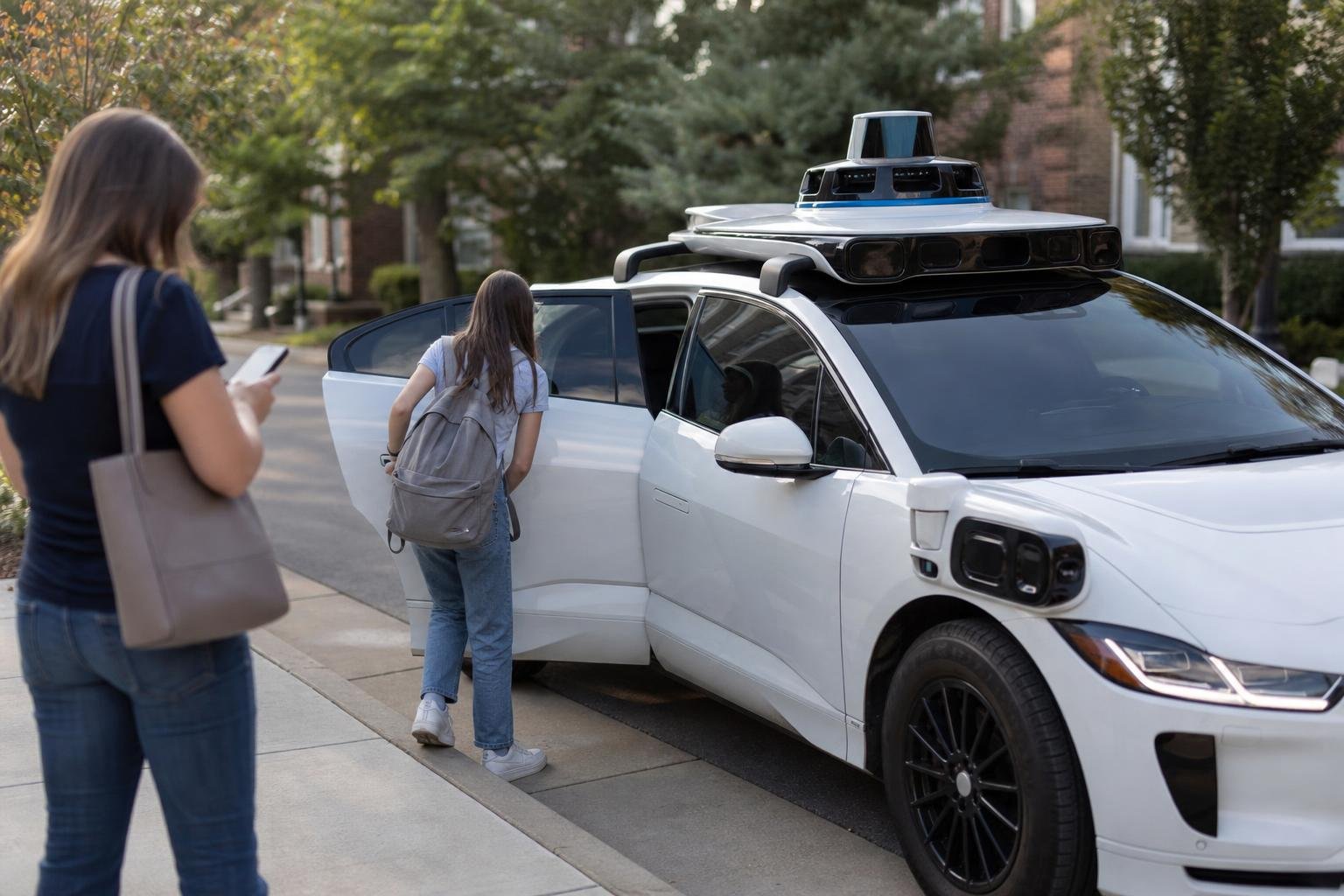
Waymo says teenagers ages 13 through 17 can now request fully autonomous rides in a 50-square-mile area of Nashville when their accounts are linked to a parent or guardian. The company is pairing access for younger riders with trip-status sharing, automatic receipts and family-oriented rider-support features.[1]
The expansion matters less as a geographic milestone than as a test of whether a robotaxi can perform a routine family transportation job: getting a teenager to school activities, work, appointments or social plans without requiring a parent to drive. The vehicle autonomy may be the visible technology, but the product’s critical component is the supervision layer around it—permissions, visibility, records and a procedure for help when a trip does not go as expected.
By the numbers
- 13: Minimum age for eligible teen riders
- 17: Maximum age for the new teen-access program
- 50 square miles: Nashville service area cited for teen access
A robotaxi product designed for family logistics
Waymo’s announcement describes a parent- or guardian-linked account model rather than unrestricted access for minors. That distinction is important. For families, transportation decisions generally involve more than whether a vehicle can complete a route safely. They also involve who authorized the trip, whether the rider reached the intended destination, how a parent learns about changes, and whom to contact if the rider needs assistance.
Trip-status sharing gives the supervising adult visibility into an active ride. Automatic receipts create a transaction record, potentially making it easier to reconcile household transport spending and confirm that a planned trip occurred. Rider-support features provide a channel for resolving problems that, in conventional carpooling, would usually be handled by a parent, another adult driver or a dispatcher. Waymo has not detailed in the announcement the precise support escalation procedures, guardian controls, payment rules or data-retention policies for the Nashville teen product.[1]
Those details are not secondary implementation questions. They define whether the service can be trusted for recurring use. A family product needs reliable account linking and age verification; clear consent flows; rapid notification when a rider changes plans or a trip is interrupted; and support personnel who can communicate effectively with both a young passenger and a guardian. It must also set understandable rules for pickup and drop-off at schools, venues and homes, where legal access, traffic conditions and the rider’s ability to identify the correct vehicle all matter.
The operational trust layer behind autonomy
Autonomous-driving systems are typically evaluated through their driving behavior: perception of road users, prediction of their movement, planning of a safe path and control of steering, acceleration and braking. Those capabilities remain fundamental. A fully autonomous service also needs a separate operational system that connects the vehicle, rider, remote support organization and account holder.
For teen riders, that system has to work under conditions that are ordinary but consequential: a phone battery dies, a pickup point is confusing, a rider leaves an item behind, a destination changes, a vehicle is delayed, or a passenger becomes uncomfortable. The appropriate response may involve in-app guidance, contact with rider support, a guardian notification, or an instruction to remain in the vehicle at a safe location. The announcement establishes that Waymo intends to offer support and shared trip information, but it does not establish how these edge cases are handled or what response times apply.[1]
That is why the program is a meaningful product test. A robotaxi does not replace a parent’s chauffeuring simply by arriving without a human driver. It has to provide enough situational awareness and recourse that a guardian can delegate a trip while retaining appropriate oversight. In that sense, account design and customer operations are as important to adoption as vehicle hardware and automated-driving software.

Why Nashville and teen access matter commercially
The addressable market for autonomous rides broadens materially when the service can serve households rather than only independently traveling adults. Teen trips are often time-sensitive and frequent, including extracurricular activities, part-time jobs and visits to friends. They also create a persistent transportation burden for parents and guardians, particularly in places where walking, cycling and fixed-route transit are not practical for every journey.
For Waymo, family-linked access could increase ride frequency and make the service part of a household’s regular transport budget rather than an occasional convenience. It also puts the company in more direct competition with informal carpooling, private vehicles and conventional ride-hailing. Unlike a standard ride-hailing marketplace, however, a fully autonomous operator controls both the driving system and the rider experience. That control can make consistent safety and support procedures easier to standardize, while also making the operator directly accountable when those procedures fail.
The move could pressure other autonomous-vehicle operators to treat minors and supervised accounts as a distinct product category, not merely an age-gating setting. The likely competitive differentiators are not only service-area size and wait times, but guardian controls, pickup safety, accessibility, incident communications and the clarity of policies for unaccompanied younger passengers.
Questions that remain for families and regulators
The announcement leaves several practical questions unanswered. Families will want to know whether a guardian can approve individual rides, restrict destinations or service hours, receive arrival and drop-off alerts, manage more than one teen profile, and reach a trained human quickly. They will also want clear information about charges for rerouting, cleaning, damage claims and lost-property recovery.
Privacy is another central issue. Trip sharing can reassure a guardian, but it also creates sensitive records of a minor’s movements. A durable family service needs transparent controls over who can see live location, how long trip history is retained, whether teens can alter sharing settings, and how data is protected. The company’s statement highlights status sharing and receipts but does not specify those policies.[1]
There are also location-specific concerns. A vehicle may navigate a roadway successfully yet still face an awkward pickup at a crowded school entrance, sports facility or apartment complex. Families and local authorities will judge the service by how it performs at these handoff points, not only by its behavior in normal traffic. Clear curbside procedures and dependable customer support will be necessary to turn a technically capable ride into a repeatable family routine.
What to watch next
The most useful evidence from Nashville will be operational rather than promotional: whether families use the feature repeatedly, how often support is needed, how reliably pickups and drop-offs work at youth-oriented destinations, and whether guardians regard the notification and help systems as sufficient. Waymo has not published those measures in the announcement.[1]
Expansion to additional cities, more granular guardian controls and published information about support handling would be stronger signals that teen access is becoming a scalable product category. So would evidence that schools, venues and local communities can accommodate autonomous-vehicle pickup patterns without creating congestion or confusion.
The broader implication is that autonomous mobility is moving toward a service-design challenge. Driving autonomy can make a ride possible; family supervision features make it delegable. The companies that solve both parts credibly may gain a route into everyday household transportation that is larger and more durable than adult-only robotaxi use.
Editor’s Take
I see this as one of the more commercially serious robotaxi features because it attacks a real household pain point: the fragmented, repetitive trips that force parents to reorganize work and evening schedules. A guardian-linked account, live trip visibility and a reliable human-support path are not cosmetic add-ons. They are the minimum product plumbing needed before many families will delegate transportation to a driverless service.
I would watch the exception handling more closely than the 50-square-mile map. The decisive test is what happens when a teenager cannot find the pickup, needs to change a destination, loses a phone or simply feels unsafe. If Waymo can make those moments predictable and supportable, it has a credible substitute for some carpooling. If not, the autonomy inside the vehicle will be impressive but insufficient for family trust.
References
- Waymo — https://waymo.com/intl/jp/blog/




_System_prepares_for_the_first_autonomous_landing_aboard_the_amphibious_transport_dock_ship_USS_Nashville_(LPD_1.jpg)