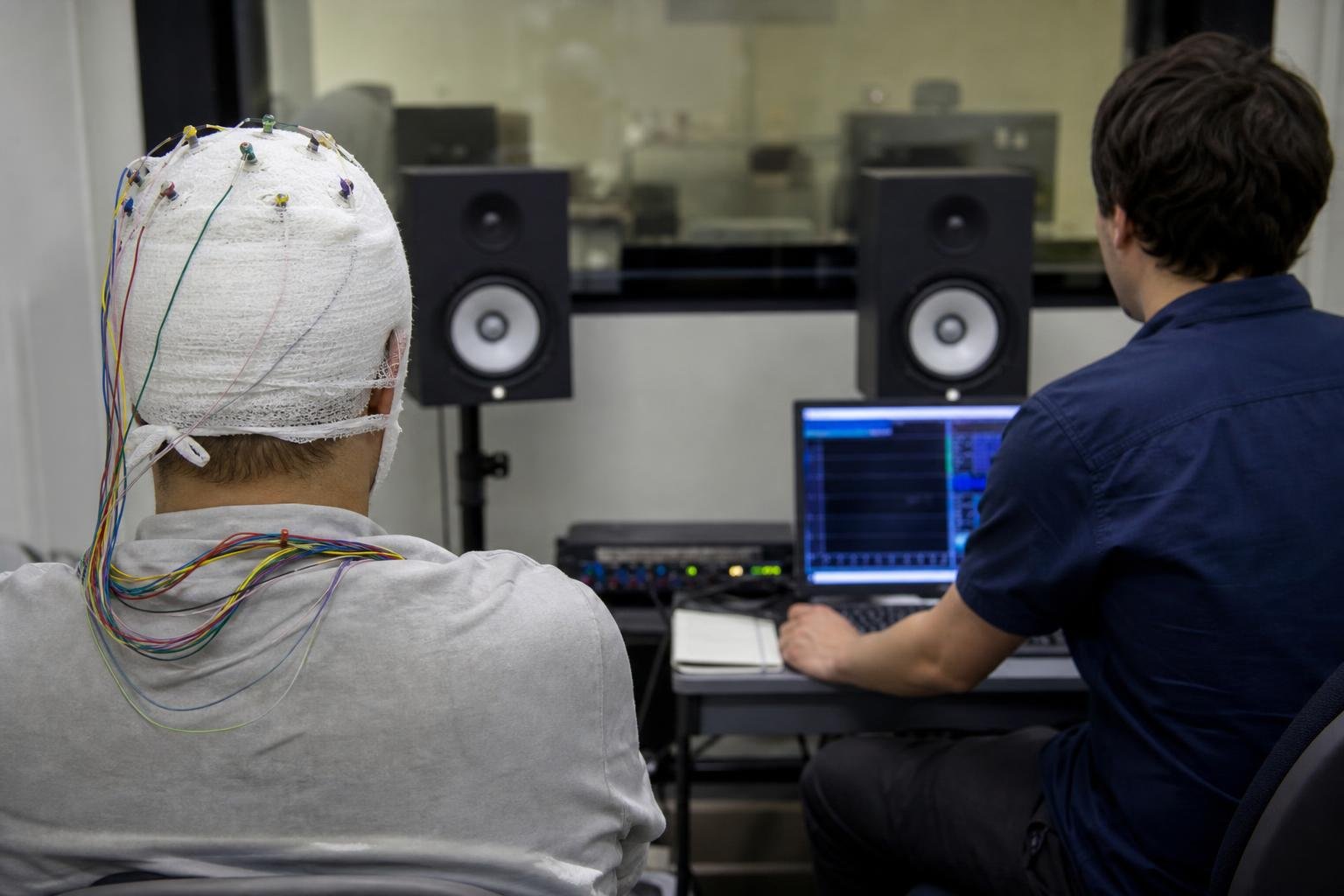
Researchers have demonstrated a closed-loop auditory-attention system that uses intracranial neural signals to determine which speaker a listener is attending to and then dynamically boosts that person’s voice. In experiments, the system improved speech intelligibility, reduced reported listening effort, and followed both prompted and spontaneous shifts in attention.[1]
The result matters because it moves neural attention decoding beyond observation. Earlier work has often treated the ability to identify an attended talker from brain activity as a measurement problem. This study uses that estimate to alter the audio reaching the listener in real time, creating a feedback loop between intent, neural decoding and sound processing. It is an important design direction for future assistive listening technology, although the present system’s dependence on intracranial recordings places it far from a conventional hearing aid.
By the numbers
- 1 closed loop: Neural activity is used to guide an audio-processing response rather than merely label attention after the fact.
- 2 attention-shift conditions: The system tracked both instructed shifts of attention and self-initiated shifts.
- 3 reported outcomes: Better speech intelligibility, lower listening effort and attention tracking during dynamic listening.
The available study summary does not specify participant count, processing latency, exact speech-intelligibility improvement or the size of the listening-effort reduction. Those details will be central for judging the system’s practical performance and reproducibility.
From decoding attention to controlling sound
The difficult part of listening in a crowded room is not simply making all sound louder. A listener may hear several voices at once but want to follow only one conversation. Conventional hearing aids address this with directional microphones, beamforming, noise reduction and, in some products, algorithms intended to separate speech from background sound. Those tools can improve the signal reaching the ear, but they generally must infer the desired speaker from acoustic cues, device orientation or manual controls.
The system described in Nature Neuroscience adds a different input: the listener’s neural activity. The brain signal serves as an estimate of auditory attention—effectively, which of the available speech streams the person is trying to follow. The system then uses that estimate to selectively amplify the attended speaker.[1]
That makes the work a closed-loop system. In practical engineering terms, the loop has four jobs: acquire a neural signal, decode the attended talker, apply an audio adjustment, and continue updating as the user changes focus. The final requirement is particularly important. A useful assistive device cannot lock onto a speaker forever after a single selection; it must release and redirect its enhancement when the user turns to another person or changes conversational goals.
Intracranial recordings give researchers access to neural activity with a signal quality that non-invasive systems have not consistently matched for this kind of real-time control. They are also the study’s largest barrier to broad deployment. The finding should therefore be understood as a demonstration of a control principle, not evidence that brain-controlled consumer hearing aids are imminent.
What the experiments demonstrated
The researchers report that the system enhanced the listener’s ability to understand speech in crowded listening conditions and lowered listening effort. Those are complementary measures. Speech intelligibility asks whether a person can accurately identify what was said; listening effort addresses the cognitive work required to do so. An assistive system that preserves accuracy but requires sustained concentration can still leave users fatigued, especially in work, school, healthcare and social settings where noisy conversations last for hours.
The reported ability to follow instructed attention shifts establishes that the system can respond when a listening task changes. Its performance during self-initiated shifts is arguably the more consequential result. Real conversation is not a lab script: people look away, rejoin a group, respond to a different speaker and change their focus without issuing an explicit command. If a system is to be useful rather than intrusive, its estimate of intent must keep pace with those changes.
The study therefore addresses a broader human-machine-interface problem: whether a device can act on inferred intent without forcing the user to operate a separate control. In this case, the action is modest and concrete—adjusting the relative prominence of voices—but the design principle is significant. The device is not trying to decode language, thoughts or broad mental states. It is using a constrained neural signal to improve a specific sensory task.
Why the result matters for hearing technology
For the hearing-device industry, speech in noise remains one of the most persistent unmet needs. Audio-processing advances can reduce steady environmental noise and improve directionality, but competing talkers remain difficult because they are themselves meaningful, changing signals. The correct answer is also user-specific: the loudest speaker is not necessarily the speaker the listener wants to hear.
This research suggests a possible long-term path toward intent-aware audio systems. Rather than treating auditory attention as a setting selected once through a phone app, a future device could continually adjust its enhancement strategy based on an estimate of where the user’s attention has moved. That could complement—not replace—microphones, beamforming, source separation and user controls.
The nearer clinical opportunity may be in systems already associated with implanted neural hardware, rather than in the mass hearing-aid market. For patients who have intracranial electrodes for clinical reasons, a neural interface could potentially provide an additional control channel for sensory-assistance research. Any such application would require separate validation, safety review and a clear benefit over less invasive alternatives.
For hearing-aid makers, cochlear-implant developers and companies building neural interfaces, the commercial implication is less about an immediately shippable product than about product architecture. The study supports investing in audio pipelines that can accept a continuously updated intent signal. The source of that signal might eventually be non-invasive neural sensing, eye gaze, head orientation, acoustic scene analysis, explicit controls or a combination of them. Intracranial activity is currently the proof-of-principle input, not the scalable interface.
The constraints behind the promise
Intracranial recordings are invasive and are generally obtained in tightly controlled clinical contexts. That alone rules out straightforward translation into consumer hearing devices. A viable everyday product would need a substantially less burdensome sensing method, reliable operation across people and environments, low enough latency to avoid distracting artifacts, and power consumption compatible with portable hardware.
Attention decoding also creates safety and usability questions. Incorrectly amplifying the wrong talker can be more than an inconvenience: it could disrupt a conversation, obscure an important warning or cause the listener to mistrust the system. Designers will need confidence measures, quick overrides and behavior that degrades gracefully when the decoder is uncertain. A system should not make aggressive audio changes when its estimate of attention is weak.
Privacy deserves similarly careful treatment. The reported application is narrow, but neural recordings are sensitive health-related data. Products based on neural intent signals would need clear limits on collection, retention, processing and secondary use. The appropriate standard is not merely whether a decoder works, but whether users can understand and control what is being inferred from them.
There is also a scientific caution. Better performance in an experimental setup does not automatically establish benefit in restaurants, family gatherings, transit stations or workplaces with changing acoustics and conversational norms. Future studies should report performance across realistic sound scenes, the speed and reliability of attention switching, failure rates, individual variability and comparisons with state-of-the-art acoustic-only processing.
What to watch next
The most important next step is not a promise of a consumer brain-controlled hearing aid. It is a series of practical benchmarks: how quickly the system identifies a new attended speaker, how often it selects the wrong voice, whether benefits persist outside structured tests, and how much neural-signal quality can decline before the closed loop ceases to help.
Researchers will also need to show whether comparable control can be achieved with less invasive sensing. If it cannot, the technology may remain a specialized clinical tool. If it can, the result could reshape how assistive devices are designed: not as fixed amplifiers or purely acoustic classifiers, but as adaptive systems that treat the user’s moment-to-moment intent as an input.
Editor’s Take
I see the closed-loop design as the real advance here. Decoding attention is scientifically interesting; using it to improve the audio stream a person is actually hearing is the point at which it begins to resemble a useful product capability. The focus on self-initiated attention shifts is especially encouraging because that is where real interfaces either feel natural or fail.
The hype would outrun the facts if this were presented as a new kind of retail hearing aid. Intracranial recording is a profound practical constraint, and the missing operational details—especially latency, error behavior and performance in uncontrolled settings—matter as much as the headline result. The next milestone worth watching is whether a less invasive sensor, paired with strong audio processing and clear user override controls, can preserve enough of this intent signal to make crowded conversations materially easier.
References
- Nature Neuroscience – https://www.nature.com/articles/s41593-026-02281-5