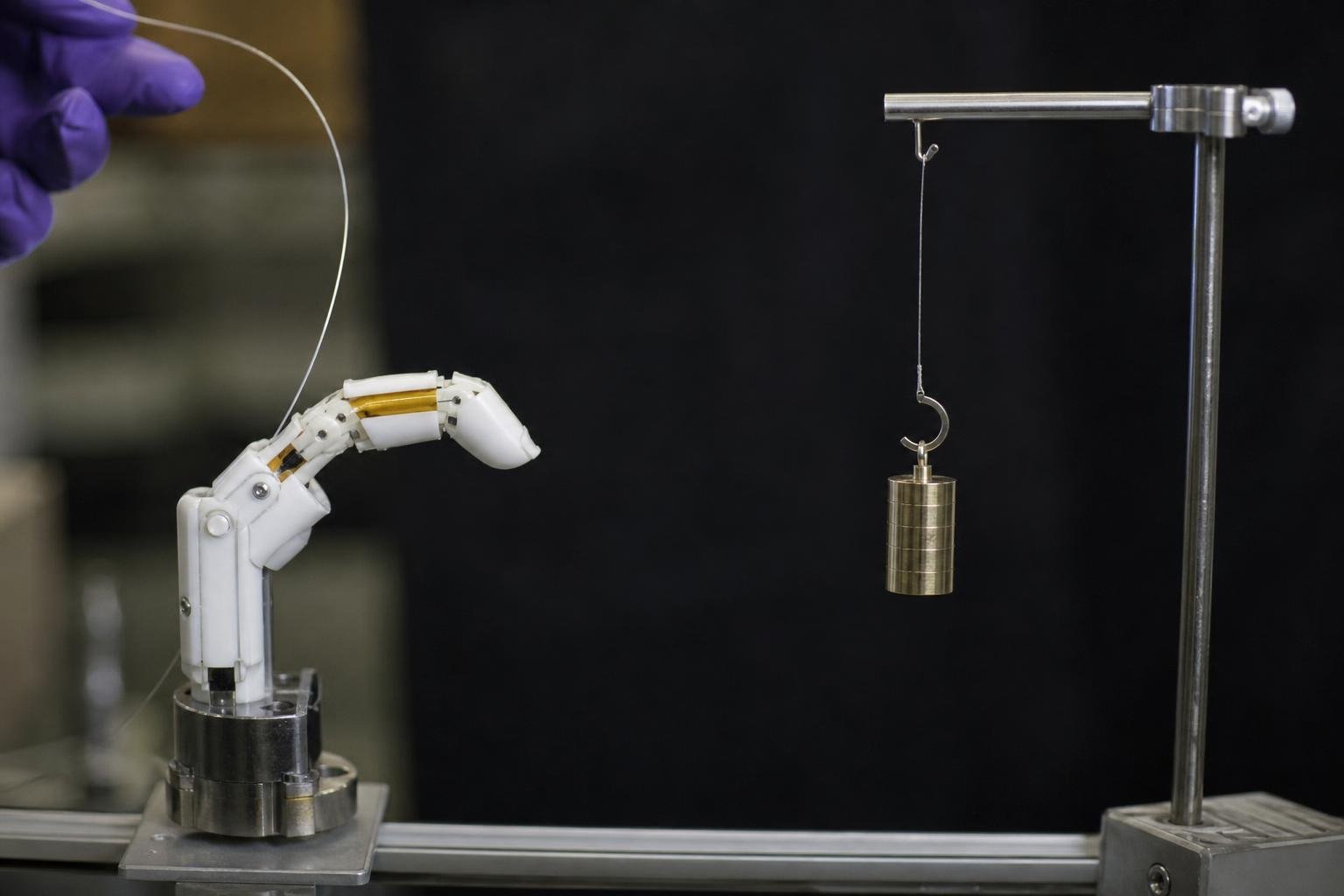
Researchers at EPFL have demonstrated FiberMotor, a flexible, thread-like actuator designed to convert electrical energy directly into motion without the conventional gear trains associated with many electric motors. The team showed the device lifting a 75-gram load, flexing a robotic finger and remaining back-drivable—meaning an outside force can move it rather than encountering a locked, rigid mechanism. [1]
The significance is less about shrinking a motor than changing where actuation can live. Soft robots, wearable devices and compliant prosthetics are often built from flexible materials but driven by rigid motors, transmissions, cables and housings. A fiber-format actuator could reduce that mechanical mismatch, placing motion closer to the structure that needs to bend, grip or assist a user. The demonstrations are still laboratory evidence, however, and key questions around power, durability, control, manufacturing and safety certification remain open.
By the numbers
- 75 grams: Load lifted in an EPFL FiberMotor demonstration.
- 0 conventional gears: The actuator is intended to produce motion directly from electrical energy, rather than through a conventional geared motor assembly.
- 3 reported demonstrations: Load lifting, robotic-finger flexion and back-drivable operation.
A response to soft robotics’ actuator problem
Robotics has long had a materials-and-actuation mismatch. Conventional electric motors are efficient, mature and readily controlled, but their useful motion is generally rotational and often too fast for direct use. Robot designers commonly add reduction gears, belts, tendons or linkages to obtain the torque and movement required at a joint. Those components can be excellent engineering choices in industrial machinery, but they add bulk, inertia, stiffness and friction.
Those trade-offs become more pronounced when a robot is intended to work around people or conform to the body. A soft gripper may have silicone fingers, flexible joints and compliant coverings, yet still depend on a distant rigid motor driving a cable. A wearable assistive device may be constrained less by software than by the weight, noise, pressure points and alignment demands of its actuation system. In prosthetics, a mechanism that resists a user’s incidental motion can make an otherwise capable device feel unnatural.
EPFL’s FiberMotor addresses that problem at the actuator level. The central proposition is a motor that can take a fiber-like form factor and be integrated into a system as a flexible element, rather than mounted as a rigid electromechanical component. The EPFL report describes direct conversion of electrical energy into motion without conventional gears. [1]
That distinction matters because it can simplify an entire mechanical architecture. If actuation is distributed along a limb, finger or textile-compatible structure, engineers may need fewer transmission stages and fewer remote components. The potential benefit is not merely smaller packaging: it is a machine whose force path and physical behavior better match a compliant body.
Why back-drivability is a central feature
The most consequential feature in the reported demonstrations may be back-drivability. A back-drivable actuator can be moved by an external force while it is unpowered or while the mechanism is yielding. In practical terms, a person should be able to push a robotic finger or wearable joint and have it give rather than fight the motion as a locked transmission might.
Back-drivability is not identical to safety. Safe human-machine interaction also depends on sensing, software limits, materials, fault behavior, electrical design and the maximum force available from the system. But low mechanical resistance can provide a useful passive safety property: it reduces the need to rely exclusively on software to make a device physically compliant.
For a robot hand, that could improve contact behavior. Rather than imposing a rigid trajectory on an object, a finger can potentially conform to the object and absorb small disturbances. For a wearable support system, it could reduce resistance when the wearer changes posture or moves unexpectedly. For a prosthetic device, it could support more natural interaction between the user, the mechanism and the surrounding world.
There are control benefits as well. Gear trains can introduce backlash, friction and reflected inertia, all of which complicate force-sensitive manipulation. A compliant actuator does not eliminate those challenges, but it can make physical interaction more forgiving. The trade-off is that compliance also makes precise positioning harder: a system that yields under force requires good sensing and control if it must hold a particular shape, grip force or joint angle.
What the EPFL demonstrations establish—and what they do not
The reported tests establish three important points. First, FiberMotor can perform useful mechanical work, as shown by the 75-gram lifting demonstration. Second, the format can be used to produce articulated motion in a robotic-finger demonstration. Third, it can remain mechanically yielding under external force. Together, those results make a credible case that the concept is relevant to soft robotic structures rather than being only a materials demonstration. [1]
They do not yet establish that FiberMotor is ready to replace conventional motors in commercial robotic hands, assistive wearables or medical devices. A 75-gram payload is meaningful as a proof of operation, but application suitability depends on additional measurements: force or torque across the actuator’s range, displacement, speed, electrical input, energy efficiency, response time, heat generation and cycle life.
The supplied EPFL material also does not, by itself, answer how performance changes after repeated bending, loading and exposure to sweat, dust, cleaning agents or daily handling. Those issues matter especially for body-worn products. A laboratory actuator may operate effectively over a limited test sequence while a consumer or clinical product must tolerate millions of motions, predictable failure modes and serviceable assembly.
The same caution applies to manufacturability. Fiber-like components can potentially be appealing because they may be woven, routed or embedded, but commercial production requires consistent properties along length, robust electrical connections, repeatable attachment methods and quality control. The move from a working prototype to a dependable component supplier is often where promising soft-robotics technologies face their hardest test.
Potential uses: wearables, prosthetics and safer hands
Wearable robotics is a natural target. Current exosuits and assistive devices frequently use cable transmissions or rigid actuator packs positioned away from the assisted joint. A lightweight flexible actuator could potentially be placed nearer to the point of assistance or distributed along a garment. That could reduce cumbersome routing and improve comfort, provided the actuator delivers sufficient force without excessive heat or power demand.
In prosthetics, the opportunity is more nuanced. Users need devices that are strong enough to perform tasks but compliant enough to avoid feeling mechanically detached from the body. A back-drivable fiber actuator could be useful in fingers, cosmetic coverings or other structures where compactness and safe passive behavior are important. But prosthetics also impose high reliability and regulatory demands, and any proposed actuator would need to demonstrate stable operation, controllable force and compatibility with the device’s sensing and battery systems.
Robot hands may be the nearer-term research application. Manipulation remains difficult because real objects vary in shape, friction, fragility and position. Compliance can help a hand accommodate those variations. If fiber actuators can be placed within or alongside fingers, they could allow designs that are slimmer and mechanically simpler than hands driven by multiple remote motors and tendons. That remains an engineering proposition rather than a demonstrated product advantage until FiberMotor is tested in repeated grasping tasks with measured force, speed and reliability.
The industrial implications extend beyond humanoid-style robots. Medical training tools, rehabilitation devices, adaptive fixtures and compact automation equipment could benefit from actuators that combine electrical drive with mechanical compliance. Still, conventional motors will remain difficult to displace where high continuous power, rigid positioning, established supply chains and low component cost matter more than conformability.
The next evidence investors and product teams will need
EPFL is the key research organization behind FiberMotor, and its announcement frames the work around a new actuator geometry rather than an incremental revision to a standard motor. [1] The next phase should turn that geometry into a complete performance case.
For product developers, the most useful data would include force-to-weight and force-to-volume performance, operating voltage and current, efficiency under representative loads, thermal behavior, bending-radius limits, response speed, controllability and lifetime under cyclic use. Comparisons with tendon-driven, pneumatic and small geared electric alternatives would be particularly valuable. Back-drivability should also be quantified, since the force needed to move the unpowered or yielding actuator is crucial for user comfort and contact safety.
Independent replication will matter. Soft-actuation research has produced many compelling demonstrations, but commercial adoption tends to favor technologies that retain their properties outside carefully controlled laboratory setups. A FiberMotor platform will need to show that its flexibility does not come at the cost of unpredictable performance, difficult fabrication or short working life.
The development nonetheless points toward a broader trend: robot actuation is becoming more structurally integrated. Instead of treating motors as discrete hardware bolted onto a mechanism, researchers are increasingly trying to make the active component part of the mechanism itself. FiberMotor’s value will depend on whether it can preserve the strengths of that approach—light weight, compliance and direct integration—while meeting the unglamorous requirements of repeatable manufacturing and long-term operation.
Editor’s Take
I think the back-drivable behavior is more commercially important than the visual novelty of a motor that resembles a thread. Robotics teams already know how to add small motors to a hand or a wearable; the harder problem is making the resulting product comfortable, tolerant of contact and mechanically honest about the fact that people and everyday objects do not behave like rigid test fixtures.
I would watch for cycle-life data, thermal measurements and a realistic comparison against cable-driven systems before treating FiberMotor as a platform technology. The 75-gram lift and robotic-finger demonstration show that this is more than a passive smart material, but they do not yet show the continuous output and durability required by a useful hand, exosuit or prosthesis. If EPFL can prove those fundamentals, the biggest payoff may be simpler machines with fewer rigid transmission parts—not a wholesale replacement for every motor.