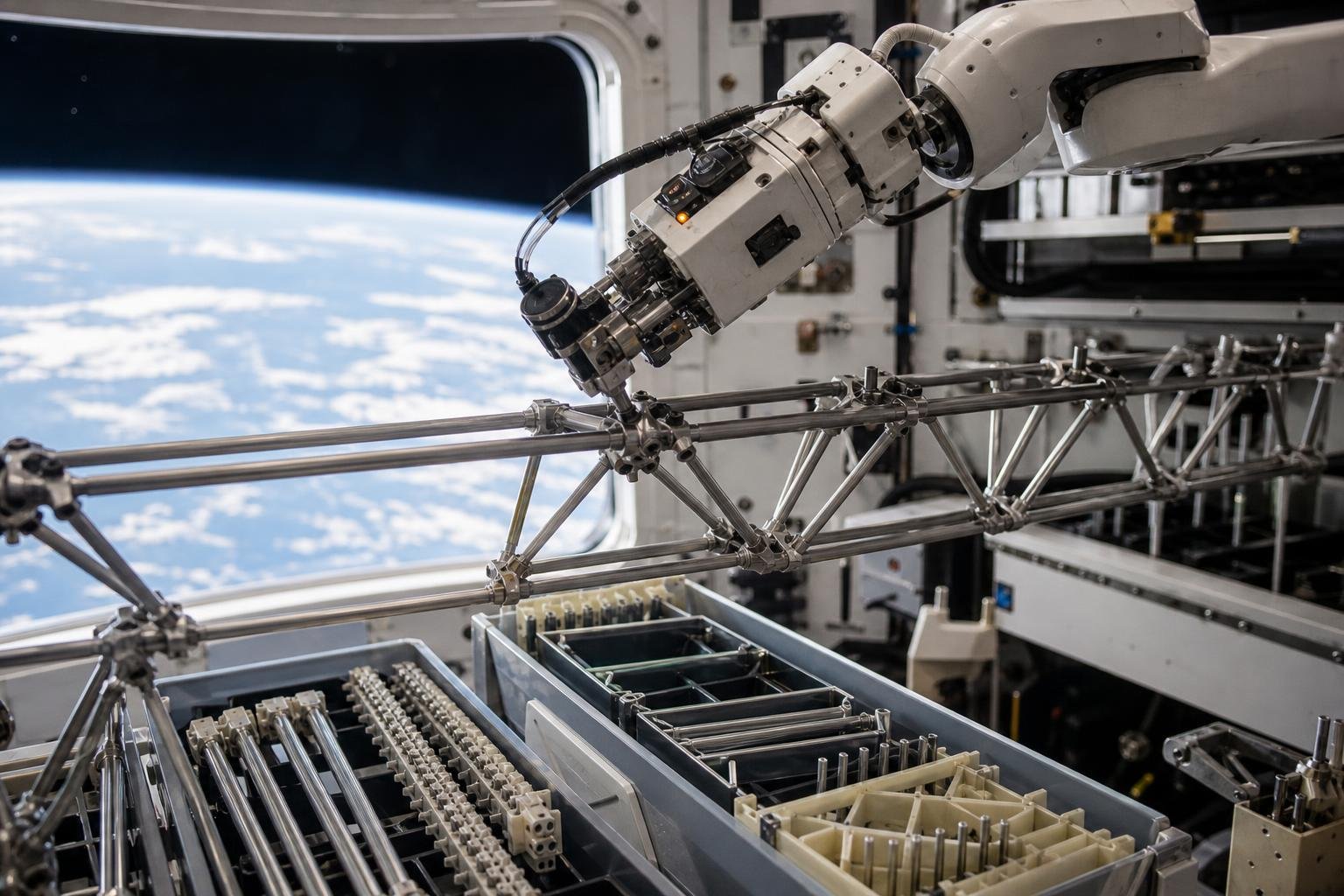
A Caltech-built robotic system has autonomously assembled a structural truss in orbit, a practical test of whether spacecraft can build large hardware after launch rather than carrying it to space in one piece. The demonstration, conducted under the Defense Advanced Research Projects Agency’s Novel Orbital and Moon Manufacturing, Materials and Mass-efficient Design program, or NOM4D, used a manipulator to retrieve structural components from nearby dispensers and connect them without astronaut assistance.[1]
The result matters less as a showcase for a robot arm than as evidence for a different approach to spacecraft design. Launch vehicles impose hard limits on payload volume, mass, vibration tolerance and fairing geometry. Autonomous in-space assembly could allow satellites, telescope supports, antenna arrays, solar-power structures and other frameworks to be launched as compact kits, then erected where they will operate.
What the demonstration established
According to Phys.org, the Caltech system constructed a truss: a load-bearing framework made from connected structural members. Trusses are useful test articles for orbital manufacturing because they are mechanically meaningful, modular and scalable. They also expose the core challenge of assembly: a robot must repeatedly find, grasp, position and securely join parts while maintaining the geometry of the growing structure.
The reported workflow involved nearby dispensers holding the structural components. The autonomous manipulator selected a component, moved it to the assembly site and connected it to the developing truss. That sequence is important because it combines material handling and construction. A machine that can merely move an object is not necessarily able to create a stable structure; it must work within alignment tolerances, account for the changing state of the assembly and complete a connection reliably enough for the finished framework to carry loads.
The demonstration also removed astronauts from the construction loop. Human-tended assembly remains valuable for maintenance, unusual contingencies and high-consequence work, but crew time is limited and expensive. For structures intended for distant orbits, cislunar space, or eventually the lunar surface, sending people to perform repetitive construction tasks may not be practical. Autonomous systems are therefore central to the economic case for building beyond a launch vehicle’s envelope.
Why launch constraints make assembly commercially relevant
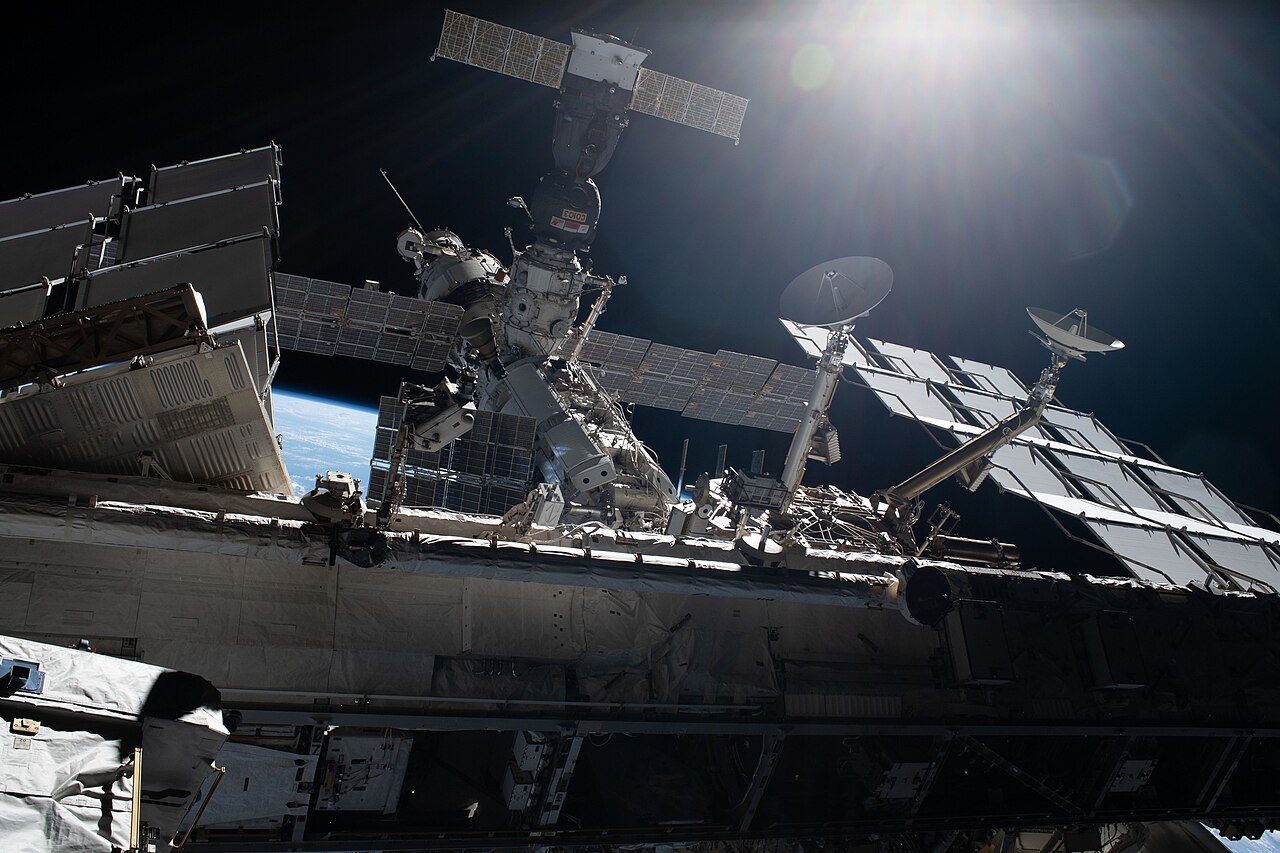
Spacecraft are generally designed around the constraints of launch: what fits inside a payload fairing, survives ascent loads and can deploy predictably after separation. Folding mechanisms have extended those limits, enabling deployable solar arrays, antennas and sunshields. But deployables impose their own compromises. They can require complex hinges, motors, latches and release systems; they must unfold without snagging; and their final geometry can be limited by the need to stow them compactly.
Assembly changes the design trade-off. Instead of packaging one large, intricate object, a mission can launch repeated standardized components and construction hardware. This could be especially attractive for structures whose dimensions are driven by performance: long antenna baselines, large communications apertures, expansive power-generation arrays, telescope backplanes and lightweight booms.
There is also a resilience argument. A modular system can potentially replace a faulty member, add capacity over time or use common parts across several spacecraft designs. Those benefits will depend on interfaces becoming standardized and on the assembly process achieving high reliability. A modular structure is not inherently cheaper if every connection introduces costly hardware, operational complexity or a new failure mode.
How much autonomy was involved—and what remains unproven
The reported test is meaningful because the robot performed the pick-and-connect operation autonomously rather than relying on astronaut handling. Still, autonomy is not a binary property. The available report establishes autonomous execution of the assembly task, but does not by itself demonstrate every capability required for operational orbital construction.[1]
A production-grade in-space construction system would need to handle several additional layers of autonomy:
- Perception and state estimation: It must determine the location and orientation of parts, tools and connection points under changing lighting conditions and in a flexible, moving structure.
- Guidance and control: It must manage reaction forces and avoid inducing motion that prevents accurate placement or threatens nearby spacecraft hardware.
- Connection verification: It must confirm that a joint is correctly seated, locked and capable of carrying its intended load, not merely that two parts appear to touch.
- Fault handling: It must recover from a jammed part, an unsuccessful connection, a damaged component or degraded sensors without turning a minor anomaly into mission-ending debris.
- Inspection and repair: It must evaluate the finished structure and, ideally, correct defects or replace modules after construction.
The gap between a truss demonstration and useful infrastructure is therefore substantial but specific. The next evidence to watch is not simply a larger robot or a longer truss. It is repeatability across many connections, quantified joint quality, construction in relevant orbital conditions, recovery from deliberate faults, and a clear accounting of mass, power, time and ground-operations burden. Those measurements will determine whether assembly reduces total mission cost rather than shifting complexity from the launch vehicle to the spacecraft.
DARPA, Caltech and the NOM4D manufacturing agenda
Caltech developed the robotic system, while DARPA’s NOM4D program provides the framework for advancing manufacturing, materials and mass-efficient structural design for operations beyond Earth. The agency has positioned NOM4D around the proposition that orbital and lunar infrastructure should not be constrained by terrestrial manufacturing assumptions or by the size of a launch vehicle’s payload compartment.[2]
The program’s relevance extends beyond robotics. In-space construction depends on the co-design of materials, joints, storage systems, manipulators, sensing, and structural analysis. A lightweight member is valuable only if it can be stowed, dispensed and joined reliably. Likewise, a capable robot is of limited use if components demand extremely precise handling or if each connection needs specialized equipment.
The principal organizations identified by the reporting are Caltech and DARPA. DARPA materials and manufacturing work has also been associated with Andrew Detor, whose agency profile describes a focus on moving advanced materials and manufacturing technologies from laboratory development toward practical application.[2] That translation challenge is central to this test: the objective is not an isolated robotic accomplishment, but a manufacturing method that can support mission hardware.
Market implications: a supply chain for structures, not just spacecraft
If autonomous assembly matures, it could alter how the space sector divides work. Launch providers would carry compact packages of parts and assembly equipment. Spacecraft primes could sell modular structural platforms. Robotics specialists could supply manipulators, sensors and construction software. Materials companies could develop members and joints designed for vacuum, thermal cycling and long-duration exposure.
The earliest business case is likely to be in high-value structures that cannot be launched intact and that deliver a direct performance advantage when enlarged. Communications systems, remote-sensing payloads, scientific observatories and space-based power architectures are often cited as candidates because aperture area, baseline length or collecting area can matter more than the simplicity of a single launch package.
However, the technology will compete with proven deployable mechanisms, rideshare architectures and the declining cost of launching larger payloads. Autonomous construction must demonstrate that it can beat those alternatives on mission-level economics, not merely show that it can assemble a structure. Procurement customers will also need confidence in certification, debris mitigation, collision avoidance and post-mission disposal for larger orbital systems.
The practical milestone to watch
The Caltech test should be viewed as a construction primitive demonstrated in space: retrieve a standardized element, place it accurately and make it part of a load-bearing framework. That primitive is foundational. It is also only one part of an eventual orbital construction site.
Useful infrastructure will require a broader system: repeatable component supply, robust joints, autonomous planning, structural inspection, power and thermal management, and operating rules for working safely around valuable spacecraft. The strongest follow-on demonstrations would build increasingly useful structures while publishing the operational data needed to evaluate reliability and cost.
For now, the achievement is a credible step toward making launch a delivery mechanism for raw structural capability rather than a final constraint on spacecraft size. The distinction is important. The long-term value of autonomous assembly lies not in putting a robot in orbit, but in making orbital hardware less dependent on being folded, overbuilt or fully finished before it leaves Earth.
Editor’s Take
I see this as a better milestone than the usual “robot does task in space” headline suggests. The meaningful output is a connected structural framework, assembled from supplied parts without an astronaut acting as the hands and judgment of the system. That is the basic manufacturing operation that large orbital infrastructure has been missing.
The next test I would watch is deliberately unglamorous: many repeated joints, measured structural performance, and autonomous recovery after a misalignment or failed connection. A truss that looks assembled is not yet an industrial process. A system that can build, inspect and repair a structure with predictable mass, power and time budgets could materially change how satellite operators and scientific missions design large hardware.
The hype will outrun the evidence if this is presented as proof that orbital factories are imminent. It is not. But it is a concrete step toward a supply chain in which launch delivers compact modules and robots turn them into useful architecture where volume is no longer dictated by a rocket fairing.
References
- Phys.org – https://phys.org/news/2026-11-robot-successfully-space-autonomous-demo.pdf
- DARPA, Andrew Detor profile – https://www.darpa.mil/about/people/andrew-detor?utm_source=openai