Researchers have introduced EVA, a mixture-of-experts foundation model for RNA that can process sequences with an 8,192-token context window and was trained on more than 114 million full-length RNA sequences. The model reported state-of-the-art performance on seven of nine evaluation benchmarks, but the more consequential result came in the laboratory: RNA aptamers designed with EVA showed roughly twofold improvements in fluorescence intensity and binding affinity versus a positive control.[1]
The study marks a meaningful, if still early, transition for biological language models. Many sequence models are useful for annotation, classification or ranking candidate molecules. EVA was tested as a generative design system whose outputs were synthesized and experimentally evaluated. That does not make it a general-purpose RNA drug-discovery engine, but it is evidence that a long-context RNA model can help create functional molecules with measurable improvements.
By the numbers
- 114 million+ full-length RNA sequences used for training
- 8,192 tokens in EVA’s maximum context window
- 7 of 9 benchmarks led by EVA
- About 2× improvement in aptamer fluorescence intensity and binding affinity relative to a positive control
Why RNA Needs Long Context
RNA is often represented as a linear string of nucleotides, but its biological behavior depends heavily on shape. Bases that are far apart in the primary sequence can pair with one another, forming stems, loops, junctions and higher-order structures. Those structures can determine whether an RNA binds a target, fluoresces, is translated, remains stable or is recognized by a cell.
That makes context length more than a model-engineering specification. A short-window model may see local sequence motifs while missing relationships between distant regions that jointly define a folded molecule. An 8,192-token context window gives EVA the capacity to model considerably longer sequence-level dependencies in a single pass, including interactions that would be separated by thousands of positions in a long RNA.
The distinction is particularly relevant for full-length sequences. Training on fragments can teach a model useful local grammar, such as nucleotide preferences around a motif. Full-length RNA data expose it to broader organization: combinations of domains, distant structural constraints and sequence patterns associated with different RNA classes. EVA combines that long context with a mixture-of-experts architecture, in which specialized parts of the network can be selectively activated for different inputs. The goal is to increase model capacity without applying every parameter pathway to every sequence.
Long context alone does not guarantee that a model has learned RNA folding physics or cellular behavior. RNA structure is affected by ions, temperature, binding partners and the cellular environment, among other factors. Still, the design gives EVA a better opportunity than short-context sequence models to learn correlations associated with long-range structure.
pl.wiki: Cygaretka
commons: Cygaretka, CC BY-SA 3.0, via Wikimedia Commons
From Benchmark Scores to Wet-Lab Validation
The research team reported leading results on seven of nine benchmarks, an indication that EVA performs strongly across the tested computational RNA tasks.[1] Such results matter because they establish that the model is competitive at the standard prediction and representation tasks used to assess sequence models. They are not, however, the end product that biotechnology users need.
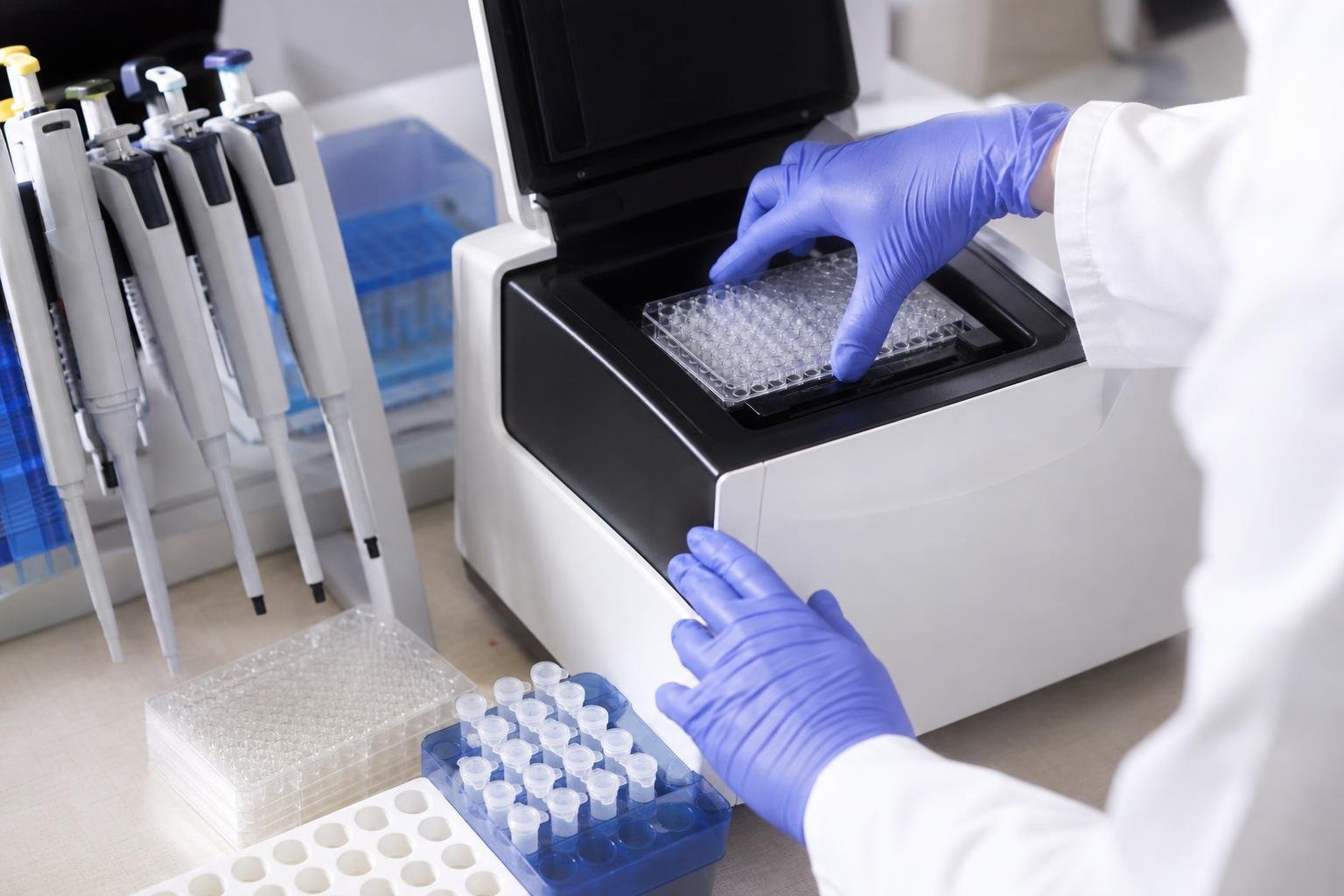
The aptamer experiments are therefore the key part of the paper. Aptamers are short, structured RNA molecules selected or engineered to bind specific targets. They are frequently described as nucleic-acid counterparts to antibodies, although their properties, manufacturing and practical constraints differ. In the study, EVA-generated aptamers delivered approximately twice the fluorescence intensity and binding affinity of a positive control.[1]
That is a useful design validation for two reasons. First, it moves beyond asking whether a model can recognize patterns in held-out sequences. Second, it tests outputs against physical measurements: fluorescence and target binding. A molecule that improves under an assay is a more demanding result than a higher benchmark score, because the model must generate a sequence that survives the gap between training data and molecular behavior.
The claim should nonetheless be kept narrow. The reported laboratory results validate designed aptamers in the study’s assay setting. They do not establish that EVA can reliably create therapeutic RNAs, optimize delivery, predict immunogenicity, solve tissue-specific expression, or replace the iterative screening and validation required in drug development.
A New Tool for RNA Design Workflows
The near-term commercial implication is not autonomous molecular invention. It is a potentially more capable front end for experimental design cycles. Computational-design providers can use models like EVA to propose candidates, prioritize variants and explore sequence space before synthesis. Laboratory teams can then test a smaller, more targeted set of molecules rather than relying solely on broad random libraries or manually chosen mutations.
This could be relevant across aptamers, RNA sensors, regulatory elements, RNA switches and other engineered RNA applications where function depends on sequence and fold. It may also interest RNA therapeutics companies that have built proprietary sequence libraries and assay datasets. Public training corpora can provide broad biological priors, while proprietary data may be more valuable for fine-tuning models toward a particular chemistry, delivery system, target class or assay.
The competitive advantage in this market is unlikely to rest on a foundation model alone. The scarce assets are likely to be high-quality experimental data, robust assays, synthesis capacity, formulation knowledge and feedback loops that link model proposals to measured outcomes. A model that reduces the number of design-build-test rounds could lower cost and accelerate discovery; a model without reliable experimental feedback remains principally a hypothesis generator.
EVA also adds pressure to the idea that biology AI should be judged only through benchmark tables. For buyers and partners, the useful question is increasingly operational: how much does a model improve the hit rate, activity, specificity or development profile of molecules tested in a real workflow?
What Would Turn a Promising Result Into a Platform
The next evidence to watch is breadth and reproducibility. Researchers will need to show whether long-context generative design works across additional RNA classes, targets and assay formats, not only for the aptamer cases reported here. Independent replications, ablation studies comparing different context lengths, and direct comparisons with established experimental selection methods would clarify how much of the improvement comes from EVA’s architecture, its training corpus and its candidate-selection process.
It will also be important to measure properties that matter outside a controlled assay. For therapeutic or diagnostic use, those can include stability in relevant biological fluids, off-target binding, manufacturability, cell uptake, performance in complex samples and consistency across batches. An RNA molecule can bind well in vitro yet fail because it degrades quickly, folds differently under physiological conditions or cannot reach its intended location.
There are practical concerns around training-data provenance, duplicate or closely related sequences, benchmark leakage and the tendency of generative models to produce candidates that appear plausible but do not generalize. The study’s wet-lab result is precisely why EVA deserves attention, but it is also why stronger validation matters: the field should test whether the observed gains persist across experiments rather than extrapolating from a limited set of successful designs.
The larger direction is clear. RNA AI is moving from interpreting sequences toward proposing molecules that experimentalists can test. EVA suggests that longer sequence context can be useful in that transition, especially where distant nucleotide interactions shape function. The practical value will be determined by whether such models repeatedly improve experimental programs, not by context-window size in isolation.
Editor’s Take
I see EVA’s aptamer result as the right kind of progress: modest enough to be credible, but concrete enough to matter. A roughly twofold assay improvement over a positive control is more relevant to a molecular-design team than another marginal benchmark gain. The 8,192-token window is important because RNA is not simply text; distant sequence regions can be part of the same physical structure, and models need enough scope to represent that possibility.
The commercial test is whether EVA-like systems can consistently give teams better candidates per synthesis run. That means watching for replicated results across targets, clear comparisons against conventional selection workflows, and evidence that gains survive the messy constraints of real applications. The hype would outrun the facts if this were presented as automated RNA drug discovery today. The real opportunity is a stronger design engine inside a disciplined experimental loop.
References
- Nature Machine Intelligence – https://www.nature.com/articles/s42256-026-01321-w