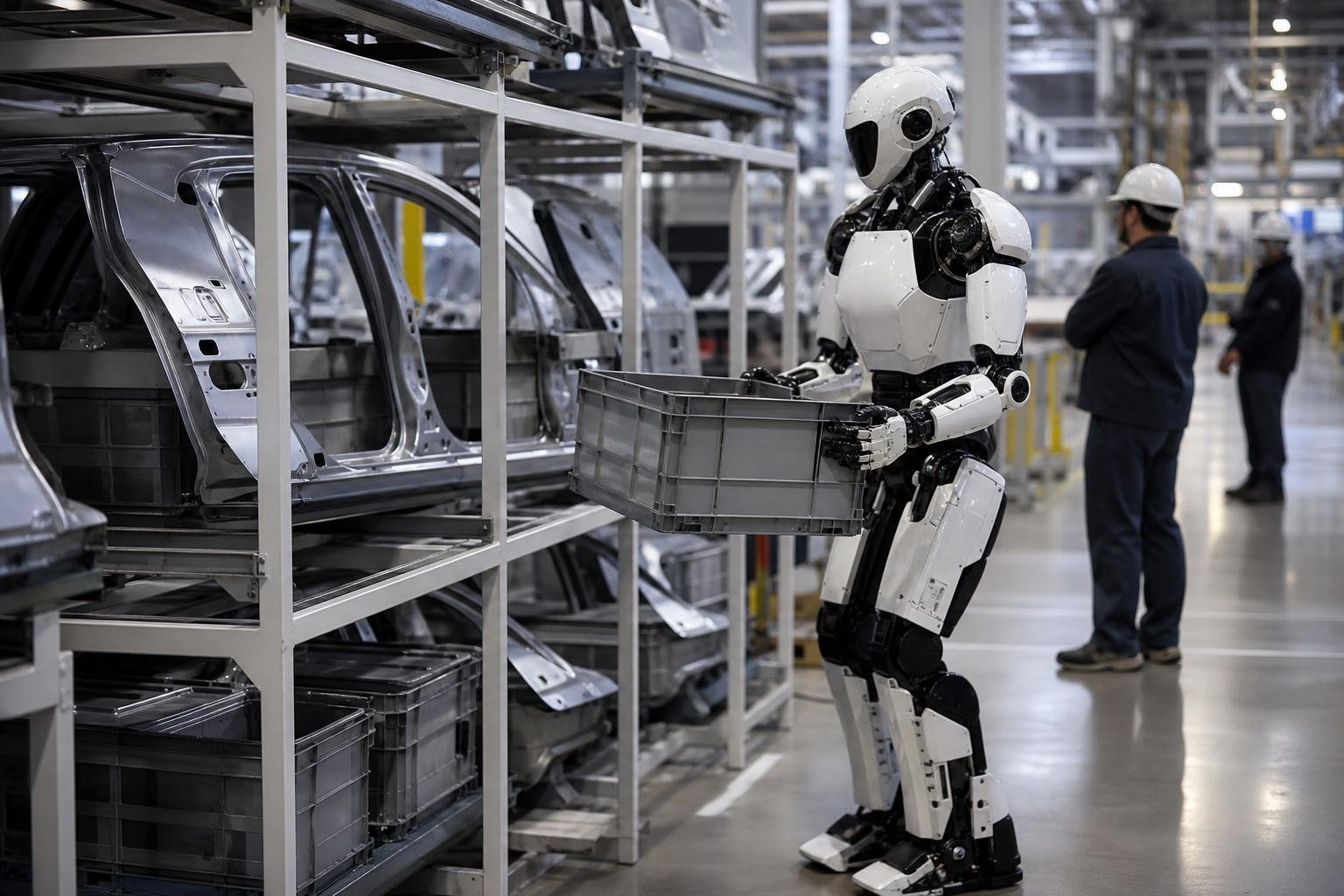
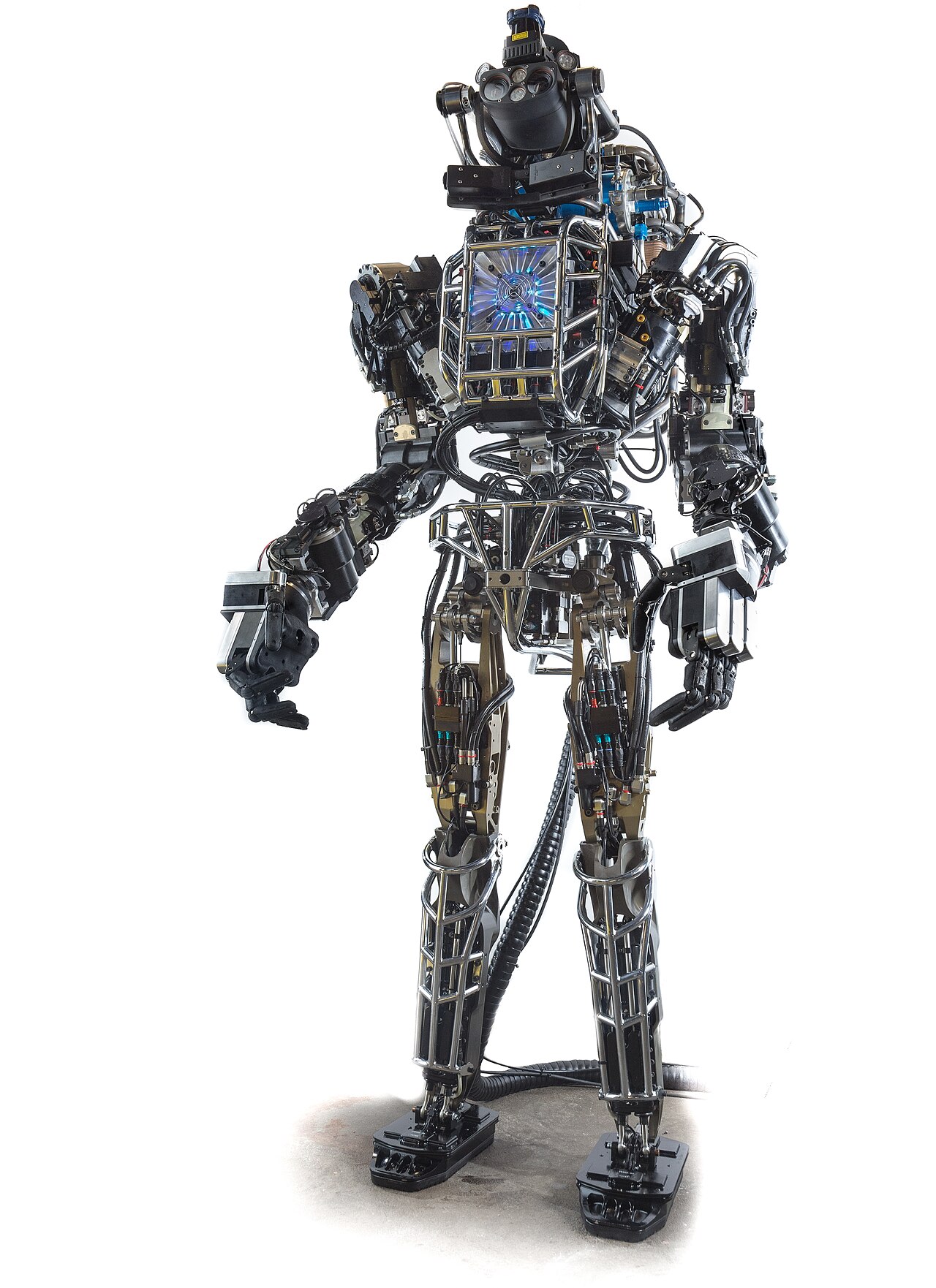
Boston Dynamics has opened a permanent Robotics Metaplant Application Center inside Hyundai Motor Group Metaplant America near Savannah, Georgia, creating a factory-embedded site for training its Atlas humanoid robot on automotive work. The company says Atlas is being developed against real tasks including parts logistics, sequencing and placement, rather than solely in laboratory settings or controlled demonstrations. [1]
The significance is less the opening of another robotics facility than the operating model behind it. A permanent center within an active vehicle plant can give Boston Dynamics a repeatable pipeline for collecting task data, testing robot behavior against production constraints and revising hardware and software before attempting wider deployment. That may help close the gap between capable humanoid demonstrations and industrial automation that is safe, reliable and economical enough to run every shift.
By the numbers
- 1: Permanent Atlas application center opened within Hyundai Motor Group Metaplant America.
- 3: Initial task categories identified by Boston Dynamics: parts logistics, sequencing and placement.
- 2027: Target year for a major expansion of the center.
- About 10x: Planned facility expansion relative to its current size.
A training pipeline embedded in production
Industrial robots have long been trained and programmed for narrowly specified work: welding a known joint, moving a part between fixed points or operating within a protected cell. Humanoid robots pursue a different opportunity. They are intended to work in facilities designed around people, using existing aisles, racks, containers, tools and workstations without requiring every process to be rebuilt around a conventional robot.
That ambition creates a difficult engineering problem. Manufacturing jobs are not defined only by a motion trajectory. A robot must identify the correct item, handle variations in orientation and packaging, maintain a safe path around people and equipment, meet cycle-time expectations, recover from mistakes and hand off work cleanly to downstream operations. It must do so under changing lighting, clutter, vibration, replenishment schedules and the practical constraints of a running plant.
Boston Dynamics describes the Georgia center as a place to develop Atlas against those conditions. The value of locating the operation at Hyundai’s plant is that engineers can expose the system to the exception cases that are often absent from a polished demo: a container in the wrong position, an unexpectedly unavailable part, a congested route, a shifted production sequence or an awkward grasp. Those cases are central to whether automation delivers useful uptime rather than simply completing a nominal task once.
The center also gives the company a more direct feedback loop. Task observations can inform data collection and model training; trial results can reveal where perception, manipulation, motion planning or the workstation itself needs revision; and the resulting changes can be evaluated on the same class of work. In theory, that iterative loop is the missing middle layer between a general-purpose humanoid platform and a production deployment.
Why logistics, sequencing and placement are meaningful first tasks
The initial categories Boston Dynamics identified are consequential because they sit at the boundary between material flow and assembly. Parts logistics involves moving components to the correct point of use. Sequencing requires delivering the right variant in the correct order, a critical requirement when a line builds vehicles with different configurations. Placement concerns putting an item where a worker, machine or subsequent process expects it.
These jobs can be attractive entry points for a humanoid because they often involve spaces and materials already designed for human reach and mobility. They can also be bounded more readily than complex final assembly. A deployment can begin with a limited set of containers, routes and handling rules before attempting a broader range of tasks.
But they are not trivial. A parts-delivery error can stop a line or cause a quality issue. Poorly controlled placement can create ergonomic, safety or traceability problems. The commercial benchmark is therefore not whether Atlas can walk through a plant or lift a component; it is whether it can execute a defined workflow with a measurable level of availability, accuracy, throughput and safe fault recovery.
That distinction matters for Hyundai as well. Automakers already use extensive conventional automation, including industrial arms, conveyors, automated guided vehicles and vision systems. A humanoid must complement those systems where a fixed machine is costly or inflexible, not replace equipment that already performs a task more cheaply and predictably.
What the announcement proves—and what it does not
The opening demonstrates a deeper commitment than a temporary pilot or a staged factory visit. Boston Dynamics is establishing a named, permanent application center and has said it plans to expand the site to roughly 10 times its current size in 2027. [1] That scale-up plan suggests the company expects factory training and validation to become a sustained part of Atlas development.
It does not, however, establish that humanoid robots are already deployed at scale in automotive production. Boston Dynamics’ announcement describes training and application development. It does not provide production fleet size, shift-level uptime, cycle-time performance, unit economics, safety incident data or a timetable for broad commercial operation. Those are the indicators that would show whether Atlas has crossed from development work to a repeatable industrial product.
That caution is particularly important in humanoid robotics, where visual demonstrations can obscure operational limits. In a discussion of factory readiness, Mühlens warned that many public demonstrations run slowly, use safety barriers or take place under conditions that do not represent real production environments. He also raised concerns about the behavior of heavy balancing humanoid robots when power is removed. [2]
Those concerns are practical rather than theoretical. A mobile, human-scale robot requires well-designed states for normal operation, faults, emergency stops, power loss and manual recovery. It needs predictable interactions with nearby workers and clear procedures for an operation that fails midway through a task. A permanent factory center can help identify these issues earlier, but it does not eliminate the engineering and certification work required to address them.
The economic test for Atlas
The industrial case for humanoids is not simply labor substitution. Manufacturers may use them to cover repetitive material-handling work, reduce exposure to ergonomically difficult tasks, respond to labor shortages, support flexible production mixes or automate workspaces where dedicated equipment would require expensive redesign. The strongest use cases are likely to be those with enough repetition to justify automation but enough product or process variation to make fixed automation unattractive.
For that equation to work, robot performance must be evaluated over more than a successful task completion. Buyers will need evidence on integration time, supervision requirements, maintenance, spare parts, training, safety controls, fault recovery and the amount of infrastructure modification needed. A robot that needs extensive human tending or frequent resets may add cost even if its manipulation performance is impressive.
The Georgia center is structured to address part of that problem by making the work environment itself a development input. Instead of treating the factory as a final showcase, Boston Dynamics can use it as a source of operational data and a testbed for improving task definitions, robot behavior and supporting workflows. That approach resembles the application engineering process used for many industrial technologies: begin with specific jobs, measure failure modes, refine the system and expand only when performance is repeatable.
A signal to the humanoid robotics market
Hyundai’s ownership connection to Boston Dynamics gives the effort an unusually direct path to a manufacturing environment. For the wider market, the project is a signal that the next competitive phase may be less about showing a humanoid can perform a striking isolated action and more about building the infrastructure to learn from many routine actions in real facilities.
That infrastructure includes task data, instrumented work areas, production-aware testing, safety processes, application engineers and customers willing to define the economic value of individual jobs. It also requires disciplined scoping. A useful early deployment does not need to prove that a humanoid can do every human task. It needs to show that a particular workflow can be performed safely and consistently at a cost and scale that a plant operator can justify.
The planned 2027 expansion will be an important milestone to watch, but the more revealing signals will be operational: whether the range of tasks grows, whether Atlas moves from supervised training into sustained production use, and whether Boston Dynamics publishes measurable evidence of reliability and throughput. The application center may become a model for industrializing humanoid robotics. For now, it is best understood as a serious bridge-building effort, not proof that the bridge has already been crossed.
Editor’s Take
I see the permanent, factory-embedded setup as the most credible part of this announcement. Humanoid robots will not become economically useful because they can execute a carefully prepared routine. They become useful when engineers can repeatedly observe what goes wrong on ordinary factory days, convert those failures into training and design changes, and verify that the corrections hold up under production pressure.
The next evidence that matters is not another Atlas video. It is data showing how long the robot can operate on a bounded task, how often it needs help, what happens during an interruption or power-loss event, and whether it can meet the line’s timing requirements without forcing the plant to adapt around it. The planned expansion is a positive signal, but the hype still outruns the facts until Boston Dynamics demonstrates those operating metrics at meaningful scale.
References
- Boston Dynamics – https://bostondynamics.com/news/boston-dynamics-opens-robotics-metaplant-application-center-to-train-humanoid-robots-for-manufacturing-tasks/
- Automation News – https://automationnews.com/news/events/automation-news-webinar-humanoid-robots-not-yet-ready-for-widespread-factory-deployment-experts-warn/