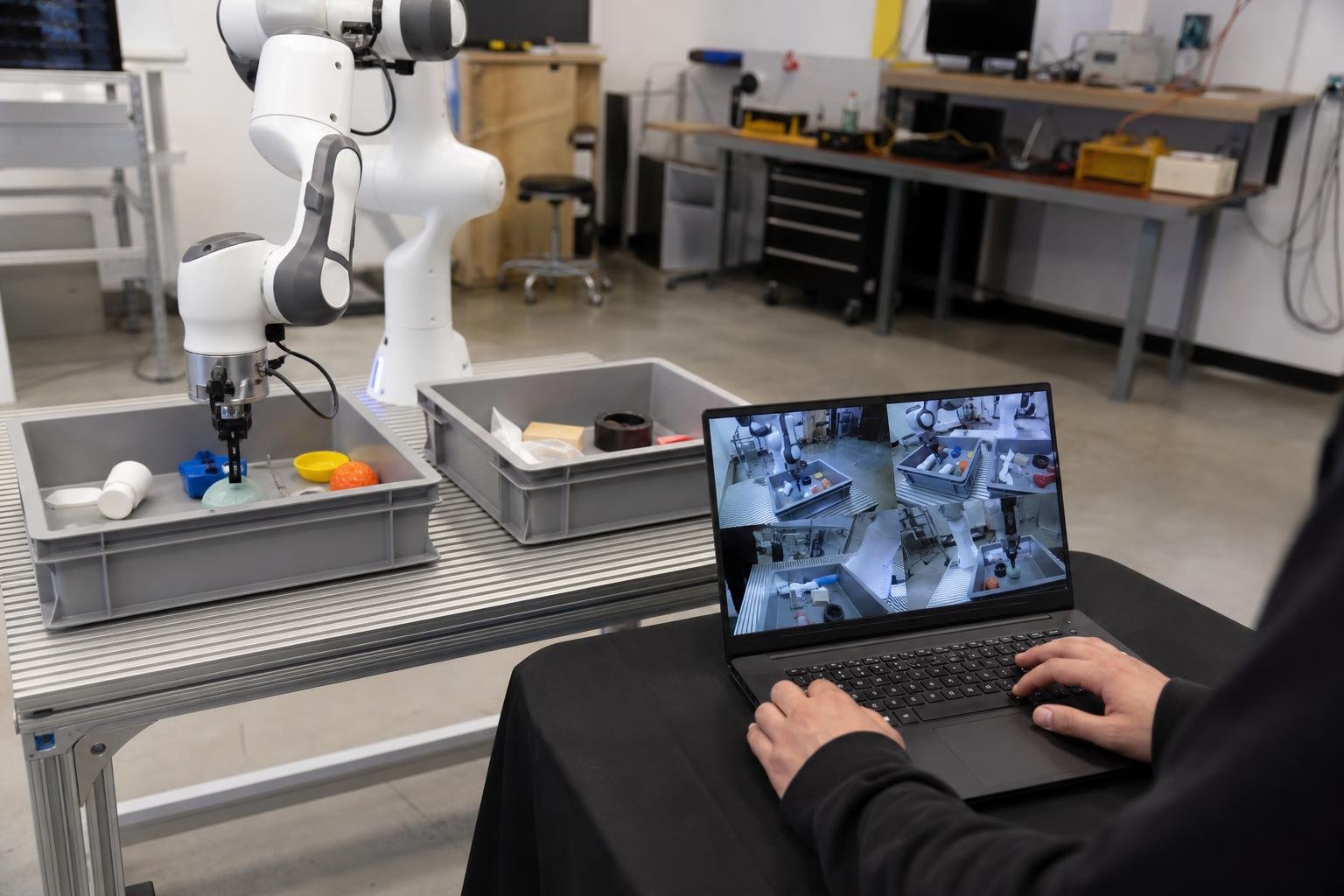
AXIS, a new robotics data engine described in a July 24 arXiv paper, proposes a shared infrastructure for gathering the examples needed to train robot manipulation systems. The project combines browser-based teleoperation, automated task generation and automated quality filtering, and reports a dataset of more than 50,000 manipulation trajectories covering 207 tasks.[1]
The significance is less about a new policy architecture than about the expensive, slow process of showing robots how physical work is done. Manipulation models need demonstrations across object placements, camera views, grasp approaches, motion paths and failure cases. AXIS is an attempt to make that supply of demonstrations easier to expand through a community of contributors, then turn it into training-ready data rather than an uncurated collection of robot logs. Its authors report that continual pretraining with AXIS data improved the success rate of a π0.5 policy by 5.8%, an encouraging result that remains far short of proof that the system is ready for the disorder and accountability requirements of commercial deployments.[1]
By the numbers
- 50,000+ — reported manipulation trajectories in the current AXIS dataset
- 207 — tasks represented in the dataset
- 5.8% — reported success-rate improvement for a π0.5 policy after continual pretraining
- 3 — central collection and curation components: browser teleoperation, task generation and quality filtering

Data, not just models, is the constraint
Robot manipulation has made visible progress in recent years as vision-language-action models and imitation-learning policies have absorbed larger sets of demonstrations. Yet the basic training input is unusually difficult to obtain. A language model can learn from text created for people. A robot must learn from synchronized observations and actions recorded while an embodied machine interacts with a specific environment.
That means a useful example may need camera streams, robot state, end-effector commands, task context and an outcome label. It must also be physically valid: a grasp that appears plausible in a video is not necessarily a sequence a robot can repeat without collision, slippage or joint-limit problems. Collection is therefore typically constrained by costly robot time, trained operators, lab supervision and data-cleaning work.
AXIS treats this bottleneck as an infrastructure problem. Instead of assuming that every useful trajectory must be collected by a small, centralized research team, the system aims to let distributed contributors operate robots through a browser. The core proposition is practical: reduce the friction of operating a robot, provide a structured stream of tasks to perform, and screen the resulting records before they become training data.[1]
That framing matters because more examples alone are not enough. A robot dataset full of incomplete tasks, disconnected controls, obstructed views or anomalous sensor readings can make training less reliable. The value of a data engine is in the complete loop: assign work, capture the demonstration, evaluate whether it is usable, and feed accepted data back into a growing corpus.
How AXIS turns remote operation into a data pipeline
The paper’s system has three linked layers. Browser-based teleoperation is the collection interface. It allows operators to control a robot without requiring a local installation of specialist robotics software, potentially widening the pool of people who can contribute demonstrations. For research groups, that model could also make it easier to add collection capacity across sites or schedule robot use outside a single lab’s working hours.
Automated task generation is the second layer. In a manipulation dataset, task diversity is not simply a matter of accumulating more repetitions. A system must vary the action goal and the conditions under which that goal is pursued: which item is selected, where it begins, where it must go, what orientation is required, and what environmental arrangement surrounds it. Automated generation can provide contributors with a continuous queue of structured work rather than relying on operators to invent demonstrations ad hoc.
The third layer is automated quality filtering. This is especially important in teleoperated data, where the raw record can include hesitation, misclicks, recoveries, failed grasps, unintended collisions or incomplete episodes. Filtering can make a dataset more coherent and reduce the burden on human reviewers. It also creates a consequential design choice: a filter that is too permissive admits noisy examples, while one that is too strict may discard precisely the recovery behavior and difficult edge cases that robust robots need to learn.
The paper reports that these components have produced more than 50,000 trajectories across 207 tasks. That breadth is meaningful because manipulation policies tend to benefit from variation in both tasks and execution strategies. A robot that has only seen one idealized route to a successful placement can be brittle when an object is slightly displaced or an initial grasp fails. A larger corpus can expose it to more of the state space that real operations contain, provided the tasks, hardware and data formats are sufficiently compatible.[1]
What the π0.5 result establishes—and what it does not
AXIS’s headline model result is a reported 5.8% increase in success rate for a π0.5 policy after continual pretraining on the collected data.[1] Continual pretraining is important in this context because it tests whether a base policy can absorb newly gathered experience rather than requiring a training process to start from scratch. If reproducible, that capability would support a more iterative robotics workflow: deploy or collect, curate, update the model, then evaluate again.
The reported gain is evidence that the dataset contains useful training signal. It is not, by itself, evidence that the data engine has solved general-purpose manipulation. The paper’s robustness tests address simulated perturbations involving layout, cameras and sensors. Those are appropriate tests of whether a policy is overly dependent on a fixed visual arrangement or ideal sensing conditions, but they are only part of operational robustness.[1]
Commercial settings introduce failures that are difficult to represent through controlled perturbations. Objects can be novel, flexible, reflective, wet, damaged or partially occluded. Contact forces can differ because packaging changes, surfaces deform or items shift under load. Workspaces accumulate clutter. Calibration drifts. A human may unexpectedly enter the work area. Production systems must also obey speed limits, collision policies, audit requirements and recovery procedures that are stricter than a benchmark’s definition of task success.
There is also an important statistical question: whether the 207 tasks represent distinct physical skills or many variations of a narrower set of skills. Both are useful, but they imply different levels of generalization. Moving many objects between known locations may create a strong pick-and-place corpus, while still offering limited evidence about tasks requiring tool use, deformable-material handling, precise insertion, bimanual coordination or safe interaction in changing spaces.
Community collection could reshape robotics economics
If the approach scales, AXIS could affect who is able to build competitive manipulation systems. Today, large robotics companies and well-funded labs can devote substantial resources to fleet operations and in-house data collection. A browser-accessible system with automated task routing and quality checks could allow smaller teams, academic groups and distributed operator communities to contribute to a shared data supply.
That does not eliminate the importance of hardware. A trajectory is shaped by a robot’s kinematics, gripper, cameras, control latency and workspace. Data collected on one platform may transfer imperfectly to another. Still, a common collection layer could help standardize metadata, task definitions and evaluation procedures, making it easier to combine data where the hardware and interfaces are compatible.
The strategy also resembles the broader shift from bespoke demonstrations to data operations. The winning organization may not be the one with a single spectacular model release, but the one that can reliably run a closed loop between real robot experience and model improvement. For warehouse, light manufacturing, laboratory and retail automation vendors, that loop is potentially a competitive asset: every deployed system can become a source of examples, but only if consent, privacy, security and quality controls are built into the pipeline.
For contributors and operators, the community model raises governance questions. The paper’s central technical claim is dataset construction, but an enduring shared infrastructure will also need clear rules around data ownership, contributor compensation, access rights, security of remotely operated equipment and the handling of video from real workplaces. Those issues will be as important to adoption as teleoperation latency or model scores.
The next tests for AXIS
The most useful follow-up evidence would be broader evaluation rather than a larger trajectory count alone. Independent tests should measure performance on unseen objects, unseen environments, altered lighting, difficult materials, contact-rich tasks and prolonged operation with realistic safety restrictions. Reporting failure modes matters as much as reporting aggregate success rates: an occasional missed placement and an unsafe collision are not comparable failures in an industrial setting.
Researchers will also want to know how data quality changes as the contributor base expands. A small group of skilled operators working on standardized hardware is very different from a broad community using variable network conditions and potentially different robot setups. AXIS’s automated filtering is designed to make that scale possible, but its effectiveness should be assessed against human review and against downstream policy behavior on hard cases.
For now, AXIS is best understood as a credible effort to industrialize the unglamorous part of robot learning: producing varied, usable records of physical work. The reported training improvement suggests that the engine is generating data with practical value. The larger question—whether that value survives the transition from controlled evaluation to messy, safety-constrained operations—remains open.[1]
Editor’s Take
I see AXIS as a more commercially relevant idea than another narrow benchmark win. In manipulation, the bottleneck is often not selecting a policy checkpoint; it is obtaining enough clean demonstrations of the awkward cases that operators encounter every day. A browser-based collection layer, task queue and automated acceptance gate is the kind of operational machinery that can compound over time.
I would watch the quality filter and the transfer story more closely than the 5.8% result. The gain says the data helped π0.5 under the reported evaluation, which is a meaningful signal. It does not show that a remotely collected dataset can handle slick packaging, unknown inventory, imperfect calibration and safety constraints on a live production floor. The opportunity is real if AXIS can demonstrate that its data pipeline improves those hard outcomes without creating a costly human-review operation behind the scenes.
References
- arXiv — https://arxiv.org/abs/2607.21588