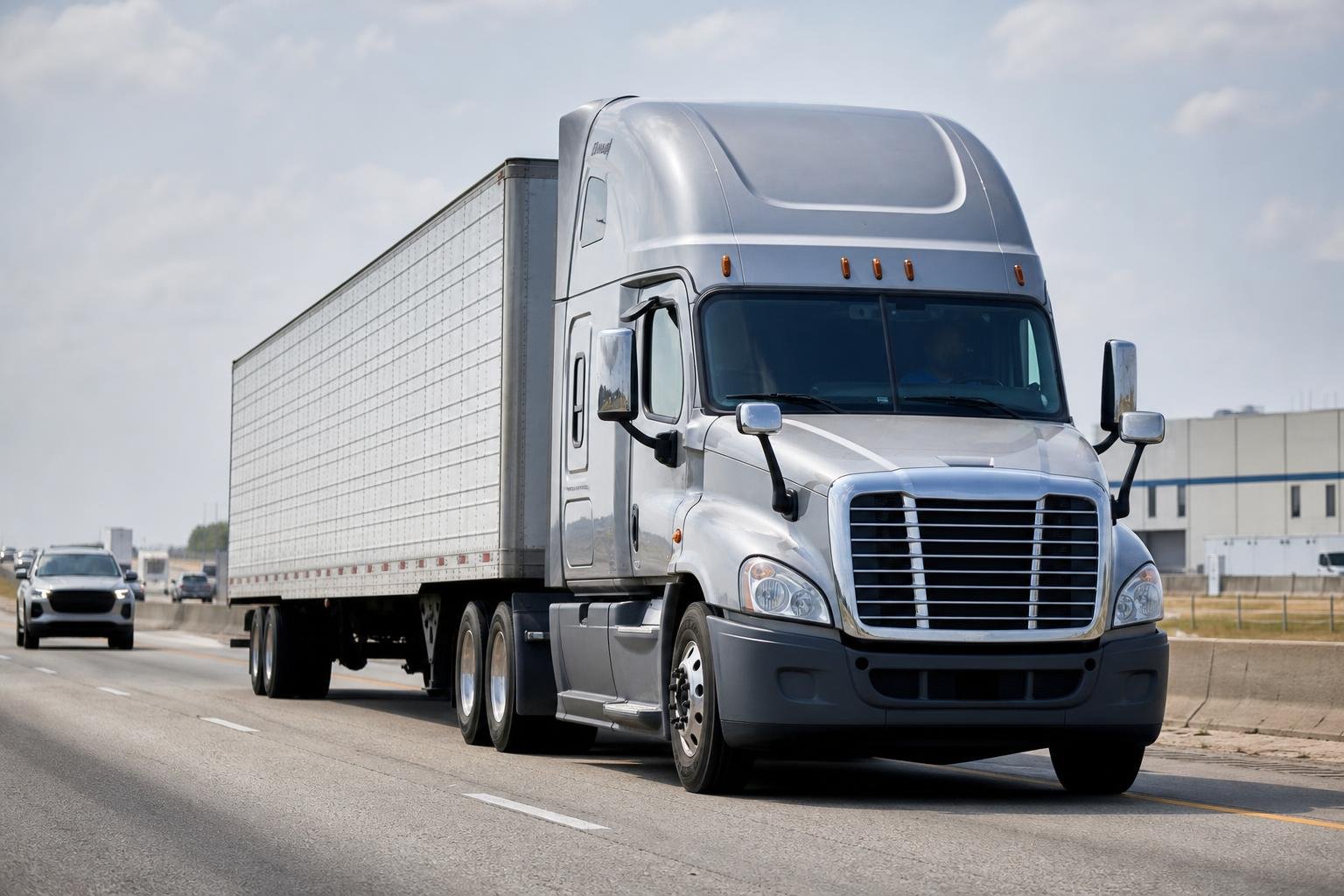
Kodiak AI has signed a binding agreement to supply 75 autonomous trucks to freight operator DTL Transport, with deliveries scheduled to begin in 2028. The companies plan to use the vehicles on interstate freight routes including Dallas–El Paso and Dallas–Atlanta, making the transaction Kodiak’s first binding commercial agreement under its driver-as-a-service model.[1]
The significance is not that an autonomous truck has completed another supervised run. A carrier has committed to acquire vehicles intended for routine freight work on public highways, while Kodiak is positioning itself as the provider of the driverless operating capability. The deal is therefore a useful marker of where autonomous trucking stands: beyond pilot demonstrations, but still years from the first planned deliveries and subject to operational, regulatory and insurance questions that pilots do not settle.
By the numbers
- 75 trucks: Autonomous vehicles Kodiak is contracted to deliver to DTL Transport.
- 2028: Planned start of deliveries under the agreement.
- 225 miles: Distance of Kodiak’s autonomous freight pilot in California preceding the deal.[1]
- More than 10,000 pounds: Vehicle weight threshold covered by California’s updated heavy-duty autonomous-vehicle testing rules.[2]
A commercial commitment, not a pilot milestone
Autonomous-trucking companies have long used freight pilots to show that a vehicle can navigate a particular corridor, transfer a load, or complete a limited set of trips under defined conditions. Those tests matter, but they do not by themselves establish an economically repeatable transport service. The DTL agreement introduces commitments that demonstrations can avoid: a fleet quantity, a customer relationship, delivery timing and identified commercial lanes.
That distinction is especially important because the buyer is a freight operator rather than a technology partner conducting an experiment. DTL is expected to own the trucks, while Kodiak supplies its driverless capability as a service. In practical terms, the arrangement shifts autonomous trucking toward a familiar fleet-industry division of responsibilities. The carrier can integrate vehicles into its equipment base and customer network; the autonomy developer is accountable for the technology, operating system and support needed to make those trucks productive.
It also creates a sharper measure of success. A 75-truck deployment must be maintained, dispatched, insured and kept available at a level that supports a freight operator’s business. The relevant question will not simply be whether a truck can drive autonomously on an interstate. It will be whether the combined vehicle-and-service offering can move loads reliably enough, at a cost that justifies its purchase and operating model.
What the 2028 timetable says about the remaining work
The start date is a sign of commercial intent, but it is equally a reminder that public-road deployment has a long path between contract signing and routine service. A two-year-plus lead time allows for vehicle production, integration, validation, customer onboarding, depot planning and the construction of an operating-support model. It also leaves time for the regulatory environment governing driverless heavy trucks to develop across the states on the proposed routes.
For an interstate truck, the technical task extends beyond staying centered in a lane. The system must perceive vehicles, road edges, work zones, emergency responders and debris; predict the behavior of other road users; plan safe maneuvers at highway speeds; and maintain a safe state if sensors, computing hardware or communications encounter a fault. It must also manage the operational edges of freight: entering and exiting distribution yards, handling trailers, fueling or charging where applicable, inspections, roadside incidents and handoffs involving human staff.
A scalable driverless service needs redundancy at several layers. Perception sensors and onboard compute need fault-tolerant designs; braking, steering and power systems need safe fallback behavior; and fleet operations need processes to monitor exceptions and recover vehicles without turning every unusual event into a prolonged remote-support exercise. These are not merely engineering details. Their performance determines truck utilization, maintenance requirements and the number of support personnel required per vehicle.
The scheduled Dallas–El Paso and Dallas–Atlanta lanes are commercially meaningful because interstate corridors offer sustained highway driving and connect large freight markets. Yet defined routes do not eliminate complexity. Weather, construction patterns, traffic density, interchange design, loading locations and state-by-state rules can all affect what is operationally viable. The routes should be understood as an initial operational design domain—specific conditions in which the service is intended to work—not evidence that the system is ready for every U.S. freight lane.
Driver as a service changes who carries the risk
Kodiak’s driver-as-a-service structure is central to the agreement. Rather than asking a carrier to buy a truck and independently run an autonomy stack, the model pairs customer-owned equipment with an ongoing autonomous-driving service. That can reduce the burden on a carrier to build specialized robotics, software-safety and remote-operations teams internally.
For Kodiak, the model creates recurring operational obligations rather than a one-time vehicle sale. The company will need to demonstrate that its service can support fleet uptime, safety performance, software updates, incident response and changing route conditions. For DTL, the arrangement makes the economics dependent not just on vehicle acquisition cost but on the continuing service terms, utilization achieved and the extent to which autonomous operations reduce or reallocate labor and operating costs.
This is why binding fleet commitments are more revealing than one-off pilots. They force the parties to define responsibility for vehicle availability, maintenance interfaces, teleoperations or remote assistance where permitted, data access, accident procedures and insurance. The public terms disclosed with the announcement do not resolve those questions, but the fact that a carrier has entered a binding deal suggests those issues have moved from abstract talking points into commercial negotiation.
California progress does not equal commercial authorization
Kodiak’s agreement follows a 225-mile autonomous freight pilot in California and the company’s receipt of a California Department of Motor Vehicles permit to test heavy-duty autonomous vehicles in 2026.[1][2] The permit is meaningful because California’s updated rules opened a path for testing vehicles weighing more than 10,000 pounds. But it is not a blanket authorization for unmanned commercial freight operations.
California’s testing permits require a human safety operator and impose operating restrictions, according to TechCrunch’s reporting on the updated rules.[2] That difference is fundamental. A safety-driver testing permit evaluates supervised operation under conditions set by the regulator. Routine paid driverless service requires a broader framework covering deployment authority, vehicle compliance, enforcement interactions, crash reporting, insurance and the practical ability to operate across jurisdictions.
The same issue applies to the proposed Texas-centered lanes. Interstate freight crosses multiple local and state operating environments even when most driving occurs on controlled-access highways. By 2028, the critical regulatory test will be whether the relevant authorities permit these lanes to become routine commercial operations, rather than whether they allow limited testing. Policymakers will also face questions about how autonomous trucks interact with law enforcement, emergency services, roadside inspections and work zones.
The market test: utilization, safety and repeatability
The broader autonomous-trucking market has been shaped by a tension between attractive economics and difficult execution. Long-haul freight is an appealing target because trucks often operate on repeat corridors, carrier schedules are measurable, and driver shortages and turnover can be costly. A vehicle capable of safely extending usable operating hours could improve asset utilization. But those theoretical gains disappear if autonomous trucks require extensive support, cannot run during common adverse conditions, or spend too much time awaiting specialized maintenance.
Industry proponents will view the DTL agreement as evidence that carriers are willing to make longer-horizon commitments when autonomy is packaged as an operating service instead of a speculative technology purchase. Safety advocates and regulators are likely to focus on a different standard: transparent evidence that driverless trucks manage predictable highway operations and rare but consequential edge cases at least as safely as conventional alternatives.
The first useful indicators will be concrete rather than promotional. They include whether Kodiak meets the 2028 delivery schedule, whether the vehicles enter revenue-generating service on the announced lanes, the conditions under which they can operate without a human driver, their availability rate, and how the companies disclose safety incidents and operational limits. A single successful run is not the same as sustained freight capacity; neither is a purchase agreement the same as a deployed fleet.
If the program works, it could give other carriers a clearer procurement template for autonomous trucking: buy or lease compatible equipment, contract for the driving service, and begin with tightly defined lanes. If it stalls, the reasons will be equally informative, revealing whether the main constraint is technology maturity, manufacturing, regulation, fleet economics or the difficulty of integrating driverless vehicles into ordinary freight operations.
Editor’s Take
I see the 2028 date as the most honest and important detail in this announcement. A 75-truck binding commitment is materially different from a pilot, but the long runway acknowledges that a driverless freight business is an operating system, not a feature bolted onto a tractor. It has to work through dispatch, maintenance, insurance, roadside events and customer deadlines—not just on a clean highway segment.
The driver-as-a-service structure is commercially sensible because most carriers should not have to become autonomy-software operators. What I will watch is the conversion from named corridors to routine paid service: safety-driver status, operating hours and conditions, fleet availability, and the support labor required behind the scenes. The hype outruns the facts if a signed order is described as deployed driverless capacity. But if Kodiak delivers these trucks and DTL can keep them moving on scheduled freight lanes, it will be one of the clearest tests yet of whether autonomous trucking can become normal fleet infrastructure.