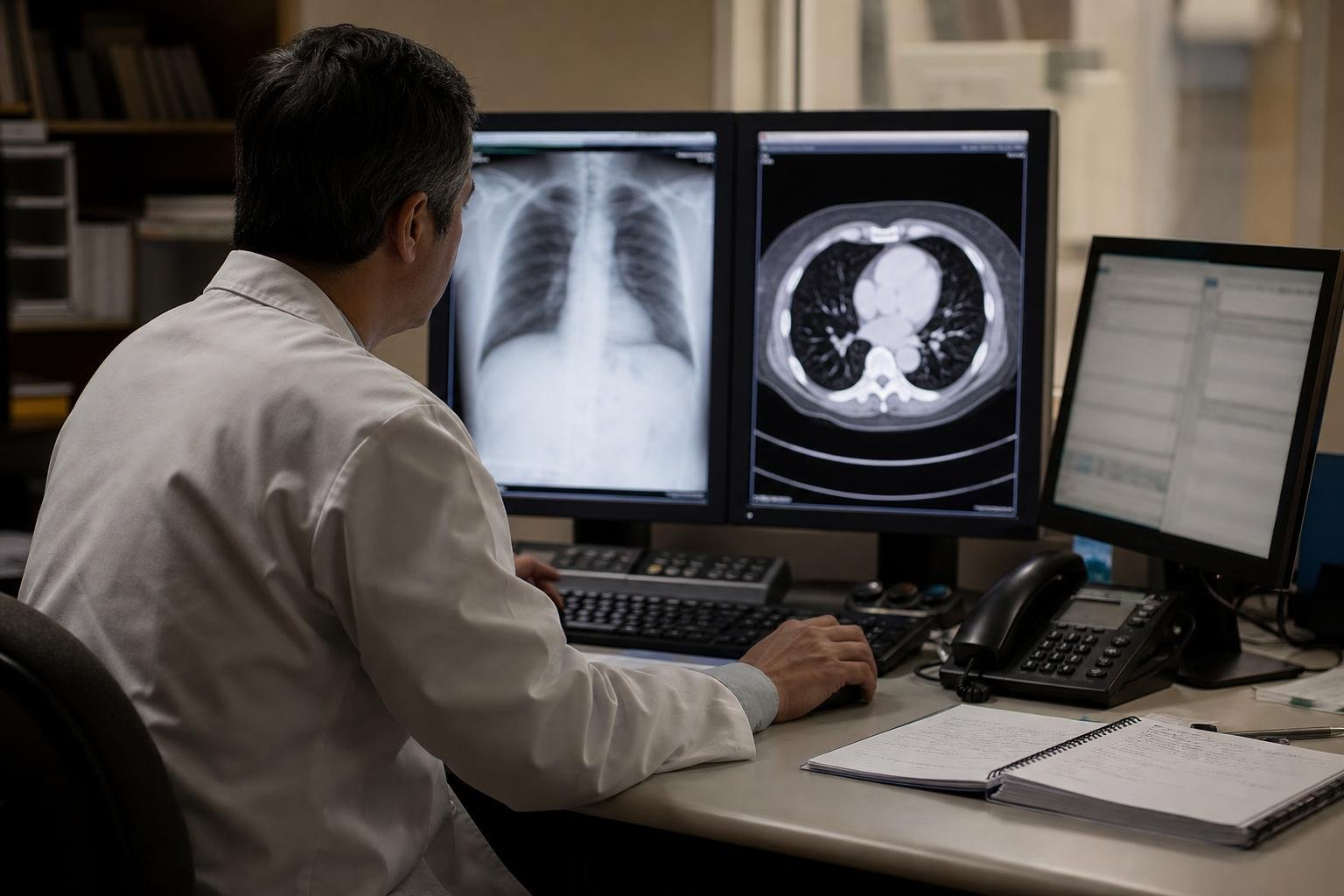
A peer-reviewed study in Nature Communications reports that Impression-R1, a specialized AI reasoning model for drafting radiology impressions, improved report quality in a randomized reader study while reducing report completion time by 27%. The evaluation covered 11,884 cases drawn from six institutions and public datasets, giving the work a broader evidentiary base than the single-site demonstrations common in clinical AI research. [1]
The result matters because the central radiology-AI question is moving beyond whether a general-purpose model can produce fluent medical text. The more consequential question is whether a system designed for a narrow reporting task improves clinicians’ work under realistic review conditions. Impression-R1 offers encouraging evidence on that point, but its results should not be confused with evidence that AI can safely issue radiology reports without physician oversight. [1]
By the numbers
- 11,884 cases: Total cases evaluated across institutional and public data.
- 6 institutions: Participating institutional sources, alongside public datasets.
- 27%: Reduction in report completion time with AI assistance in the randomized reader study.
Why the study design is more meaningful than a benchmark score
Radiology-reporting models are often evaluated with automated text-similarity metrics or against a reference report. Those tests can be useful for model development, but they have a fundamental limitation: there can be several clinically acceptable ways to express the same findings. A model may use wording that looks similar to a reference yet omit an important conclusion, or use different wording while producing a more useful report.
Impression-R1 was evaluated across a comparatively large, multi-institutional collection of cases and public datasets, then examined in a randomized reader study. That combination matters. Dataset breadth tests whether performance is tied too closely to one hospital’s reporting style, imaging population, or documentation conventions. A reader study tests a more practical question: whether clinicians working with the system produce better reports and finish their work faster. [1]
The randomized component is particularly important because workflow claims are otherwise vulnerable to selection effects. Faster results may reflect easier cases, unusually motivated users, or comparisons with an unrealistic baseline. Randomized reader evaluation cannot eliminate every source of bias, but it provides substantially stronger evidence than a retrospective claim that a model’s output resembles expert text.
A model focused on the radiology impression
The impression is the concise, clinically actionable portion of a radiology report. It synthesizes the examination’s salient findings and communicates what referring clinicians most need to know: the primary conclusion, the degree of urgency where applicable, and relevant recommended follow-up. Drafting it requires more than converting observations into polished prose. It requires prioritizing findings, preserving important uncertainty, and avoiding conclusions that are not supported by the source information.
Impression-R1 is presented as a domain-specific reasoning model for this task rather than a general text generator repurposed for medicine. That design choice reflects a growing direction in clinical AI: focus a model on a constrained, high-value part of a workflow, evaluate it against domain-relevant criteria, and keep the clinician as the accountable final reviewer. [1]
Specialization does not make a model inherently reliable. It does, however, make evaluation more concrete. The intended output is bounded, the user is clear, and quality can be assessed in terms that matter to reporting practice rather than only in terms of generic language fluency.
The workflow gain and its market significance
A 27% reduction in completion time is a material workflow result in a specialty where report turnaround, growing imaging volumes, and clinician workload are persistent operational concerns. If the gain holds across sites and examinations, AI assistance could give radiologists more time to review complex studies, communicate urgent findings, resolve ambiguities, and perform the other work that a drafting system cannot replace.
For imaging providers and health systems, the finding also changes the commercial standard for reporting AI. The valuable product is not simply an interface that generates a plausible impression. It is a system that fits the reporting workflow, reliably preserves clinician control, and demonstrates measurable gains in both quality and efficiency. A vendor that can show those outcomes in varied clinical environments will have a stronger case than one relying on headline benchmark performance alone.
That distinction could favor tightly integrated tools over standalone chat interfaces. The operational challenge is not merely generating text; it is presenting the draft at the right point in the reporting process, making edits easy, showing enough context for verification, recording clinician changes, and working within local governance and health-information systems. The study’s multi-source evaluation is evidence in favor of generalizability, but it is not a substitute for implementation testing in each deployment environment.
Why faster drafting is not autonomous practice
The authors caution that broader clinical validation remains necessary. That caution is central to interpreting the study. A reader study can show that radiologists are more effective with assistance, but it does not establish that the model can independently make diagnostic judgments, manage rare edge cases, or safely operate across every scanner protocol, patient population, subspecialty, and reporting convention.
Clinical risk in radiology impressions is asymmetric. A draft that is stylistically awkward can be corrected quickly. A draft that omits a critical finding, overstates certainty, or introduces an unsupported recommendation can create a much more serious problem—especially if time pressure encourages users to accept fluent language without sufficient verification. The model’s apparent ability to reason about a report does not remove the need for the radiologist to inspect the underlying findings and retain final authority.
Broader validation should therefore examine prospective use in routine clinical operations, not just curated retrospective cases. Important questions include whether quality and time benefits persist across institutions, how often clinicians modify or reject suggestions, whether the tool affects error rates and report turnaround in production, and whether its performance is stable across patient groups and examination types. Governance also needs to address audit trails, monitoring for drift, privacy, accountability, and clear escalation paths when a draft conflicts with clinical judgment.
What comes next for radiology AI
The likely near-term role for systems such as Impression-R1 is assistive: a clinical co-pilot that produces a reviewable draft, not an autonomous reporting engine. That is still a meaningful opportunity. Report composition is repetitive but consequential work, and a high-quality draft can reduce administrative friction without transferring diagnostic responsibility away from the radiologist.
The study raises the bar for the field. Future claims will be more credible when they pair broad external evaluation with reader-centered outcomes, transparent descriptions of failure modes, and prospective evidence from ordinary practice. The most important follow-on result would not be another language benchmark. It would be a demonstration that the observed quality and efficiency gains endure after deployment, with clinicians retaining the ability to identify and correct errors before reports reach patients and referring providers.
Editor’s Take
I see the 27% time result as the most commercially relevant figure in this paper, but only because it is paired with a reader-study quality improvement and a large, multi-institutional evaluation. That is a much more useful signal than a model winning a text-generation benchmark. Radiology groups do not buy elegant prose; they buy dependable workflow capacity without compromising clinical judgment.
The next test is straightforward and demanding: show the same benefit prospectively in live reporting systems, quantify when radiologists change the AI draft, and publish the failures as clearly as the successes. The hype outruns the facts when “reasoning model” becomes shorthand for autonomous diagnosis. The practical opportunity is stronger than that claim: a carefully governed drafting tool that saves time while leaving the radiologist firmly in charge.
References
- Nature Communications – https://www.nature.com/articles/s41467-026-79102-7