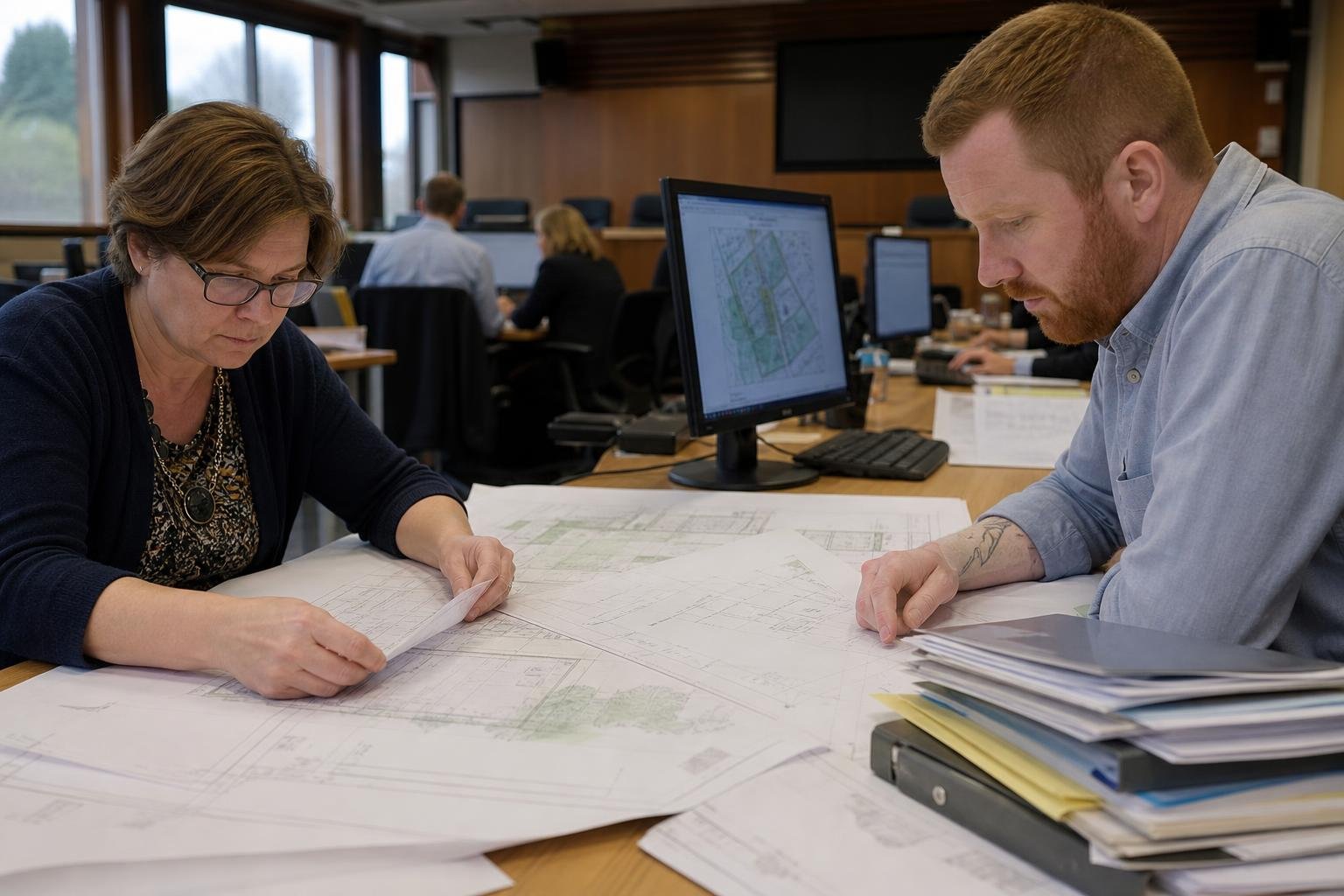
The UK government is expanding PlanAssist, an AI-assisted planning tool backed by Google DeepMind, from initial trials in Camden, Barnet and Dorset to 15 councils for a 12-month beta. The move is aimed at a mundane but economically important problem: the administrative workload that slows routine planning decisions, housing alterations and local development.
PlanAssist is not being positioned as an automated planning authority or a replacement for planning officers. Its practical promise is narrower: reduce the time officers spend finding information, handling repeatable casework and preparing material for decisions, while leaving statutory judgment, local-policy interpretation and accountability with humans. Early government results are encouraging, but the wider beta will determine whether those gains can be repeated across councils with different systems, planning policies and caseloads. [1]
By the numbers
- 15 councils: Planned participants in the expanded beta.
- 12 months: Duration of the beta programme.
- 58%: Reported reduction in time spent on key planning tasks during early testing.
- Eight to four weeks: Reported reduction in routine householder application processing times in the early trial.
What PlanAssist is intended to do
Planning departments process large volumes of documents, correspondence, plans, local-policy material and consultation responses. Much of that work requires professional expertise, but much of it also involves repetitive administrative steps: locating relevant information, assembling a case file, checking that submitted material can be assessed, and turning complex records into usable summaries.
PlanAssist is designed to support that workflow rather than independently approve or reject development. The government describes the tool as a way to speed key planning tasks and help councils deal with routine applications faster. In practice, that makes it an administrative-capacity tool: software intended to bring relevant information and draft material to an officer more quickly, so the officer can spend more time on the issues that require judgment. [1]
That distinction matters. A planning decision can turn on site-specific facts that are difficult to reduce to a general rule: design and heritage effects, neighbour impacts, flood risk, transport constraints, local-plan wording, consultation evidence and the balance of competing public interests. AI can assist with document-heavy work, but it does not remove the need to explain a decision, apply policy lawfully or defend it if challenged.
The Google DeepMind connection reflects a broader government effort to use advanced AI systems in public-service workflows. But the technology’s value here is not a dramatic prediction of which developments should go ahead. It is whether the system can reliably reduce the friction around straightforward, high-volume work without introducing errors, omissions or new review burdens.
Why routine planning speed has an outsized economic effect
Householder applications may appear less consequential than major housing schemes, but they are a useful test case. They are numerous, often relatively standardised and still require residents, architects, builders and council staff to wait for a formal process to complete. A reduction from eight weeks to four, as reported in early testing, can affect renovation schedules, contractor availability and household spending decisions. [1]
For councils, faster handling of routine work can also create capacity for more complex applications. Those larger cases are where planning departments face the greatest demands: coordinating specialist advice, engaging communities, assessing infrastructure requirements and negotiating conditions. If automation reduces time spent on lower-risk administrative tasks, it could allow scarce professional staff to focus on decisions where their expertise has the greatest public value.
This is also why the programme should not be assessed solely by the number of applications processed. A useful system should improve the quality and consistency of case preparation, reduce avoidable delays and preserve a clear audit trail. Speed achieved by producing weak summaries or prompting extra checks would simply move the bottleneck elsewhere.
Early results are promising, but they are not yet proof of scale
The reported 58% reduction applies to time spent on key planning tasks, not necessarily to every stage of every application. Likewise, the reported fall in routine householder processing time from eight weeks to four is an early-trial result, not a guaranteed national service standard. The 15-council beta is therefore the more meaningful test.
Scaling across local authorities is difficult because planning services do not operate from a single clean, uniform dataset. Councils use different software, archive records in different formats and apply locally specific plans and supplementary guidance. An AI assistant that performs well in one authority may need careful configuration, data preparation and staff training before it delivers comparable results elsewhere.
The 12-month period should provide enough time to test performance beyond an initial demonstration phase. The most useful evaluation would separate time saved in individual tasks from end-to-end decision times, and compare outcomes by application type. It should also record how often officers correct, reject or substantially amend the tool’s output. Those measures would show whether PlanAssist is creating durable capacity or merely shifting work into quality assurance.
Human oversight remains the central design requirement
Professional bodies have stressed that AI in planning must be deployed with care. The Royal Institution of Chartered Surveyors has highlighted both the potential for AI to support planning officers and the continuing need for human professional judgment, particularly where data quality, bias, transparency and public confidence are at stake. [2]
For PlanAssist, the operational questions are concrete. Officers need to know what information the system used, whether it missed relevant evidence and how it reached a suggested summary or output. Councils must protect applicant and resident data, maintain records appropriate for public decision-making, and ensure that automated assistance does not embed inconsistent interpretations of local policy.
There is also a governance issue. Planning decisions affect property rights, local amenity and public money. Applicants and communities need a clear route to challenge a decision, and councils must remain able to explain it in terms that do not depend on opaque model behaviour. A sensible deployment model keeps the AI within the officer workflow, requires review before material is relied on, and treats its output as assistive rather than determinative.
A test of public-sector AI that can be measured
PlanAssist represents a more practical form of public-sector AI adoption than broad claims about algorithmic government. Planning has visible queues, identifiable administrative tasks and measurable service outcomes. That gives the programme a clear standard: does it reduce processing time and staff burden while maintaining decision quality and legal robustness?
If the answer is yes, the implications extend beyond planning. Other local-government functions with document-intensive, rules-based workflows may be candidates for similar tools. But planning is unusually sensitive because it combines procedural rules with local discretion and contested public interests. Success will depend less on the sophistication of the underlying model than on integration with council records, rigorous controls and staff confidence in when to trust the tool.
The expanded beta is therefore best understood as a service-delivery experiment. It could help ease a real bottleneck constraining household projects and local growth. Its lasting value will depend on transparent evidence that it helps officers do better work faster, rather than asking them to supervise another complicated system.
Editor’s Take
I think this is the right shape of AI deployment for government: target a constrained workflow, measure the operational result and keep accountable professionals in charge. Cutting a routine householder process from eight weeks to four is meaningful if the result holds across councils, because it makes the planning system more predictable for residents and small builders while freeing officers for difficult cases.
What I would watch next is not the headline task-time saving but the quality-control data. How frequently do officers amend PlanAssist outputs? Does it reduce end-to-end delay after consultation and validation are included? Can councils show a usable audit trail? Those answers matter far more than whether the tool can generate persuasive-looking text. The hype would be claiming that AI solves planning; the credible opportunity is that it gives an overstretched planning service more usable capacity.
References
- GOV.UK – https://www.gov.uk/government/news/faster-planning-decisions-as-new-rules-and-ai-tackle-delays
- Royal Institution of Chartered Surveyors – https://ww3.rics.org/uk/en/journals/land-journal/ai-planning-officers-development.html