A person with amyotrophic lateral sclerosis (ALS) used a chronically implanted brain-computer interface to operate smart devices through self-initiated, silent-speech commands, according to a study published in Nature Communications. The system decoded intended commands from brain activity without requiring the participant to vocalize them aloud.[1]
The result matters less as another demonstration that neural signals can be classified than as a test of a more practical question: whether a person who cannot reliably speak can independently initiate a command whenever it is needed. The study is an early result in one participant, not evidence that the approach is ready for broad clinical deployment. But it addresses a central limitation of many prior brain-decoding experiments, which have relied on externally cued tasks, fixed trial timing, or overt speech.
By the numbers
- 1 participant: The report describes a single person with ALS.
- 0 audible words required: Commands were based on silent speech rather than spoken vocalizations.
- Chronic implant: The electrocorticographic interface remained implanted for ongoing use, rather than being a temporary recording setup.
Blaus, CC BY 3.0, via Wikimedia Commons
From prompted decoding to self-paced control
Brain-computer interfaces, or BCIs, translate measured neural activity into a digital output: text, a cursor movement, synthesized speech, or a device command. In communication-focused research, the neural activity may be recorded while a participant attempts to speak, imagines speaking, mouths words, or performs an instructed task at a specified moment.
Those controlled experiments are essential for training and evaluating decoding systems. They do not, however, solve the full interaction problem faced by someone living with progressive paralysis. A usable assistive interface must distinguish a deliberate command from the rest of the day’s neural activity; it must work when the user decides to act, rather than only after a computer prompt; and it must connect to functions that matter outside a laboratory.
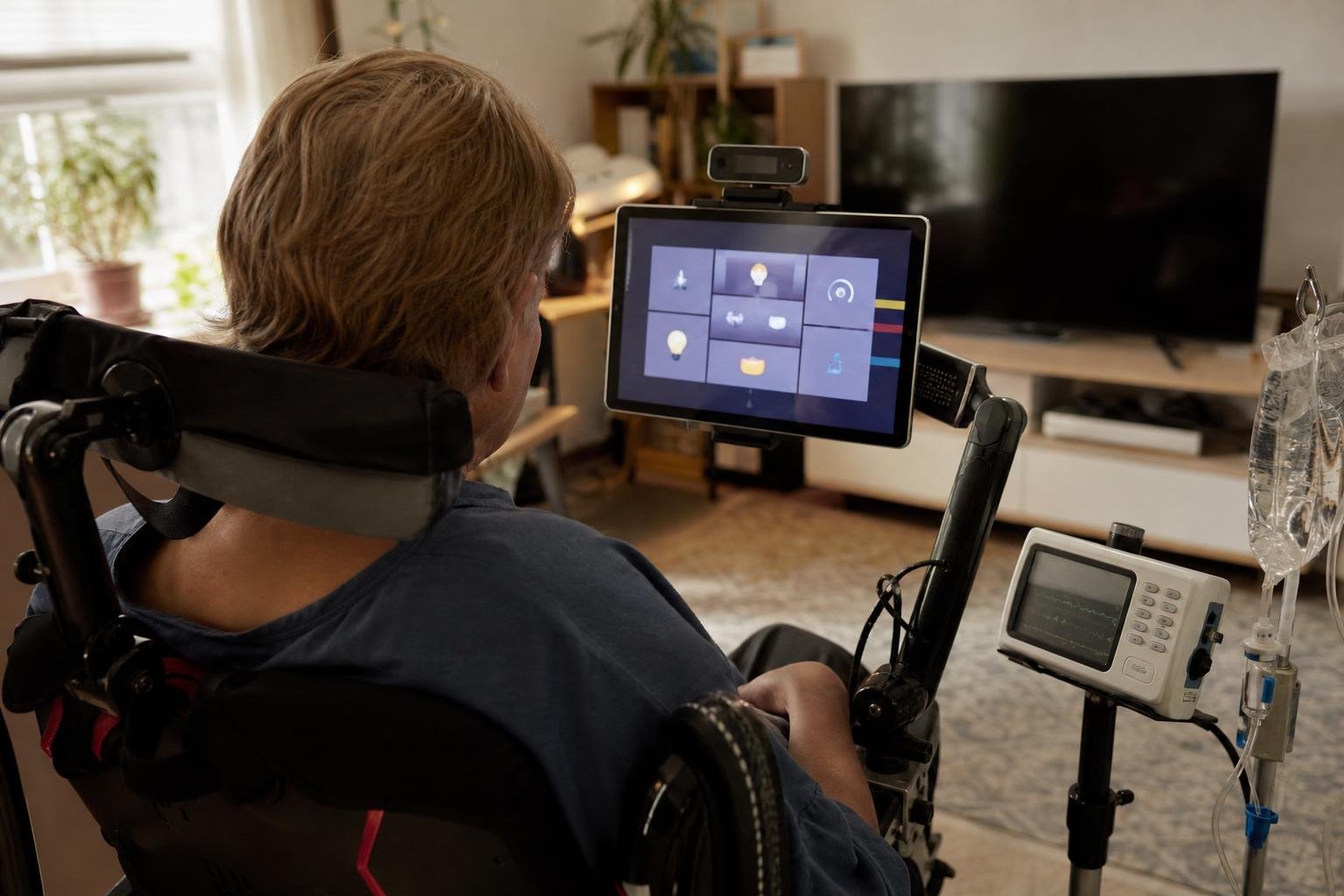
The new study centers on that distinction. The participant used self-paced silent-speech commands to control smart devices. In practical terms, the interface was intended to provide an always-available route from an internally formed command to an action in the surrounding environment. That is a different target from showing that a model can identify a word or phoneme during a short, repeated experimental trial.[1]
Silent speech is particularly relevant in ALS. The disease can progressively impair voluntary muscle control, including the muscles used for speech, while leaving cognition intact. Conventional assistive technologies, including eye tracking, switches, and speech-generating devices, can be highly effective for many people. Their usefulness can nevertheless be constrained by fatigue, eye-movement limitations, changing motor function, positioning, lighting, or the need to select from a visual interface. A neural pathway could eventually serve as another access method when those options are insufficient.
How the implanted interface works
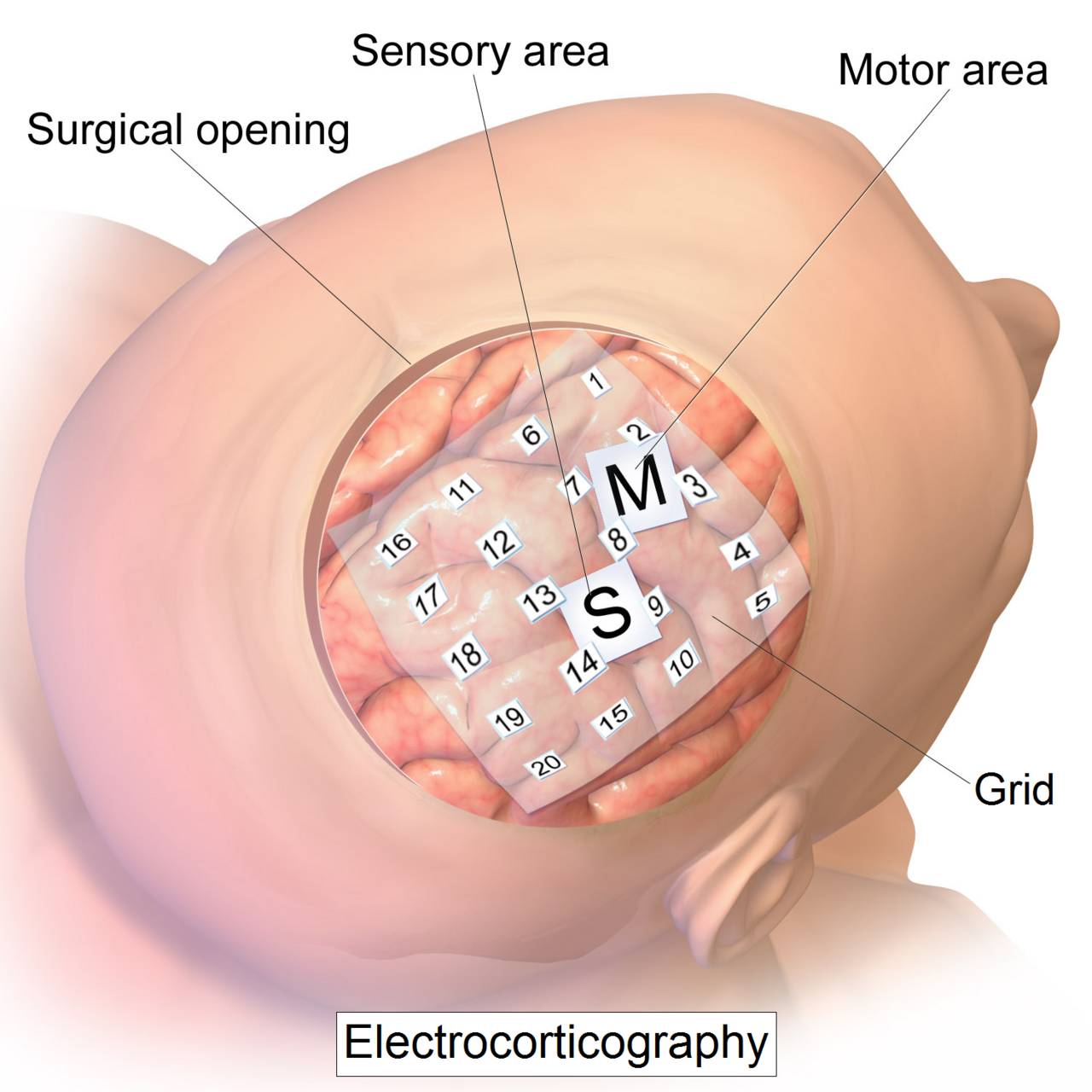
The system used electrocorticography, or ECoG: electrodes placed on the surface of the brain beneath the skull. Unlike noninvasive electroencephalography, which records through the scalp, ECoG can capture neural activity with higher spatial resolution and less signal attenuation. Unlike penetrating microelectrode arrays, it does not insert electrodes into brain tissue. These trade-offs have made ECoG a significant approach in BCI research, particularly for decoding activity associated with movement and speech.
For this study, the implanted interface recorded cortical activity associated with the participant’s intended silent-speech commands. Software then classified those patterns and linked recognized commands to smart-device functions. The important technical feature is not merely that the system recognized a rehearsed pattern, but that it operated in a self-paced mode: the participant could initiate a command rather than waiting for a trial cue.[1]
That design creates harder engineering problems. A decoder must identify intended control activity while avoiding false activations caused by unrelated thought, movement, noise, or changes in neural signals over time. In a home-control system, an accidental command is not a minor classification error; it can undermine trust in the interface. The study therefore belongs to a class of BCI work in which reliability, command confirmation, latency, and error handling are as consequential as headline decoding accuracy.
The word chronic is also meaningful. A clinically useful implanted BCI must remain functional beyond a single recording session. Chronic use raises questions about electrode stability, signal drift, device maintenance, recalibration, comfort, infection risk, surgical burden, and whether the user can operate the system with limited support. The report demonstrates an implanted approach over time, but one case cannot establish long-term durability across patients or institutions.
Why smart-home control is a consequential use case
Smart-device control may sound less dramatic than generating fluent text or restoring a natural-sounding voice, but it addresses an immediate form of autonomy. Turning devices on or off, adjusting a connected environment, calling for assistance, or selecting entertainment can reduce dependence on another person for routine actions. For people with severe motor impairment, the value lies in deciding when to act without having to wait for a caregiver to interpret a need.
The study’s focus on device control also reflects a pragmatic BCI product strategy. A small vocabulary of high-value commands can be easier to validate and safer to deploy than open-ended language decoding. It can also integrate with existing smart-home platforms rather than requiring every function to be rebuilt around a neural interface.
That does not make the task simple. Real homes are noisier than laboratories, routines change, networks fail, and connected devices have uneven interoperability. An assistive BCI will need clear feedback to tell users what the system heard, a way to cancel or confirm consequential actions, and fallback controls for caregivers. For safety-critical tasks, the system’s interaction design may matter as much as its neural decoder.
What the result does—and does not—establish
The paper provides evidence that silent, internally initiated speech can be used as a control signal for connected devices by one person with ALS.[1] It does not show that all people with ALS will produce equally decodable signals, that the same electrode placement will work across users, or that a device can be implanted and used routinely in ordinary clinical care.
Single-participant BCI studies are common because implants, individualized neural anatomy, and intensive calibration make research difficult. They can establish feasibility and reveal real human factors that group studies cannot capture. But generalization requires replication across participants, disease stages, languages, home environments, and different patterns of speech and motor impairment.
There are also privacy and governance issues specific to speech-related neural data. A command decoder is not the same thing as a system that reads unrestricted private thoughts. Still, as interfaces become more capable, developers and regulators will need boundaries around data collection, storage, remote access, consent, and secondary use. Users should retain control over when an interface is listening for commands and how its data are handled.
Implications for the BCI industry
The immediate commercial significance is not a ready-made consumer product. It is validation of a product direction: implanted BCIs may be most valuable first as assistive-control systems for people with severe paralysis, where even a limited command set can have substantial daily value. That direction sits alongside other BCI goals such as cursor control, text entry, robotic assistance, and speech restoration.
The study also underscores that the BCI market is not solely an electrode problem. A complete system requires surgery and clinical follow-up, stable recording hardware, decoding software, cybersecurity, device integrations, accessible user-interface design, and reimbursement pathways. Companies and academic teams that can combine those elements may be better positioned than those that demonstrate strong decoding only under tightly controlled conditions.
The next meaningful milestones will be replication and practical performance rather than more dramatic terminology. Researchers will need to show that self-paced control remains dependable over long periods, quantify unintended activations and missed commands, reduce daily setup demands, and demonstrate use in real homes. Comparisons with eye gaze, switch scanning, and other established assistive technologies will also be necessary. The best BCI may not replace those tools; it may become a complementary access path for users whose needs change over time.
Editor’s Take
I see the self-paced element as the most important part of this result. A system that recognizes a command only when a researcher asks for one is scientifically useful, but it is not yet an independence tool. Letting a user silently decide when to control a device is the beginning of an interaction model that can fit real life.
The hype would be to call this mind reading or to treat one implanted demonstration as proof of a near-term mass market. It is neither. The practical opportunity is narrower and more valuable: build dependable, low-error control systems for people whose existing access methods no longer meet their needs. I will be watching for multi-user home studies, false-activation data, and evidence that users can rely on the system without a research team in the room.
References
- Nature Communications — https://www.nature.com/articles/s42003-026-10477-5