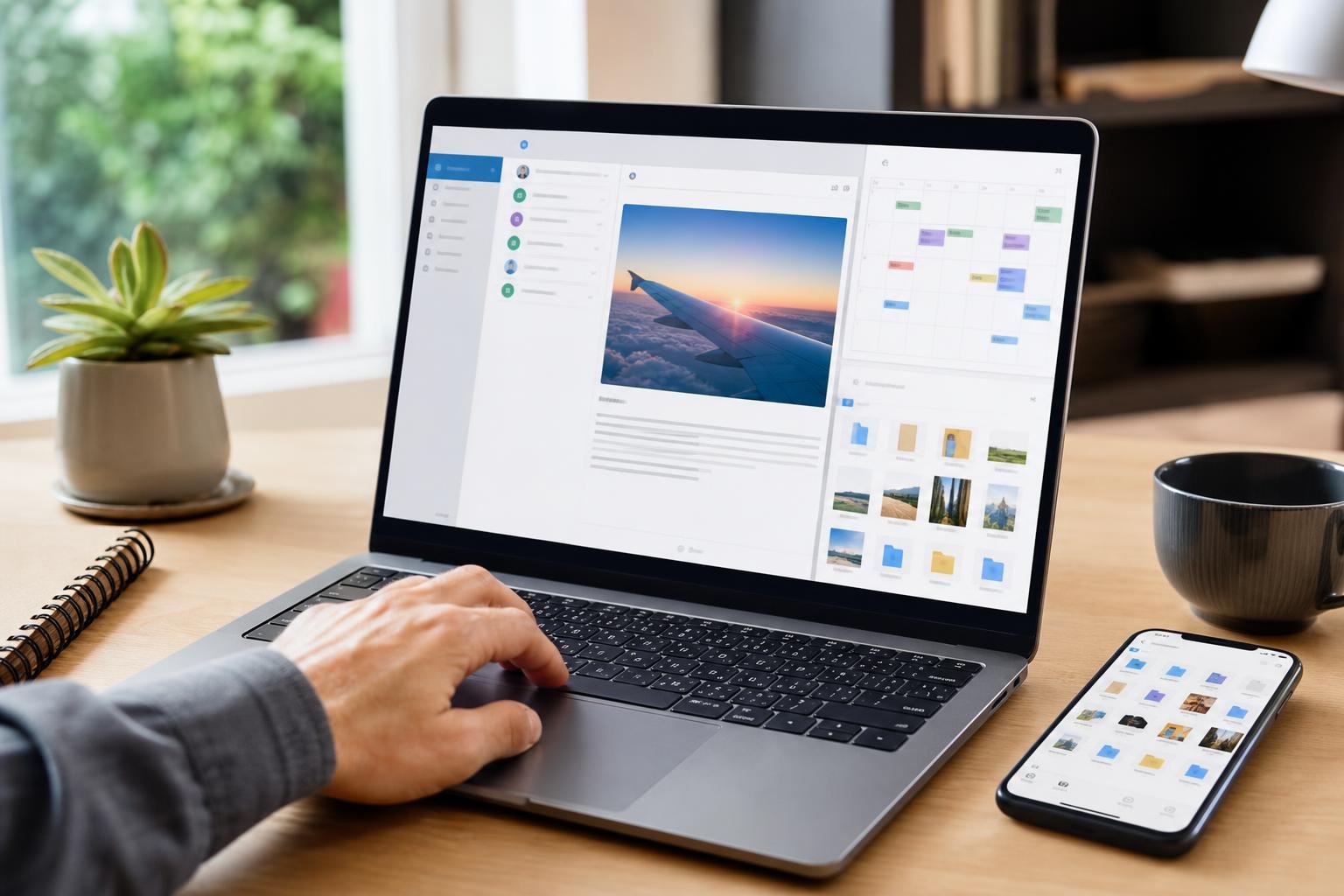
Google has introduced Googlebook, a new premium laptop category built around Gemini and Android technologies, marking its most ambitious effort yet to move beyond ChromeOS’s traditional strengths in education and lower-cost computing. Announced May 12 at The Android Show: I/O Edition 2026, the first Googlebook systems are planned for fall 2026 from Acer, ASUS, Dell, HP and Lenovo.[1][2]
The announcement matters less as the debut of a single laptop than as Google’s attempt to make AI the organizing principle of personal computing. Google describes the change as a move “from an operating system to an intelligence system,” with Gemini intended to act throughout the interface rather than sit in a chatbot window. But Googlebook is not, at least publicly, the name of a new operating system: it is platform and product-category branding for software that combines Android technologies with ChromeOS-derived laptop capabilities.[1][3]
A premium Android-based laptop platform
Googlebook is positioned alongside, not immediately in place of, Chromebooks. Google says Chromebooks will remain the simpler, lower-cost option, while Googlebooks will target premium machines with more capable hardware, deeper Android integration and Gemini-centered features. Existing newer Chromebooks are still expected to receive up to 10 years of software support under Google’s current policy.[2][3]
That distinction is important because Google has not announced a Google-manufactured Googlebook. Instead, it is creating a hardware category for partner-built laptops. Google has confirmed premium construction, multiple screen sizes and form factors, and a signature exterior glowbar in Google colors. The glowbar is described as both decorative and functional, though the company has not explained its full behavior.[2][3]
Much remains undisclosed. As of May 16, Google has not named the first devices, set prices, listed exact release dates or published detailed specifications such as processor models, memory, storage, display characteristics or battery-life estimates. Press reports indicate the initial generation will span Intel, Qualcomm and MediaTek processors, opening the door to both x86 and Arm designs.[4]
Reports have referred to the underlying effort as “Aluminium OS,” but that is an internal codename rather than a public product name confirmed by Google. The company has said only that its new laptop experience combines Android and ChromeOS elements. That leaves the final operating-system identity, and the degree to which ChromeOS survives beneath the platform, unresolved.[3]
Gemini moves into the interface
Googlebook’s defining pitch is “Gemini Intelligence,” a version of Gemini integrated into the user interface and application workflow. The company’s premise is that a laptop can understand what a user is viewing and offer relevant actions before the user opens a separate AI assistant.
The clearest example is Magic Pointer, a Gemini-powered cursor developed with Google DeepMind. A cursor wiggle brings up context-sensitive options, including “ask,” “compare” and “create.” Pointing to a date in an email could offer to create a calendar event; selecting two images could initiate an image-combination or visualization task. Google has also demonstrated image editing, summaries, location identification and actions derived from visible on-screen information.[1][2]
The concept goes beyond an AI sidebar, but its usefulness will depend on speed, accuracy and restraint. Early demonstrations tested by PCWorld showed Magic Pointer handling some image and location tasks, yet the publication found it slow, clunky and unreliable in more complex interactions. Its reviewer argued that typing a conventional prompt could sometimes be faster.[5]
There are practical interface questions, too. A gesture designed to invoke AI must avoid accidental activation, and a persistent AI menu must not interfere with accessibility or familiar pointer behavior. Google has not yet detailed Magic Pointer’s latency targets, model architecture, on-device versus cloud processing, permission model or the conditions under which actions need explicit user confirmation.[1][2]
Widgets and Android-phone continuity
Googlebook will also support Create My Widget, an Android 17 feature that lets users describe a widget in natural language. Gemini can draw on information from Google services including Gmail and Calendar, along with web data, to create personalized dashboards. Google’s example is a travel view containing flight details, hotel information, reservations and a countdown.[1]
The more conventional, and potentially more immediately useful, features concern the Android phone. Cast My Apps will let users open and interact with applications installed on a connected Android phone without separately installing them on the laptop. Quick Access will allow the Googlebook file browser to view, search and insert phone-stored files without manual transfers.[2]
These capabilities give Googlebook a direct answer to Apple’s continuity features between iPhone and Mac. The difference is that Google is trying to turn Android’s installed-app base into a laptop advantage, not simply synchronize notifications and files. Phone integration requires an Android 17-or-later device and setup, according to Google’s product site.[2]
The desktop-app challenge
Googlebook will distribute software through Google Play, and Google says developers will be able to build more adaptive Android applications for larger displays instead of merely scaling up phone layouts. Alexander Kuscher, Google’s senior director for Android tablets and laptops, has described the systems as native Android-based devices with deeper access to laptop hardware and the operating system. Google also expects Chrome to have a desktop-oriented version.[3]
This approach could give Google a larger starting app ecosystem than ChromeOS traditionally had. It could be especially compelling for education, web-based work and people who already rely heavily on Android services. Android Central called the move one of Google’s more promising recent directions, citing Android’s app base and cross-device potential.[6]
Yet the platform’s largest strategic question is whether Android apps can satisfy premium-laptop buyers. Google has not established support for Linux applications, legacy desktop software, Windows compatibility, virtualization or the professional creative tools that many customers expect from Windows and macOS systems. A premium price without a clearly competitive desktop software catalog would create an obvious mismatch.
PCWorld has characterized Googlebook as a vehicle for Gemini as much as a conventional laptop platform, questioning whether the AI focus may obscure unresolved issues around local performance, user control and desktop-grade applications.[5] Those concerns cannot be settled until shipping devices are independently tested.
Privacy, performance and pricing remain open questions
Googlebook’s ambition also raises a trust question. A system designed to interpret visible content, work with Gmail and Calendar, access phone files and recommend actions based on cursor context will need clear and granular controls. As of May 16, Google has not published complete details on data retention, screen-content handling, cloud transmission, enterprise controls, permission prompts or the division of processing between local hardware and remote services.[1][2]
Those gaps do not establish a privacy failure. They do mean that buyers, IT administrators and developers lack key information needed to assess the platform’s data boundaries. The same is true for performance: the promise of proactive AI will be judged differently if common actions involve noticeable delays or recurring cloud requests.
Googlebook also arrives in a tougher laptop market. Apple has introduced the lower-priced MacBook Neo, while Microsoft’s Copilot+ PC push and Windows on Arm systems have made battery life and integrated AI standard competitive claims. Google’s differentiator is not simply adding an assistant to a desktop; it is making Gemini and Android-phone continuity central to the experience.[7]
For now, Googlebook is a significant strategic announcement rather than a fully specified product launch. It offers a credible outline of a premium Android laptop direction: Gemini at the interface level, stronger continuity with Android phones, Play-distributed applications and support for both Arm and x86 hardware. Whether that outline becomes a compelling alternative to Windows and macOS will depend on the unanswered details—price, application quality, performance, privacy controls and whether Magic Pointer proves more helpful than intrusive—when the first systems arrive this fall.
Editor’s Take
I like Google’s underlying bet: the laptop has spent too long treating the phone as a peripheral, when Android users already carry their apps, files, identity and daily context in their pocket. Casting phone apps and accessing phone files without manual transfers could be more valuable on day one than the headline AI features. If Google makes that pairing fast, dependable and easy to revoke, it has a meaningful answer to Apple’s ecosystem advantage.
But “AI-centric” is not a product category by itself. Magic Pointer needs to beat a keyboard shortcut, a search box or a direct click often enough that users leave it enabled; early reports of latency and clumsy interactions are a warning that context-aware assistance can quickly become friction. I will be watching for concrete details on local versus cloud processing, screen-data permissions, enterprise management, battery life and offline behavior. Just as important, Google must prove that adaptive Android apps can feel like serious desktop software at premium laptop prices—not merely enlarged phone apps with Gemini attached.
References
- Google Blog – https://blog.google/products-and-platforms/platforms/android/meet-googlebook/
- Googlebook – https://googlebook.google/
- WIRED – https://www.wired.com/story/googlebook-laptop-platform/
- Tom’s Hardware – https://www.tomshardware.com/laptops/intel-confirms-googlebook-ai-laptop-partnership-opening-x86-possibilities-for-new-os-google-vp-says-devices-to-also-ship-with-mediatek-chips
- PCWorld – https://www.pcworld.com/article/3136774/googlebooks-arent-just-android-laptops-theyre-a-trojan-horse-for-gemini.html
- Android Central – https://www.androidcentral.com/chromebooks-laptops/google-announces-googlebook
- Axios – https://www.axios.com/2026/05/12/googlebook-ai-chromebook-announcement