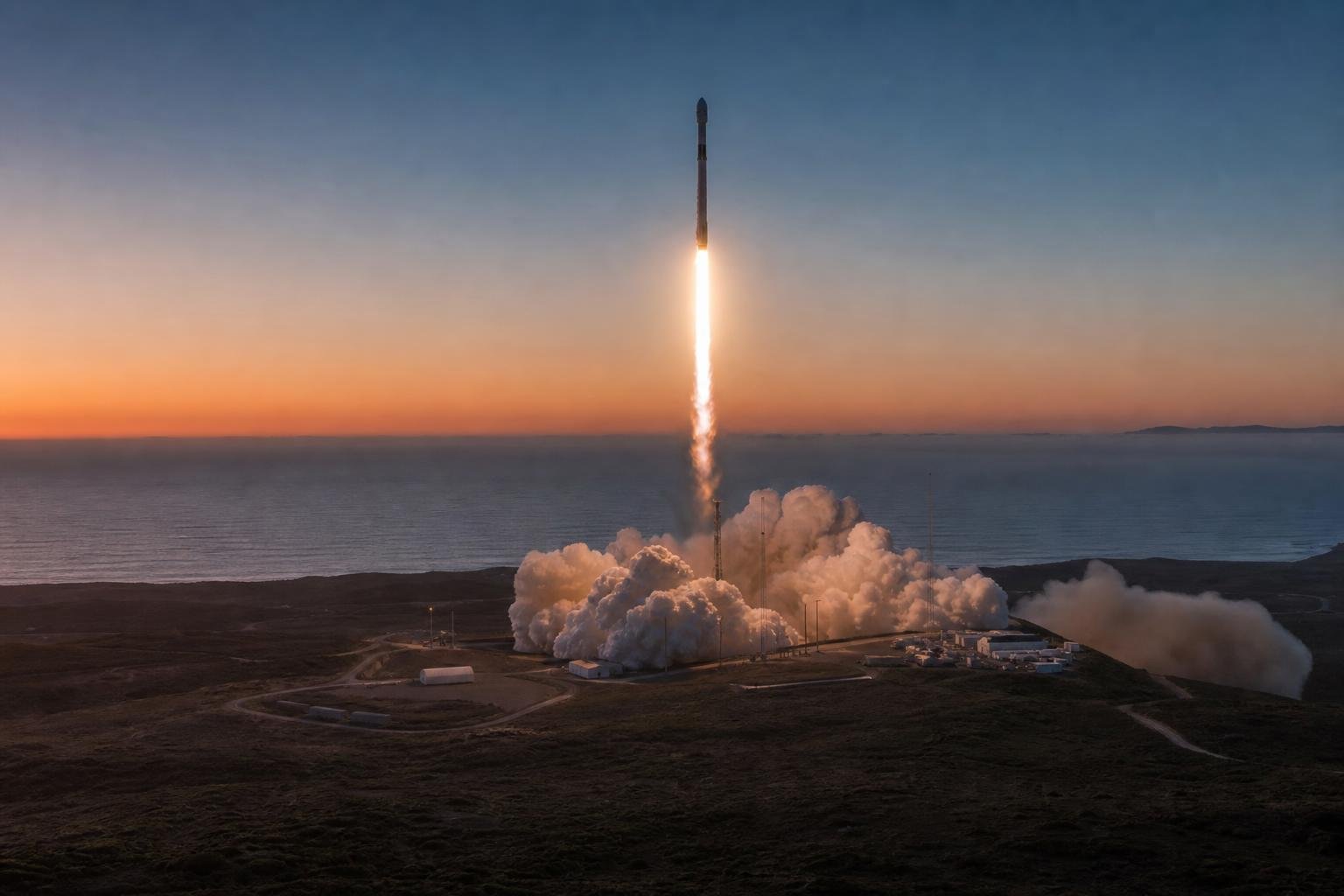
SpaceX’s Transporter-17 rideshare mission has carried a City Labs technology demonstrator called BOHR into low Earth orbit, marking what the Florida company describes as the world’s first commercial nuclear-powered satellite. The July 7 Falcon 9 launch from Vandenberg Space Force Base in California placed 81 payloads in orbit, including the small spacecraft carrying City Labs’ tritium-based NanoTritium power system.[1][2]
The milestone is real, but the description needs an important qualification. BOHR’s nuclear source does not power the entire satellite: conventional solar panels run the spacecraft bus, while the radioisotope system supplies a dedicated low-power payload demonstration. Its significance is less a replacement for solar arrays or large radioisotope generators than a commercial, regulatory and technical test of always-on nuclear micropower in space.[1][3]
A rideshare launch for a nuclear-power demonstrator
Falcon 9 lifted off at 3:12 a.m. EDT on July 7, or 0712 UTC, from Vandenberg’s California launch site. Payload deployment began roughly 50 minutes later. The rocket’s first-stage booster landed on SpaceX’s droneship Of Course I Still Love You about 8.5 minutes after liftoff.[2]
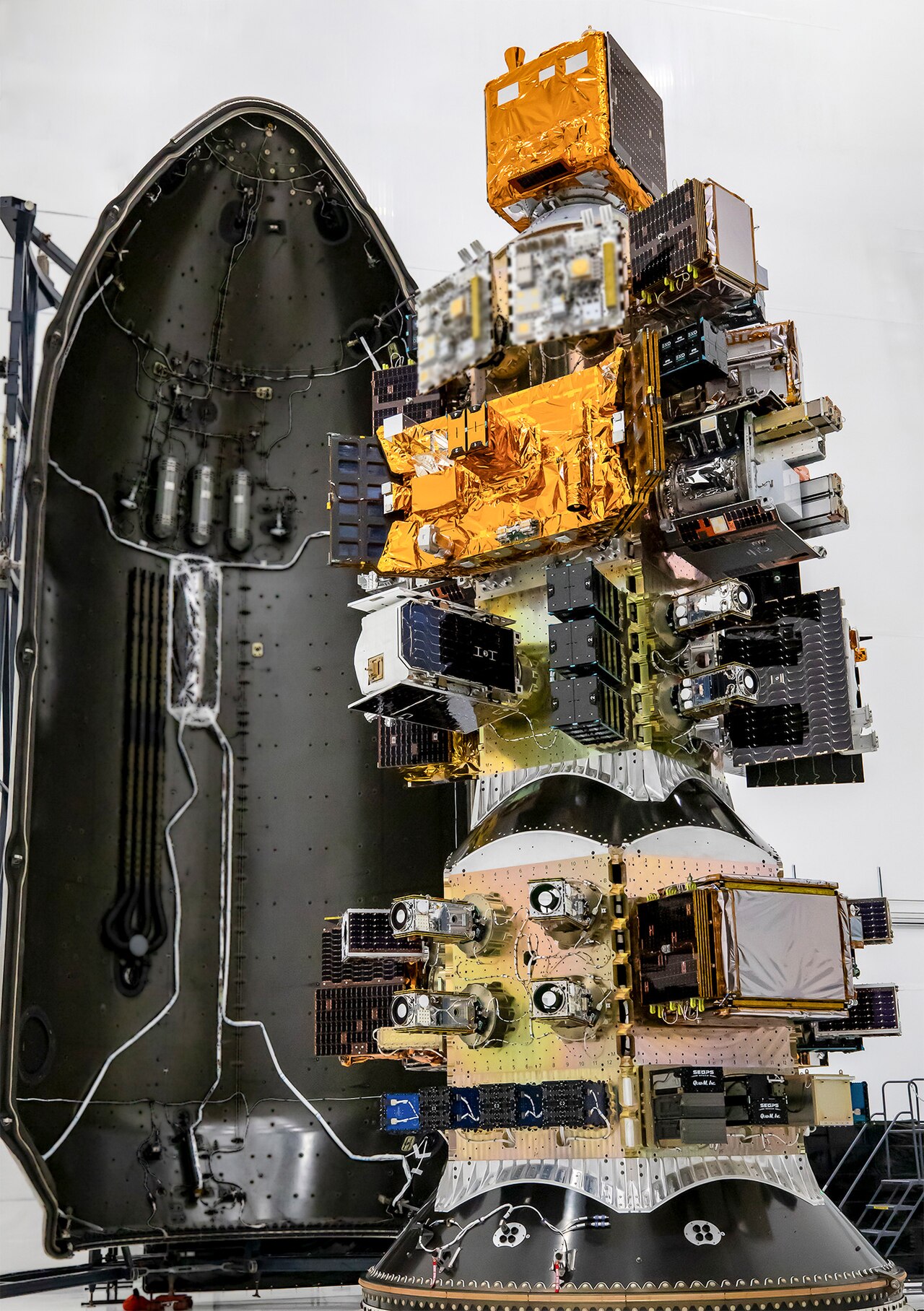
BOHR, short for Betavoltaic Orbital High-Reliability, was one of 81 payloads aboard the Transporter-17 mission. It was not a dedicated SpaceX nuclear mission: SpaceX provided the launch service, while Miami-based City Labs developed the spacecraft and its power technology. The Transporter program’s rideshare model gives small satellite operators a route to orbit without the cost of purchasing an entire launch; SpaceX had flown more than 1,800 payloads through the program before this mission, according to Space.com.[2]
Aviation Week reported that BOHR appears to be a 1U CubeSat, a form factor roughly 10 centimeters on each side. City Labs had not released a full public spacecraft specification sheet as of July 8.[4]
How NanoTritium differs from an RTG
BOHR contains no nuclear reactor. Its NanoTritium unit is a betavoltaic power source: tritium, a radioactive isotope of hydrogen, emits beta particles during decay, and a semiconductor converts that particle energy directly into electricity. This differs from a radioisotope thermoelectric generator, or RTG, which converts heat from radioactive decay into electrical power.[3]
The distinction matters because betavoltaic devices are designed for persistent micropower, not high-output spacecraft operations. City Labs says the BOHR payload is intended to validate continuous power independent of sunlight. The satellite itself still relies on solar power for ordinary bus functions, including the systems needed to operate the spacecraft.
City Labs has not publicly disclosed a definitive mission-level output figure for NanoTritium aboard BOHR. Earlier Small Business Innovation Research documentation for its P100 betavoltaic technology described continuous low-power operation over decades for uses including low-power sensors and memory backup.[5] That profile is fundamentally different from NASA’s long-running RTG fleet. NASA lists beginning-of-mission power of about 158 watts for Voyager’s RTGs and 292 watts for General Purpose Heat Source RTGs used on several deep-space missions.[6]
As a result, BOHR should not be read as a demonstration that a miniature radioisotope battery can run a conventional communications satellite, a lunar rover, a habitat or an electric propulsion system. It is a test of a durable power source for electronics that need small amounts of electricity over long periods, including when solar energy is unavailable.
Why the commercial approval matters
Nuclear power in space is not new. U.S. government missions have used radioisotope systems since the 1960s, including Voyager, Galileo, Cassini, New Horizons and Mars rover missions.[7] Those programs typically relied on plutonium-238 RTGs and government-managed mission architectures.
BOHR’s novelty is commercial. City Labs says the Federal Aviation Administration issued affirmative payload authorization on September 30, 2025, making it the first commercial nuclear-space mission to proceed through the FAA’s nuclear-payload approval pathway established under National Security Presidential Memorandum-20. The company says Sandia National Laboratories independently reviewed and supported the launch-safety analysis.[1]
The FAA evaluates launches involving radionuclides case by case, considering public health, property safety, national security and foreign-policy issues.[8] That scrutiny is central to BOHR’s value as a pathfinder. A successful launch does not by itself prove a scalable commercial nuclear-power market, but it does establish a precedent for a privately developed radioisotope payload moving through the U.S. commercial licensing process.
City Labs founder and CEO Peter Cabauy called the flight a historic step toward routine commercial nuclear power in space. That is the company’s stated ambition rather than an independently established market outcome, but the mission has been treated by industry coverage as a meaningful technology and regulatory demonstration.[1][4]
Potential uses and practical limits
City Labs is targeting applications where solar arrays, rechargeable batteries or routine maintenance are poor fits. Those include long-lived sensors, secure memory backup, autonomous surveillance systems, space-domain-awareness payloads and instruments operating in extreme or inaccessible environments. The company has also pointed to permanently shadowed lunar regions and distributed lunar sensor networks, where sunlight can be intermittent or absent.[1][5]
The timing coincides with renewed U.S. interest in power systems for lunar exploration. The American Nuclear Society reported July 8 that NASA was preparing a lunar-surface-power solicitation and considering radioisotope-powered rover concepts.[9] A very-low-power betavoltaic source could be useful for keeping selected electronics alive through long lunar nights or in shadowed terrain, even if it cannot provide the energy needed to drive a rover or support a surface base.
City Labs’ likely early market is also tied to defense. The company has received support through Department of Defense and Department of the Air Force-related programs, including Air Force Research Laboratory, AFWERX, SpaceWERX and SBIR work. In May, it also announced a $1.5 million DARPA contract for next-generation nuclear-battery technology.[1][5]
A narrow but meaningful first
The phrase “world’s first commercial nuclear-powered satellite” is best understood as shorthand. BOHR is the first publicly reported commercial spacecraft carrying this kind of nuclear-powered payload and the first nuclear CubeSat identified by City Labs, rather than the first nuclear-powered spacecraft ever flown. Government space programs have used radioisotope power for decades.
It is also not yet a fully nuclear-powered satellite in the usual sense. The flight tests a radioisotope micropower payload while solar panels operate the rest of the 1U-class spacecraft. That limitation is substantial, but it does not erase the achievement: BOHR has put a privately developed betavoltaic power source into orbit on a commercial rideshare and through a commercial FAA authorization process. The results of the on-orbit demonstration will determine whether that precedent becomes a practical platform for persistent, ultra-low-power space systems.
Editor’s Take
BOHR is a meaningful commercial milestone, but the useful way to view it is as a power-resilience demonstrator, not a solar-panel replacement. A tritium betavoltaic source that reliably delivers tiny amounts of electricity for years could be extremely valuable for watchdog electronics, secure memory, low-duty-cycle sensors and survival modes when a spacecraft is dark, damaged or operating in shadow.
The bigger unlock may be regulatory rather than electrical. A privately developed nuclear payload clearing a commercial FAA authorization process gives suppliers, insurers and satellite operators a concrete precedent to build on. What matters next is the on-orbit data: actual delivered power, degradation, radiation effects on the surrounding electronics, thermal behavior and whether the approval process can be repeated without becoming a bespoke, multi-year exercise.
Hype outruns the facts when this is framed as a nuclear-powered communications satellite or a route to powering lunar bases. It is neither. But a dependable microwatt-to-milliwatt-class source can create real products where conventional batteries are the dominant maintenance and mission-life constraint—and that is a commercially important niche.
References
- City Labs – https://citylabs.net/first-commercial-nuclear-powered-satellite-aboard-spacex-transporter-17/
- Space.com, Transporter-17 launch coverage – https://www.space.com/space-exploration/launches-spacecraft/spacex-falcon-9-transporter-17-rideshare-launch-81-satellites
- Space.com, commercial nuclear satellite coverage – https://www.space.com/space-exploration/launches-spacecraft/spacex-just-launched-the-1st-ever-nuclear-powered-commercial-satellite
- Aviation Week – https://aviationweek.com/space/satellites/city-labs-launches-small-sat-demonstrator-nuclear-battery
- SBIR.gov, City Labs award – https://www.sbir.gov/awards/186994
- NASA, Radioisotope Thermoelectric Generators – https://science.nasa.gov/planetary-science/programs/radioisotope-power-systems/power-radioisotope-thermoelectric-generators/
- NASA, Radioisotope Power System Missions – https://science.nasa.gov/planetary-science/programs/radioisotope-power-systems/missions/?utm_source=openai
- Federal Aviation Administration, nuclear payload guidance – https://www.faa.gov/regulations_policies/advisory_circulars/index.cfm/go/document.information/documentID/1042239
- American Nuclear Society – https://www.ans.org/news/step-1783543777/