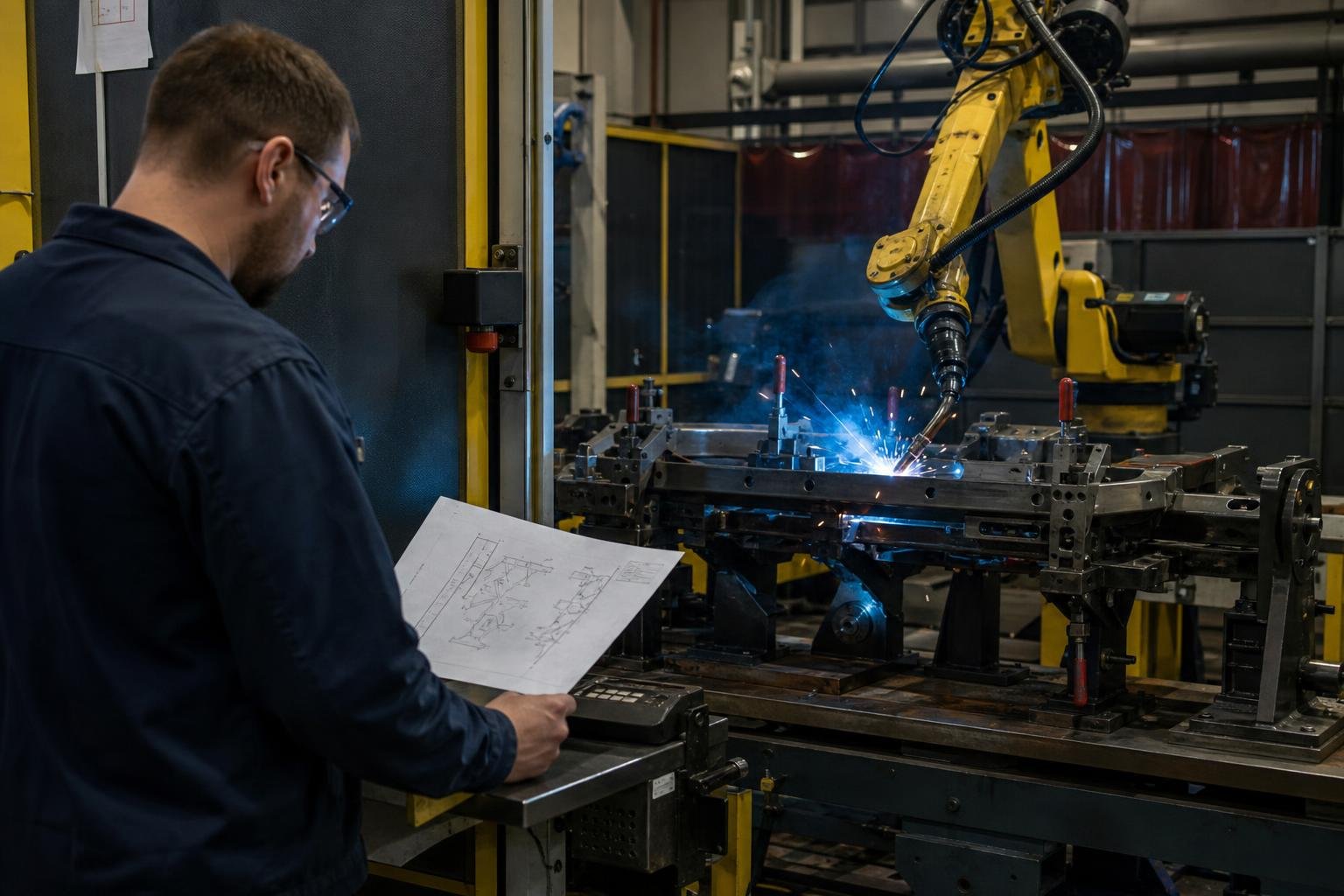
FANUC says it has developed an AI Welding Agent with Google Cloud that can read component drawings, generate an arc-welding program for a robot and execute the work. The company plans to demonstrate the system at the International Welding Show and says shipments are scheduled to begin by the end of 2026.[1]
The significance is less about putting a conversational interface beside a welding cell than about attacking a persistent manufacturing bottleneck: translating engineering intent into a validated, safe and production-ready robot program. If the system can reliably bridge that gap, it could reduce the specialist programming effort required when a welded assembly changes or a new part reaches the shop floor. But FANUC’s announcement describes a product on the path to demonstration and shipment, not a broadly proven deployment; the difficult validation steps between a drawing and a sound weld remain decisive.
By the numbers
- 1 AI agent: FANUC’s announced AI Welding Agent.
- 1 planned public venue: the International Welding Show, where FANUC plans demonstrations.
- End of 2026: FANUC’s stated target for the start of shipments.
The translation layer manufacturers want to remove
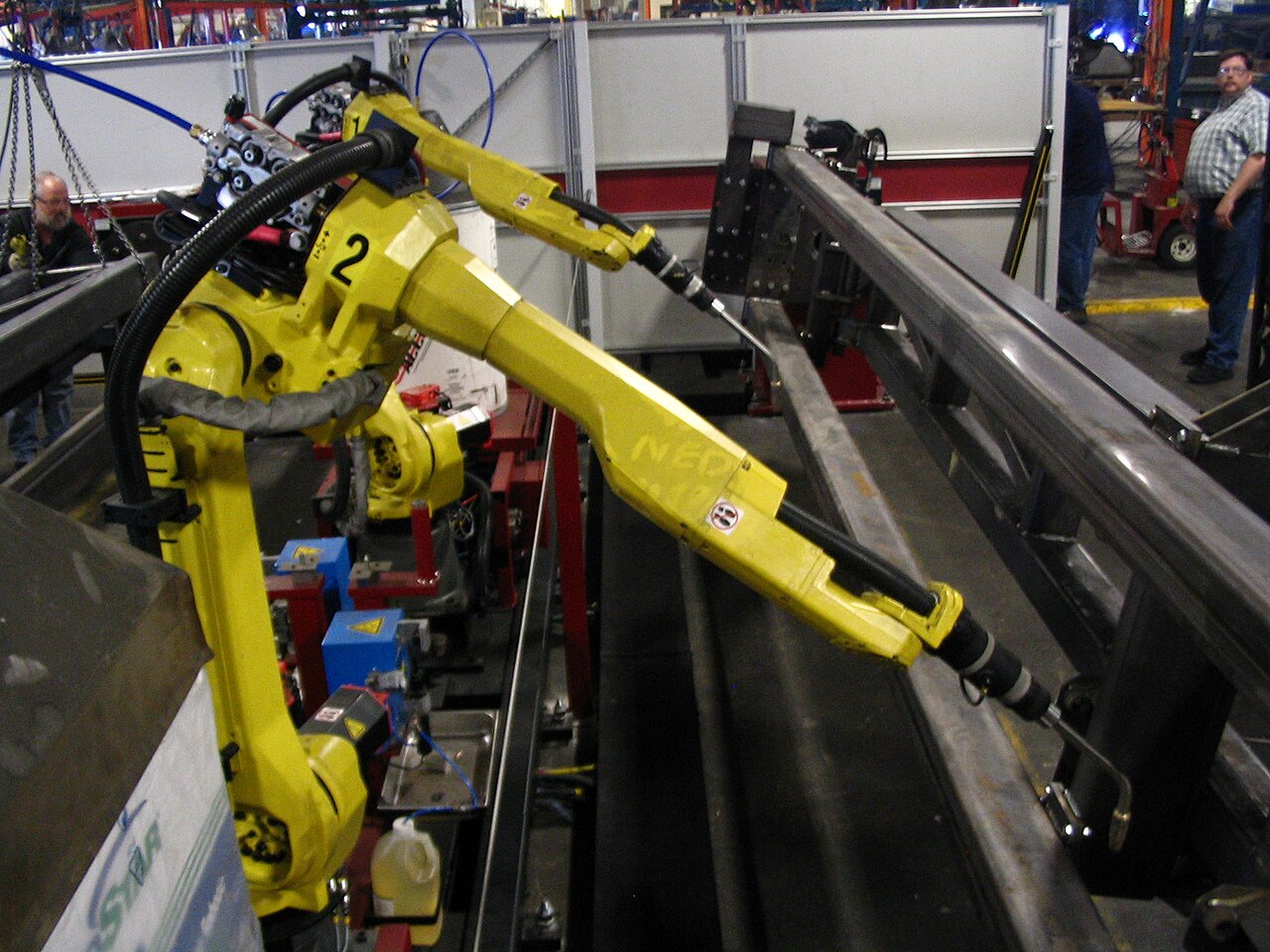
Robotic welding is highly automated once a cell is commissioned, but preparing a robot for a particular assembly is often still an engineering task. A programmer or welding engineer must interpret a drawing or CAD definition, identify the joints to be welded, establish the sequence, choose weld parameters, define the robot’s approach and departure paths, account for clamps and fixtures, and then prove the motion in a real cell.
That process exists because a drawing is not, by itself, a robot instruction set. It may specify dimensions, weld symbols, material and joint requirements, but it generally does not provide every physical fact a robot needs: the exact location of the workpiece in the fixture, the coordinate frames of the cell, torch geometry, cable limits, accessibility around a joint, or the manufacturing allowances needed for variation between parts.
FANUC’s claim is that its agent can span three stages that are normally separated: interpretation of component drawings, automatic program generation and program execution.[1] The commercial opportunity lies in connecting those stages without requiring a programmer to manually convert each design decision into a sequence of robot poses and welding instructions.
For high-mix production, prototype work and factories facing shortages of experienced robot programmers and welding personnel, that connection could matter as much as incremental improvements in robot speed. A conventional offline-programming workflow can already derive robot paths from CAD data, but it still requires a technician to configure the cell, review the process and resolve exceptions. The practical test for FANUC’s agent will be whether it reduces that review burden rather than merely moving it to a different screen.
What must work from drawing to arc
The announced workflow combines several technical problems that should be evaluated separately. First, the software must extract usable manufacturing information from the drawing. This may include geometry, dimensions, datums and welding symbols, which communicate such details as joint type, weld location, size and continuity. Drawings vary widely in quality and conventions, particularly when they include scanned documents, legacy formats, incomplete annotations or customer-specific notation.
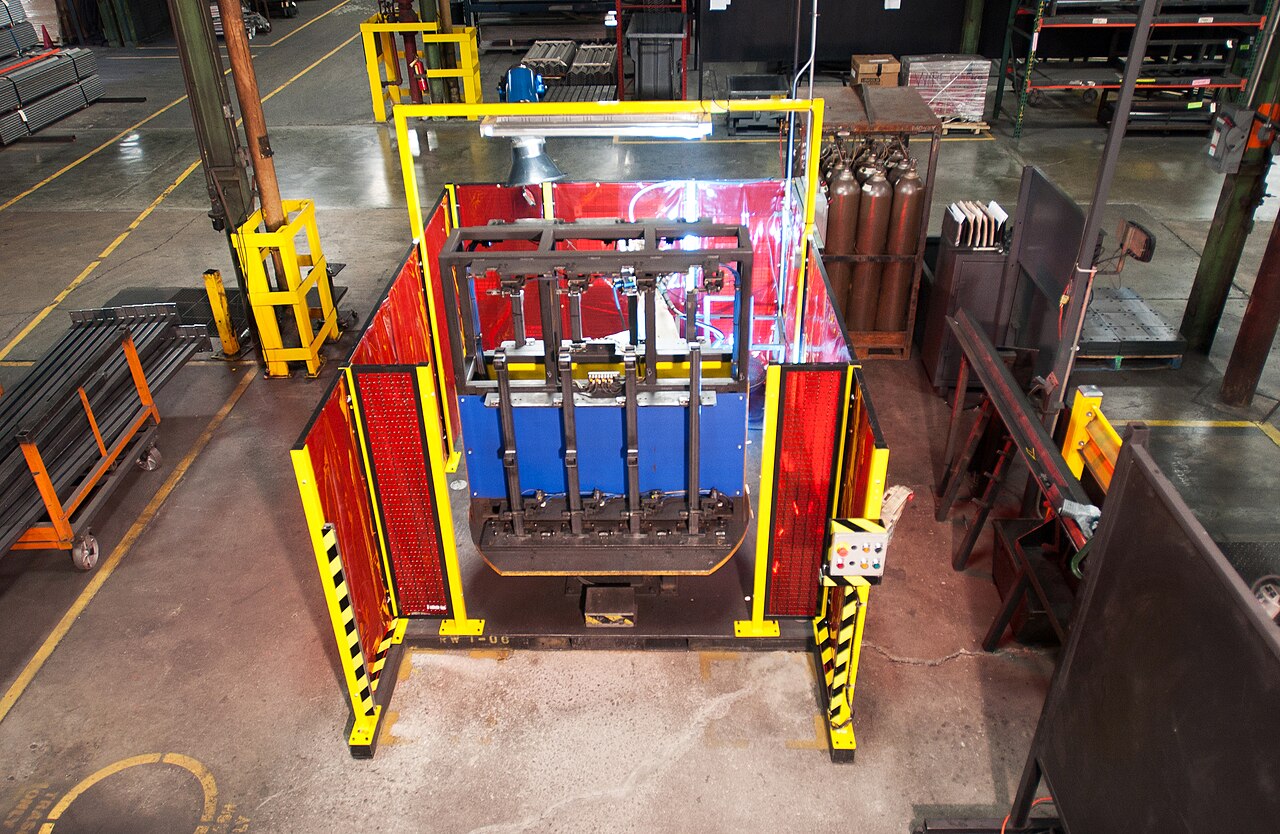
Second, the system needs a grounded model of the production cell, not only the component. It must associate drawing geometry with the actual workpiece orientation, fixture and robot coordinate system. It must know where the torch can reach, avoid collisions with clamps and surrounding equipment, and respect robot kinematics. A path that looks valid on a drawing can be unreachable in the cell because of wrist orientation, torch angle, joint clearance or a singular robot posture.
Third, it must convert weld requirements into process instructions. In arc welding, this involves choices that can include travel speed, current and voltage behavior, wire-feed settings, torch work angle and travel angle, start and stop treatment, weaving, and the order of passes. Those settings depend on the base material, thickness, joint preparation, filler wire, shielding gas, required weld size and qualified welding procedure. The announcement does not publicly specify which drawing formats, welding processes, robot/controller models, sensing technologies, materials or parameter-selection methods are supported.[1]
Finally, any generated program needs verification. Manufacturers will expect simulation and collision checks before the robot moves, followed by supervised validation on the actual fixture. Part variation, thermal distortion, tack-weld location and fixturing tolerances can shift a seam away from its nominal design position. In many applications, seam tracking, touch sensing, vision or other adaptive controls are needed to reconcile the planned path with the physical workpiece. An AI-generated program does not remove these realities; it changes where engineering work is concentrated.
FANUC, Google Cloud and the evidence still missing
FANUC is the robot supplier and product developer named in the announcement, while Google Cloud is the cloud partner. FANUC has not identified individual executives, engineers or customer sites associated with the product in the cited announcement.[1] Nor does the announcement specify the division of technical responsibilities between FANUC’s robot-control stack and Google Cloud’s AI and cloud services.
That distinction matters for buyers. A production system may use a cloud model to interpret natural-language or drawing information, but robot motion generation, controller integration and safety controls must be deterministic, traceable and compatible with the cell’s operating environment. Manufacturers will want clarity on whether designs are processed on premises or in the cloud, what data leaves the factory, how customer intellectual property is protected, whether the system can operate during connectivity interruptions, and how generated programs are versioned and approved.
They will also want performance evidence. Useful demonstration metrics would include the types of drawings accepted; the proportion of welds generated without manual edits; time from drawing input to an approved program; success across part families; first-pass weld quality; recovery behavior when a seam differs from nominal; and the scope of required operator review. FANUC has announced a planned demonstration, but has not published those measurements in the cited material.[1]
A milestone schedule, not a deployment verdict
FANUC has set out two near-term milestones: demonstrations at the International Welding Show and the start of shipments by the end of 2026.[1] Both are meaningful, but neither should be read as evidence that the technology has already solved the broad industrial problem. A show demonstration can establish that a controlled workflow operates on selected parts. Shipment indicates commercial availability, not necessarily mature performance across the variability of customer drawings, fixtures and welding procedures.
The most consequential question is the boundary of autonomy. The agent may be most valuable initially as a programming copilot that prepares a first-pass job, proposes weld sequences and creates a simulation-ready program for a qualified engineer to approve. That would still be a substantial gain if it shortens programming cycles and lets scarce welding specialists focus on process qualification, quality exceptions and line improvement.
Fully unattended generation and execution would demand a higher bar. Welds often carry structural, safety and regulatory implications. Shops will need auditable evidence of who approved a program, which input revision was used, what welding procedure governed it, and what happened on the line. The appropriate operating model is likely to remain human-authorized automation, particularly for new part introductions and safety-critical work.
Market implications for industrial automation
The announcement arrives as robot suppliers, cloud providers and manufacturing-software companies seek to make automation easier to deploy. The cost of a robot is only part of a welding-cell investment; engineering, programming, integration, fixturing, commissioning and ongoing support can determine whether a project is economical. Tools that make robots more accessible to smaller manufacturers or speed up reprogramming for larger ones could expand the addressable market for welding automation.
FANUC’s position as a robot manufacturer is important because drawing interpretation alone is not enough. A viable product must connect AI output to robot controller behavior, safety systems, welding power sources, process knowledge and support operations. Google Cloud brings AI and cloud capabilities, while FANUC must demonstrate industrial reliability and a workflow that fits established quality practices.
The competitive pressure will extend beyond general-purpose AI. Offline programming vendors, CAD/CAM providers, welding-equipment companies, machine-vision suppliers and robot integrators all address parts of the same workflow. The differentiator will not simply be whether a system can describe a weld in natural language. It will be whether it produces correct, inspectable and repeatable programs that improve throughput without creating unacceptable process or liability risk.
What to watch at the demonstration
- Input scope: whether the agent works from 2D drawings, native CAD models, PDFs or a defined subset of those formats.
- Cell awareness: how it incorporates fixture geometry, torch configuration, workpiece location and collision constraints.
- Welding scope: the supported joint types, materials, weld processes and qualified procedures.
- Human control: what approvals, simulation checks and edits are required before execution.
- Adaptation: how the system handles part-to-part variation, seam location differences and weld-quality feedback.
- Operational evidence: whether FANUC shows a repeatable workflow on more than a single idealized part.
Editor’s Take
I see the valuable idea here as engineering compression, not AI theater. The handoff from drawing to robot is full of repetitive translation work, and a system that creates a solid first-pass welding program could make a real difference in quoting, new-product introduction and high-mix fabrication. Even a workflow that still requires an experienced engineer to approve the final program can be commercially useful.
I would not treat a drawing-reading demo as proof of autonomous welding. The hard part is the messy physical world: fixtures, tolerances, access, distortion, parameter qualification and traceability. What I want FANUC to show is not merely that an agent can generate code, but that the code survives simulation, reaches the seam in a real cell and produces an inspectable weld under a disciplined approval process. If the late-2026 shipment target comes with that evidence and clear data-governance answers, this could be one of the more practical uses of generative AI in factory automation.