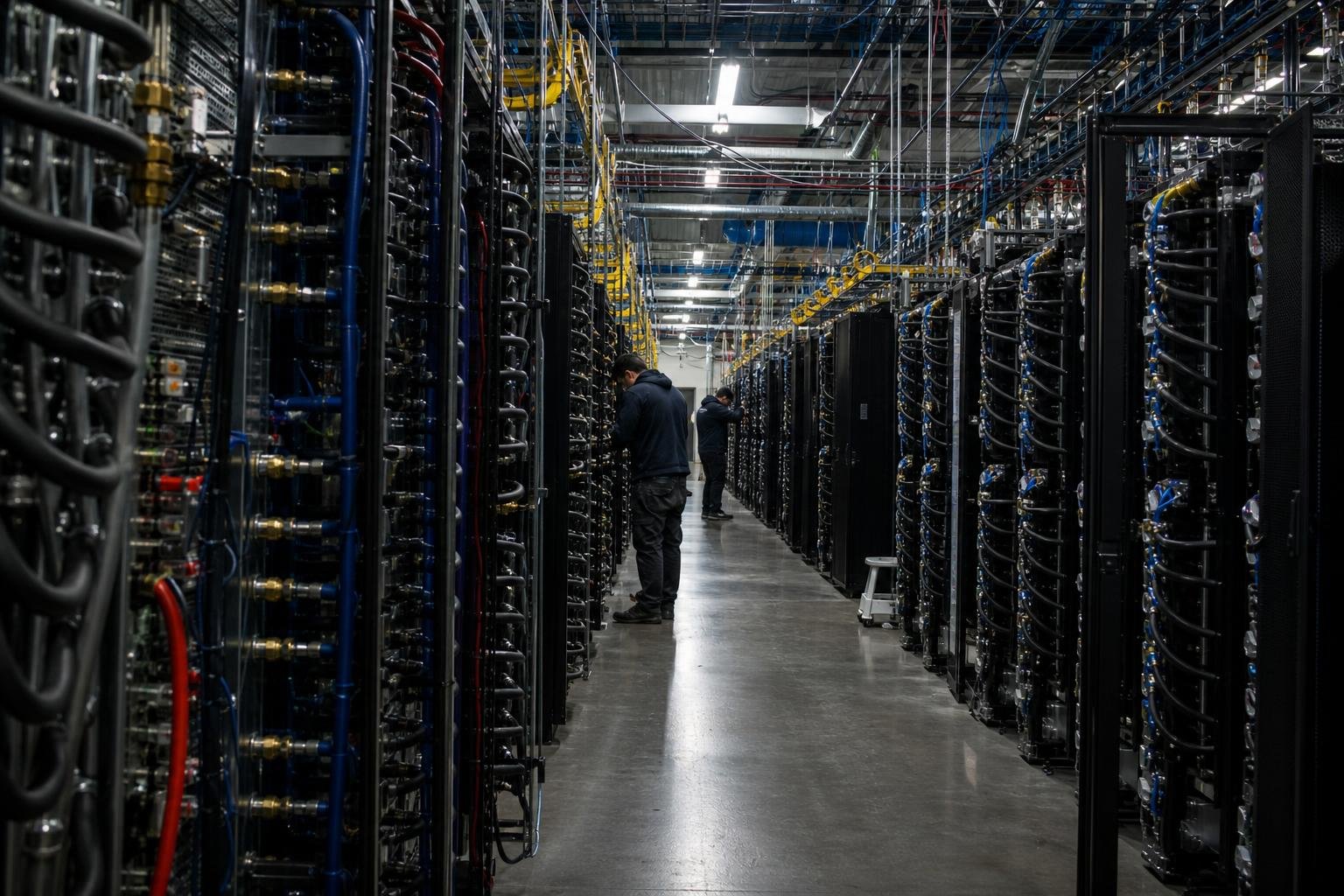
Google has agreed to pay SpaceX $920 million a month for access to a large Nvidia GPU cluster under a cloud-services agreement disclosed in SpaceX’s IPO materials. The deal, signed June 5, would give Google access to approximately 110,000 Nvidia GPUs, along with the CPUs, memory and other equipment needed to run them. [1]
The agreement is a major validation of SpaceX’s effort to turn AI infrastructure associated with Elon Musk’s xAI operations into a cloud-computing business. It also gives Google a sizable source of Nvidia-based capacity outside the custom TPU infrastructure that underpins much of its own AI and cloud operation.
A $920 million monthly commitment
Under the agreement, Google LLC is scheduled to pay $920 million per month from October 2026 through June 2029. If that full monthly charge applied through the 33-month period, payments would amount to roughly $30.36 billion. SpaceX’s filing does not state a total contract value, however, and the actual amount could differ because the agreement includes an initial ramp period, delivery conditions and termination rights. [1]
Fees will be reduced through September 2026 as the capacity ramps. SpaceX must deliver the committed GPU capacity by September 30. If it misses that deadline, Google receives a one-month grace period before it can either terminate the agreement or accept a smaller GPU allocation at proportionally lower fees. [1]
After December 31, 2026, either Google or SpaceX can end the agreement with 90 days’ notice. That provision makes the headline monthly commitment meaningful but not equivalent to a fully locked-in multiyear revenue backlog. Google also retains ownership of its content, AI models and related data under the agreement. [1]

What Google is buying
The disclosed capacity consists of approximately 110,000 Nvidia GPUs and the surrounding server components required to operate a large cluster. The filing does not identify the GPU model, the data-center location, the networking design, storage systems, service-level terms or Google’s planned workloads. [1]
That leaves open whether Google will use the capacity for training Gemini and other models, serving inference workloads, internal research, Google Cloud customers, or several of those purposes. The important point is that Google is securing a substantial block of Nvidia accelerator capacity from an external provider despite already operating extensive AI infrastructure and developing its own Tensor Processing Units.
SpaceX’s June 3 S-1 amendment described its broader AI facilities as Colossus and Colossus II, together providing about 1 gigawatt of compute power. The company said it had deployed a cluster of roughly 110,000 GB300 processors and 220 megawatts of compute power in 64 days. Those disclosures offer context for the Google agreement, but SpaceX has not said that Google’s contracted capacity is the same cluster or is located at either named facility. [2]
SpaceX’s emerging compute-leasing business
The Google agreement arrives as SpaceX prepares for its public-market debut and is presenting AI infrastructure as another large revenue opportunity alongside launch and Starlink. Rather than reserving all GPU capacity for Musk’s AI efforts, SpaceX is seeking to monetize its rapidly built clusters by leasing them to other model developers and cloud customers. [2]
Google is not the first major customer disclosed for that strategy. Anthropic separately agreed to use SpaceX’s Colossus 1 capacity in a deal reported at $1.25 billion per month. That arrangement was reported to cover more than 300 megawatts and more than 220,000 Nvidia GPUs. [3]
Together, the Google and Anthropic arrangements represent roughly $2 billion in potential monthly compute revenue, assuming the stated commitments and capacity deliveries hold. That revenue opportunity is central to the argument that SpaceX can generate returns from AI infrastructure even if its own AI products do not absorb all available capacity. [4]
Demand is strong, but the contract carries execution risk
The deal illustrates the continuing scarcity of high-end AI compute, particularly where companies can obtain both large GPU allocations and the power, cooling and networking needed to operate them. Anthropic CEO Dario Amodei has cited compute constraints amid the company’s growth, and its SpaceX arrangement reflects the scale at which leading AI developers are competing for infrastructure. [3]
For SpaceX, the immediate challenge is delivery. Google’s contractual remedies make the September target consequential: the company must make about 110,000 GPUs available on schedule or risk a reduced agreement or termination. The public filing does not disclose how much capacity was already operational when the agreement was signed, the ramp-period fee schedule, or potential penalties SpaceX could face for a delay. [1]
There is also a longer-term pricing question. SpaceX’s ability to command premium rates depends in part on continued shortages of GPUs, power and data-center capacity. Analysts cited by Axios have argued that expanded data-center construction and more efficient inference could eventually make compute less scarce, weakening the economics of leasing giant GPU clusters. The 90-day termination option available after the end of 2026 gives Google flexibility if its requirements or alternatives change. [4]
A new infrastructure relationship between AI rivals
The transaction highlights a changing competitive structure in AI. Google is simultaneously a frontier-model developer, a major cloud provider and now a customer for another company’s Nvidia-based supercomputing capacity. SpaceX, best known for rockets and satellite internet, is positioning itself as an infrastructure supplier to companies that may compete with Musk’s own AI efforts.
For Google, the agreement appears to be a hedge against constraints in the AI supply chain rather than a replacement for its internal systems. For SpaceX, it is evidence that its GPU clusters can be sold as a service at extraordinary scale. Whether that becomes a durable business will depend on the company’s ability to deliver capacity, retain customers and maintain pricing power as the broader AI-compute market evolves.
Editor’s Take
I read this less as Google abandoning TPUs than as a very expensive supply-chain hedge. Frontier AI work is constrained by delivered, usable capacity—not just chip designs—and a block of roughly 110,000 Nvidia GPUs could give Google flexibility for bursts of training, inference demand, or Cloud capacity while its own facilities continue expanding. The headline rate is enormous, but it is the ability to secure power, cooling, networking and operational GPUs together that customers are paying for.
The important caveat is that this is not $30 billion of irrevocable backlog. The ramp conditions, September delivery deadline and 90-day termination option after 2026 put execution risk squarely on SpaceX. I would watch for evidence of the actual facility, GPU model, network performance and sustained utilization; those details determine whether this becomes a repeatable compute-leasing business or an unusually large capacity reservation made during a shortage.
References
- U.S. Securities and Exchange Commission – https://www.sec.gov/Archives/edgar/data/1181412/000162828026041150/spacexagreementfwp.htm
- U.S. Securities and Exchange Commission, SpaceX S-1 amendment – https://www.sec.gov/Archives/edgar/data/1181412/000162828026039276/spaceexplorationtechnologi.htm?utm_source=openai
- Axios, Anthropic compute agreement – https://www.axios.com/2026/05/07/musk-anthropic-compute-spacex-ai
- Axios, SpaceX IPO bull and bear case – https://www.axios.com/2026/06/09/spacex-ipo-bull-bear-elon-musk