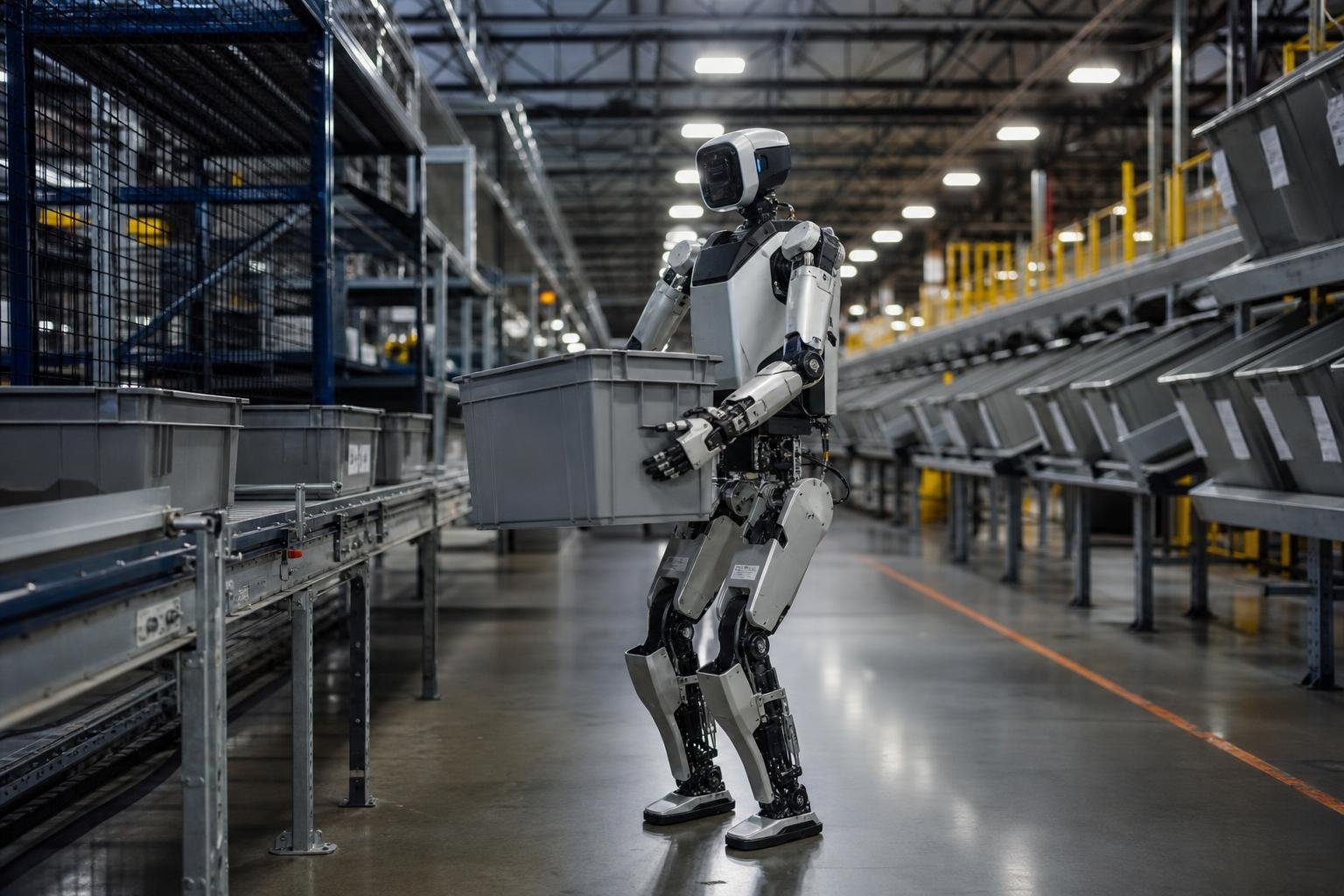
GXO Logistics and Agility Robotics are expanding deployments of Agility’s Digit humanoid robots to additional logistics sites in North Carolina and Tennessee, following work at GXO’s Flowery Branch, Georgia facility. The companies said Digit has moved more than 100,000 totes at the Georgia operation since the partnership began.[1]
The 100,000-tote milestone is more consequential than the announcement’s geographic expansion alone. It suggests that a humanoid robot can be kept on a repeatable warehouse task long enough to produce a meaningful operating record at a major third-party logistics provider. That is a narrower, more useful signal than the broader claim that humanoids are ready for general-purpose industrial work.
By the numbers
- 100,000+ totes: Reported moves by Digit at GXO’s Flowery Branch, Georgia facility.
- 2 additional deployment locations: New GXO sites announced in North Carolina and Tennessee.
- 3 states: Georgia, North Carolina and Tennessee are named in the expanded U.S. deployment.
- 1 proven operating site: Flowery Branch is the facility cited for the tote-handling milestone.
What the milestone actually demonstrates
Moving totes is not a glamorous robotics demonstration, but it is a commercially relevant warehouse job. Totes are standardized containers, and their movement can be measured directly: each completed transfer is a discrete unit of work. That makes tote handling a practical test of whether a robot can sustain useful throughput in an operating facility rather than simply complete an isolated demonstration.
For a logistics operator, the central questions are operational: whether the robot completes the assigned moves reliably, fits safely into the facility’s workflow, and can be managed without creating more exceptions than it removes. A six-figure count does not answer every one of those questions, but it is evidence that the deployment has progressed beyond a short trial. GXO and Agility are now taking that work to further sites, according to the companies’ announcement.[1]
That distinction matters because humanoid robots are often discussed as if their value depends on matching the full range of human warehouse labor. The nearer-term opportunity is more constrained: a robot that repeatedly performs one well-defined movement within an existing process can earn its place if its output, uptime and operating cost make sense for the customer.
Why constrained material handling is an early target
Warehouses contain many repetitive handoffs between storage, conveyors, workstations and outbound processes. Some are already heavily automated with fixed machinery. Others remain dependent on people because layouts change, volumes fluctuate, or the work occurs in spaces designed around human dimensions. A bipedal, human-scale system such as Digit is aimed at operating in those environments without requiring every task area to be rebuilt around a fixed automation cell.
Tote movement is particularly well suited to an early deployment model because the item being handled is relatively consistent and the desired result is easy to verify. The robot’s assignment can be bounded by known pickup and drop-off locations, clear material-flow rules and defined exception paths. That does not make the work trivial: reliable perception, grasping, navigation, balance, fleet supervision and integration with the site’s wider process are all necessary. But it makes performance measurable in a way that broad promises about “general-purpose” robotics are not.
For GXO, a contract logistics company whose facilities must serve varied customer operations, the attraction is not necessarily a single robot that can do every job. It is a deployable capability for repeatable tasks where labor availability, ergonomics, consistency or peak demand create pressure. For Agility, the expansion offers a demanding customer environment in which to establish that Digit can be implemented at more than one location.
Expansion is meaningful, but the operating data still matter
The announcement provides a milestone count and names the states receiving additional deployments, but it does not disclose the number of Digit units at each site, the duration of the Georgia operation, average moves per hour, uptime, labor requirements, intervention rates, shift coverage or the economics of the installations. Those details determine whether a deployment is repeatable at scale rather than merely technically viable.
Nor does 100,000 tote moves establish that humanoids can replace conventional warehouse automation. Fixed conveyors, sorters, autonomous mobile robots and purpose-built robotic cells can be highly effective where tasks and layouts are stable. Humanoids will have to show that their flexibility offsets the added complexity of legs, arms and human-compatible navigation in places where fixed automation is impractical or uneconomic.
There is also a difference between deploying a robot at a site and expanding it through a network. Each new facility can introduce different floor plans, tote flows, safety procedures, software systems and operating rhythms. The North Carolina and Tennessee launches are therefore important not because they prove universal capability, but because they test whether the Georgia workflow can be transferred and adapted without excessive site-specific engineering.
A practical test for the humanoid-robot market
The GXO-Agility expansion points to a more credible adoption path for humanoid robots: start with tasks that have clear boundaries, reliable metrics and an existing business owner. In that model, success is measured in completed movements, predictable availability and usable integration with warehouse operations—not in a robot’s ability to perform an open-ended collection of human activities.
The next useful indicators will be similarly concrete. GXO and Agility will need to demonstrate that Digit can maintain or improve performance across the new sites, that deployments become faster to commission, and that the robots can take on additional carefully defined material-handling workflows. Evidence on throughput, downtime, safety performance and total operating cost would carry more weight than a growing count of announced partnerships.
For now, the companies have supplied one of the measurements the market needs: a reported six-figure volume of completed tote moves in a live logistics setting. It is not proof that humanoids have arrived everywhere. It is evidence that one focused job may be becoming repeatable enough to expand.
Editor’s Take
I view the 100,000-tote figure as the real news here. A tote transfer is mundane, but that is precisely why it matters: mundane work has a process owner, an expected rate, a cost and an immediate way to identify failure. Robotics businesses are built on those repeatable, unglamorous tasks—not on demos designed to imply that a machine can do everything a person can do.
The North Carolina and Tennessee sites are the next serious test. I would watch for evidence that GXO can commission the same workflow with less custom work at each facility, and for operational metrics beyond total moves. If Digit can deliver predictable availability and throughput in multiple warehouse layouts, it will have earned a valuable niche. If every site requires extensive tuning or frequent human rescue, the hype will still be ahead of the business case.