SpaceX has outlined plans for GigaSat, an approximately 11-million-square-foot manufacturing complex in Bastrop County, Texas, intended to build satellites for a proposed network of orbital AI data centers. Elon Musk presented the project in a SpaceX video published June 8, setting a company target to manufacture enough space-based compute hardware to add roughly 1 gigawatt of capacity per year by the end of 2027.[1]
The proposal is one of the clearest signs yet that SpaceX sees AI infrastructure as a potential extension of its launch, Starlink and satellite-manufacturing businesses. It is also an exceptionally ambitious engineering and economic bet: the factory is not yet operating, the preliminary AI1 compute satellite has not flown, and the broader vision depends on solving thermal, radiation, launch-cost and orbital-safety problems at a scale no company has demonstrated.
A factory designed for orbital compute
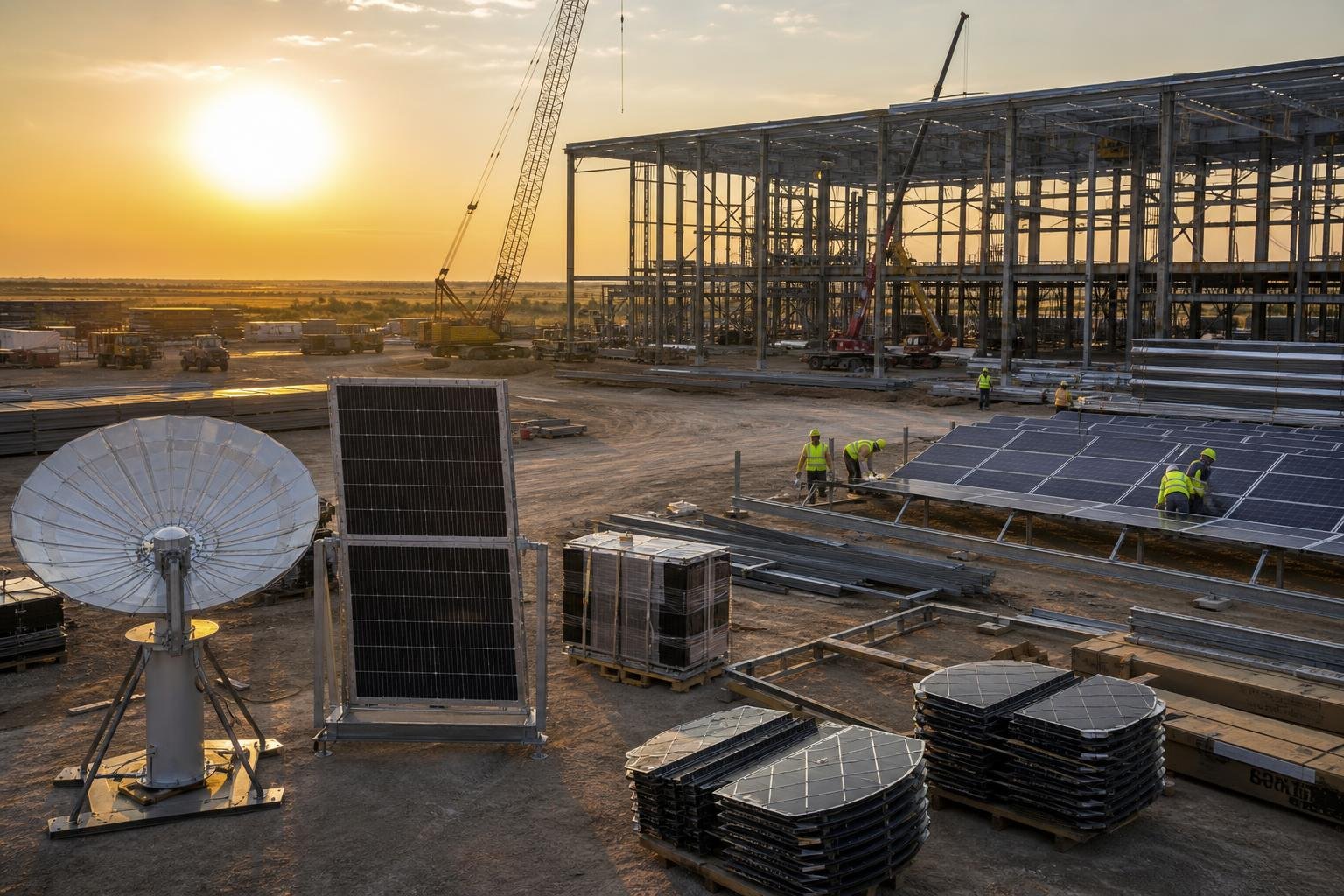
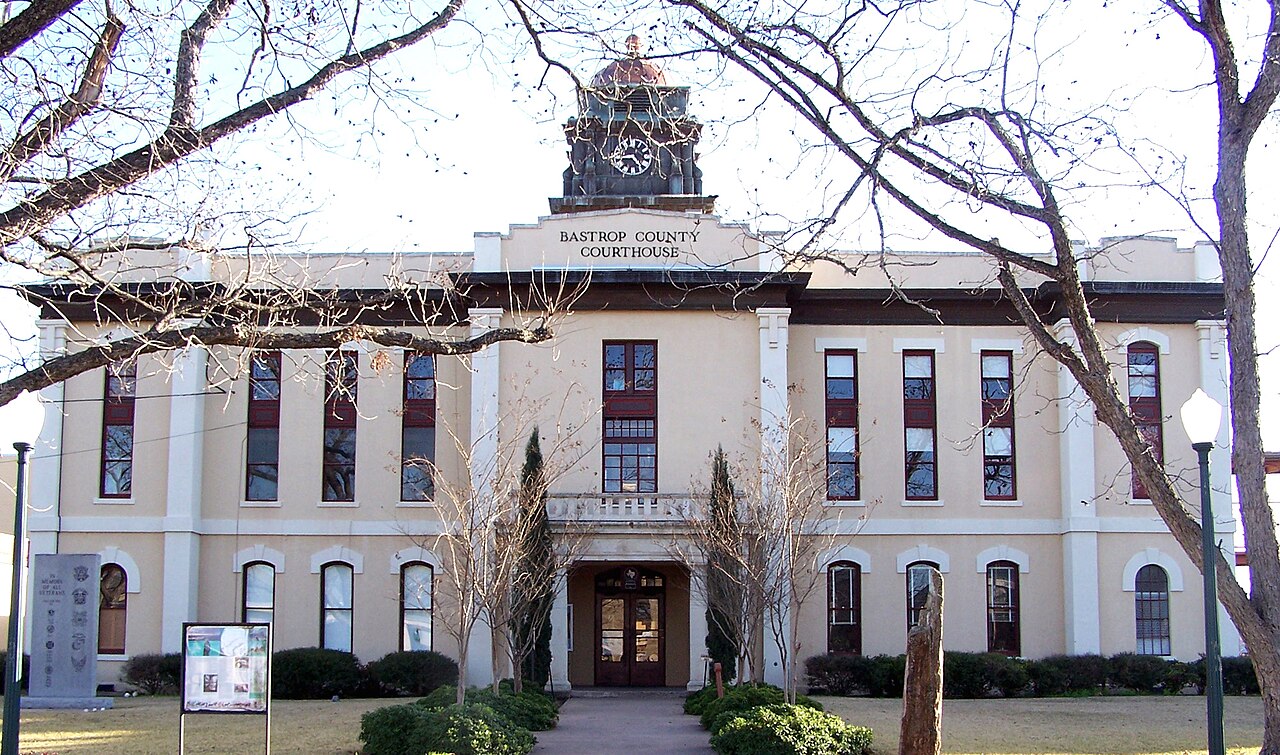
GigaSat is planned for a roughly 1,000-acre site in Bastrop County. At 11 million square feet, it would be more than 10 times the size of SpaceX’s Starfactory spacecraft-production complex, according to Tom’s Hardware.[1] The stated goal is vertical integration rather than merely final assembly.
SpaceX plans for the campus to produce solar ingots, wafers and cells; printed-circuit boards and silicon-based electronics; solar arrays; radiators; and other spacecraft hardware. The site would also support Starlink user terminals and gateways, along with research, testing, warehousing and logistics. Solar-manufacturing construction was already under way as of the announcement, while the primary AI-satellite production building was nearing groundbreaking.[1]
The scale matters because an orbital data center is not a single spacecraft. SpaceX’s first reference design, called AI1, would provide about 150 kilowatts of peak compute power and approximately 120 kW of sustained or average compute power. On the 150-kW measure, 1 GW of added capacity would imply about 6,667 AI1-class satellites annually. On the stated sustained figure, the equivalent is roughly 8,333 spacecraft. The widely cited estimate of more than 6,000 satellites therefore relies on peak rather than continuously delivered capacity.[1][2]
SpaceX said it expects to build a “reasonable volume” of complete AI satellites during 2027. Its 1-GW-per-year figure is a target for the end of that year, not current output, deployed capacity or a disclosed customer commitment.

AI1: a data-center node built around sunlight and radiators
The preliminary AI1 spacecraft is substantially different from a Starlink broadband satellite. SpaceX described a vehicle about 20 meters tall and roughly 70 meters across when its solar structure is deployed, designed to operate in low Earth orbit at approximately 600 to 800 kilometers. Other company filings describe a potential operating range extending from 500 to 2,000 kilometers.[2][3]
Instead of prioritizing user-facing antennas and radio hardware, AI1 would dedicate much more of its mass and surface area to power generation, computing and heat rejection. SpaceX said its reference design assumes solar-array output near 250 watts per square meter and radiator performance of about 1,400 watts per square meter. The company has discussed designs capable of hosting Nvidia GB300-generation hardware and future Vera Rubin platforms, as well as reference designs compatible with Google TPUs. Those references do not establish Nvidia or Google as confirmed GigaSat manufacturing partners.[2]
SpaceX characterizes AI1 as roughly comparable to a rack of high-end AI hardware. Musk said the system could deliver latency of around 3 milliseconds, although the practical latency experienced by a customer will depend on where data originates, how traffic is routed through the network and where results are delivered.
In the proposed architecture, laser inter-satellite links would join compute satellites into distributed clusters, while Starlink’s optical network would carry traffic between the constellation and Earth. A June regulatory disclosure said Starlink already had more than 23,000 inter-satellite laser links, providing an existing communications foundation that a new orbital-compute layer could use.[3]
SpaceX also expects to use dawn-dusk, sun-synchronous orbits, where satellites can spend much of their time in sunlight. More consistent solar exposure could reduce reliance on batteries and lower the power interruptions associated with orbital eclipses. But it does not remove the central physical constraint: virtually all electricity consumed by processors becomes heat that must be expelled into space.
Thermal engineering is the decisive challenge
Terrestrial data centers can reject heat through air cooling, water systems and other infrastructure. In vacuum, a spacecraft must emit waste heat as infrared radiation. That is why AI1’s proposed radiators are as fundamental to its design as its accelerators and solar arrays.
SpaceX has described a system using radiators, vapor chambers, active cooling loops and specialized coatings. Ian Dahl, SpaceX’s director of satellite engineering, has argued that the satellite could be simpler than Starlink in some respects because compute, solar generation and radiator surfaces replace a substantial amount of communications equipment.[4] Even so, a sustained 120-kW AI payload in orbit has not been publicly demonstrated.
Independent analysis underscores the difficulty. IEEE Spectrum noted that at much larger scales, the area needed for solar collection and heat rejection can become comparable, driving up spacecraft size, mass and attitude-control requirements.[5] A satellite also needs its electronics, cooling loops, power equipment and structural systems to remain reliable through radiation exposure and repeated thermal cycling.
SpaceX’s June prospectus projected that early orbital AI spacecraft could deliver about 100 kW of compute per metric ton and improve over time. Its longer-range ambition is far more expansive: 100 GW of new AI-compute capacity annually by the end of the decade, potentially involving thousands of launches and roughly one million metric tons delivered to orbit each year.[4] Those are forward-looking company assumptions, rather than proven performance or an approved deployment schedule.
The business case: unconstrained power versus launch and replacement costs
The appeal of processing data in orbit is straightforward. Space offers access to abundant solar energy and avoids the terrestrial constraints increasingly shaping large AI campuses: grid interconnection queues, power shortages, water consumption, land availability and local permitting. Processing some Earth-observation data before sending it down could also reduce communications needs.
The U.S. Government Accountability Office found that space-based data centers could potentially reduce certain Earth-bound electricity, water and infrastructure demands, particularly for in-orbit processing. But it concluded that the large solar arrays, cooling systems and high-throughput communications required for major space data centers have not been demonstrated at the necessary scale.[6]
Cost is another unresolved question. An ABI Research comparison covered by IEEE Spectrum estimated that placing and operating a GPU in orbit for one year could cost at least an order of magnitude more than operating an equivalent GPU in a terrestrial data center, even under a highly optimistic assumed Starship launch price of $44 per kilogram.[5] The calculation is simplified rather than a final verdict on the concept, but it illustrates how strongly orbital computing economics depend on launch price, satellite mass, useful operating life and the cost of replacing failed hardware.
Radiation compounds that problem. Commercial AI accelerators can suffer bit flips, latch-ups and permanent failures in the space environment; radiation-hardened alternatives generally sacrifice performance. Unlike servers in a conventional data center, failed GPUs in an orbital constellation cannot simply be swapped by a technician. Operators may need extensive redundancy, shielding or faster replacement cycles, each of which adds mass and cost.[7]
Regulation, congestion and a million-satellite ambition
GigaSat is connected to a much broader SpaceX filing seeking authority for as many as one million orbital data-center satellites. That filing is a request, not an authorization to deploy a million-spacecraft constellation, and it does not establish funding or a launch schedule for that ultimate scale.[8]
The scale has drawn objections from astronomers and space-safety advocates. The American Astronomical Society asked the Federal Communications Commission to deny SpaceX’s application in a March filing, citing potential effects on astronomy, collision avoidance, access to low Earth orbit, reentry safety and the concentration of orbital resources.[9] Astronomer Jonathan McDowell has separately warned that a constellation of the proposed size could increase close approaches dramatically unless station keeping and traffic coordination are exceptionally reliable.[8]
SpaceX is not the only organization pursuing orbital computing. Starcloud has launched a satellite carrying an Nvidia AI processor, and Google has proposed Project Suncatcher, an orbital AI-compute demonstration based on TPU technology. These efforts point to growing interest in the concept, but they also underline its early stage: testing processors in space is far removed from operating a distributed, gigawatt-scale AI cluster.[7]
For now, GigaSat is a manufacturing plan built around an unproven satellite architecture and an unusually aggressive deployment target. SpaceX enters the effort with assets few prospective competitors can match: launch capability, large-scale satellite production experience and Starlink’s optical network. Whether those advantages can overcome the physics and economics of orbital AI infrastructure remains the defining question.
Editor’s Take
I think SpaceX is attacking a real bottleneck: AI demand is increasingly constrained by power delivery, interconnection timelines and cooling infrastructure rather than just chip supply. A vertically integrated satellite factory could make orbital compute less implausible than it would be for a conventional cloud operator, especially if Starship reaches genuinely low, high-cadence launch costs and Starlink’s laser network can carry useful workloads.
But the headline number is doing a lot of work. A 1-GW annual capacity target by late 2027 means manufacturing thousands of very large, power-hungry spacecraft each year, while proving high-power thermal control, accelerator reliability under radiation and economical replacement cycles. The near-term commercial case is most credible for processing data that is already in space—Earth observation, defense sensing and satellite-network operations—not for broadly replacing terrestrial GPU clusters. The milestones to watch are an AI1 flight, measured sustained compute and heat-rejection performance, satellite mass, and a disclosed cost per delivered compute-hour.
References
- Tom’s Hardware – https://www.tomshardware.com/tech-industry/big-tech/spacex-unveils-11-million-square-foot-gigasat-factory-a-new-manufacturing-facility-for-space-based-data-centers-aims-for-1-gw-year-of-space-ai-compute-by-late-2027-from-its-satellites
- Data Center Dynamics – https://www.datacenterdynamics.com/en/news/spacex-details-ai1-satellite-data-center-claims-150kw-peak-compute/
- SpaceX SEC filing – https://www.sec.gov/Archives/edgar/data/1181412/000162828026041013/japanfwp_06042026.htm
- SpaceX EU Prospectus – https://content.spacex.com/cms-assets/FINAL_Documents%20and%20Updates/SpaceX%20-%20EU%20Prospectus%20%28Approved%20by%20Bafin%29%20-%20June%205%2C%202026.pdf
- IEEE Spectrum – https://spectrum.ieee.org/orbital-data-centers-heat
- U.S. Government Accountability Office, Data Centers in Space – https://www.gao.gov/products/gao-26-109012
- Associated Press – https://apnews.com/article/92bc8ad95593bf3b5b801ddf36427194
- Scientific American – https://www.scientificamerican.com/article/spacex-plans-to-launch-one-million-satellites-to-power-orbital-ai-data/
- American Astronomical Society FCC Petition – https://aas.org/sites/default/files/2026-03/American%20Astronomical%20Society%20-%20SpaceX%20Orbital%20Data%20Centers%20Petition%20to%20Deny.pdf