
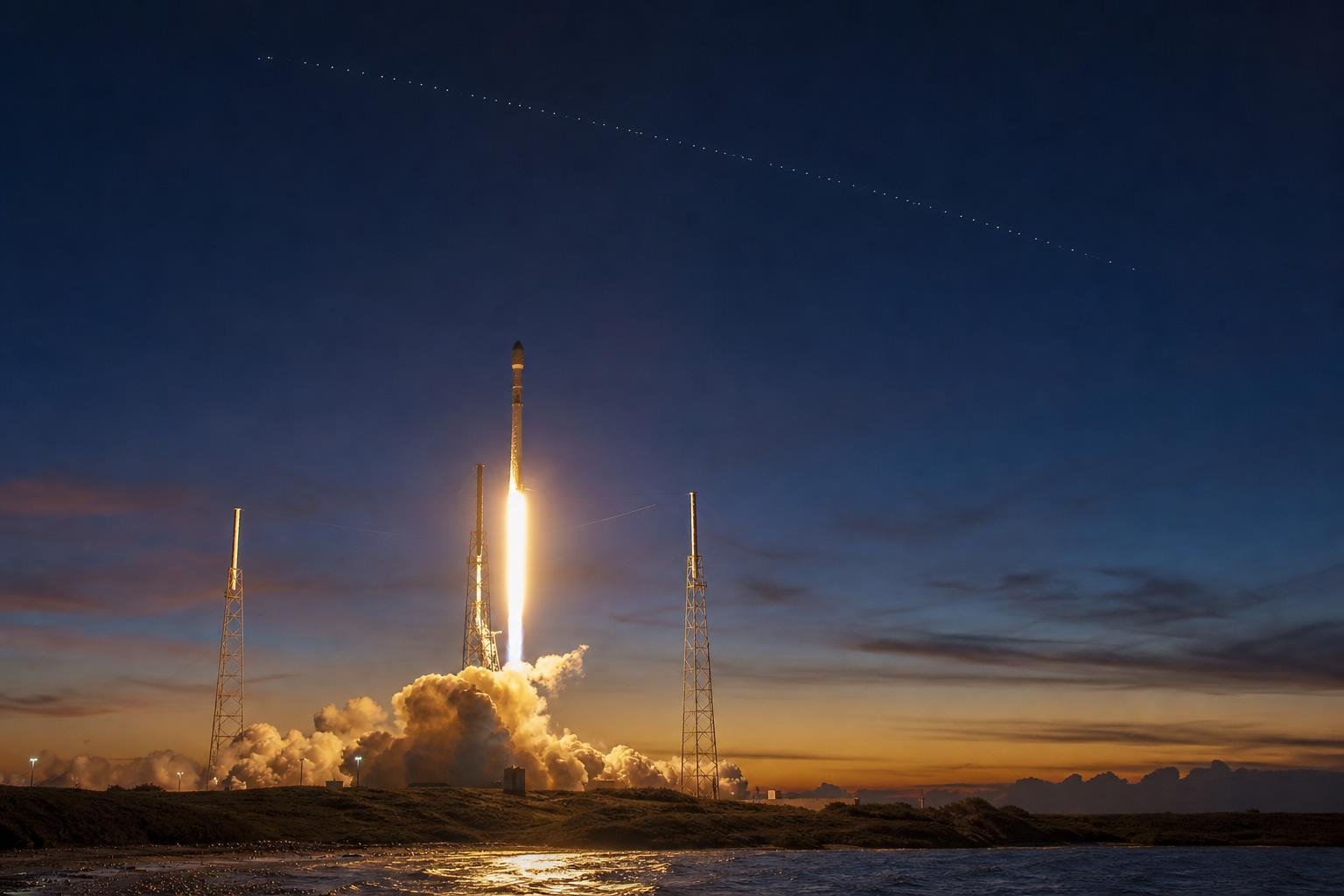
SpaceX has proposed what may be the most ambitious infrastructure program in the commercial-space era: an orbital data-center network of up to 1 million satellites designed to supply AI compute from low Earth orbit. The company filed its application for the SpaceX Orbital Data Center System with the Federal Communications Commission on January 30; the FCC Space Bureau accepted it for filing in February, beginning a review process rather than granting approval to build or deploy the constellation. [1]
The proposal matters not because a million AI satellites are imminent—they are not—but because it reveals the project-management challenge behind SpaceX’s broader AI strategy. The company is attempting to connect satellite manufacturing, Starship launch capacity, laser networking, autonomous fleet operations, xAI workloads and prospective chip production into a single program. Every link has to mature. A weakness in regulation, thermal design, launch cadence, hardware reliability or orbital safety could become the program’s critical path.
A proposed system, not a deployed constellation
SpaceX’s filing describes a non-geostationary system operating in shells between 500 and 2,000 kilometers, using 30-degree and sun-synchronous inclinations. Some shells could be only 50 kilometers apart. The architecture would use optical inter-satellite links and connect with first- and second-generation Starlink systems. [1]
That framework should not be mistaken for an authorization or a construction schedule. As of June 12, the FCC had not publicly authorized the full million-satellite proposal, AI1 had not flown, and SpaceX had not begun mass deployment. The one-million figure is the upper bound in an application and a long-range ambition, not a near-term fleet commitment.
SpaceX has said operational deployment could begin as early as 2028, while investor materials indicate that demonstration hardware could potentially fly sooner. That distinction is important for program governance. A demonstration mission can validate pieces of a design; it cannot by itself establish that a system can be manufactured, launched, networked, replaced and safely operated at orders of magnitude beyond today’s constellations. [2]
The company’s proposed first-generation spacecraft, AI1, illustrates the difference in scale. In a June 8 technical discussion, SpaceX described a satellite roughly 20 meters tall with a deployed wingspan of about 70 meters, approximately 150 kilowatts of peak power and 120 kW of sustained compute power. AI1 would remove much of the broadband-specific communications hardware used on Starlink satellites and devote more of its mass and power budget to AI accelerators, solar arrays and heat rejection. [3]

The critical path runs through power, heat and launch
SpaceX’s core premise is that solar-powered compute in orbit could bypass growing terrestrial constraints around electricity, water, land and grid interconnection. Dawn-dusk sun-synchronous orbits are central to that case because they can offer near-continuous solar exposure. The company’s materials describe early spacecraft at roughly 100 kW of compute power and a later target of about 100 kW per metric ton of spacecraft mass. [2]
Generating electricity is only one part of the engineering problem. AI accelerators turn substantial amounts of power into heat, and spacecraft cannot shed that heat through air convection. SpaceX proposes radiators, vapor chambers, active cooling loops and specialized coatings. Its own materials acknowledge that the AI satellites need considerably larger radiators than conventional Starlink spacecraft. [2]
That makes thermal hardware a first-order schedule and reliability risk rather than a subsystem detail. Josep Jornet, a Northeastern University engineering professor, has warned that the needed radiator structures could be massive and fragile, at a scale beyond what has been built for this purpose. [4] A project plan that measures progress only by accelerator performance or solar-array output would miss the system constraint: compute cannot be sustained if waste heat cannot be rejected reliably through every orbital condition.
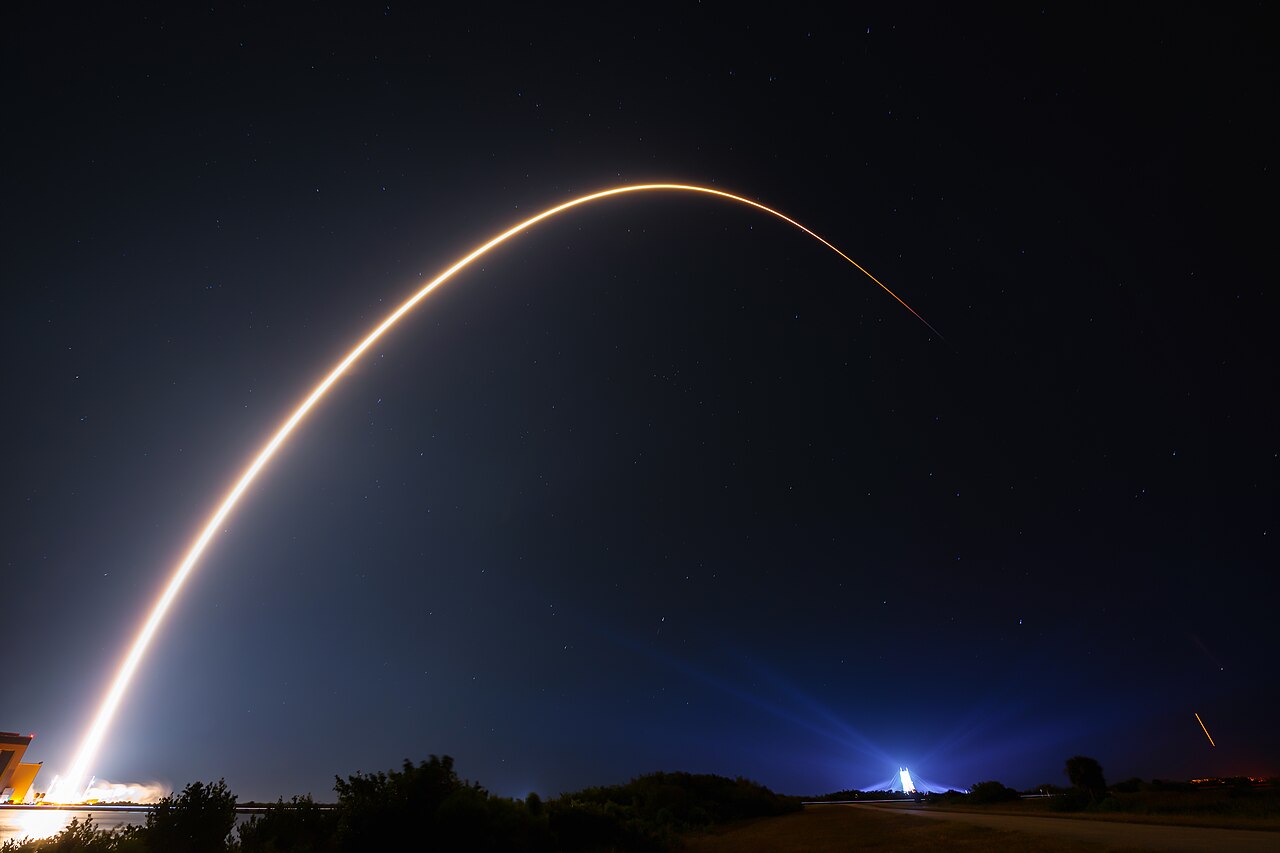
Launch logistics are equally foundational. SpaceX’s long-range scenario contemplates deploying 100 gigawatts of power capacity annually, moving roughly 1 million metric tons to orbit per year and conducting potentially thousands of launches annually. The company also says a viable commercial service could begin at far lower deployment volumes. [2] That is a sensible staging premise, but it leaves Starship reliability, turnaround time, payload integration and launch-site capacity as major dependencies. The million-satellite version of the program cannot be scheduled independently of a reusable heavy-lift launch system operating at a scale not yet demonstrated.
Reuse helps, but scaling changes the risk profile
SpaceX has a real project advantage: much of the proposed operating model is intended to build on Starlink. The company says its network already has more than 23,000 optical inter-satellite lasers and plans to reuse software for workload allocation, collision avoidance, software updates and fault tolerance. It reported that Starlink spacecraft conducted more than 1,000 automated collision-avoidance maneuvers per day in 2025, without a satellite loss attributed to its autonomous avoidance system. Those are company claims, not independent proof that the same systems can safely govern a million-spacecraft population. [2]
This is where familiar project-management concepts become unusually consequential. A million-node constellation requires configuration control across hardware versions, continuous cybersecurity management, validated fail-safe behavior, supply-chain traceability and clear rules for retiring degraded assets. Radiation-damaged or failed compute hardware cannot be handled like a failed server in a terrestrial facility. It must be bypassed through redundancy, shifted to lower-value workloads, replaced by another spacecraft or disposed of. [4]
SpaceX’s plan accounts for workload reassignment, retirement and controlled disposal or graveyard orbits, but the operational burden remains exceptional. The company must prove not only that satellites can autonomously avoid conjunctions, but that the network can preserve safe behavior during software defects, communications failures, failed propulsion, changing traffic patterns and hardware attrition.
Regulation and external impacts are program workstreams
FCC approval, spectrum coordination and interference analysis are not administrative steps at the end of the program. They are gating workstreams that shape the system’s architecture and usable deployment rate. Amazon Leo has urged the FCC to deny or intensively scrutinize the application, arguing that SpaceX has not provided credible detail on conjunction avoidance, interference, disposal and replacement. Amazon also warned that the proposal could give SpaceX excessive influence over launch-insertion orbits. [5]
Astronomy is another constraint that must be treated as an engineering requirement, not merely a public-relations issue. Astronomer John Barentine has cautioned that high-inclination, sunlit spacecraft could create tens of thousands of bright moving objects visible from the ground, interfering with observations. [6] Collision and debris concerns scale in parallel. John Crassidis, a former NASA engineer and University at Buffalo professor, warned that a million spacecraft could approach a collision-risk tipping point. [4]
The Government Accountability Office has reached a similarly cautious assessment of the field: key power, communications and spacecraft technologies exist, but large-scale orbital data centers for AI training remain technically immature. It noted that large systems may require solar arrays larger than anything yet launched and assembled in space. [7] These concerns do not establish that orbital computing is impossible. They establish that mitigation, transparency and independent validation must be managed as deliverables alongside throughput and cost.
A staged program needs stage-specific proof
The strongest execution path is likely to be incremental. Early missions should establish AI1’s power generation, thermal performance, radiation tolerance, laser-network behavior and autonomous workload management. Subsequent deployments would need to demonstrate repeatable production, replacement economics, deorbit or disposal performance and coexistence with other operators. Only then can SpaceX assess whether a larger distributed compute network outperforms terrestrial alternatives for selected workloads.
That approach also fits the market reality. SpaceX acquired xAI in February, tying the orbital-compute effort to Grok and the company’s broader AI infrastructure strategy. It has also described Terafab, a proposed chip-manufacturing initiative with Tesla and, later, Intel participation. Yet public details on Terafab construction timing, capital commitments and production milestones remain limited. [2] Vertical integration can shorten feedback loops, but it can also concentrate risk when launch, chips, satellite production and customer demand are all interdependent.
Other companies are pursuing variants of the same thesis. Google’s Project Suncatcher is studying solar-powered orbital data centers using TPUs, while Blue Origin’s Project Sunrise and startups including Starcloud are pursuing related concepts. [4] The near-term competitive question is therefore less likely to be who places a million satellites in orbit first. It is who can show that targeted orbital workloads deliver enough value to justify the added cost, operational complexity and environmental responsibility.
For SpaceX, success will depend on disciplined sequencing. The company has announced an architecture and an extraordinary end-state. The project now needs evidence at each gate: regulatory clearance, flight-ready hardware, dependable Starship cadence, safe autonomous operations and economics that hold up against ever-larger terrestrial data centers. Until those gates are passed, the million-satellite network remains an ambitious program proposal rather than an operational AI utility.
Editor’s Take
I see the orbital-data-center pitch as a serious systems-engineering experiment, not a near-term replacement for terrestrial AI clusters. SpaceX has credible advantages in launch, satellite production, optical networking and fleet operations, but none of those advantages removes the physics: every kilowatt delivered to accelerators becomes a thermal-management problem. The first useful milestone is not a headline satellite count; it is independently observable proof that an AI1-class spacecraft can sustain compute, reject heat, survive radiation and remain maintainable through autonomous operations.
The market test is equally important. Orbital compute will need to win particular workloads on latency, resilience, energy availability or economics—not simply claim that land-based grids are constrained. I would watch for staged demonstrations of power-to-compute efficiency, radiator reliability, laser-link throughput, replacement cost and safe disposal. The million-satellite number is useful as a statement of architectural ambition, but it is where hype most clearly outruns the evidence: launch cadence, orbital safety, spectrum coordination and regulatory approval are all core product constraints, not paperwork to solve later.
References
- Federal Communications Commission Space Bureau – https://docs.fcc.gov/public/attachments/DA-26-113A1.pdf
- SpaceX investor materials filed with the U.S. Securities and Exchange Commission – https://www.sec.gov/Archives/edgar/data/1181412/000162828026041013/japanfwp_06042026.htm
- Investing.com – https://www.investing.com/news/stock-market-news/ahead-of-spacex-ipo-musk-says-ai-satellites-will-use-mostly-existing-technology-4731920
- Associated Press – https://apnews.com/article/elon-musk-orbital-ai-data-centers-xai-spacex-92bc8ad95593bf3b5b801ddf36427194
- Light Reading – https://www.lightreading.com/satellite/amazon-thinks-spacexs-data-center-plan-is-a-bunch-of-hooey
- Space.com – https://www.space.com/space-exploration/satellites/spacexs-1-million-orbiting-ai-data-centers-could-ruin-astronomy
- U.S. Government Accountability Office – https://www.gao.gov/products/gao-26-109012




.jpg)