
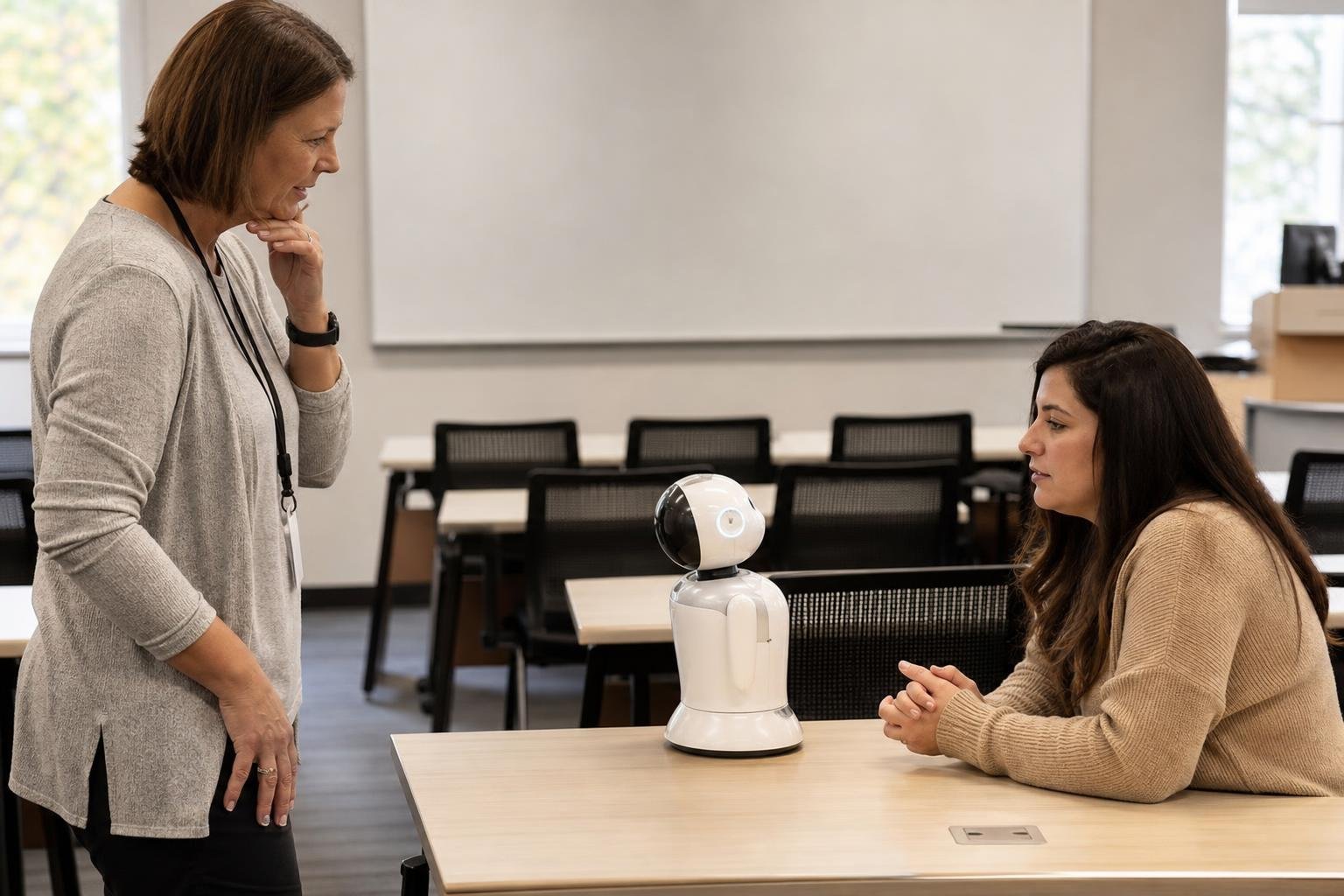
La Trobe University is deploying an AI-driven social robot, Fletch, to help trainee teachers rehearse difficult conversations with parents before they face them in a real school. The robot can simulate a confrontational parent and alter its responses according to the trainee teacher’s behaviour, turning a traditionally improvised role-play exercise into a repeatable training scenario.[1]
The practical significance is not that a robot is taking over a teacher’s work. It is that schools may gain a more available, psychologically safer environment for practising one of the profession’s most consequential interpersonal skills: de-escalating conflict while protecting a student, a family relationship and staff wellbeing. Several Victorian schools have signed on to use Fletch for staff training, according to reporting on the program.[1]
A rehearsal space for high-stakes school conversations
Parent-teacher communication can become difficult quickly when a discussion concerns a child’s behaviour, achievement, discipline or school expectations. The scenarios described in reporting on Fletch include parents sending accusatory messages, rejecting expectations set by the school and escalating disputes in public settings.[2]
Those situations demand more than subject knowledge or policy recall. A teacher may need to acknowledge a parent’s concern without accepting an inaccurate allegation, explain a decision without becoming defensive, set boundaries, identify when a matter should be escalated, and keep the focus on the student. Novice teachers often encounter these pressures early in their careers, yet formal preparation has commonly depended on lectures, occasional workshops, or peers and instructors volunteering to act out a scenario.
That conventional approach has limits. A role-play facilitator may be difficult to schedule, may perform a scenario inconsistently between sessions, and may hesitate to sustain the emotional intensity that makes the exercise useful. Trainees can also feel judged when making mistakes in front of classmates or supervisors. A responsive simulation does not eliminate the need for expert feedback, but it can make initial practice less socially exposing and easier to repeat.

How responsive simulation changes the exercise
Fletch is presented as an AI-driven social robot rather than a scripted video or a fixed decision-tree quiz. Its central feature is behavioural responsiveness: the simulated parent’s replies can change based on how the trainee approaches the interaction.[1] That matters because conflict-management training is not mainly about selecting a single correct sentence. It is about recognising cues, adjusting tone, asking clarifying questions and recovering when an exchange starts to deteriorate.
A static scenario can test whether a trainee remembers a school procedure. An adaptive one can test whether the trainee’s approach creates trust or increases resistance. If a trainee appears dismissive, overexplains policy, interrupts, or fails to address an underlying concern, the system can continue the conversation on a more difficult path. If the trainee listens, validates the emotion without conceding unsupported claims, and offers an appropriate next step, the scenario can develop differently.
The value of that model depends on the quality of the simulation design, not simply on the presence of AI. The robot must have scenarios grounded in realistic school procedures, plausible parent concerns and clear safeguarding limits. It also needs a structured debrief. The useful learning moment is often not that a trainee “won” an argument, but that they can identify where the conversation changed, what signals they missed and what they would do differently next time.
From scarce role-play to repeatable practice
For teacher-education providers and schools, the appeal is operational as much as technical. Human-led role-play requires trained participants, dedicated time and careful coordination. It can be highly effective, particularly when led by experienced educators, but access tends to be limited by staffing and budgets. Standardised workshops offer broader reach, yet may not give every participant enough time to speak, make errors and try again.
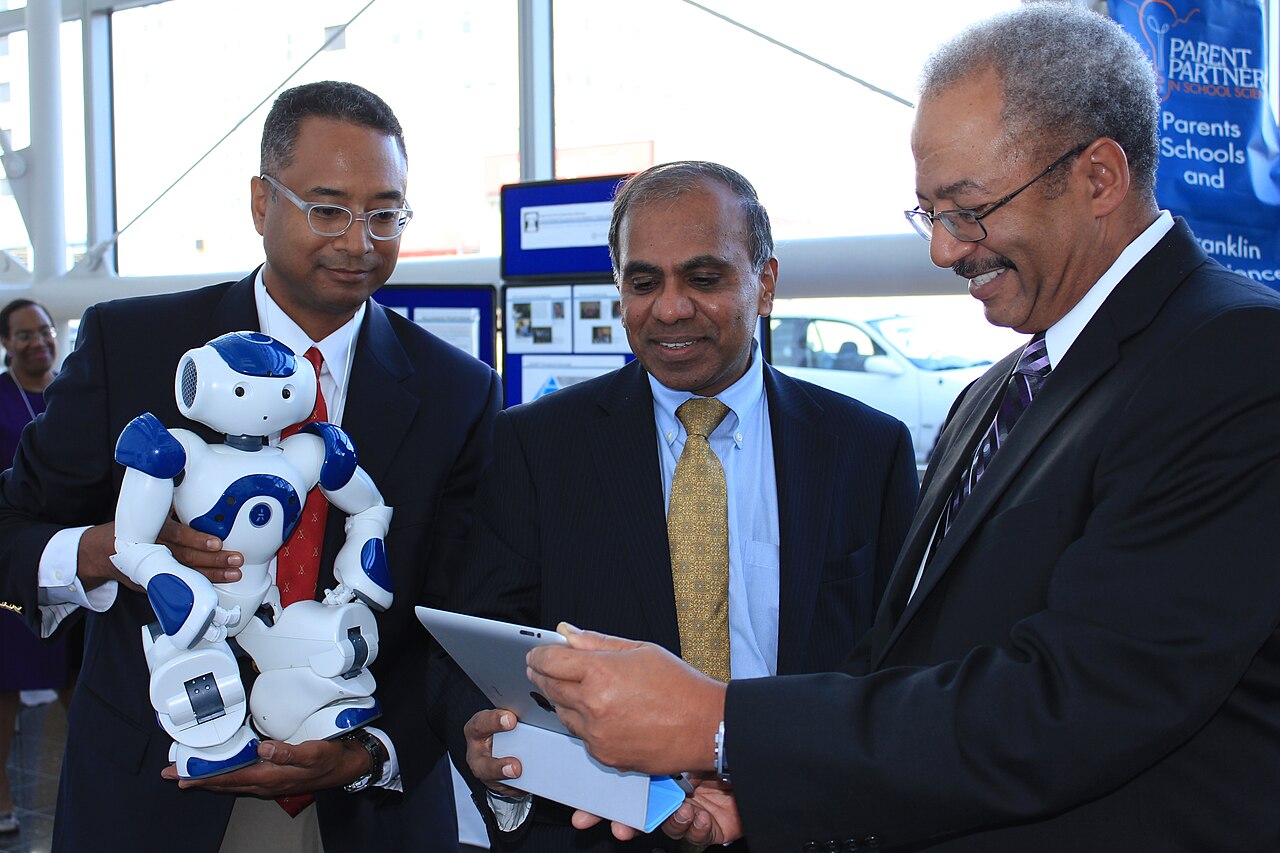
A robot-based simulation could be scheduled more frequently and reused across cohorts. It could allow a trainee to practise a difficult conversation several times, changing their wording or approach without requiring a new facilitator each time. Schools that have signed on to use Fletch for staff training point to a potential use beyond initial teacher education: ongoing professional development for teachers, leaders and support staff.[1]
That does not make the technology a substitute for mentors. Experienced school leaders bring contextual judgment that a simulation cannot fully reproduce: local community history, a student’s circumstances, legal obligations, cultural considerations and the subtle dynamics of a real relationship. The strongest deployment model is likely to combine simulation with coaching, observation and policy guidance. The robot can supply repetitions; human educators can interpret performance and connect it to professional responsibility.
What needs to be proved
The early deployment should not be confused with evidence that the system improves real-world outcomes. The reported initiative establishes that schools are willing to trial the technology, but it does not by itself demonstrate that trainees using Fletch handle parent conflict better, experience less stress, or reduce escalations after entering classrooms.[1] Those are testable questions that require comparison with established training methods and follow-up in actual school settings.
Assessment is another challenge. An AI system can potentially log turn-taking, language choices, pauses and scenario outcomes, but those signals are not automatically valid measures of professional competence. A teacher may use technically polite language while missing the family’s concern; another may speak imperfectly but build rapport through context and empathy. Any scoring system should be transparent, reviewed by educators and treated as feedback rather than an opaque judgment of a trainee’s suitability.
Privacy and governance will also be central if the system records voice, video or interaction transcripts. Education providers need clear retention rules, informed consent, access controls and assurances that practice data will not be repurposed for disciplinary monitoring. Scenario content needs regular review to avoid stereotyping parents by culture, class, disability, language or family structure. A poorly designed “difficult parent” simulation could teach staff to anticipate hostility rather than approach families as partners.
There is also a risk of narrowing conversations to what the system is designed to recognise. The most valuable simulations will include not only confrontational exchanges but also misunderstandings, grief, accessibility issues, competing expectations and situations in which the school has made a mistake. Effective training should reward curiosity, accountability and appropriate escalation, rather than merely calming a simulated parent.
A wider market for conversational skills training
Fletch sits within a broader shift toward AI-assisted simulation for professions where communication failures carry real costs. Education, healthcare, customer service, social care and public administration all rely on difficult conversations that are hard to teach through lectures alone. The commercial opportunity is not primarily humanoid hardware. It is a training system that can deliver credible scenarios, support reliable facilitation and show whether repeated practice transfers to the workplace.
For schools, the buying decision will likely rest on practical questions: whether the scenarios reflect local policy, how much setup and staff training are required, whether the system works for groups as well as individuals, and whether it fits professional-development budgets already under pressure. A social robot may add presence and emotional immediacy compared with a screen-based chatbot, but it also introduces hardware support, accessibility and maintenance considerations.
If La Trobe’s program demonstrates that responsive practice improves confidence and judgment without increasing administrative burden, it could provide a model for teacher preparation more broadly. Its most realistic near-term role is not autonomous coaching. It is a reliable training partner that gives educators more chances to practise difficult human interactions before a student’s family, a school community or a teacher’s career is affected by the outcome.
Editor’s Take
I see the strongest case for Fletch in repetition, not novelty. Schools can teach communication frameworks in a workshop, but they rarely give every trainee enough live practice to discover how quickly a tense exchange can go off course. A system that safely lets teachers restart, try a different response and then debrief with a mentor addresses a real capacity problem.
The next milestone should be rigorous evidence, not more theatrical demonstrations of a talking robot. La Trobe and participating schools should measure transfer: whether trainees communicate more effectively with real families, whether supervisors see better judgment, and whether the tool works across varied communities. If those results hold up, responsive simulation could become useful infrastructure for professional learning; if it merely produces polished interactions with a machine, the hype will have outrun the educational value.




.jpg)