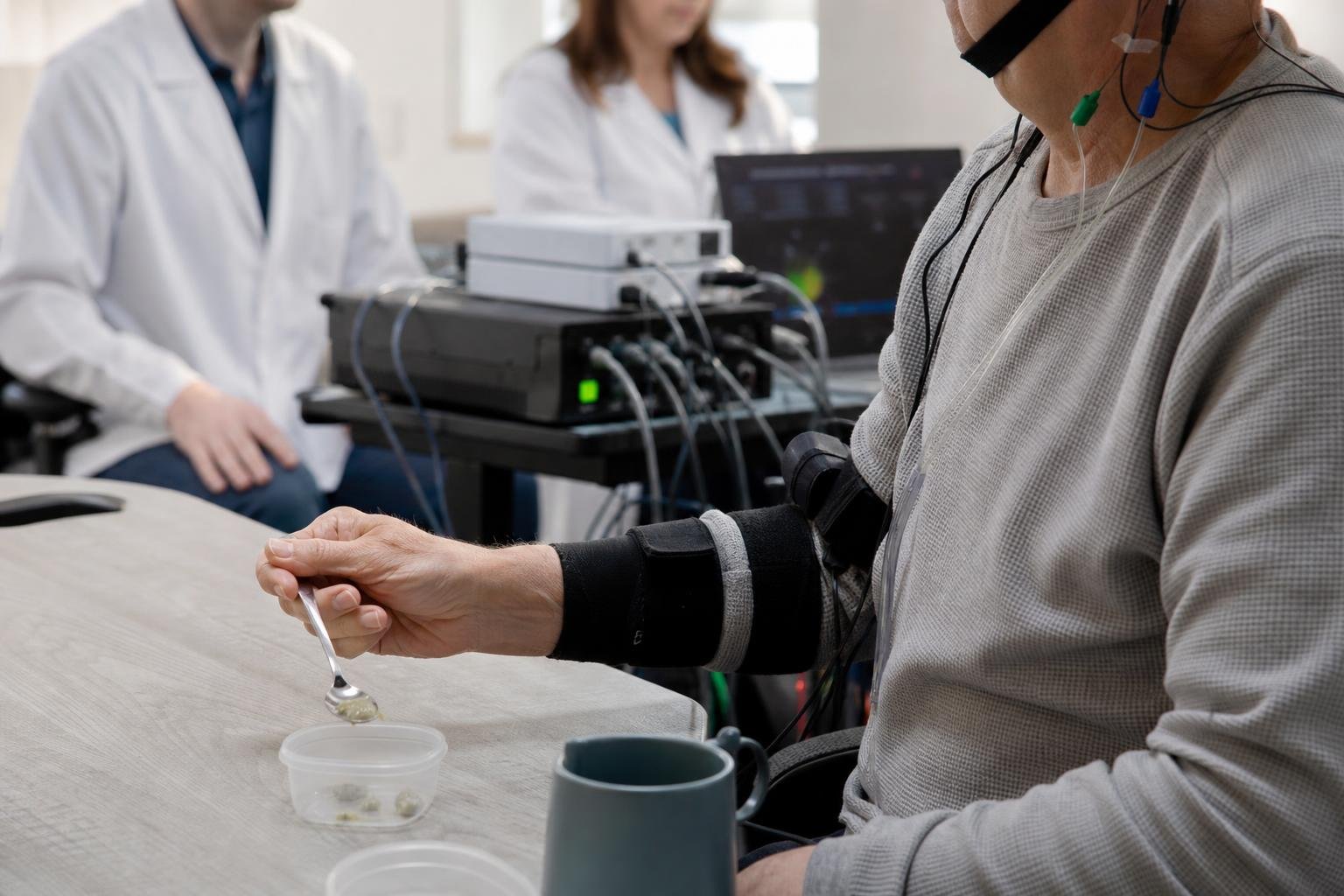
Researchers have reported a hybrid neuroprosthetic system that enabled a person with chronic, complete tetraplegia to perform tasks including self-feeding and handling delicate objects. The system combines an intracortical brain-computer interface (BCI), which decodes intended movement from brain activity, with targeted electrical stimulation of the spinal cord and cerebral cortex.[1]
The significance is not simply that a participant could control a device using neural signals. The study reports that the closed-loop system was associated with persistent improvements in the participant’s own elbow movement and wrist sensation. That distinction matters: conventional BCIs can provide assistive control while active, whereas a rehabilitation-oriented neuroprosthesis aims to improve function in the body itself. The result remains an early, single-participant report, but it points toward a more ambitious model for neurotechnology after spinal cord injury.
By the numbers
- 1 participant: The reported clinical result comes from one person and requires replication in larger studies.
- C4 sensory complete: The participant had a chronic cervical spinal cord injury classified as sensory complete at the C4 level.
- C5 motor complete: The injury was classified as motor complete at the C5 level.
- 2 stimulation targets: The system used targeted stimulation of the spinal cord and cerebral cortex, directed by an intracortical BCI.
A neuroprosthesis designed to close the loop
Many high-profile BCI demonstrations have focused on replacing a lost output channel. A person may use neural activity to move a cursor, type text, operate a robotic arm or activate an externally worn device. Those achievements can be life-changing, but they generally depend on the assistive hardware and decoding system remaining in operation.
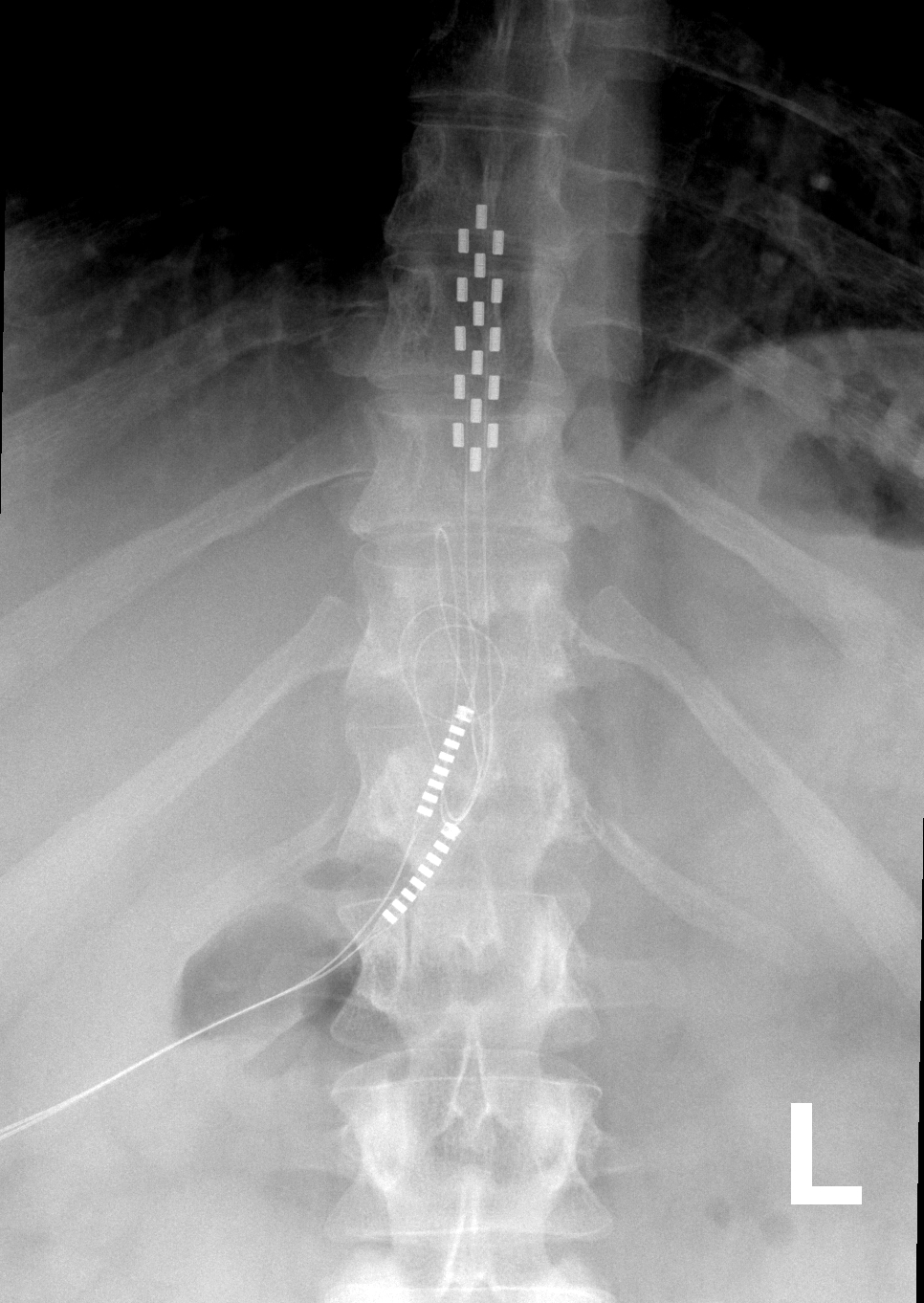
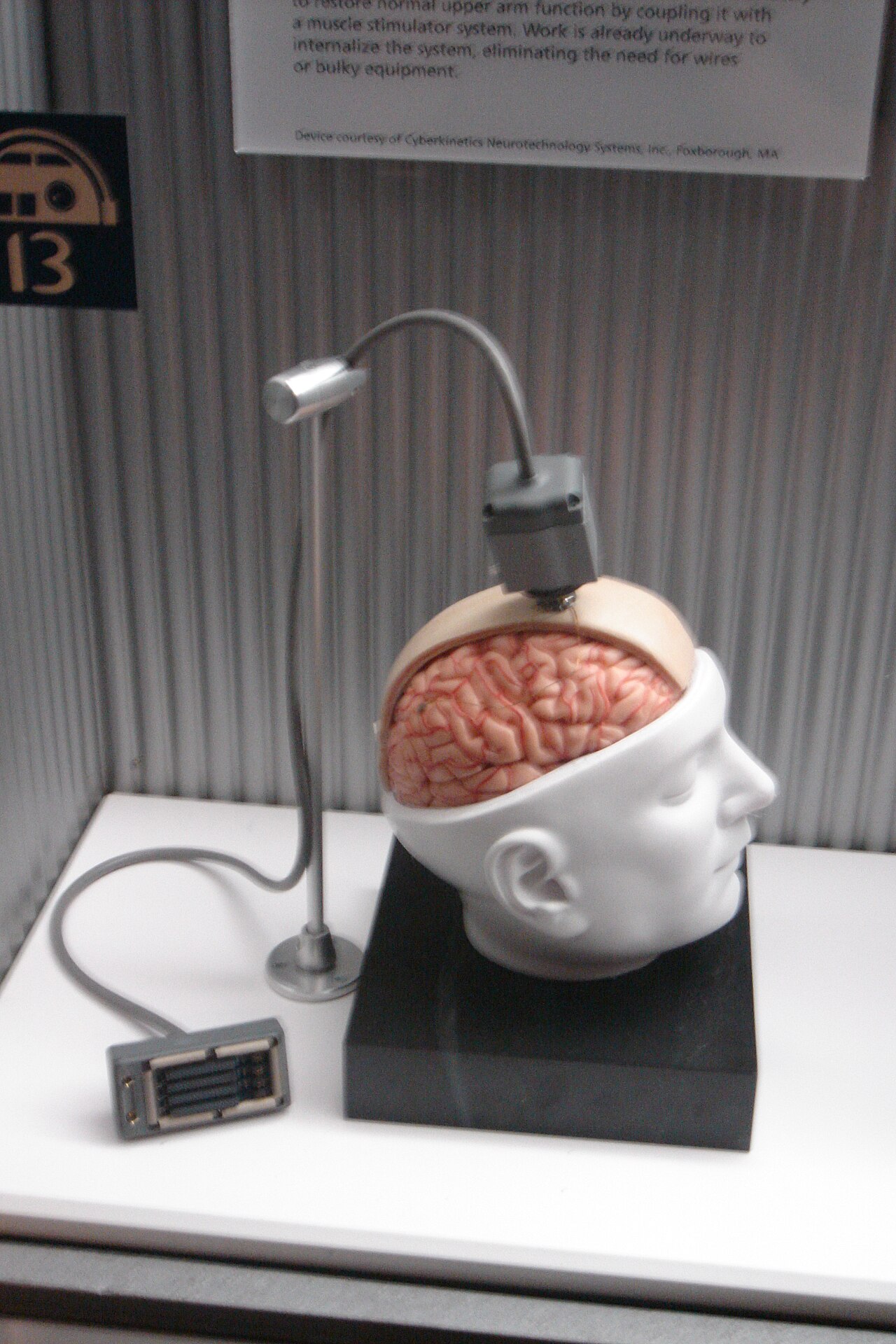
The Nature Medicine report pursues a different architecture. An intracortical BCI records neural activity directly from the brain’s cortex and uses decoding algorithms to infer movement intent. That information is paired with stimulation at two points in the nervous system: the spinal cord, which carries and organizes signals relevant to limb movement, and the cerebral cortex, a central site for motor and sensory processing.[1]
This is a closed-loop proposition in the broad clinical sense: intended movement is captured from the brain, stimulation is applied to pathways involved in executing and perceiving movement, and the participant receives functionally meaningful sensory information. Rather than treating decoding and stimulation as separate tools, the system uses them as parts of an integrated intervention.
The reported outcomes included self-feeding and manipulation of delicate objects—activities that require more than gross reaching. They depend on controlled arm positioning, hand shaping, grip regulation and sensory feedback. The ability to work with fragile objects is particularly relevant because force control and tactile information are among the functions most difficult to restore after severe cervical spinal cord injury.
Why persistent gains are the central claim
The most consequential finding is the report of persistent improvements in elbow movement and wrist sensation. A temporary assistive effect would mean that a user performs better only while the system is actively decoding and stimulating. A persistent effect suggests that repeated, intent-linked activation may have changed how surviving neural pathways are recruited or used.
That does not establish a permanent cure for paralysis, nor does it show that the result will generalize across injury levels, causes of injury or participants. The report concerns one individual with a specific chronic injury profile. It also cannot, by itself, separate all possible contributions of stimulation, task practice, decoder performance, rehabilitation exposure and the participant’s individual biology.
Still, the rehabilitation framing is important. Neurological recovery is often constrained by the challenge of delivering the right activity to the right circuits at the right time. A brain-driven system can potentially make stimulation contingent on a person’s own intention to move, rather than delivering stimulation independently of that intent. That pairing may be more biologically meaningful than passive activation alone, particularly when it is repeated during real functional tasks.
Technical innovation: decoding intent, activating pathways, restoring feedback
The study’s hybrid design brings together technologies that have often progressed on parallel tracks. Intracortical BCIs can capture high-resolution neural signals and support rapid decoding of intended actions. Spinal stimulation can modulate circuitry below an injury, potentially enabling residual pathways to contribute more effectively to movement. Cortical stimulation adds a route to influence or provide sensory information at the brain level.
The practical challenge is coordination. The decoder must identify useful movement-related signals reliably enough for the stimulation system to respond appropriately. Stimulation parameters must be tailored to the person and task without producing uncomfortable, unstable or unhelpful effects. The system must also preserve enough timing fidelity that the participant experiences movement and sensation as controllable rather than delayed or artificial.
For the participant, the endpoint is not an abstract signal-processing metric. It is whether the system supports ordinary actions: bringing food to the mouth, grasping an item without crushing it, repositioning an arm, or sensing the wrist. The reported tasks make the work more clinically meaningful than a laboratory cursor-control demonstration, even as it remains a highly specialized research system.[1]
What the result means for the neurotechnology market
The result strengthens the case for a neurotechnology sector that is broader than implanted communication BCIs or robotic control systems. The commercial opportunity may increasingly lie in integrated therapeutic platforms: implanted recording hardware, implantable or external stimulation systems, decoding software, clinical programming tools and rehabilitation workflows designed as one product ecosystem.
That is also a harder market to build. A therapy combining brain recording with spinal and cortical stimulation could face substantial engineering, surgical, regulatory and reimbursement complexity. It would require durable implants, reliable long-term signal quality, rigorous safety management, training for clinical teams and evidence that benefits justify the procedural burden and cost.
For device makers and BCI developers, the strategic implication is that decoding accuracy alone may not define value. The more consequential question is whether decoded intent can be translated into measurable improvements in independence, safety and function outside a research setting. Rehabilitation endpoints such as feeding, dressing, transfers, sensation and reduced caregiver dependence are likely to matter more to clinicians, payers and users than an isolated benchmark for cursor speed or robot-arm control.
Questions that replication must answer
Single-participant neuroprosthetic studies are often necessary early steps, especially where surgery and individualized programming are involved. They can establish feasibility and reveal what a system can accomplish under careful clinical supervision. They cannot establish typical outcomes, durability across years, comparative effectiveness or the rate of adverse events.
Future studies will need to test whether persistent motor and sensory improvements occur in additional participants, including people with different levels and completeness of injury. They will also need to clarify how long gains last, whether they continue to improve with use, how much training is required, and whether benefits remain after stimulation is reduced or paused.
Other critical issues include implant longevity, infection and revision risk, stability of intracortical recordings, battery and hardware maintenance, stimulation safety, and the burden of calibration. Researchers will need controlled designs that distinguish restoration produced by the hybrid system from changes associated with conventional therapy, participant motivation or repeated task practice.
The paper is therefore best read as a strong clinical signal rather than a finished treatment. It demonstrates a direction: neural interfaces may become active rehabilitation systems that connect intention, movement and sensation. Whether that direction becomes broadly available care will depend on replication, simplification and evidence of durable benefit in everyday life.
Editor’s Take
I think the persistent-gain claim is the part worth watching most closely. Thought-controlled robotics and computer interfaces are valuable, but they can leave users dependent on a complex external stack. A system that helps a person regain even a limited amount of their own arm movement or sensation could be more practical in daily life, provided the effect survives beyond a tightly supervised session.
The next meaningful milestone is not another polished demonstration of object handling. It is a replicated study that clearly shows who benefits, how long benefits last, what rehabilitation dose is needed and whether the hardware can be managed outside an elite research program. The hype would outrun the data if this single case is described as a general restoration of function. But the architecture—decoding intention and using it to drive targeted stimulation—looks like one of the most credible routes from BCI spectacle to rehabilitation product.
References
- Nature Medicine – https://www.nature.com/articles/s41591-026-04498-0