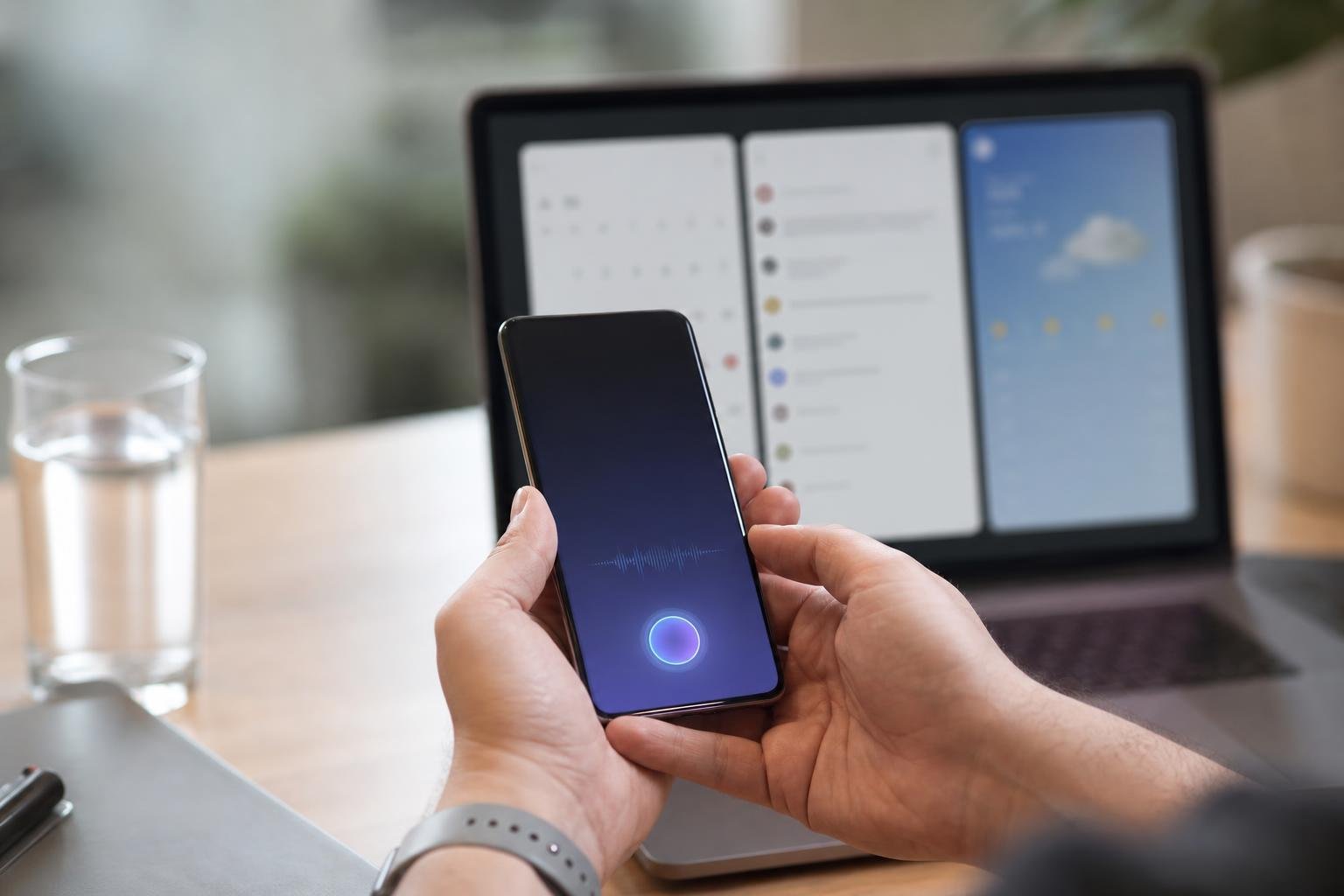
Apple has opened its redesigned, AI-powered Siri to public-beta testers with the release of the iOS 27 public beta on July 14. The rollout moves the new assistant beyond the developer audience and gives a broader group of users access to a Siri designed to search personal device content, understand what is on screen and complete tasks that span multiple apps.[1]
The important change is not simply a more conversational Siri. Apple is testing whether an assistant becomes materially more useful when it can, with appropriate authorization, work across the information and applications that already define a person’s digital life. Its answer relies on a hybrid system of on-device models and Private Cloud Compute, an architecture intended to deliver more capable AI without asking iPhone users to treat their personal data as an ordinary cloud prompt.
By the numbers
- iOS 27: The public-beta release carrying the redesigned Siri
- July 14: Date Apple released the iOS 27 public beta
- First public availability: The new Siri is available beyond developers for the first time
- 2026: Year of the public-beta rollout

From voice commands to personal context
Siri’s earlier design was built primarily around discrete commands: set a timer, send a message, play a song or answer a factual question. The new version is meant to operate on a more continuous understanding of context. According to TechCrunch’s report, it can search personal content on a device, recognize on-screen information and take actions across applications.[1]
Those capabilities matter because many useful requests are not confined to one app. A person may want to identify an appointment mentioned in a message, find related travel details in email and add the relevant information to a calendar. An assistant that can only answer questions or open apps still leaves the user to assemble that workflow. An assistant that can access relevant information and carry out a requested sequence can reduce the manual work.
That is the promise of agentic AI in consumer software: not merely generating text, but selecting information, navigating app boundaries and executing a bounded task. It is also where the practical stakes rise. A system capable of seeing a screen and retrieving personal information can be far more helpful than a general-purpose chatbot, but it also needs clearer limits, reliable confirmation behavior and a defensible approach to sensitive data.
Apple’s hybrid privacy architecture
Apple is positioning the new Siri around two layers of computation: models that run on the device and Private Cloud Compute for requests that need more processing capacity. The on-device layer is central to the company’s privacy case. Processing locally can reduce the need to transmit personal material off the phone and can keep routine intelligence close to the apps and data a user has authorized Siri to access.
Some requests will exceed the capacity of local models. Private Cloud Compute is Apple’s mechanism for handling those more demanding tasks while preserving a tighter privacy model than conventional consumer AI services. In practical terms, this is an attempt to avoid a false choice between a limited offline assistant and a cloud-first assistant whose usefulness may depend on centralizing more user data.
The architecture does not remove the need for trust. The sensitive question is not just where a model runs, but what data is selected for a request, what permissions the assistant has, how long information is retained, whether an action requires confirmation and how users can inspect or revoke access. Public testing will show whether Apple’s safeguards are legible enough in everyday use, rather than merely persuasive in technical descriptions.

A broader test than a Siri redesign
The public beta turns Apple’s Siri effort into a real-world test of a strategy increasingly relevant across the industry. Standalone chatbots can be useful for drafting, research and brainstorming, but they often lack reliable access to the current personal context required to complete tasks. Conversely, operating systems and phone makers already sit at the intersection of communications, photos, files, calendars, browsers and third-party apps.
That position gives platform owners an advantage in building assistants that can act, not just talk. It also creates a higher bar. Users have longstanding expectations that their phones contain private material, including health information, financial messages, location history, photos and work documents. Apple’s commercial opportunity is to make that access feel like an extension of device privacy rather than a trade for AI convenience.
For developers, cross-app Siri workflows could become a new distribution and interaction layer. If users begin asking the assistant to complete tasks rather than opening an app and navigating its interface, developers will need to consider how their services expose actions, handle permissions and communicate the consequences of automated steps. The winners may be apps with clear, reliable task definitions rather than simply the most polished screens.
Early evidence is about access, not proven utility
The initial evidence is necessarily limited. The July 14 public beta establishes that Apple has broadened testing beyond developers, but public-beta availability is not the same as demonstrated reliability at consumer scale.[1] The material provided for this report does not establish independent performance measurements, error rates, adoption figures or representative user feedback.
That distinction is important. Context-aware AI can fail in ways that a conventional voice assistant does not: it can retrieve the wrong item from a similar conversation, infer an incorrect relationship between on-screen content and a personal record, or execute the wrong action across apps. Even a low error rate may be unacceptable for certain categories, such as payments, travel changes, health-related information or messages sent to the wrong recipient.
The most useful early signals will therefore be qualitative as well as technical. Testers will reveal whether Siri asks for confirmation at the right moments, whether its interpretation of a screen matches user intent, whether it handles ambiguous requests transparently and whether it saves enough time to justify granting access. A capable assistant that needs frequent correction may remain a novelty; one that reliably removes a few common, multi-app chores could change how people use their phones.
What Apple and the market need to prove
Apple’s rollout comes after years in which Siri’s perceived capabilities have often lagged expectations set by competing AI products. The company now has to prove three related claims: that its assistant can reason over personal context, that it can take action safely and that its privacy design is not a constraint on usefulness.
The public beta is likely to expose tensions among those goals. More permissive app access can make an assistant more capable, but also raises the consequences of an incorrect inference. More confirmation screens can limit mistakes, but may make a workflow slower than doing it manually. On-device processing can support privacy and responsiveness, while cloud resources may still be necessary for difficult requests. The product challenge is to decide where each trade-off belongs without making users manage the underlying complexity.
If Apple succeeds, the company could establish a model for consumer AI in which personal context is valuable precisely because it is controlled. If it falls short, the result may reinforce the argument that agentic assistants remain best suited to narrow, reversible tasks. Either outcome will shape how phone makers, app developers and cloud AI providers approach the next generation of assistants.
Editor’s Take
I think Apple is pursuing the right product problem: an assistant is valuable when it can finish a real task using the information already on a phone, not when it merely produces an eloquent answer in a separate chat window. The combination of on-device processing and Private Cloud Compute is a pragmatic design, because a phone-sized local model cannot do every job and consumers should not have to accept indiscriminate cloud exposure as the price of better automation.
What I will watch is the failure behavior. The decisive feature will not be whether Siri can demonstrate a complicated cross-app request once; it will be whether it knows when to ask, shows users what it is about to do and makes errors easy to stop or undo. The hype outruns the facts if “personal context” is treated as proof of dependable agency. In this beta, permission design and task reliability matter at least as much as model intelligence.