BIOTRONIK Neuro has launched Embrace One Proactive Intelligence, an artificial-intelligence capability designed to identify emerging support needs among patients using the company’s Prospera spinal-cord-stimulation (SCS) system. The system analyzes more than 200 patient data points per day and flags patterns that may warrant clinician outreach, additional patient support or therapy review. It does not autonomously adjust stimulation settings or change treatment. [1]
The distinction is important. Medical AI is often discussed in terms of diagnosis or automated clinical decisions, but a nearer-term use case may be operational and clinical triage: helping care teams detect when a patient with an implanted therapy may be struggling before that patient disengages, waits for a routine appointment or stops using therapy effectively. For spinal-stimulation providers, that could make follow-up more continuous without handing treatment decisions to software.
By the Numbers
- More than 200: data points analyzed per patient each day, according to BIOTRONIK Neuro.
- 0: autonomous therapy changes made by Embrace One Proactive Intelligence.
- 1: early evidence venue cited for the pilot data: the American Society of Pain and Neuroscience annual meeting in Miami Beach.
From implanted device to ongoing care signal
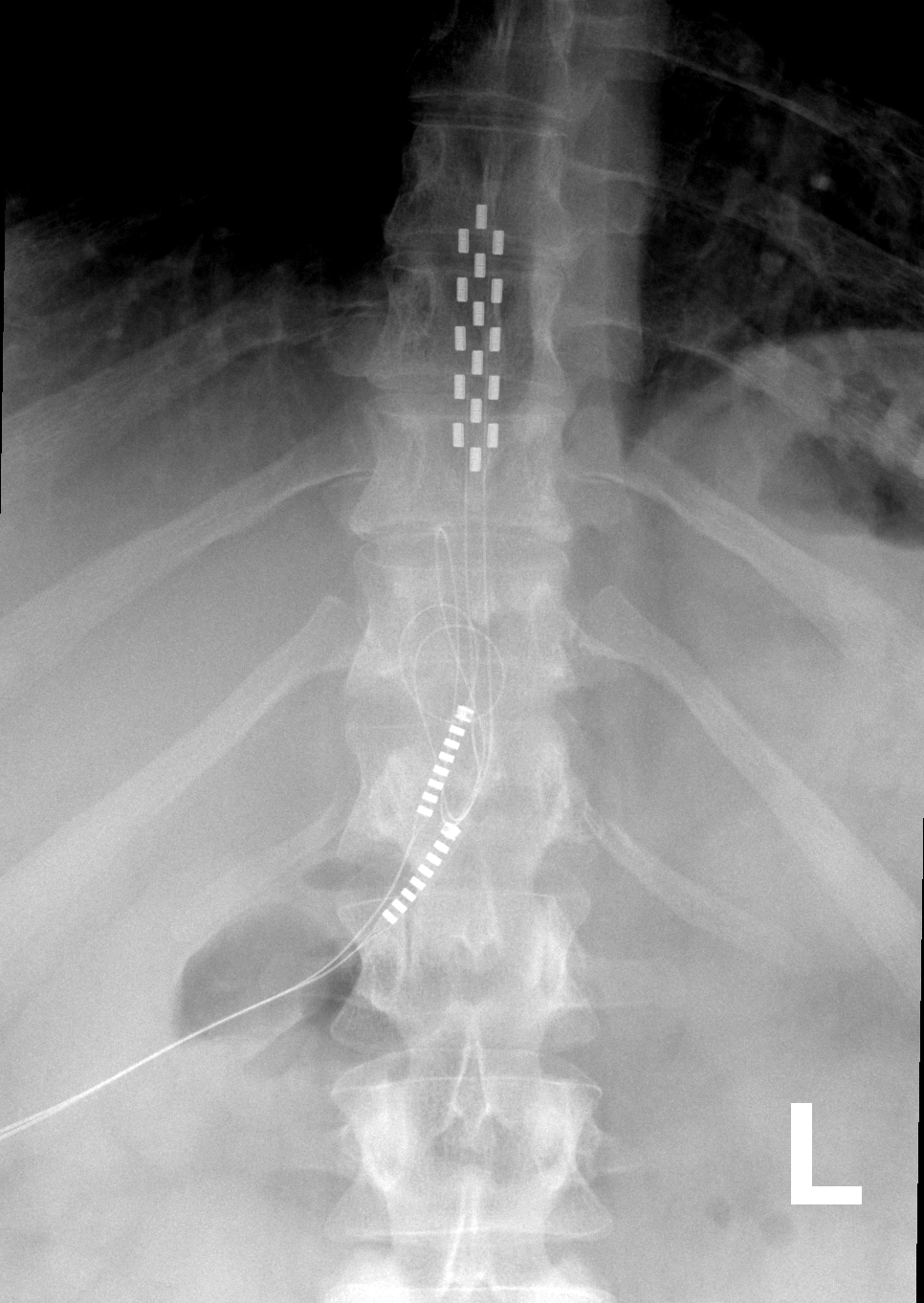
Spinal-cord stimulation is used in chronic-pain management. An implanted system delivers electrical stimulation intended to alter pain signaling, while clinicians and patients work over time to find settings, usage patterns and follow-up arrangements that support durable benefit. That process does not end when the implant procedure is complete.
Patients can need help for many reasons: a change in symptoms, uncertainty about using the system, reduced engagement, charging or device-management difficulties, or a need to revisit therapy settings with a clinician. These issues may be clinically meaningful even when they do not constitute an emergency. Yet conventional follow-up can depend heavily on scheduled visits and on patients recognizing that a problem is worth reporting.
BIOTRONIK’s stated approach is to use the data generated around Prospera therapy to identify signals associated with an emerging need for support. The company positions Embrace One as a proactive layer for care management and triage, rather than as a replacement for clinical judgment or an automated controller of stimulation. [1]
What the AI does—and does not do
The practical workflow described by the company is a flagging model. The AI analyzes daily information and identifies patients whose patterns may suggest that they would benefit from attention. A clinician or support team can then decide whether outreach, education, troubleshooting, a follow-up visit or a therapy review is appropriate.
That is a materially narrower claim than autonomous treatment optimization. Embrace One does not independently change stimulation parameters, prescribe care or determine a diagnosis. Any response remains with the care team and patient. This design may be more compatible with the way implanted-device programs operate today, where technical, clinical and patient-support decisions often require context that is not captured in a device data stream.
The distinction also matters for evaluating the technology. The core question is not simply whether an algorithm can detect unusual patterns in a large set of data points. It is whether those flags lead to timely, appropriate interventions and better patient outcomes without overwhelming clinics with low-value alerts.
Early evidence and the validation gap
BIOTRONIK Neuro said pilot data related to the capability were presented at the American Society of Pain and Neuroscience annual meeting in Miami Beach. The announcement identifies investigators including Marc Russo, Jason Yu, Kasra Amirdelfan, Jason Pope, Leonardo Kapural and Christopher Gilligan in connection with prior and related work. [1]
Presentation at a specialty meeting is a useful early dissemination step, particularly in a field where clinicians need to understand how a new workflow fits into real practice. It is not, however, equivalent to a peer-reviewed outcomes study. The announcement does not by itself establish whether AI-guided outreach improves pain relief, functional outcomes, therapy adherence, retention, satisfaction, adverse-event detection or the efficiency of clinic operations.
Those are the measures that will determine the technology’s value. Stronger evidence would compare AI-supported monitoring with standard follow-up, report the precision and clinical usefulness of alerts, and show what happened after patients were contacted. It should also examine whether performance holds across different patient populations and care settings.
A market shift toward managed neuromodulation
For the neuromodulation market, Embrace One points toward a broader competition beyond implant hardware and stimulation waveforms. Device makers increasingly have an incentive to build services around the patient journey: remote monitoring, structured follow-up, support coordination and tools that help clinical teams focus scarce time on patients most likely to need help.
Prospera is BIOTRONIK Neuro’s SCS platform, and the company describes its associated digital capabilities as supporting the management of therapy over time. [2] An AI triage layer could make that platform more operationally valuable to practices if it reduces avoidable patient drop-off and helps teams intervene earlier.
But deployment will depend on workflow design. Clinics need clear ownership of alerts, escalation protocols, documentation practices and realistic service-level expectations. A signal is useful only if a trained person can interpret it and act on it. The most successful systems will likely be those that suppress noise, present a concise reason for each flag and fit into the channels clinicians already use to manage patient follow-up.
Privacy, accountability and the next test
Continuous analysis of patient-generated data also raises familiar but consequential questions. Providers and manufacturers will need to define what data are used, who can access them, how long they are retained, and how patients understand the monitoring relationship. Clinical teams also need to know the limits of the model: what it can detect, what it may miss and when a lack of alert should not be treated as reassurance.
The next phase for Embrace One will therefore be less about the size of its daily data feed than about demonstrated care impact. If the system can reliably surface patients who would otherwise fall through the cracks, and if care teams can respond without creating alert fatigue, it could represent a useful model for AI in implanted-device care. If it merely adds dashboards and notifications without improving outcomes, it will be another digital layer competing for clinical attention.
Editor’s Take
I think BIOTRONIK is aiming at one of the more credible immediate uses of medical AI: making sure an implanted therapy does not become invisible between appointments. The useful innovation is not an algorithm turning the stimulation up or down on its own. It is a disciplined way to tell a care team, early enough to matter, that a particular patient may need a human conversation.
The commercial and clinical test is straightforward. I would watch for data showing the alert rate, the fraction of alerts that lead to meaningful action, response times and patient outcomes versus ordinary follow-up. “More than 200 data points a day” sounds impressive, but the only number that ultimately matters is how many patients receive better, more timely care because a signal was recognized and acted upon.
References
- PR Newswire, BIOTRONIK Neuro launch announcement – https://www.prnewswire.com/news-releases/biotronik-neuro-launches-embrace-one-proactive-intelligence-a-proprietary-ai-capability-that-identifies-emerging-support-needs-in-scs-patients-302828708.html
- BIOTRONIK, Prospera SCS product information – https://www.biotronik.com/en-us/professionals/prospera-scs