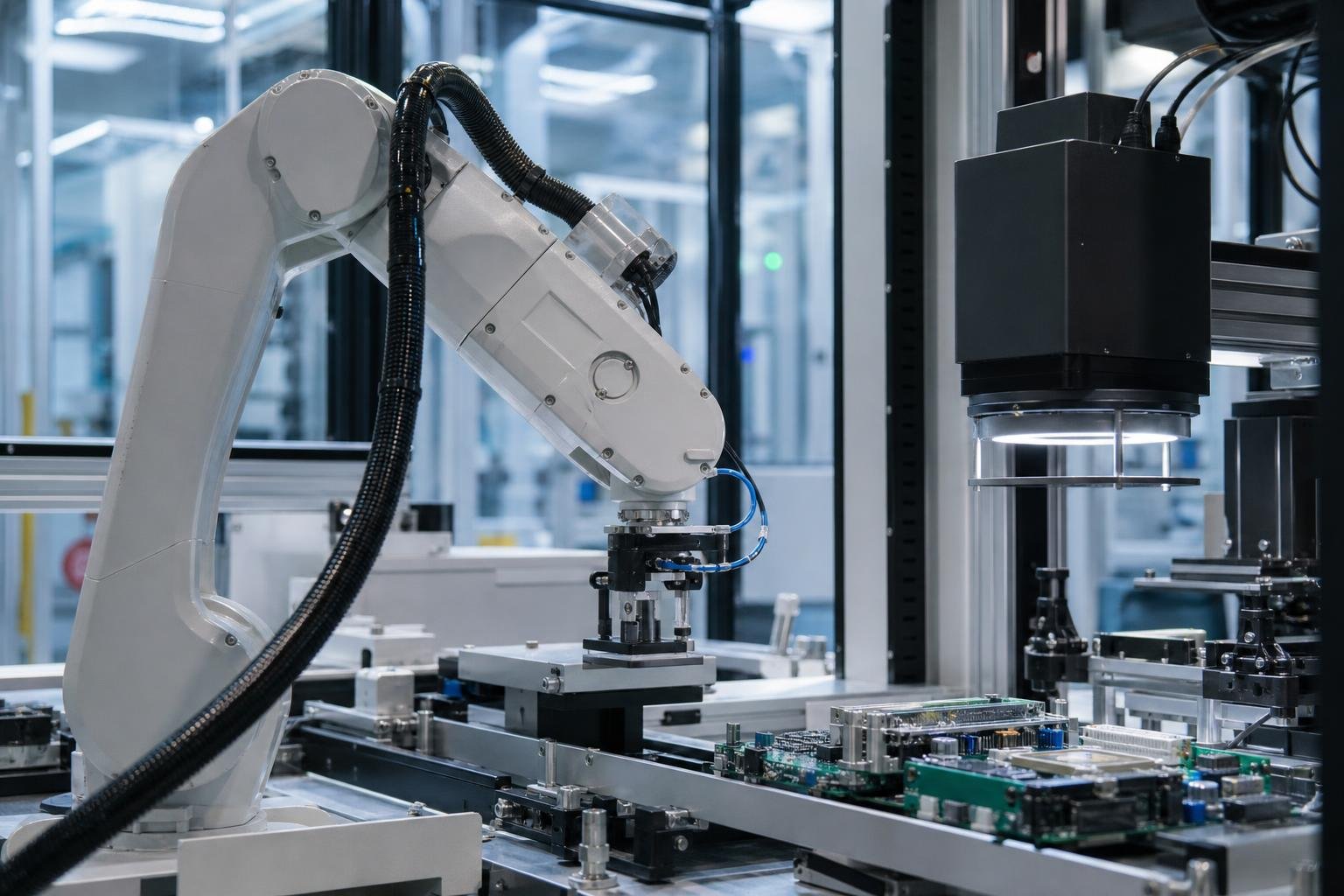
NEURA Robotics and Italian embedded-computing company SECO have announced a partnership to develop and manufacture compute modules for NEURA’s cognitive-robot portfolio, including the 4NE1 humanoid. The companies also say they intend to use real-world production data to develop automation systems aimed at semiconductor and electronics manufacturing.[1]
The significance is less about the appearance of another humanoid robot than about the infrastructure behind one. A robot manufacturer that wants to move from demonstrations to repeatable deployments needs reliable embedded computing, a manufacturable supply chain, production data from actual environments, and applications narrow enough to justify installation. The announcement presents a plan to assemble those elements in Europe. It does not, however, establish that those systems are already operating on customer factory floors.
By the numbers
- 2 companies: NEURA Robotics and SECO are party to the announced collaboration.
- 1 humanoid platform: NEURA’s 4NE1 is specifically named as a target for the compute-module work.
- 2 manufacturing sectors: the partners identify semiconductor and electronics production as intended automation targets.
- September 7, 2026: date of SECO’s partnership announcement.
From robot design to an industrial compute platform
Compute hardware is central to physical AI because robots must process sensor inputs, interpret their surroundings, plan motion, apply safety rules and control actuators under tight timing constraints. Unlike a conventional cloud application, a production robot cannot rely on a distant data center for every decision. It needs local, dependable computing that fits its electrical, thermal, mechanical and lifecycle requirements.
SECO’s role, as described in the announcement, is to work with NEURA on compute modules that can be developed and manufactured for the robot maker’s systems. That is a more consequential task than supplying a generic processor board. A production-ready module must be designed around the robot’s sensor set, power budget, cooling arrangement, software stack, serviceability and expected operating life. Standardizing that layer can reduce the amount of bespoke hardware work required for each robot configuration and can make qualification, procurement and support more repeatable.
The press release frames the collaboration around NEURA’s “cognitive robots,” a term the company uses for machines intended to perceive and act in changing physical settings. The 4NE1 humanoid is the highest-profile example named in the release, but the practical value of the partnership would depend on whether a shared embedded-compute foundation can support multiple robot products and factory tasks rather than a single showcase machine.
Neither company disclosed processor choices, performance specifications, operating-system details, functional-safety certification plans, production volumes or a timetable for module availability. Those omissions matter. They leave open whether the work will result in a broadly reusable computing platform, a custom design for NEURA alone, or an early engineering program that remains some distance from volume manufacturing.
Production data is the harder industrial asset
The second part of the agreement is a plan to collect real-world production data and use it in developing factory automation. This may prove more important than the module itself. Robotics systems can be trained and tested in simulations, but industrial deployment exposes them to the conditions that make automation difficult: variable parts, reflections and occlusions, changing work instructions, fixture tolerances, component-handling errors, maintenance interruptions and the need to work around people and existing equipment.
Data from operating production environments can help improve perception models, exception handling, task planning and the monitoring systems used to identify failures. It can also reveal where automation is economically worthwhile and where it is not. For a robotics supplier, that feedback loop is part of the route from an impressive general-purpose platform to a machine that integrators and manufacturers can support.
Yet the announcement should not be read as evidence of an established industrial data network. The companies say they plan to collect production data and develop automation systems; they do not identify plants, customers, installed systems, data volumes, benchmarks or measured productivity outcomes. Semiconductor and electronics factories also impose strict requirements around intellectual property, traceability, cybersecurity, uptime and process control. Any data program will need clear governance over what is captured, where it is processed, who may access it and how it is separated from sensitive customer information.
A focused entry point for physical AI
Semiconductor and electronics manufacturing are logical, if demanding, targets. Both sectors contain repetitive material movement, machine tending, inspection, assembly and handling tasks. They also feature high-value components and processes where errors, contamination, electrostatic discharge, traceability failures or unplanned downtime can be costly. That creates room for automation, but it also sets a higher bar for reliability than a broad humanoid demonstration suggests.
The partnership’s stated focus is notable because it narrows the question from whether a humanoid can perform many tasks to whether a robotic system can solve selected production problems with measurable operational value. In factory settings, the winning implementation may not always be a fully humanoid robot. Fixed automation, mobile robots, dedicated end effectors and conventional machine-vision systems can be better suited to many jobs. A cognitive robot needs to demonstrate an advantage in flexibility, reconfiguration or access to workspaces designed around human operators.
That is why compute standardization and data collection belong together. The compute platform can make robot configurations easier to reproduce; production data can make the software more robust in the environments where those configurations are used. Neither removes the need for systems integration, safety validation, maintenance processes and customer acceptance testing.
What the European partnership changes—and what it does not
For NEURA, SECO provides an embedded-computing partner based in Italy, potentially bringing product engineering and manufacturing expertise closer to the robot maker’s European operations. For SECO, the collaboration offers a route into robotics at a point where demand may shift from development kits and pilot hardware toward purpose-built, lifecycle-managed modules.
The strategic attraction is a more regionalized industrial stack. European robotics companies often depend on globally distributed suppliers for processors, boards, sensors, manufacturing and cloud infrastructure. A closer hardware partnership can improve coordination and give both parties more control over product changes, component availability and support. It does not mean the resulting hardware will be wholly European: embedded modules typically rely on international semiconductor, memory, connectivity and power-component supply chains.
Nor does the announcement demonstrate commercial scale by itself. It contains no disclosed purchase commitment, customer deployment count, manufacturing capacity, installation schedule or revenue forecast. Those are the indicators that will determine whether the arrangement has moved beyond a strategically sensible development agreement. The meaningful milestones will be production-qualified module designs, named factory programs, validated task performance and repeat orders.
The test is deployment discipline
Physical AI is often presented as a contest to build the most humanlike machine. In industry, it is more often a contest to deliver the lowest-risk system that can complete a useful task over thousands of cycles, recover from exceptions and fit the customer’s operational economics. The NEURA-SECO agreement addresses several of the less visible prerequisites for that outcome: embedded hardware, manufacturability, production feedback and a sector-specific starting point.
Its credibility will therefore be judged not by the 4NE1’s public profile but by execution details that have yet to be announced. Observers should look for clarity on the modules’ intended standardization, safety and lifecycle support; on whether factory data is gathered from live production; and on the first concrete applications in semiconductor and electronics facilities. A partnership is a credible first step. Operating installations with independently understandable performance results would be the proof.
Editor’s Take
I view this as a more useful announcement than a new robot video, precisely because compute modules and factory data are not glamorous. If NEURA and SECO can turn a custom robot-computing design into a supportable, repeatable module, they can remove a real bottleneck between a prototype and a product that a factory can maintain for years.
The important caveat is that the release describes intentions, not a deployed production fleet. I would watch for the first named manufacturing use case, the degree to which the module is reused across NEURA products, and evidence that the data loop improves a specific task such as handling, inspection or machine tending. Semiconductor and electronics plants will reward reliability and integration discipline, not humanoid novelty. That makes this a sensible target, but also an unforgiving one.