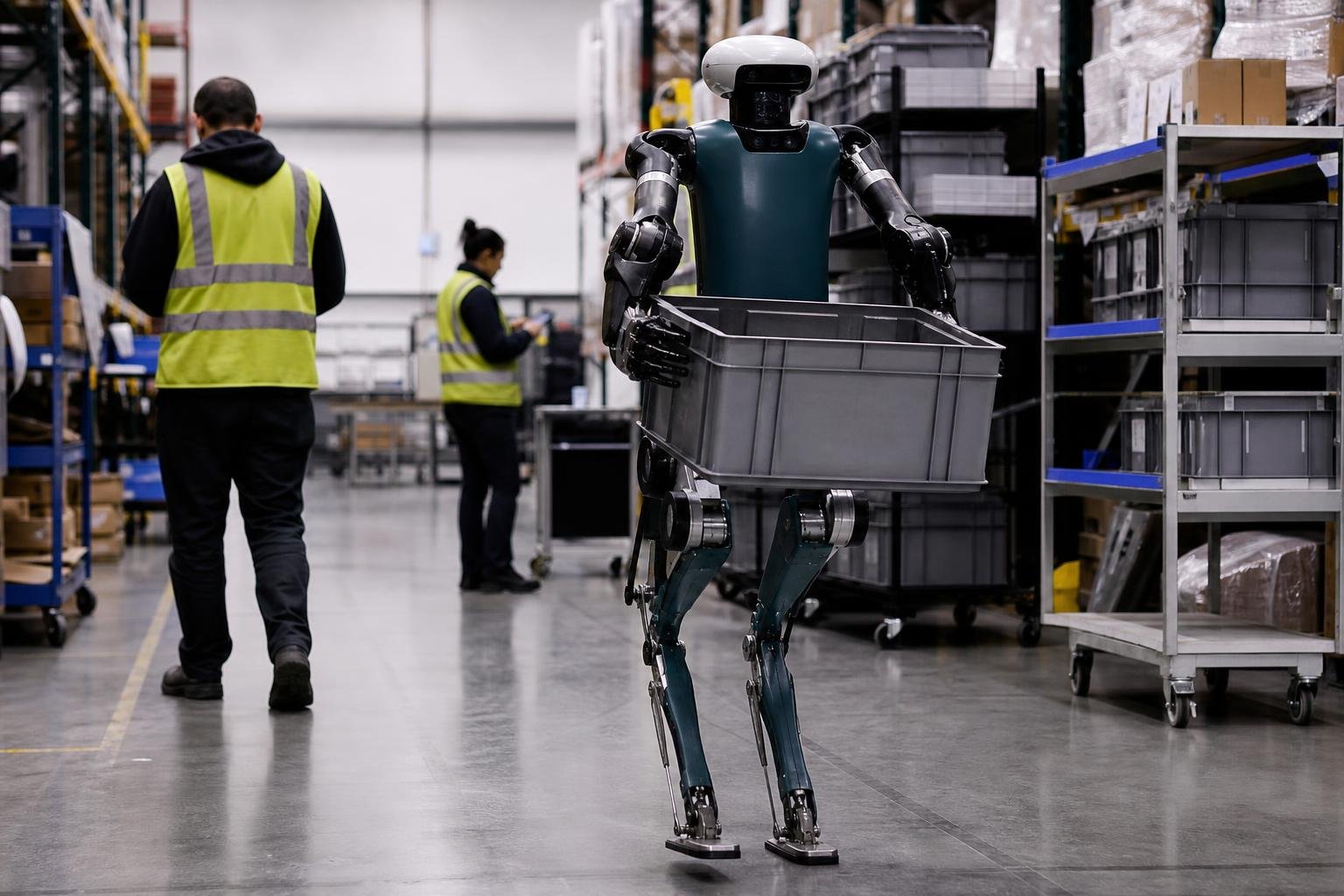
Agility Robotics has introduced Digit 5, the latest version of its bipedal warehouse robot, positioning it as a humanoid system built to work cooperatively around people without the physical safety barriers common in conventional industrial automation. The company says the platform incorporates lessons from more than 65,000 operating hours and is supported by more than $300 million in multi-year customer orders.[1]
Those figures make the announcement more consequential than a typical humanoid-robot unveiling. The central question is not whether Digit 5 can perform a compelling demonstration, but whether accumulated field operation, safety engineering and contracted demand can turn a technically striking robot into dependable equipment with a defensible cost model inside working warehouses and factories.
By the numbers
- 65,000+ hours: operating experience Agility says informed Digit 5.
- $300 million+: multi-year customer orders disclosed by the company.
- Digit 5: the newly announced generation of Agility’s humanoid robot platform.
Operational evidence is becoming the real product
Humanoid robotics has attracted intense attention because a human-shaped machine can, in principle, use buildings, aisles, shelves, bins and workflows designed around people. But the category has often been judged through short, controlled demonstrations: walking, picking an item, opening a door or completing a tightly defined task. Those demonstrations establish useful technical capabilities, but they reveal relatively little about uptime, recovery from errors, maintenance burden, fleet management or integration with a customer’s existing operating procedures.
Agility’s 65,000-hour claim matters because it shifts the conversation toward that less visible evidence. Operating hours can expose failures that are hard to discover in a lab: sensor degradation, cable and joint wear, navigation errors caused by changing inventory, inconsistent tote presentation, interruptions in wireless connectivity, and the many small edge cases created by workers sharing a facility. The company is presenting Digit 5 as a product shaped by that feedback rather than a clean-sheet prototype.[1]
That does not mean 65,000 hours alone proves broad commercial readiness. The number is most informative when paired with details that have not been established in the announcement: how those hours were distributed across sites and robots; what proportion involved autonomous productive work; task completion and intervention rates; mean time between failures; planned maintenance; and the availability achieved by customer fleets. A total can represent substantial experience while still masking a difficult long tail of operational problems.
For buyers, the more meaningful test is whether the lessons from those hours have been translated into predictable service levels. Warehouse operators do not purchase a robot for an aggregate runtime statistic. They purchase completed moves per shift, safe behavior during exceptions, minimal disruption to labor planning, and a support model that can keep equipment productive during peak demand.
What cooperative safety changes
Traditional industrial robots commonly achieve safety through separation. Fixed fencing, light curtains, safety-rated scanners and carefully constrained work cells prevent a person from entering a robot’s hazardous space while it operates at speed. This approach is effective and well understood, but it can be expensive to install and can make automation inflexible when a process or facility layout changes.
Agility says Digit 5 is designed for cooperatively safe work at scale, allowing it to operate near people without the physical barriers used by many conventional systems.[1] If that capability performs as described in customer facilities, it could materially change the deployment equation. A mobile robot that can be assigned to a workflow without constructing a dedicated cage can fit more readily into existing buildings, especially sites where people, conveyors, carts and storage areas must coexist.
Barrier-free operation is not the same as barrier-free risk. A mobile, human-scale robot introduces safety questions beyond the simple presence of fencing: how it detects people and obstacles; how it limits motion, force and speed near workers; how it behaves after a perception fault or loss of localization; how it signals its intentions; and how readily employees can stop, move around or recover the machine. Safe collaboration also depends on the task. Handling empty totes in a mapped area is a different risk problem from carrying irregular, heavy or unstable loads through an active aisle.
The practical measure will therefore be the quality of the whole deployment, not a single sensor or a marketing label. This includes hazard analysis for each site, safety-rated controls where required, commissioning procedures, worker training, clear operating boundaries and incident reporting. In many facilities, some virtual zones, speed restrictions or operational separation may remain necessary even if permanent metal fencing is not.
Customer orders are stronger than interest, but not deployment proof
Agility’s disclosure of more than $300 million in multi-year orders is another notable distinction. Announcements of pilots, memoranda of understanding and research partnerships are common across robotics. Multi-year orders indicate that customers have made a more concrete procurement commitment, and they suggest that buyers see a route to using the platform beyond a one-off trial.[1]
Yet order value should not be conflated with recognized revenue, delivered units or successful production-scale operation. The announcement does not, by itself, identify the customers, specify unit volumes, disclose delivery schedules, or establish the commercial terms behind the orders. Depending on contract structure, multi-year figures can include hardware, software, support, deployment services or future expansion commitments. Those distinctions matter when assessing both Agility’s manufacturing execution and customers’ realized return on investment.
The key organizations in this story are therefore Agility Robotics, which must manufacture and support Digit 5 at scale, and its customers, which must integrate the robot into real material-handling processes. The customers’ identities and facility-level results were not detailed in the company’s announcement. Independent performance data from those sites would be more valuable than another staged demonstration because it would show whether the robot improves throughput or labor flexibility under normal operating variability.
The warehouse economics test
Humanoids are not automatically the lowest-cost way to automate a warehouse. Fixed conveyors, automated storage systems, autonomous mobile robots and specialized robotic cells can be cheaper, faster or more reliable when a process is stable and a building can be designed around the equipment. Their advantage is specialization.
Digit’s opportunity lies where specialization is costly: facilities built for human labor, changing workflows, seasonal volume swings and jobs that involve moving through human-oriented spaces. A bipedal form can potentially reach workstations and navigate layouts without demanding a major redesign. The value proposition becomes stronger if the same fleet can take on multiple repeatable tasks over its life rather than being dedicated to one narrow station.
That flexibility carries a penalty. A humanoid has many moving parts, must balance dynamically, and combines mobility, perception and manipulation in a single system. Each capability adds potential failure modes and service requirements. The economic case must account for acquisition or subscription cost, charging, monitoring, remote assistance, on-site support, spare parts, software integration, safety validation and lost productivity during downtime. It must also be measured against the job actually displaced or augmented, not against an abstract estimate of human labor cost.
Agility’s operating-hour and order claims suggest that the company is attempting to answer this question with deployed systems and purchase commitments. The next evidence should be more operationally specific: utilization per robot, task success under changing conditions, human-assistance rates, time required to deploy a new workflow, and whether customers expand fleets after the initial contract period.
What Digit 5 signals for the humanoid market
Digit 5 arrives as numerous companies pursue general-purpose humanoids for logistics, manufacturing and other labor-intensive environments. The competitive issue is increasingly less about whether a robot can walk on two legs and more about who can turn that ability into a safe, serviceable and scalable product. That requires a supply chain, production discipline, controls software, fleet operations, customer implementation expertise and a credible path to maintenance.
Agility’s emphasis on operational hours and contracted orders is a useful marker for the market. It raises the standard by which humanoid claims should be evaluated: not a video clip, but evidence of sustained work, safety performance, customer renewal and unit economics. It also reflects a practical reality of industrial automation. Customers may accept a robot that is limited to a defined set of tasks if it is reliable, manageable and productive; they do not need a human-like machine that can do everything.
For the wider sector, Digit 5 may help clarify where humanoids are genuinely differentiated. If it can be deployed in existing facilities with less physical infrastructure and without compromising safety or availability, it could expand the range of workflows worth automating. If deployments still require frequent human intervention, extensive site controls or unusually favorable task conditions, then conventional automation will remain the more economical choice for many operations.
Editor’s Take
I regard the 65,000-hour figure as more important than Digit 5’s appearance. Hours in operating environments are where robotics teams learn which component, software behavior and recovery procedure actually determines whether a customer gets value. Agility is right to frame this as cooperative work and commercial scale rather than simply another claim of human-like capability.
But I would not treat the order total as a verdict yet. The evidence that matters next is fleet-level: productive uptime, interventions per shift, safety performance around ordinary workers, maintenance cost and follow-on deployments at named facilities. If Digit 5 can deliver those metrics while avoiding major building modifications, it will have a meaningful advantage. If the economics depend on carefully controlled environments and continuous expert support, the humanoid narrative will still be ahead of the product reality.