Researchers at Princeton University and the Princeton Plasma Physics Laboratory (PPPL) have tested an artificial-intelligence framework designed to do more than forecast fusion-plasma problems: it makes a control decision quickly enough to act on the forecast. In five real fusion experiments, the PACMAN system operated on roughly 20-millisecond timescales and, in one reported case, identified a dangerous instability about 200 milliseconds before it emerged.
That distinction matters. Fusion devices already use sophisticated feedback controls, but plasma disruptions and other instabilities can develop too quickly for conventional reactive approaches to reliably contain. PACMAN’s early result is evidence that machine learning could help shift plasma operations toward anticipatory control—detecting a deteriorating state, selecting an intervention, and applying it before the plasma becomes disruptive. It is an early experimental validation, however, not evidence that fusion control or commercial fusion has been solved.[1]
By the numbers
- 5 experiments: Real fusion experiments reported for PACMAN’s test campaign.
- About 20 milliseconds: Timescale for the framework’s control decisions.
- About 200 milliseconds: Reported warning lead time before a dangerous plasma instability appeared in one case.
Why closing the control loop is the advance
Forecasting plasma behavior is valuable, but a useful forecast must arrive before the available response window closes. PACMAN’s significance is therefore not simply that an AI model identified a difficult physical event. The key claim is that the system used its prediction in a live control loop.
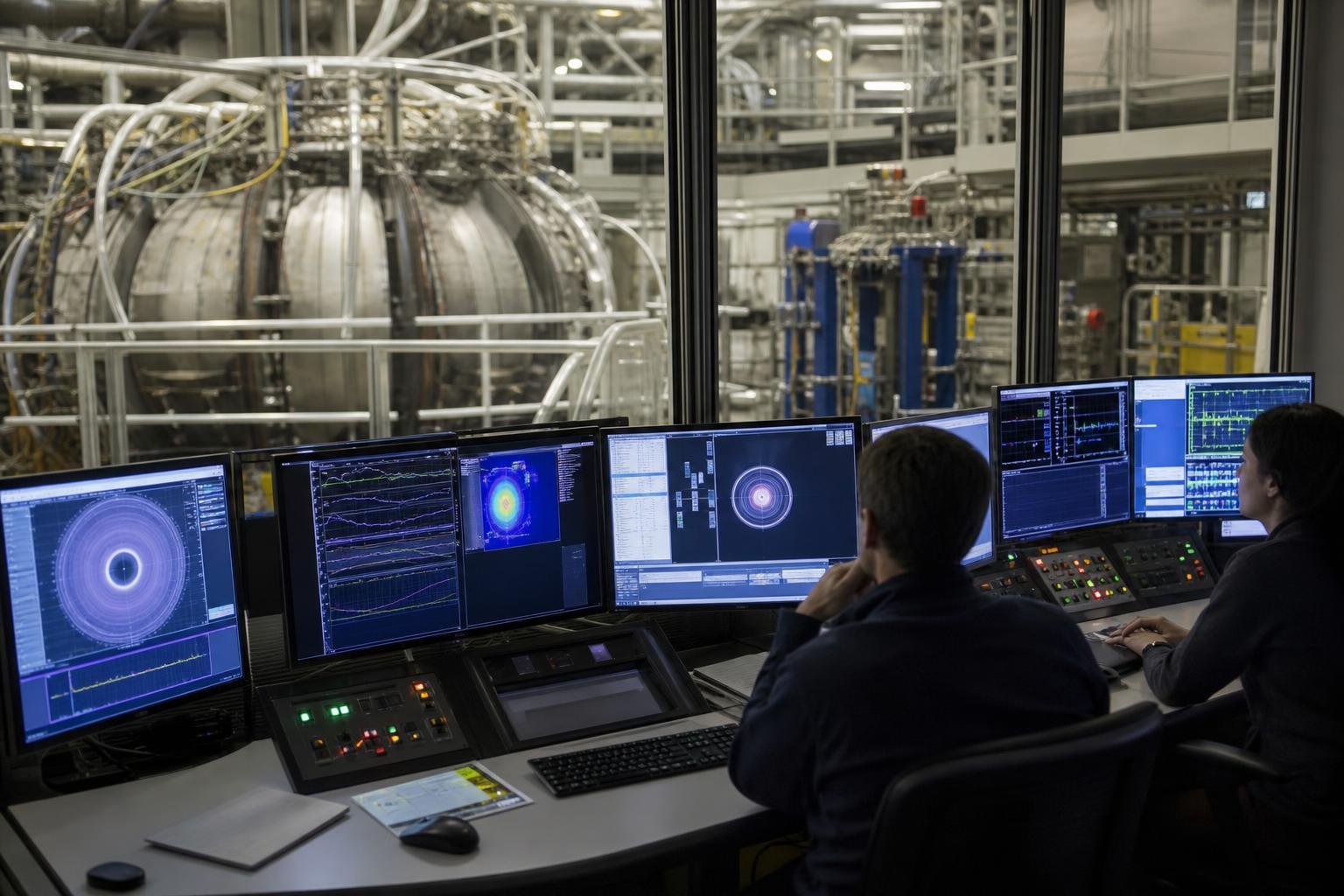
In a feedback-control system, sensors measure the state of a machine; a controller compares that state with the desired operating condition; and actuators alter the machine in response. For a fusion plasma, relevant measurements can include magnetic, electrical, thermal and density-related diagnostic signals. Actuators may adjust parameters such as heating, magnetic fields or fuel-related inputs, depending on the experimental device and the control objective.
Traditional control systems are often designed around known operating regimes and predefined responses. A machine-learning-based framework can potentially identify patterns across many signals that precede an unwanted transition, then choose a corrective action based on an evolving estimate of the plasma state. That does not eliminate the need for physics-based models or safety systems. It changes the role of AI from an offline analysis tool into a component of real-time operation.
The reported 200-millisecond warning is particularly important in that context. A quarter of a second would be unremarkable in many industrial systems, but it can be consequential in a fast-changing magnetically confined plasma. A warning that is both sufficiently early and tied to an intervention can provide time for the controller to steer the discharge away from a hazardous trajectory rather than merely react after conditions have deteriorated.[1]
What PACMAN demonstrated—and what it did not
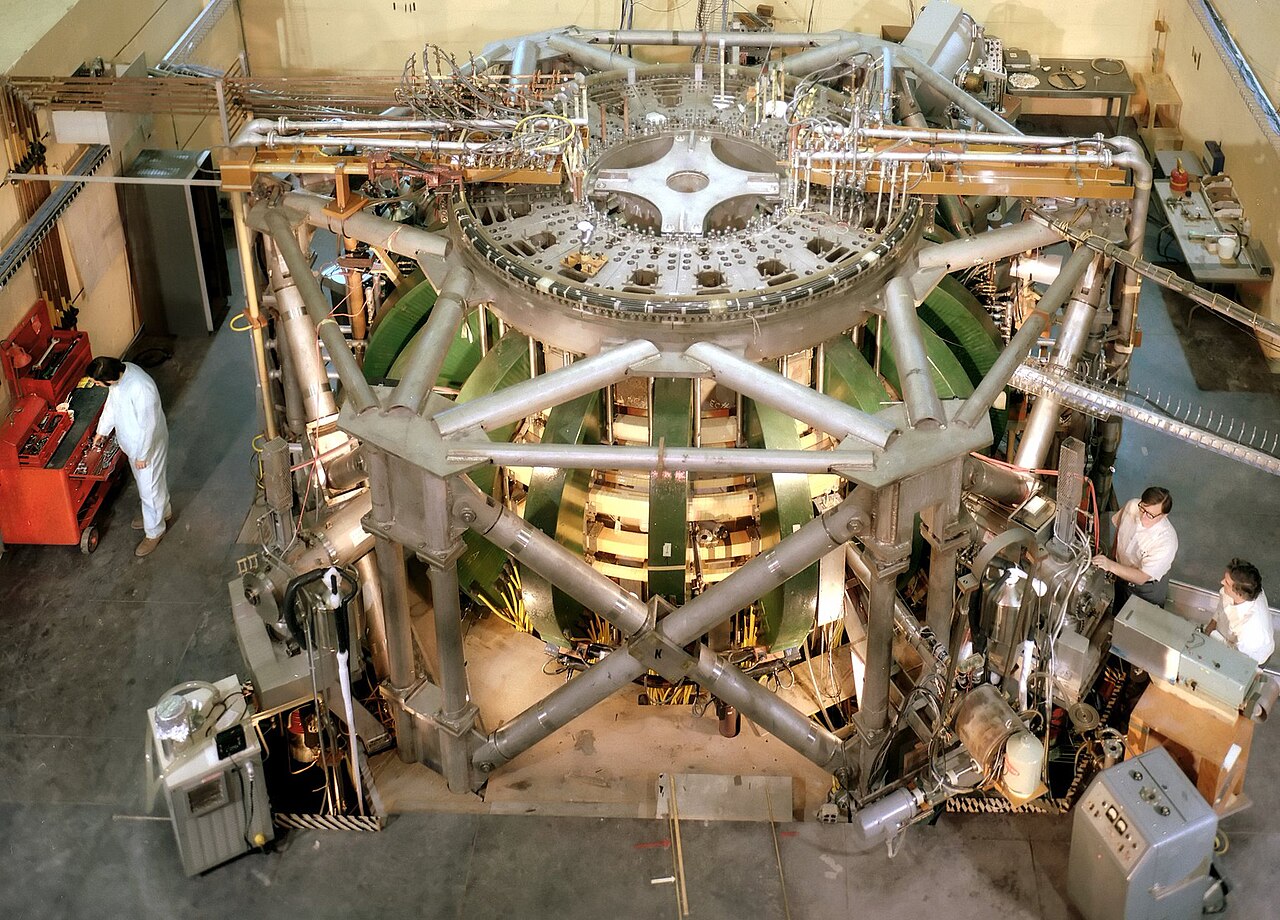
Princeton and PPPL researchers tested PACMAN in five real experiments, according to the report. Demonstrating operation on an experimental fusion system is a meaningful step beyond simulation-only work. Real devices introduce diagnostic noise, imperfect actuator response, changing plasma conditions and strict operational constraints that models do not always capture.
Still, five experiments are a narrow validation set. The results do not establish that the approach generalizes across every plasma scenario, device configuration or instability type. They also do not show that a controller will retain performance over the long, high-power plasma pulses sought by future fusion plants.
Several technical questions will determine how far the result can travel:
- Robustness: The controller must work despite sensor faults, noisy measurements, actuator delays and operating conditions outside its training distribution.
- Generalization: Performance needs to be tested across a much larger range of plasma conditions, including events that were rare or absent in the initial campaign.
- Control authority: Early prediction only helps if the machine has an actuator capable of changing the plasma’s trajectory safely and fast enough.
- Interpretability and verification: Operators and regulators will need evidence that an AI-selected response is safe, bounded and compatible with conventional protection systems.
- Portability: A method proven on one experimental platform must be adapted and validated for different geometries, diagnostics and control hardware.
These are standard challenges for high-consequence industrial control, but fusion amplifies them. The plasma is nonlinear, coupled to its surrounding hardware and subject to operating boundaries that can change over the course of a discharge. An AI controller must be fast without becoming unpredictable.
A practical path from reactive protection to anticipatory operation
Plasma instabilities are not merely a scientific inconvenience. In large magnetic-confinement devices, severe disruptions can terminate a plasma discharge and place thermal, electromagnetic and mechanical stress on components. Avoiding them can improve experimental productivity, protect equipment and expand the range of operating conditions researchers can investigate.
That makes predictive control commercially relevant even before a power-producing fusion plant exists. Companies and public laboratories developing tokamaks and related magnetic-confinement systems need more reliable plasma operation to increase availability, shorten development cycles and make better use of expensive facilities. A controller that safely avoids unstable regions could reduce aborted runs and allow operators to approach performance limits with more confidence.
For the fusion industry, the likely near-term value is operational rather than transformational. AI will not substitute for magnets, materials, heat-exhaust systems, tritium handling, licensing or the economics of building power plants. But control software can become a force multiplier for all of those investments if it increases the fraction of planned operating time that produces useful data or sustained plasma performance.
The broader market implication is that fusion developers may increasingly treat controls, diagnostic data infrastructure and validation tooling as core engineering assets rather than secondary software layers. The most valuable systems will probably combine machine learning with established plasma physics, real-time constraints and hard safety limits—not replace those elements with a black-box model.
How researchers and industry should assess the result
The appropriate reading of PACMAN is cautiously positive. It addresses a real bottleneck: converting a prediction into an intervention before a plasma event becomes unrecoverable. That is a higher bar than producing an accurate offline classifier after an experiment has ended.
At the same time, the reported results should not be treated as a direct measure of readiness for a demonstration power plant. One successful early warning in a small experimental set is not a statistically complete reliability case. Future reports will need to show repeated performance, false-positive and false-negative behavior, the specific class of instability addressed, the actions selected by the controller and the consequences of those actions for plasma performance.
Independent replication will also matter. Fusion-control methods frequently perform differently when transferred to another machine because the sensors, time constants, magnetic configuration and operational envelopes differ. A strong next phase would test whether PACMAN can be retrained or adapted efficiently while maintaining explicit safety boundaries on multiple devices.
What comes next for AI in fusion control
Near-term research is likely to focus on broadening the experimental record: more shots, more operating regimes, more instability scenarios and more tests of controller behavior under imperfect diagnostics. The central metric will not be prediction accuracy alone. It will be whether an AI-guided action measurably improves plasma stability without imposing unacceptable constraints on performance.
Longer term, predictive controllers could be integrated with digital twins, physics-informed models and conventional supervisory systems. In such an architecture, machine learning would handle rapid recognition and policy selection, physics models would help constrain predictions, and certified protection layers would retain authority over unsafe states. That layered approach is more plausible for fusion than handing open-ended control to an unconstrained model.
PACMAN’s five-experiment demonstration therefore represents a useful milestone in fusion automation. It suggests that AI can operate inside the timing requirements of live plasma control and can, at least in an early test, identify a problem with enough lead time to change the outcome. The hard work now is proving reliability at scale.
Editor’s Take
I see the 200-millisecond warning as the story’s most important number, not because it is large, but because it is usable. A forecast with no remaining actuation window is a dashboard alert. A forecast that gives a controller time to intervene is an operational capability.
The hype would be claiming that five experiments make autonomous fusion routine. They do not. What is genuinely encouraging is the direction of travel: fusion programs are beginning to test AI where it has to meet real hardware, real timing and real safety constraints. The next results to watch are repeated interventions across varied plasma conditions, clear false-alarm rates and evidence that the controller improves uptime rather than simply avoiding risk by operating conservatively.