
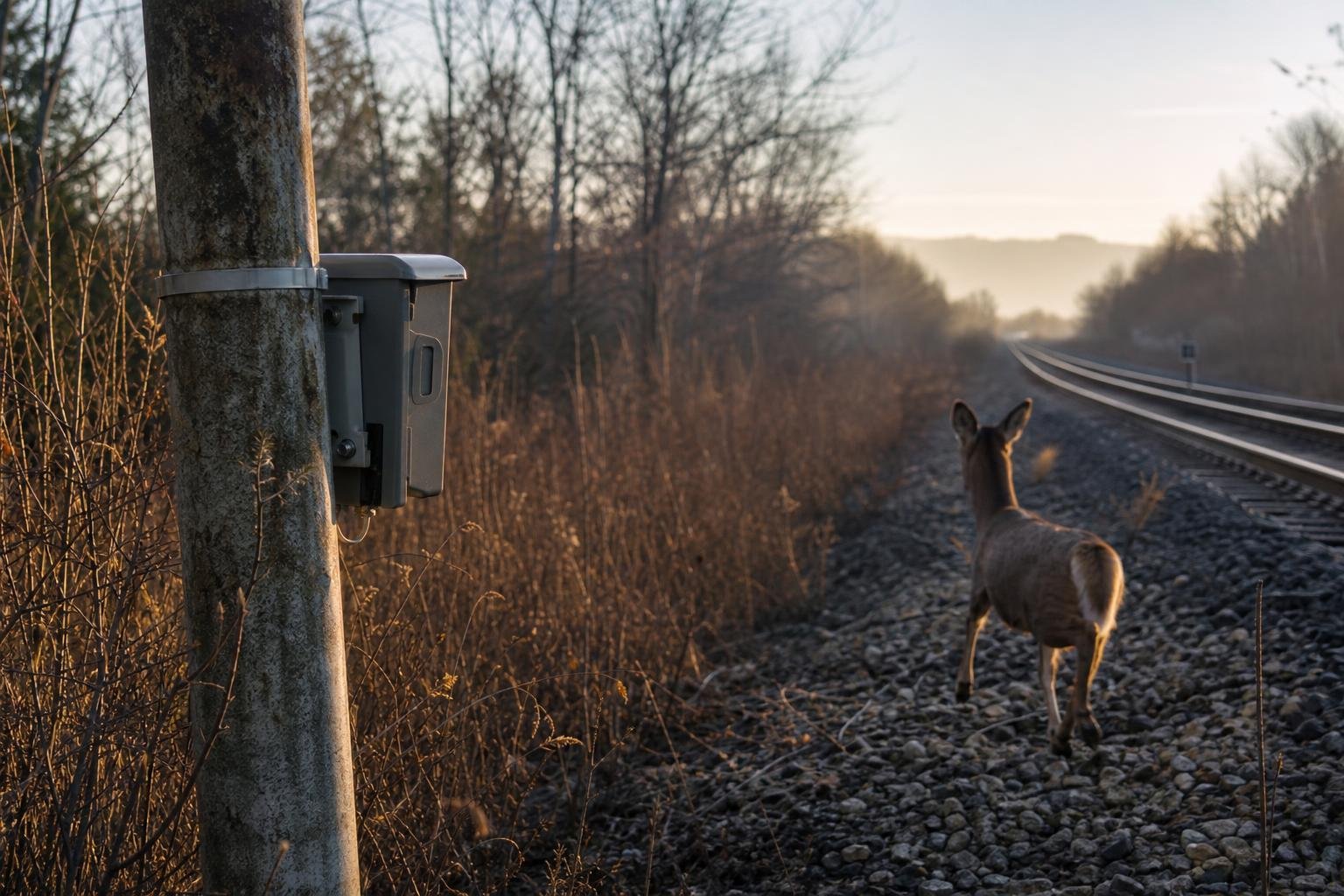
Flox Intelligence has deployed roughly 150 edge-computing wildlife deterrence devices at infrastructure and agricultural sites across North America, Europe and Australia. The systems are designed to detect nearby animals, identify them by species and trigger deterrents tailored to the animal involved, with responses varied over time to reduce the risk that wildlife becomes accustomed to them.[1]
The deployment is a notable example of artificial intelligence being used in the physical world rather than as a conversational interface. Wildlife incursions can create operational, safety and maintenance problems at airports, along rail corridors and on roads. Flox’s proposition is to make those sites more responsive: detect an animal locally, choose an appropriate intervention and act before an encounter becomes a collision, disruption or hazard. Industrial partner Alstom is among the organizations working with the company.[1]
By the Numbers
- About 150: Edge-computing devices deployed by Flox Intelligence.[1]
- 3 regions: North America, Europe and Australia are cited as deployment geographies.[1]
- 1 named industrial partner: Alstom.[1]
From passive fencing to adaptive intervention
Infrastructure operators have long relied on physical barriers, warning signs, vegetation management, patrols and, in some cases, conventional animal-warning systems to manage wildlife risk. Those measures can be valuable, but they do not always account for what is actually approaching a protected area at a particular moment. A system intended for birds near an airport has different operational demands from one intended for animals entering a rail right-of-way or crossing a road.
Flox’s approach combines local sensing and AI-based identification with species-specific deterrence. The company’s devices run at the edge, meaning detection and response occur on or near the installed hardware rather than depending on a continual round trip to a centralized cloud service. That architecture matters at distributed sites where connectivity can be constrained, latency may be important and operators may not want raw sensing data continuously transmitted off-site.
The other central feature is adaptation. Deterrents that are repeated predictably can lose their effect as animals learn that a stimulus poses no immediate threat. Flox says it varies its responses to reduce habituation.[1] In practical terms, the value of that claim will depend on the accuracy of species identification, the suitability of the selected deterrent, local environmental conditions and whether the system preserves enough variation without becoming unnecessarily disruptive.
What 150 deployments say about product maturity
A footprint of about 150 deployed devices is more meaningful than a laboratory demonstration, particularly for a product exposed to weather, changing light, seasonal wildlife behavior and the operational constraints of live transport networks. It indicates that Flox has moved beyond a single-site pilot and is operating across multiple types of locations and geographies.[1]
It does not, by itself, establish that the technology has reduced animal strikes, delays, maintenance costs or wildlife mortality by a given percentage. No such performance figures are included in the reported deployment announcement. That distinction is important. Detection models can perform well in controlled evaluations yet face difficult real-world cases involving obscured animals, unusual species, large groups, poor visibility and background activity around busy infrastructure.
The deployments nevertheless point to an increasingly practical market for edge AI: systems that have a narrow task, a measurable operational objective and a defined human buyer. Rather than attempting to automate an entire rail network or airport operation, Flox is targeting a specific failure point at the boundary between built infrastructure and animal habitat.
Safety gains must not become displaced harm
The appeal for operators is straightforward. Wildlife near runways, tracks and roads can threaten people, animals, vehicles and service reliability. Early detection and non-lethal deterrence may offer a more targeted alternative to interventions that are broad, labor-intensive or deployed only after a problem becomes acute.
But deterrence is not equivalent to solving the underlying ecological conflict. Moving animals away from a runway, rail corridor or farm may redirect them toward another road, neighboring property, alternative habitat or a different part of the same site. The central test is therefore not simply whether an animal leaves a camera’s view. Operators need to understand where it goes, whether the intervention increases risk elsewhere and whether repeated disturbances affect normal feeding, breeding or movement patterns.
Species-aware responses could be an advantage over one-size-fits-all alarms because different animals perceive and react to cues differently. Yet that capability also raises the bar for validation. Identification errors can produce an ineffective response, while an overly broad classification may treat distinct species as if they have the same behavior and welfare considerations. Site operators will need monitoring plans, local ecological expertise and clear escalation procedures for situations where deterrence is ineffective or inappropriate.
Why transport and infrastructure companies are watching
For rail, aviation and road operators, wildlife management is partly a safety issue and partly an availability issue. A disruption can propagate through tightly scheduled networks, while wildlife impacts can damage equipment and require inspections. Technologies that can run continuously at the site level are attractive because they can extend observation beyond the reach of periodic patrols.
Alstom’s involvement gives Flox access to an industrial ecosystem where reliability, integration and procurement discipline matter as much as the underlying AI model.[1] The likely commercial question is whether a deterrence system can fit into established operational workflows: who receives alerts, what is automated, how incidents are logged, how devices are maintained and what evidence an operator can use to evaluate results.
The broader market implication is that edge AI may find some of its clearest opportunities in bounded, high-cost operational problems. These systems do not need to exhibit general intelligence. They need dependable sensing, low-latency decisions, practical installation and an outcome that customers can measure over time.
Evidence, accountability and the next stage
The next stage for Flox will be less about the headline device count and more about independently useful operating evidence. Customers and regulators will want site-level data on detection accuracy, false alerts, intervention frequency, animal behavior after deterrence and changes in collisions or service interruptions. They will also need evidence that benefits are durable rather than limited to an initial period before wildlife adapts.
Transparency matters because the systems act on living animals in shared environments. Operators should be able to document what was detected, what response was triggered and why. That record is necessary both for system improvement and for assessing whether a deployment is delivering a genuine safety benefit without externalizing ecological costs.
Flox’s reported rollout suggests this category is no longer merely speculative. The company has hardware in the field across several continents and sectors.[1] The more consequential proof, however, will be whether adaptive deterrence can be shown to reduce conflict in a way that is reliable for infrastructure operators and responsible toward wildlife.
Editor’s Take
I find this a more compelling use of AI than many high-profile generative-AI launches because the problem is concrete: animals and critical infrastructure occupy the same physical space, and neither can simply be wished away. Local detection plus a prompt, species-aware response is a sensible engineering pattern, especially where network connectivity is unreliable and seconds can matter.
The 150-device figure is encouraging evidence of commercial traction, not proof of efficacy. What I would watch next is disciplined outcome reporting: animal-strike rates, false detections, repeat incursions, maintenance burden and evidence that deterrence is not simply relocating risk. If Flox and its customers can publish that operational evidence, this could become a durable infrastructure technology category rather than another AI pilot program.




.jpg)