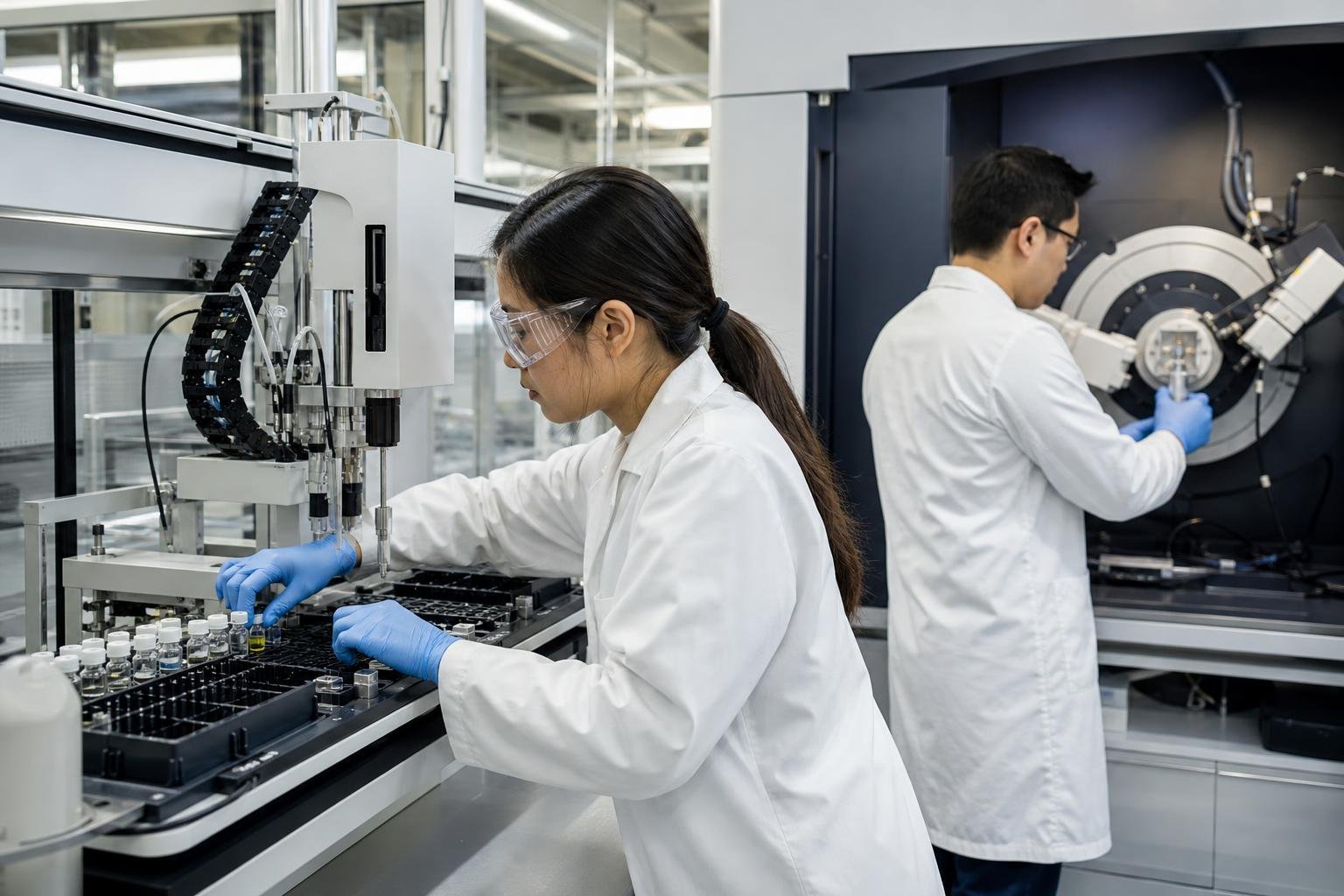
Researchers have introduced MOFGen, an agentic artificial-intelligence system for designing metal-organic frameworks, or MOFs, and steering those designs toward compounds that experimental chemists can actually synthesize. Reported in Nature Computational Science, the system combines language models, diffusion-based generative models, quantum-mechanical calculations and synthesis-planning agents in a workflow that produced hundreds of thousands of candidate structures and led to the successful laboratory synthesis of four AI-designed materials.[1]
The result matters because materials discovery has long had a practical bottleneck: computers can propose enormous numbers of chemically plausible structures, but many proposals are unstable, inaccessible through realistic reactions, or difficult to produce reproducibly. MOFGen does not eliminate that bottleneck. Four syntheses are not proof that autonomous materials discovery is solved. But they provide evidence that a coordinated AI workflow can carry a design across the gap between a digital structure and a physical material made in a high-throughput laboratory.
By the numbers
- Hundreds of thousands: candidate MOF structures generated by the workflow.
- 4: AI-designed materials successfully synthesized in experimental validation.
- 4 workflow capabilities: language modeling, diffusion-based generation, quantum-mechanical evaluation and synthesis planning.
Why making a material is harder than designing one
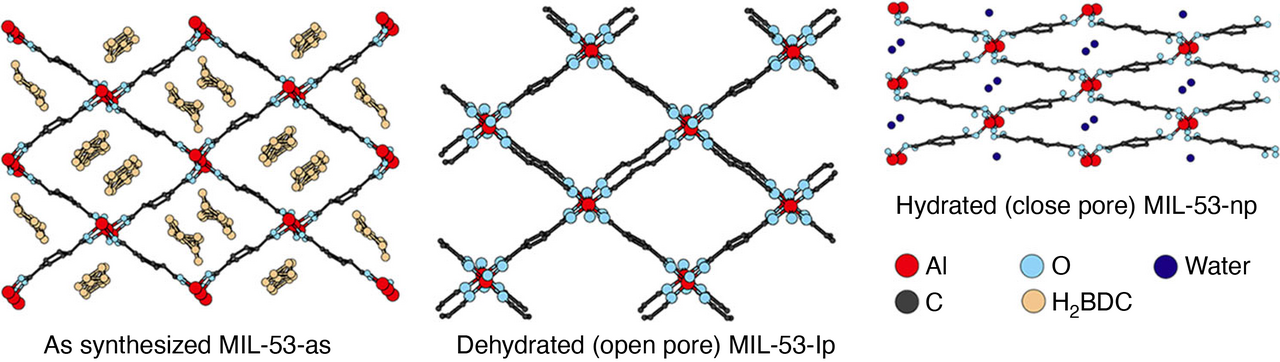
Metal-organic frameworks are porous crystalline materials built from metal-containing nodes and organic linkers. Their modular chemistry gives researchers a vast design space: changing a metal, linker, topology or functional group can alter pore size, chemical stability, adsorption behavior and other characteristics. That flexibility has made MOFs a prominent platform for gas storage, separations, catalysis, sensing and related materials research.
It also makes computational discovery difficult. A model may generate a framework that appears structurally coherent, or that scores well in a simulation, without accounting for whether the constituents will assemble into the intended crystal under workable chemical conditions. Small changes in solvent, temperature, concentration, reaction time, precursor choice or competing crystal phases can determine the product. The experimentally realized structure may differ from the target, or no usable crystalline product may form at all.
This is the central distinction in the MOFGen study. A database of virtual candidates can be useful, but it is not a manufacturing result. The paper’s experimental stage tests whether the system’s proposed materials survived the more demanding filters of chemical accessibility and laboratory execution.[1]
A multi-agent route from structure generation to synthesis
MOFGen is described as an agentic system rather than a single prediction model. Its components divide a complex materials problem into connected tasks. Generative models propose candidate framework structures; language-model capabilities can organize chemical information and help coordinate reasoning across the workflow; quantum-mechanical calculations assess candidates through physically grounded computation; and synthesis-planning agents focus on routes that may be feasible for a laboratory to carry out.[1]
That division of labor is important. Diffusion models are well suited to sampling from complex design spaces and generating new candidates rather than merely searching a fixed catalog. Yet generation alone tends to optimize for resemblance to training data, formal validity or an abstract objective. Quantum-mechanical calculations introduce a separate physical check, helping distinguish structures that look reasonable in a representation from those that satisfy more fundamental energetic or electronic constraints.
The synthesis-planning layer addresses a different problem again: whether a material can be approached from available precursors and experimentally meaningful procedures. In conventional materials informatics pipelines, synthesizeability is often treated as a late-stage human judgment. MOFGen brings it into the computational loop. That does not mean the software can fully predict crystallization, which remains sensitive to conditions and tacit laboratory knowledge. It means synthesis is treated as a design constraint rather than an afterthought.
The workflow consequently resembles an engineering review process more than an unconstrained idea generator. One component creates options; others reject or prioritize them based on physical calculations and experimental practicality. The value of this approach depends on the quality of those handoffs. A strong structure generator cannot compensate for unreliable physical screening, and a good synthesis planner cannot rescue a target whose underlying chemistry is unsound.
What four successful syntheses establish
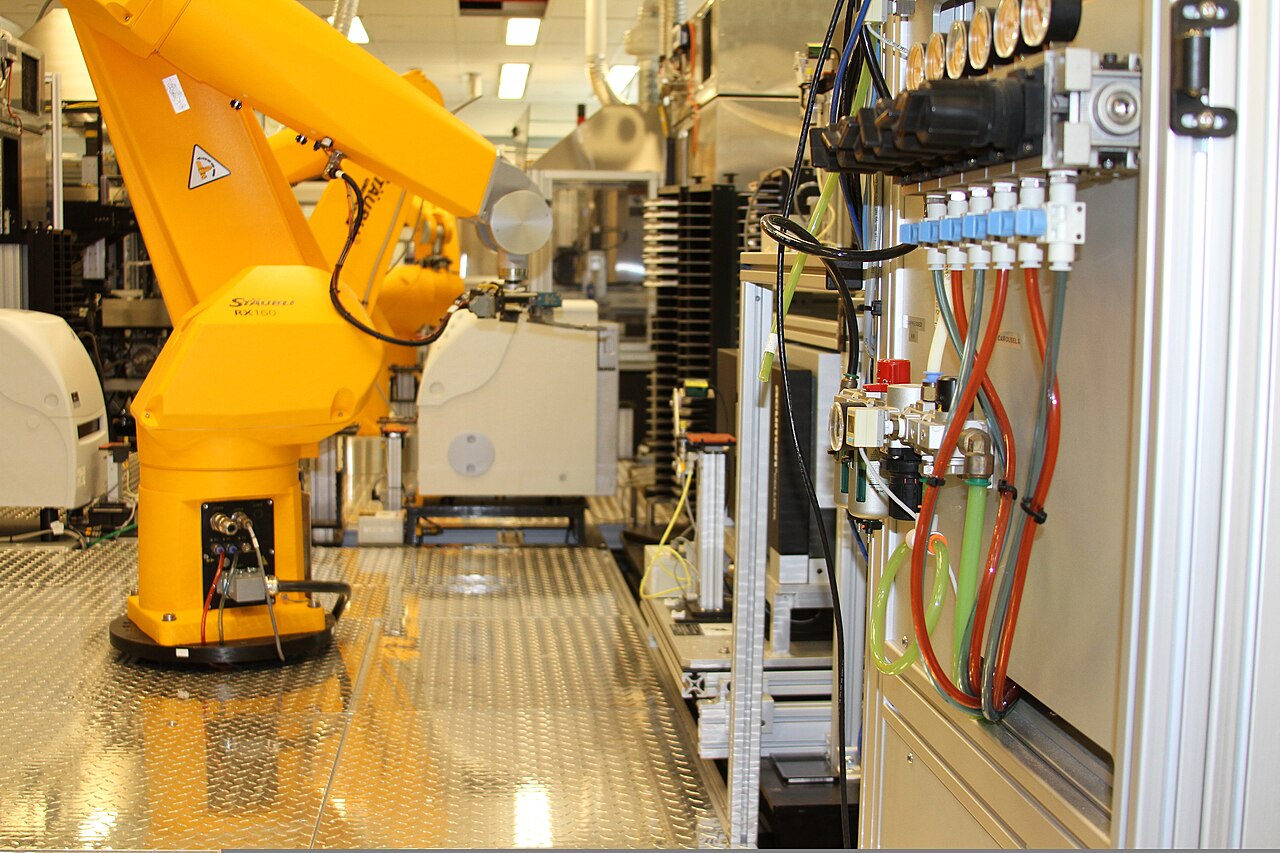
The high-throughput experimental validation is the study’s most consequential element. Successfully synthesizing four materials designed by the system demonstrates that at least some candidates selected by the workflow were not just digital artifacts. They could be translated into experimental recipes and produced as materials in the lab.[1]
That is meaningful progress for a field where model evaluations can otherwise be dominated by retrospective benchmarks. A model may be tested on whether it rediscovers known structures or predicts properties in a held-out dataset. Such tests measure useful capabilities, but they do not test the complete path from a newly generated design through chemical procurement, reaction setup, crystallization and material characterization. The four syntheses put MOFGen under a more relevant standard: did the proposed design lead to a real material?
The experiments also show why high-throughput methods are a natural partner for agentic materials design. Even good predictions carry uncertainty. Automated or parallelized experimentation makes it more practical to test a set of prioritized conditions, generate feedback and identify failures quickly. In a mature closed-loop system, experimental outcomes would be fed back into the models to improve subsequent design and planning decisions. The reported work moves toward that model by linking computational generation to empirical validation rather than stopping at a ranked list.
What the result does not yet prove
The experimental count should be interpreted proportionately. Four successful syntheses validate feasibility for four designs; they do not establish a universal synthesis success rate across the hundreds of thousands of generated structures. Without a clearly defined denominator for candidates that reached experimental testing, and without comparable results from alternative selection methods, it is not possible to infer how much the multi-agent approach improves yield over expert-guided workflows or simpler computational screens.
Nor does successful synthesis automatically demonstrate superior materials performance. A new MOF may be crystallizable but not especially useful for a commercial separation, storage process, catalyst or sensor. Practical value depends on application-specific properties, stability over time, scale-up behavior, raw-material cost, safety, process compatibility and the reproducibility of manufacturing. The study’s reported achievement is that four designs crossed the synthesis threshold, not that they have already cleared all of those deployment tests.
There is also a broader reproducibility question for AI-directed chemistry. Researchers will want to know how robustly each design can be reproduced across batches, instruments and laboratories; how much human intervention was needed to interpret model outputs; and whether the selected syntheses represent routine cases or unusually favorable ones. These questions do not diminish the demonstration. They define the evidence needed before a research workflow becomes a dependable industrial platform.
Industry implications: a shift from search to decision-making
For materials companies, the potential value of systems such as MOFGen is not simply the ability to create more hypothetical structures. Chemical and advanced-materials organizations already face an abundance problem: the number of conceivable compounds vastly exceeds the number that can be made, characterized and qualified. The valuable system is the one that narrows that space into experiments worth running.
MOF development is especially relevant to sectors where porous materials are central, including industrial gas separations, carbon-management processes, chemical production and specialized sensing. In those markets, development timelines are constrained not just by discovery but by experimental cycles and qualification requirements. A workflow that improves the fraction of computational suggestions worth synthesizing could reduce wasted laboratory effort and help teams explore design choices that would be impractical to enumerate manually.
The nearer-term adoption model is likely to be human-supervised. Computational chemists, synthetic chemists and process engineers will still set target specifications, judge trade-offs and investigate anomalous results. Agentic software may increasingly act as the coordination layer that translates between those disciplines: generating candidates, documenting rationale, proposing experiments, tracking results and revising priorities. The economic test will be whether it improves the rate of validated discoveries per laboratory dollar, not whether it generates the largest virtual library.
The next evidence that will matter
The strongest follow-up studies would report the full funnel: how many candidates were generated, filtered, selected for synthesis, attempted and successfully obtained; what failure modes occurred; and how the results compare with established computational and expert-led baselines. Performance data for the resulting materials would also matter, particularly if tied to a concrete target such as a separation, adsorption or catalytic use case.
Researchers will also need to assess whether the workflow generalizes. MOFs offer structured chemical building blocks and substantial prior data, making them an attractive domain for AI. Other material classes may pose different challenges, including less standardized synthesis data, more complex phase behavior or manufacturing constraints that are harder to encode. The key test is whether the same generate-screen-plan-experiment pattern can transfer without relying on extensive case-by-case human repair.
For now, MOFGen’s significance is more precise than claims of autonomous discovery. It shows a credible path toward systems that combine generative AI with physical calculations and laboratory planning, then accept experimental synthesis as the ultimate check. That is a more demanding and more useful standard than novelty on a screen.
Editor’s Take
I see the four syntheses as the point of the paper, not the size of the candidate library. Generating hundreds of thousands of MOF-like structures is computationally impressive, but it has limited business value if chemists cannot turn the shortlist into crystals. Connecting generation, physics-based screening and synthesis planning is the right architecture because it attacks the costliest part of materials R&D: choosing which experiments deserve scarce lab time.
The hype would outrun the facts if this were presented as a self-driving materials factory. Four successful materials do not quantify a broadly reliable hit rate, prove industrial performance or establish scale-up economics. What to watch next is the funnel data and the feedback loop: attempted syntheses versus successes, reproducibility across labs, and whether experimental failures improve the system’s next recommendations. If that loop measurably raises the number of useful materials per experimental campaign, it will be far more consequential than another large generative catalog.
References
- Nature Computational Science – https://www.nature.com/articles/s43588-026-01058-x