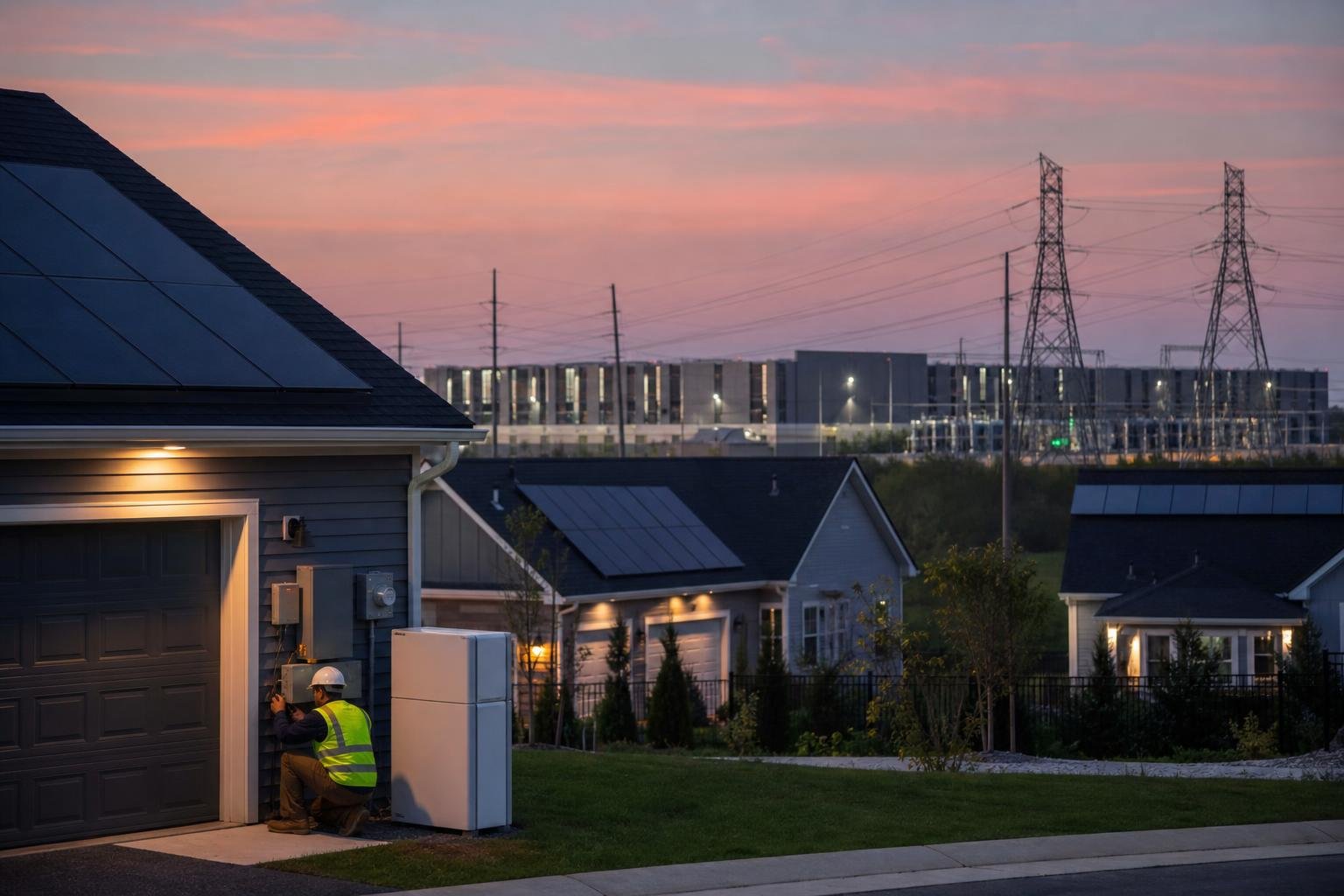
Sunrun, Tesla and Renew Home have announced a framework to make more than 16 GW of distributed energy capacity available to utilities and hyperscale data-center operators, positioning household batteries, smart thermostats and other connected devices as a faster-to-deploy tool for an electricity system strained by AI computing growth.
The June 24 proposal is significant because it aggregates equipment that is already installed in millions of homes, rather than requiring a new power plant or transmission line. But it is not a 16.8-GW power plant supplying AI data centers today. No hyperscale customer, offtake agreement, price or guaranteed delivery commitment was disclosed. The headline figure also combines battery nameplate capacity with short-duration reductions in household electricity use, two resources with very different operating characteristics. [1][2]
A virtual power plant aimed at the data-center bottleneck
The three companies are offering a commercial framework for regional virtual power plants, or VPPs. A VPP uses software and utility agreements to coordinate many smaller customer-owned resources: batteries can discharge at times of grid stress, while thermostats can temporarily reduce or shift air-conditioning demand. Aggregators can sell the resulting capacity, energy or grid services to utilities and grid operators, with participating customers generally receiving payments or bill credits.
For data-center development, the attraction is speed. Large AI campuses can need power on a scale comparable to conventional generating plants, yet new generation, transmission and distribution upgrades can take years to permit and build. The coalition says its resources could be deployed in months to reduce peak demand, ease localized congestion and provide capacity while more permanent infrastructure is developed. [1]
That does not mean a VPP can independently connect or continuously power a new campus. Its usefulness depends on whether enrolled homes and devices are electrically located where the grid needs support, whether local feeders can handle battery exports, and how much capacity is available during a particular event. The companies are presenting the fleet as a capacity-as-a-service option alongside utility programs, not as a replacement for interconnection upgrades, transmission expansion or firm generation.
What is inside the 16.8-GW figure
The advertised 16.8 GW combines approximately 7.8 GW of installed residential battery capacity from Sunrun and Tesla with about 9 GW of thermostat-managed HVAC flexibility from Renew Home. The distinction matters.
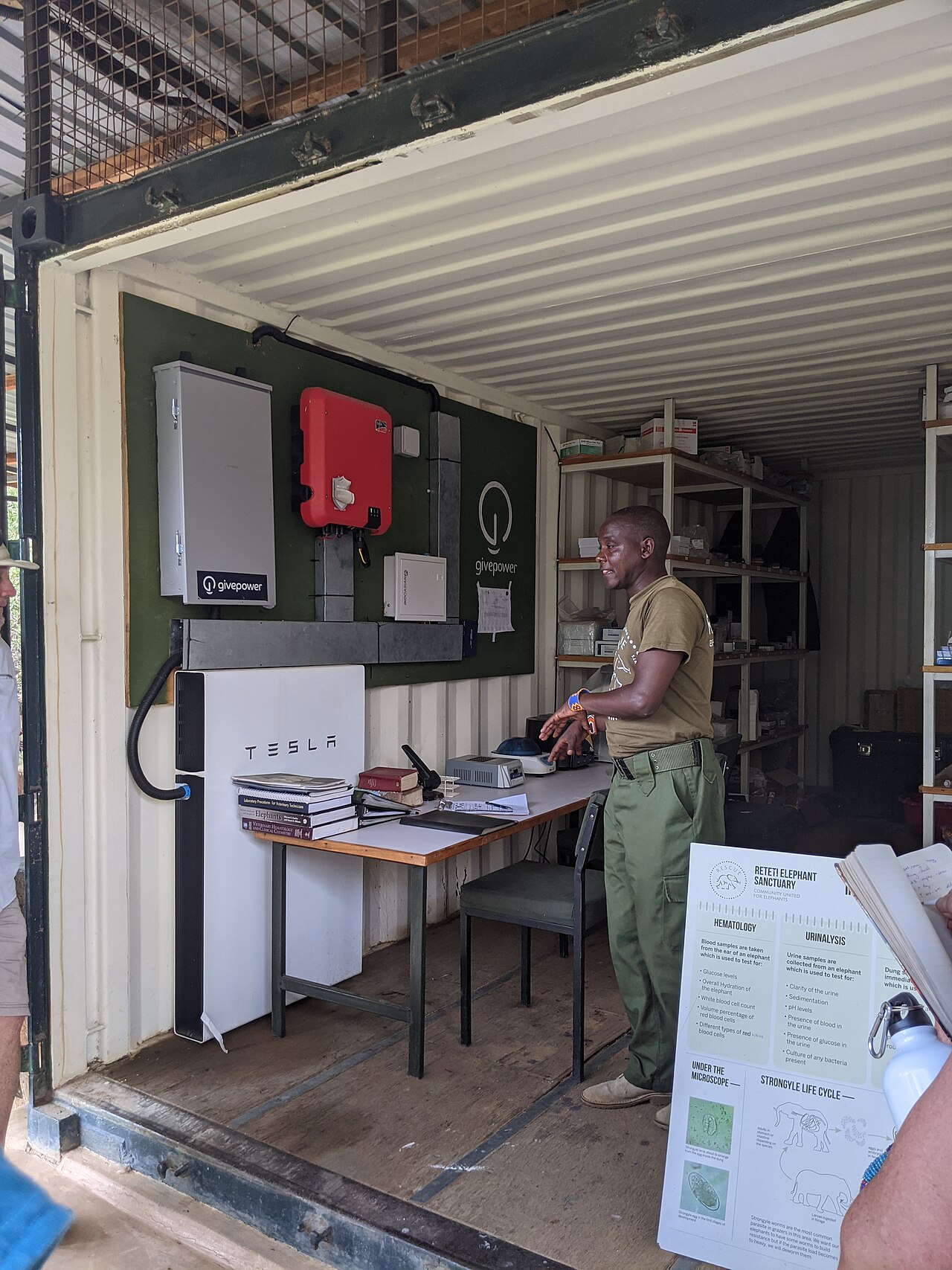
- Batteries: Sunrun and Tesla contribute capacity from hundreds of thousands of residential battery systems, including Tesla Powerwalls. Batteries can export electricity to the grid or serve household demand, subject to their state of charge, homeowner backup settings, interconnection limits and the duration of the event. The battery figure is based on installed rated capacity, not a promise that all batteries can discharge simultaneously at their full rating. [1]
- Thermostat flexibility: Renew Home’s 9-GW figure reflects one-hour peak-load-shift potential from smart thermostats and HVAC partners. This is demand response: a temporary reduction or shift in consumption. It lowers the amount of electricity the grid must supply, but it does not generate electricity or inject power into a data center. [1]
Renew Home, created from the Google Nest Renew and OhmConnect businesses and backed by Sidewalk Infrastructure Partners, says it has more than 6 million connected households. The broader coalition describes a platform spanning roughly 12 million devices in 9 million U.S. homes, including more than 8 million Renew Home smart thermostats and connected devices. [1][4]
In practical terms, the 16.8-GW number is an aggregate measure of potential flexibility rather than 16.8 GW of firm, round-the-clock generation. Dependable capacity will be lower and will vary by market rules, customer participation, weather, device availability, battery reserves and the length and location of a dispatch. A battery fleet may help cover a two-hour evening peak; thermostat demand response can reduce a hot-afternoon load spike. Neither should be treated as equivalent to a continuously operating gas, nuclear or geothermal plant.
Why PJM and Northern Virginia are central
The proposal is particularly relevant in PJM Interconnection territory, which includes the Northern Virginia data-center corridor. The companies say they have more than 300 MW available for immediate deployment in Northern Virginia, including approximately 37 MW of batteries and 276 MW of HVAC flexibility, and expect the regional total to reach at least 500 MW by 2030. They also intend to offer capacity into PJM’s proposed Reliability Backstop Process. If accepted, that proposal could make more than 1 GW available for peak shaving, locational relief and ancillary services. [1]
PJM’s own market-design work explains both the opportunity and the limitation. It characterizes hyperscale data centers as unusually large loads and distinguishes between types of AI computing. Inference workloads are generally latency-sensitive and relatively firm, while training and other throughput-oriented workloads may be paused, slowed or rescheduled more readily. [6]
That makes a residential VPP most valuable for a data center’s peak-capacity obligations, emergency grid events and potentially flexible training schedules. It is less suited to guaranteeing uninterrupted supply for latency-sensitive inference operations. Data-center operators may also need to pair VPP services with on-site generation, utility supply, storage, demand-management software and conventional grid upgrades.
The scale of potential demand is substantial. A Johns Hopkins analysis published in March estimated PJM had 8.8 GW of data-center load under construction and between 16.2 GW and 57.4 GW planned, depending on which projects are counted. Its modeling found that more non-firm or interruptible data-center service could lower annual system costs by roughly $15 billion to $16 billion in modeled scenarios, while cautioning that real-world workload flexibility remains uncertain. [7]
Where the capacity is located
The capacity map disclosed by the companies shows why geography is more important than the national headline. California accounts for about 4.66 GW, including roughly 3.61 GW of batteries and 1.05 GW of HVAC flexibility. Texas has about 1.3 GW of HVAC flexibility and 440 MW of batteries. Virginia’s more than 300 MW is strategically relevant to the data-center market, but is much smaller than the California resource. [4]
The coalition told Canary Media it could collectively relieve stress for roughly two hours at levels of about 4.7 GW in California, 1.7 GW in Texas and 1 GW across Illinois and Ohio. Renew Home also said thermostat tests in PJM cut summertime peak demand by approximately 380 MW over three consecutive afternoons while using less than half of its available customer fleet. [3]
Sunrun has a separate operating record that provides a more concrete indication of how residential batteries can participate in grid programs. In February, the company said it dispatched nearly 18 GWh from batteries during 2025, reached a combined peak output of 416 MW across 17 programs, and enrolled more than 106,000 customers. It reported 217,000 home battery systems in its overall fleet and more than $17 million in customer payments from distributed-power programs during the year. Those results should not be conflated with the new 16.8-GW offer, but they demonstrate that portions of the underlying fleet are already providing grid services. [2]
A large proposal, with important delivery questions
If fully aggregated and contractually deliverable, the coalition would be unusually large in the North American VPP market. Wood Mackenzie data cited by PV Magazine put total North American VPP capacity at 37.5 GW in mid-2025, with residential programs representing only 10.2% of that total. [5]
Yet the commercial and regulatory details remain unresolved. The June 24 announcement did not name a data-center buyer or identify which existing and prospective VPP programs the companies will jointly pursue. Participation in PJM’s Reliability Backstop Process is contingent on the process accepting the proposal. The companies have not disclosed how much capacity will receive market accreditation, what duration commitments they will make, or how customer compensation and opt-out rights will be structured. [2][3]
Those questions are especially consequential for households. Batteries may be reserved for outages, and customers may opt out of dispatches. Thermostat programs must preserve comfort and may have less available load reduction during some weather conditions. Grid operators must also determine how many distributed devices can reliably respond at once in a specific constrained area.
There is a potential consumer benefit if VPPs defer costly grid investments and direct payments to participants. Analysis cited by Canary Media for the Natural Resources Defense Council estimated that targeted VPP and efficiency investments around data centers could save participating lower-income households from roughly $50 to more than $1,000 annually, depending on program and city design. It remains unclear how broadly the new coalition’s economics would be shared. [3]
The broader premise has support: Brattle Group estimates that better use of existing grid infrastructure, including flexible demand and distributed resources, could reduce U.S. electricity bills by $110 billion to $170 billion over the next decade and speed large-load interconnections by years. That estimate supports the case for more flexible grid operation, not a validation of this specific capacity claim. [8]
For now, Sunrun, Tesla and Renew Home have assembled a large potential resource and a pitch tailored to the AI-era power crunch. Its real test will be whether that potential can be converted into locationally useful, market-accredited capacity that utilities and data-center operators are willing to contract for.
Editor’s Take
This is a credible and useful answer to a very real problem: grid capacity for AI campuses is arriving more slowly than AI load requests. Residential batteries and thermostat fleets can be enrolled, contracted and dispatched far faster than a new gas plant or transmission corridor can be permitted. For a utility facing a handful of punishing peak hours, avoiding or deferring a substation upgrade can be economically meaningful. The strongest immediate opportunity is not “powering a data center” outright; it is shaving the grid peak around one, freeing capacity while permanent infrastructure catches up.
The 16.8-GW headline needs disciplined interpretation. A battery kilowatt is not available unless the battery is charged, connected, permitted to export and not reserved by its owner for an outage. A thermostat kilowatt is a temporary reduction in demand, not generation, and its availability depends heavily on weather and customer comfort. I would watch for accredited PJM capacity, event-duration commitments, locational delivery on constrained feeders, and signed utility or hyperscaler contracts. Those figures will tell us whether this becomes a bankable capacity product or remains an impressive inventory of devices.
The practical upside is still substantial. AI training workloads that can pause, slow or shift are a particularly good match for VPP-backed demand management, especially when paired with on-site storage and conventional utility service. The winning deployments will treat customer-owned devices as a carefully measured grid resource, compensate households fairly, and use VPPs to buy time for wires and firm generation—not pretend they eliminate the need for either.
References
- Renew Home – https://www.renewhome.com/press/press-release/vppcapacity
- Sunrun Investor Relations – https://investors.sunrun.com/news-events/press-releases/detail/372/sunrun-renew-home-and-tesla-team-up-to-deliver-more-than
- Canary Media – https://www.canarymedia.com/articles/virtual-power-plants/tesla-sunrun-renewhome-vpp
- ESG Dive – https://www.esgdive.com/news/3-home-energy-providers-offer-168-gw-of-distributed-capacity-to-utilities/823748/
- PV Magazine USA – https://pv-magazine-usa.com/2026/06/25/sunrun-tesla-renew-home-announce-plans-for-16-8-gw-virtual-power-plant-program/
- PJM Interconnection – https://www.pjm.com/-/media/DotCom/library/reports-notices/special-reports/2026/20260506-powering-reliability-through-market-design.pdf
- Johns Hopkins University Energy Institute – https://energyinstitute.jhu.edu/wp-content/uploads/2026/03/Data_Center_Analysis_PJM-March-20-2026.pdf
- Brattle Group – https://www.brattle.com/insights-events/news/new-brattle-report-finds-better-utilization-of-existing-power-grid-could-save-us-consumers-more-than-100-billion-in-the-next-decade/