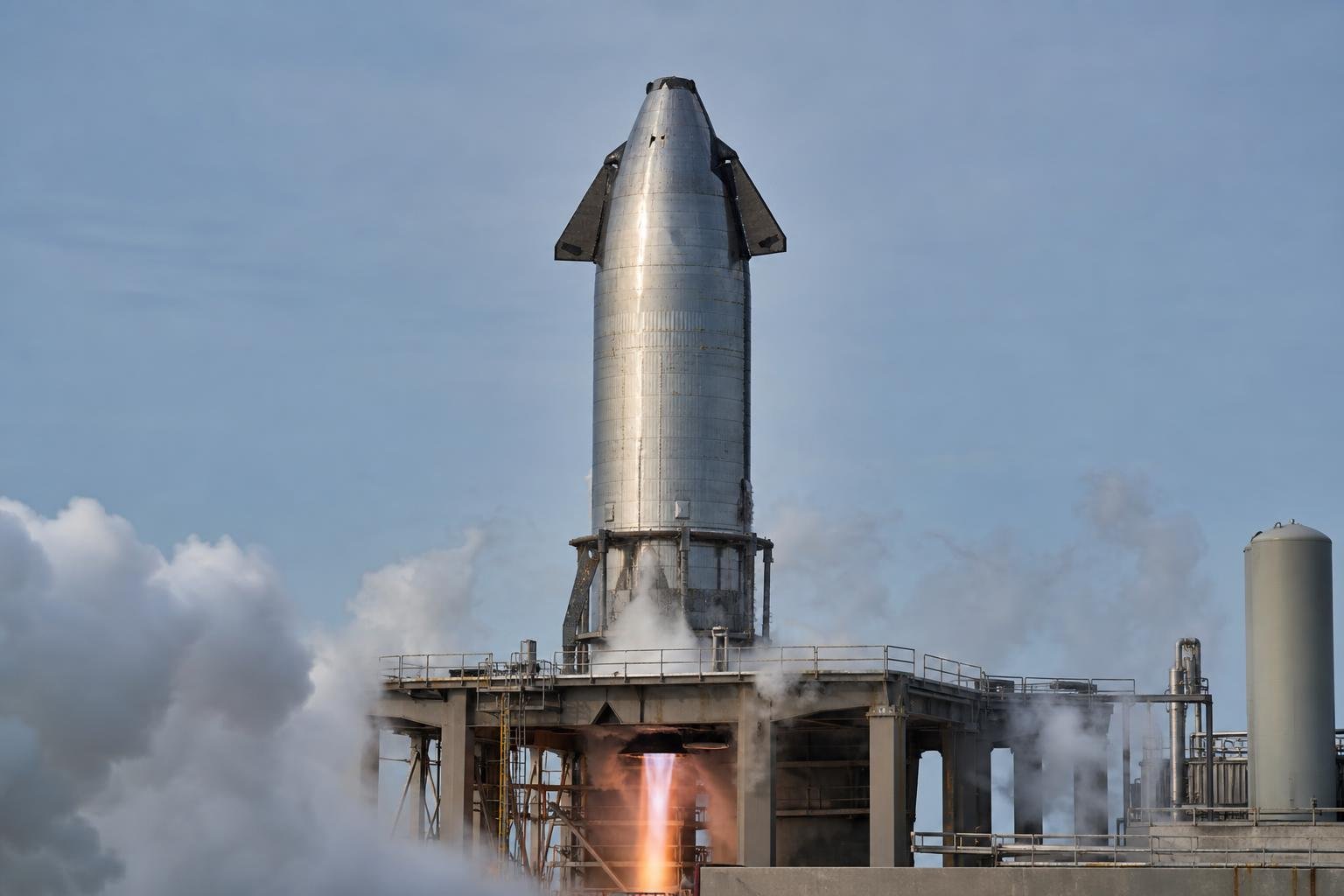
SpaceX has completed the first prelaunch engine firing of Ship 40, the Starship upper stage assigned to the company’s planned Flight 13 test. The vehicle fired one of its central sea-level Raptor 3 engines for roughly 15 seconds while secured to a stand at SpaceX’s Massey test site in Starbase, Texas. SpaceX announced the test on June 26, while public tracking records it as taking place June 25 local time. [2][3]
The brief static fire is an early but important step for the next integrated flight of Starship Version 3. It confirms that Ship 40, its tested engine, its propellant systems and its ground interfaces could operate through a planned short-duration firing. It does not, however, establish that the six-engine ship—or the complete Starship and Super Heavy stack—is ready to fly. SpaceX must still address findings from Flight 12, conduct further testing and obtain the regulatory clearance required for another launch.
What the Ship 40 test demonstrated
For the test, crews transported Ship 40 to the Massey facility, secured it to a test stand and loaded the vehicle with cryogenic propellants before ignition. The engine remained restrained throughout the firing, making the event a static fire rather than a launch attempt.
Static fires are a core ground-test milestone for large rockets. They can verify ignition sequencing, propellant feed, engine performance, vehicle plumbing, avionics interfaces and the operation of launch-site equipment without exposing the vehicle to the added risks of liftoff and flight. In this case, SpaceX described the event as a full-duration, single-engine static fire test of Starship. [2]
SpaceX did not release telemetry, chamber-pressure readings, thrust data, propellant-loading details or a formal post-test assessment. It also did not report an anomaly associated with the firing. The available evidence therefore supports a narrower conclusion: one central Raptor 3 on Ship 40 ignited and ran for the intended short ground-test duration.
A first gate for Starship Version 3
Ship 40 is a Version 3 Starship upper stage equipped with six Raptor 3 engines: three sea-level engines and three vacuum-optimized engines. All six engines are intended to operate during ascent, while a sea-level engine is used for the terminal landing burn. The vehicle is expected to pair with Super Heavy Booster 20 for Flight 13, although SpaceX has not publicly announced a launch date or a complete mission profile as of June 28. [2]
That makes the one-engine firing a first hot-fire gate, not a full qualification campaign. Before flight, SpaceX would need to demonstrate the remaining engines and assess multi-engine ignition and operation. The company has not publicly stated when that next test will occur or whether it will involve all six engines at once.
Version 3 is more than a revised engine installation. SpaceX has described the design as incorporating upgraded propulsion, increased propellant capacity, revised thermal protection, improved aerodynamic control surfaces and hardware intended to support future propellant transfer in space. The integrated Starship-Super Heavy system stands about 408 feet, or 124.4 meters, tall. [2]
Those changes are designed to move Starship toward a vehicle capable of frequent high-mass launches, recovery and orbital operations. But each change also expands the amount of hardware and software that must be tested together. A successful short static fire is useful evidence of progress; it is not proof of full-system reliability.
Flight 12 remains the key context
Raptor 3 is entering only its second flight campaign. The engine made its operational debut during Starship Flight 12 on May 22, the first integrated flight of the V3 configuration. Flight 12 reached space and completed its planned upper-stage descent profile, providing SpaceX with meaningful data on the new vehicle. [1]
But the mission was not fully nominal. One of Ship 39’s six engines failed during ascent, and the Super Heavy booster did not complete its planned return maneuver. SpaceX characterized the vehicle as operating within analyzed bounds during the flight, but the Federal Aviation Administration subsequently classified the event as a mishap and required a SpaceX-led investigation subject to FAA approval before additional launches. [1][4]
That distinction matters for interpreting Ship 40’s test. The firing is a positive sign that SpaceX is moving hardware through its development pipeline relatively quickly after Flight 12. Yet it does not resolve the flight-test questions raised by the prior mission: why the upper-stage engine failed, whether the relevant corrective actions work in flight, and what prevented the booster from executing its intended return sequence.
The next launch campaign must also validate systems the Ship 40 test did not exercise, including ascent under multiple engines, stage separation, upper-stage operations at speed and altitude, and booster recovery hardware. The FAA’s investigation and return-to-flight process remain a separate schedule gate from the ground-testing campaign. [4]
Why Starship’s progress carries wider consequences
Starship is central to SpaceX’s long-term launch strategy. The company plans to use a highly reusable, high-capacity system for large-scale Starlink deployment, a significant consideration because Starlink is SpaceX’s largest revenue source and the only profitable business identified in the company’s public IPO filing, according to TechCrunch. [4]
NASA also has substantial interest in the program. SpaceX is developing a Starship-based Human Landing System for the Artemis program, alongside Blue Origin’s commercial lander work. NASA’s preliminary Artemis III plan describes an Earth-orbit mission in which Orion would rehearse rendezvous and docking operations with commercial lander systems. [5]
For eventual lunar landings, however, Starship faces a major unproven operational requirement: large-scale orbital propellant transfer. A lunar Starship cannot carry all of the propellant it needs from Earth in a single launch. NASA’s architecture relies on multiple tanker flights to replenish a lander in orbit, a capability SpaceX has not yet demonstrated at the required scale. [2]
Starship’s performance therefore has implications beyond a single test program. It affects SpaceX’s Starlink capacity plans, NASA’s lunar schedule and the broader U.S. heavy-lift launch market, where Starship is competing alongside systems including Blue Origin’s New Glenn and NASA’s Space Launch System. Industry observers have emphasized both Starship’s strategic importance and the growing schedule pressure around proving it can perform repeatably. [4][6]
What comes next
The immediate next steps are likely to be additional Ship 40 testing, Flight 12 corrective-action work and FAA approval of the investigation process. SpaceX has not publicly confirmed the scope of a future full-vehicle engine test, a Flight 13 launch date or the mission’s final objectives.
For now, the Ship 40 firing should be viewed as a constrained readiness check that met its apparent purpose. It showed a single Raptor 3 operating on the Flight 13 upper stage under ground-test conditions. The larger milestones—six-engine performance, integrated flight reliability, booster return capability and orbital propellant transfer—remain ahead.
Editor’s Take
This is useful progress, but it is the kind of progress that can be overstated in a fast-moving launch program. A 15-second restrained firing validates a meaningful slice of the stack—engine start, cryogenic feed, controls, vehicle plumbing and ground support—but Flight 13 needs the interactions that are hardest to prove on a stand: six engines working through ascent loads, stage separation, entry, and a functioning booster return sequence.
The practical signal is that SpaceX is keeping V3 hardware moving while the FAA mishap process runs in parallel. The next evidence worth watching is not another dramatic plume photo; it is whether SpaceX identifies a credible Flight 12 engine-failure cause, demonstrates the corrective action across multiple engines, and receives regulatory approval. For Starlink economics and Artemis planning alike, repeatable operations and orbital propellant transfer matter far more than any single static fire.
References
- SpaceX — Starship Flight 12: https://www.spacex.com/launches/starship-flight-12
- Space.com — Ship 40 single-engine static fire: https://www.space.com/space-exploration/launches-spacecraft/spacexs-next-starship-breathes-fire-for-1st-time-in-prelaunch-test-video
- Next Spaceflight — Ship 40 test history: https://nextspaceflight.com/starship/hardware/65/?testId=319
- TechCrunch — FAA mishap investigation after Flight 12: https://techcrunch.com/2026/05/27/faa-orders-spacex-to-investigate-starship-v3-booster-failure/
- NASA — Preliminary Artemis III mission plans: https://www.nasa.gov/missions/artemis/artemis-3/nasa-outlines-preliminary-artemis-iii-mission-plans/
- Ars Technica — Starship’s strategic importance to the U.S. space sector: https://arstechnica.com/space/2026/05/the-us-space-enterprise-is-desperately-waiting-for-starship-will-it-finally-deliver/