
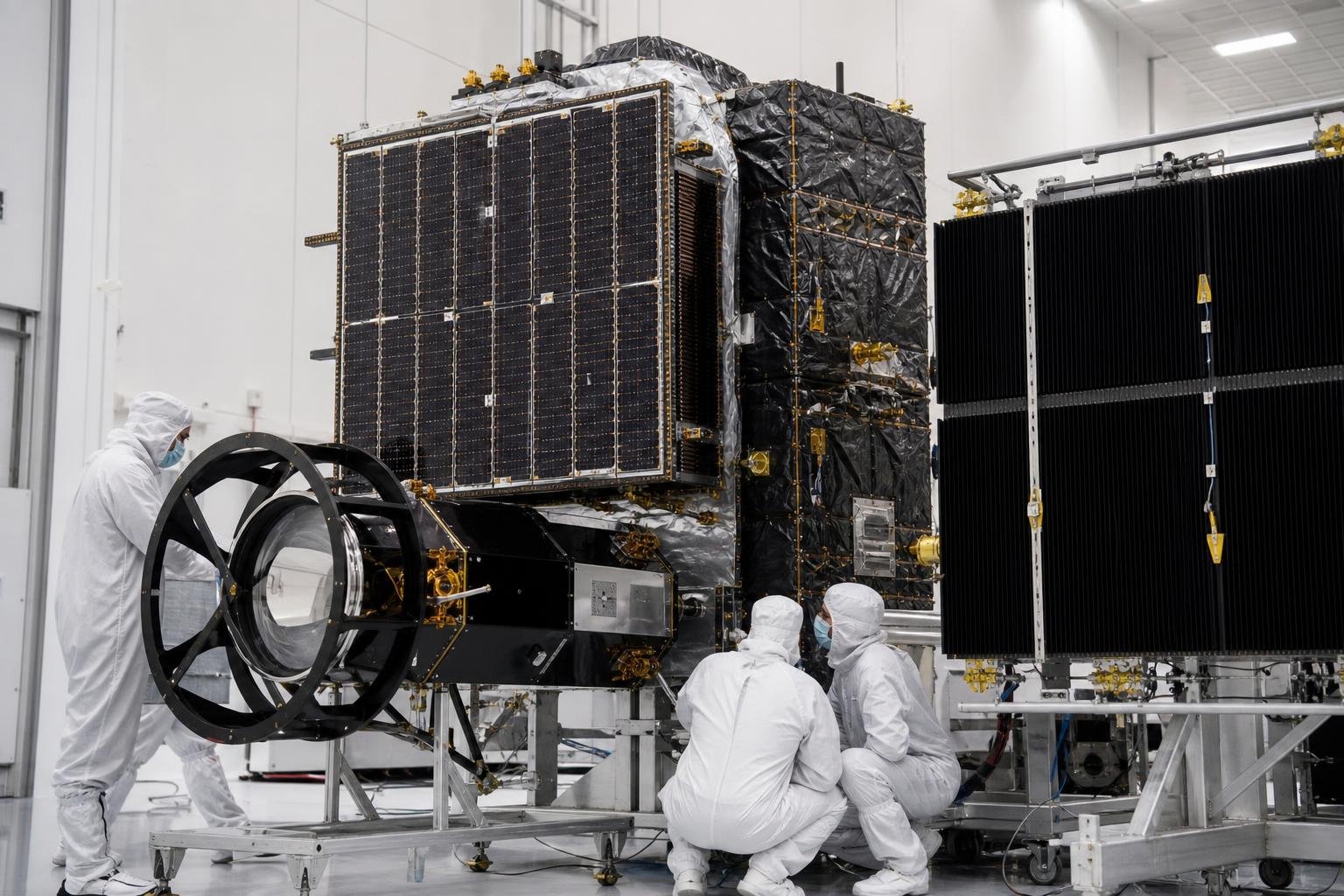
Elon Musk has given SpaceX’s proposed orbital AI-computing network a name: Starmind. Musk announced the branding in an X post on June 23, identifying the project that SpaceX has previously described in regulatory filings as its “Orbital Data Center System.” [3][4]
The name adds a public-facing identity to one of the most ambitious infrastructure proposals in the AI boom: a network of as many as 1 million solar-powered satellites designed to run AI inference and other data-center workloads in orbit. But Starmind is not yet a launched service, an approved constellation or a finished prototype. As of June 29, the Federal Communications Commission has accepted SpaceX’s application for filing and opened it to comment; it has not granted deployment authority. [1]
A proposed data center spread across orbit
SpaceX filed its application on January 30 through Space Exploration Holdings LLC, seeking authorization for a new non-geostationary satellite system. The filing describes spacecraft operating in orbital shells from 500 to 2,000 kilometers above Earth, including 30-degree-inclination and sun-synchronous orbits. Individual shells could extend up to 50 kilometers. [1]
The company’s concept is not simply a conventional satellite broadband network with extra computing capacity. Its stated objective is a distributed orbital data-center architecture, with onboard processors supplied by near-continuous solar power. SpaceX says the satellites would principally communicate through high-bandwidth optical inter-satellite links, potentially connecting with both first- and second-generation Starlink spacecraft. [1]
For radio communications with Earth, the company requested use of the 18.3–19.3 GHz band for space-to-Earth communications and 28.6–29.1 GHz for Earth-to-space links. Those proposed links are on a non-interference, unprotected basis and are associated with communications and telemetry, tracking and command functions. The main proposed network fabric between satellites would be optical rather than radio-based. [1]
SpaceX also said it expects to develop distinct spacecraft designs for different orbital shells, rather than using a single standard satellite across the entire network. That detail matters because power generation, radiation exposure, heat rejection, communications geometry and deorbiting requirements can vary substantially with altitude and orbit type.

Why SpaceX sees a market in orbital compute
The Starmind proposal is SpaceX’s answer to a rapidly growing terrestrial constraint: AI models require immense volumes of power, chips, land, cooling equipment and grid capacity. In its June prospectus, SpaceX argued that ground-based AI data centers are increasingly limited by grid interconnection queues, permitting delays, construction schedules, water use and the availability of advanced computing hardware. [2]
In space, the company argues, satellites could draw directly from sunlight and reject waste heat through radiators, avoiding the local grid and water-cooling demands that shape where terrestrial data centers can be built. SpaceX has tied the project to its broader AI ambitions, including the computing needs associated with xAI and Grok, while presenting terrestrial and orbital facilities as parts of an integrated AI-infrastructure strategy. [2]
That case has an important qualification. Space is cold, but vacuum does not cool electronics through air convection. Hardware still produces heat, and that heat must be moved to radiators and emitted as infrared radiation. Northeastern University professor Josep Jornet told the Associated Press that data-center-scale systems would need very large and potentially fragile radiator structures, a capability that has not been demonstrated at the proposed scale. [5]
SpaceX’s architecture may be more naturally suited to distributed inference, communications and selected processing workloads than to every kind of AI training. Large-scale training often requires extremely fast, tightly synchronized exchanges among accelerators, while an orbital system must contend with crosslink capacity, radiation tolerance and the movement of data between Earth and space. The eventual workload mix would depend on how those tradeoffs perform in practice.
The launch and manufacturing challenge
Starmind’s headline number—up to 1 million satellites—also reveals the scale of the industrial challenge. SpaceX’s prospectus said that deploying 100 gigawatts of computing capacity per year, using satellites with more than 100 kilowatts of compute per metric ton, would require thousands of launches annually and roughly 1 million metric tons of payload delivered to orbit each year. [2]
The company identifies fully reusable Starship vehicles and a Starship “PEZ” payload-dispenser system as the tools that could make those launch rates possible. The argument is strategically important for SpaceX: if launch becomes sufficiently cheap and frequent, the company could deploy its own computing infrastructure at a cost competitors may struggle to match. Eurospace research director Pierre Lionnet characterized that prospect as a competitive power play, given SpaceX’s potential ability to reserve low internal launch costs for its own network. [5]
Yet low launch cost would not solve the semiconductor problem. SpaceX acknowledges that processors, server equipment and specialized AI components could constrain deployment, and that those components represent much of the capital cost in terrestrial data centers as well. Moving servers into orbit does not remove the need to manufacture and purchase a vast quantity of leading-edge compute hardware. [2]
The company does not expect to repair processors in orbit. Instead, it plans extensive pre-launch testing to reduce failures. That leaves reliability as a core economic variable: AI accelerators are expensive and can be sensitive to radiation, while supplying redundancy raises manufacturing mass and launch costs. Aetherflux CEO Baiju Bhatt has pointed to the lack of routine servicing crews as a major obstacle for hardware-heavy orbital computing systems. [5]
Regulatory and orbital risks remain unresolved
SpaceX’s application is at an early procedural stage. The FCC Space Bureau accepted it for filing on February 4 and invited public comment, but that action does not approve the proposed network. SpaceX has also requested waivers from normal non-geostationary-orbit processing-round, deployment-milestone, surety-bond and filing requirements. [1]
The scale of the proposal ensures close scrutiny of space-safety issues. University at Buffalo professor and former NASA engineer John Crassidis warned that a million-spacecraft architecture could approach a collision-risk tipping point. Satellites in low Earth orbit travel at about 17,500 miles per hour, meaning a collision can create debris that threatens other satellites and potentially triggers cascading failures. [5]
A May report from the U.S. Government Accountability Office similarly identified unresolved issues around heat rejection, communications, radiation, collision risk, astronomical interference and the possibility that rapidly obsolete computing equipment may need to be decommissioned earlier than typical satellites. The GAO noted that some space-data-center deployments have been discussed for the mid-2030s, highlighting the difference between demonstrations and a commercial constellation on the scale SpaceX has proposed. [6]
A crowded but still experimental category
SpaceX is not alone in treating orbit as a possible next frontier for AI infrastructure. Google has been studying orbital data centers through Project Suncatcher; Starcloud is developing space-based AI-compute hardware; Aetherflux is pursuing space-based solar-power and computing work; and Blue Origin has announced a large satellite constellation focused on communications rather than orbital AI data centers. [5]
For now, the sector remains more concept than established industry. MIT Media Lab’s Aurelia Ekblaw told Axios that early systems are likely to be modest demonstrations or distributed computing nodes rather than giant server farms, with more purpose-built installations potentially about a decade away. [7]
That makes Starmind significant less as a near-term product announcement than as a statement of SpaceX’s intended direction. The company is positioning its launch vehicles, Starlink network, satellite production and AI investments as a vertically integrated response to the power and construction bottlenecks facing AI. Whether that strategy becomes an operating network will depend on regulatory approval, hardware reliability, launch economics and answers to difficult questions about heat, debris and orbital sustainability.
Editor’s Take
Starmind is strategically coherent even if its million-satellite headline is wildly ahead of its evidence. SpaceX is one of the few companies that can plausibly connect launch, satellite manufacturing, optical networking and AI demand under one roof. If reusable Starship reaches high flight rates, orbital compute could become a useful complement to terrestrial capacity for delay-tolerant inference, relay, edge processing and workloads already born in space.
But sunlight is not a substitute for engineering. The decisive constraints are heat rejection, radiation-tolerant accelerators, optical-network reliability, replacement cadence and safe disposal—not merely launch price. I would watch for small demonstrators with measured power, usable compute throughput, radiator mass, failure rates and end-of-life plans. Until those metrics are public, Starmind is a credible strategic direction rather than a credible data-center deployment schedule.
References
- Federal Communications Commission, Space Bureau public notice – https://docs.fcc.gov/public/attachments/DA-26-113A1.pdf
- SpaceX, June 2026 prospectus – https://content.spacex.com/cms-assets/FINAL_Documents%20and%20Updates/SpaceX%20-%20EU%20Prospectus%20%28Approved%20by%20Bafin%29%20-%20June%205%2C%202026.pdf
- Elon Musk, X post announcing Starmind – https://x.com/elonmusk/status/2069563583382630894
- Space.com, “Another ‘Star’ is born” – https://www.space.com/space-exploration/launches-spacecraft/another-star-is-born-spacex-names-ai-megaconstellation-starmind
- Associated Press, analysis of orbital AI data centers – https://apnews.com/article/elon-musk-orbital-ai-data-centers-xai-spacex-92bc8ad95593bf3b5b801ddf36427194
- U.S. Government Accountability Office, space data centers report – https://www.gao.gov/products/gao-26-109012
- Axios, orbital data-center market analysis – https://www.axios.com/2026/06/12/spacex-space-data-centers-blue-origin-google




.jpg)