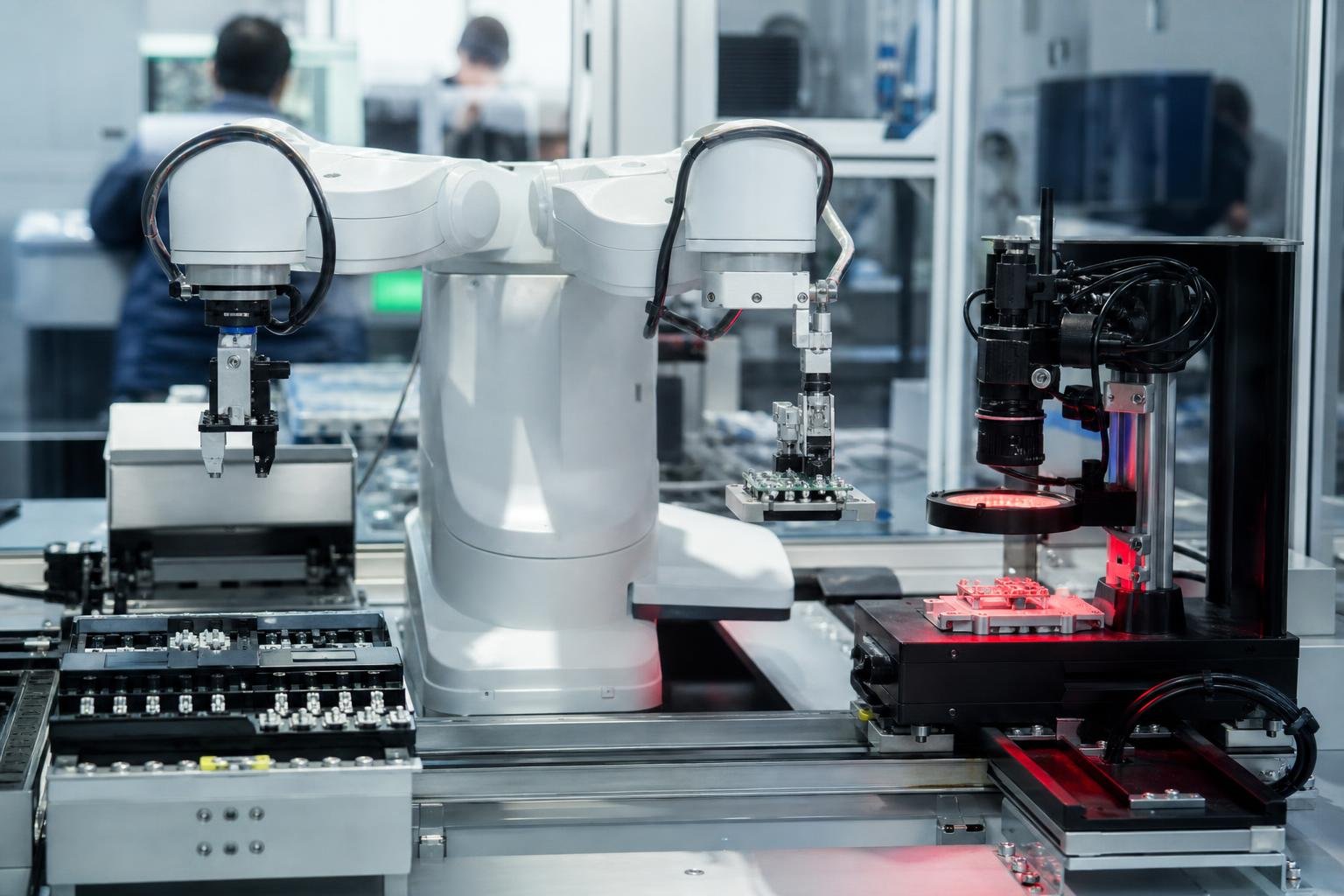
Delta Electronics used Automation Taipei 2026 to introduce an embodied-AI dual-arm robot platform and an AI-enhanced production-line digital-twin workflow. The more consequential announcement for manufacturers may be its quality-inspection claim: Delta said the workflow, incorporating NVIDIA’s Defect Image Generation skill, reduced development time for new defect-detection models from three months to two weeks.[1]
That figure is a company claim rather than an independently verified benchmark, and its applicability will depend on the factory, product, inspection method and defect type. But it addresses a persistent obstacle in industrial AI: quality systems often fail not because factories lack cameras or compute, but because the failures worth detecting are uncommon, inconsistently documented and expensive to collect as training data.
- 2 arms: Delta’s newly announced embodied-AI robot platform uses a dual-arm configuration.
- 3 months: Delta’s stated prior development time for a new defect-detection model.
- 2 weeks: Delta’s claimed development time using its AI-enhanced workflow.
The bottleneck is defect data, not just AI models
Machine-vision inspection has long been a mainstay of industrial automation. Conventional systems can be highly effective when a product’s geometry, lighting and acceptable tolerances are stable. Yet they become difficult to deploy when a manufacturer must identify subtle scratches, contamination, misplaced components, solder anomalies, surface irregularities or assembly errors that occur only occasionally.
Modern deep-learning inspection systems require representative examples of both conforming and nonconforming products. In many plants, the latter are scarce by design: a well-run production line should not make enough defective units to create a broad labeled image library. When a new failure mode emerges, engineers may need to wait for enough examples, remove affected units from the line, classify images, label the affected regions and retrain and validate the model. The process can take weeks or months, especially where production variants, reflective materials, changing illumination or multiple camera angles complicate the image set.
Delta’s announced workflow targets that data-collection delay. According to the company, it combines an AI-enhanced production-line digital twin with NVIDIA’s Defect Image Generation skill to accelerate creation of new inspection models.[1] The stated reduction from three months to two weeks is therefore best understood as a deployment-cycle claim, not evidence that the underlying inspection task has become inherently simple.
The distinction matters. A model can be trained quickly and still perform poorly on a live line if its inputs do not match reality. Production value comes from shortening the full loop: defining a defect, generating and reviewing useful training data, integrating cameras and edge inference, testing against real products, tuning thresholds, and approving the system for use.
How synthetic defects can change the economics of inspection
Synthetic image generation is attractive because it can produce controlled examples of failures that are rare, costly or unsafe to manufacture deliberately. Rather than waiting for a specific scratch or assembly anomaly to appear in production, an engineer can generate candidate images that vary a defect’s size, position, severity and relationship to the underlying product surface.
For industrial use, the useful output is not merely a visually plausible image. It must preserve the characteristics an inspection camera will encounter: material texture, reflection, shadows, lens perspective, resolution, part orientation, motion blur and the visual relationship between the defect and the product. It also needs reliable labels, such as a bounding box, segmentation mask or class designation, so that the detection model knows what feature it is expected to find.
A digital twin can make that synthesis more relevant. In this context, a production-line twin is a digital representation of equipment, work cells, product flow and, potentially, the inspection environment. If it captures camera placement, lighting, robot position and product geometry with sufficient fidelity, it can help create image data closer to a line’s real operating conditions. It can also let engineers evaluate proposed camera views or automation sequences before interrupting production.
Delta has not disclosed, in its announcement, model-accuracy results, false-positive rates, defect classes, training-set composition, validation procedures or the precise scope of its digital twin. Those details will determine whether the claimed speed improvement translates into lower rework, fewer escapes and less manual inspection. Synthetic data is usually most credible when it augments real defect imagery rather than replaces it entirely.
The dual-arm platform is a separate, longer-horizon bet
Delta’s embodied-AI dual-arm robot platform is an important companion announcement, but it addresses a different manufacturing problem. Embodied AI generally refers to AI systems that connect perception and decision-making to physical action. In a dual-arm setting, the goal is to enable a robot to manipulate objects, coordinate two end effectors and respond to variation in the work environment.
Dual-arm designs are relevant to tasks that resemble human two-handed work: holding a part while fastening it, sorting and placing components, manipulating cables, loading fixtures or performing assembly steps that require coordination. They may also reduce the need for custom single-purpose automation when product mixes change frequently.
However, a robot platform announcement does not by itself establish line readiness. Factory deployment depends on cycle time, repeatability, payload, end-of-arm tooling, machine safety, recovery from errors, integration with manufacturing-execution systems and maintenance support. “Embodied AI” can improve flexibility, but physical automation remains constrained by contact forces, occlusion, workspace design and the consequences of a missed grasp or incorrect placement.
The nearer-term link between the two initiatives is operational. Better digital representations of cells and richer visual data can support both automated inspection and robot-task development. Over time, a factory could use related simulation assets to validate camera coverage, test robot reachability and train perception systems. But that integration should be judged on measurable production outcomes, not on the shared AI label.
Why the development-cycle claim matters to the market
Industrial AI suppliers increasingly compete on time to deployment rather than on model demonstrations alone. A highly accurate vision model has limited commercial value if a plant needs a quarter to gather enough defect images every time a product changes. Conversely, a system that can create useful models in weeks can be viable for lower-volume production, high-mix manufacturing and lines where new variants arrive frequently.
That could expand the addressable market for automated quality control beyond large, standardized plants that can justify lengthy engineering programs. Electronics manufacturing is a particularly relevant setting because products often contain small, complex and visually varied components, while quality escapes can carry high downstream costs. The same principle could apply across automotive components, batteries, medical devices, packaging and precision machining, although each sector brings distinct validation and traceability requirements.
NVIDIA’s role also reflects a broader industry shift toward packaged generative-AI capabilities for industrial workflows. The crucial test is whether such tools fit into existing manufacturing data systems and governance processes. Factories need version control for models and datasets, traceable inspection decisions, procedures for handling new defect categories and a clear human-review process when the system flags uncertain cases.
What must be proven on the production floor
The most important metrics are absent from the announcement: recall of real defects, false-reject rates for acceptable products, inference latency, line uptime, retraining frequency and the amount of engineering labor required after initial deployment. A model that misses a critical fault creates quality risk; one that over-flags good units can create costly production interruptions and manual reinspection.
There is also a synthetic-to-real gap to manage. Generated defects can inadvertently be too clean, too regular or visually correlated with artifacts that do not exist on the factory floor. Models may then learn shortcuts rather than the true visual signature of a defect. Robust programs address this through holdout testing on real production images, controlled pilots, continuous monitoring and targeted collection of difficult real-world examples.
Digital twins have their own fidelity challenge. A useful inspection twin must account for changes that are easy to overlook: a light drifting out of position, lens contamination, vibration, a supplier’s surface-finish variation or a slightly different component orientation. Simulation can accelerate experimentation, but it does not remove the need for production validation.
Delta’s reported two-week cycle is promising precisely because it makes such iteration more practical. The claim will be more meaningful if Delta publishes or customers report performance across multiple defect types and line conditions, along with evidence that speed has not come at the expense of inspection reliability.
From rare-event data collection to continuous quality engineering
The longer-term implication is a shift from treating inspection models as static projects to treating them as continuously maintained manufacturing assets. When a new defect appears, teams could use a digital twin and generated imagery to form a preliminary model quickly, test it against live but controlled data, and improve it as genuine examples arrive. That approach is closer to a managed quality-engineering loop than to a one-time AI installation.
For Delta, the immediate opportunity is to connect its automation hardware, factory infrastructure and AI workflow into a coherent deployment offering. For buyers, the appeal is not an abstract promise of autonomous factories. It is the possibility of detecting newly important failures before enough faulty products have accumulated to train a conventional system.
Whether that possibility becomes routine will depend on transparent validation, practical integration and the economics of each line. Delta’s announcement puts the right operational issue in focus: the pace at which a factory can turn a newly discovered quality risk into a trustworthy inspection process.
Editor’s Take
I view the two-week claim as the part of this announcement worth watching most closely. A dual-arm robot can be impressive, but quality-inspection projects usually stall at the unglamorous point where someone asks for hundreds of labeled examples of a defect that the factory is working hard not to produce. If synthetic imagery and a usable line twin genuinely shorten that loop, they can make automation practical in far more cells than a new robot demo alone.
I would not accept the headline figure without production metrics. The next proof points should be real-line recall, false rejects, the percentage of synthetic versus real training data, and how many engineering hours remain after the model is deployed. The winning systems will not be those that generate the most convincing defect pictures; they will be those that let quality teams react quickly while preserving traceability and trust on the shop floor.