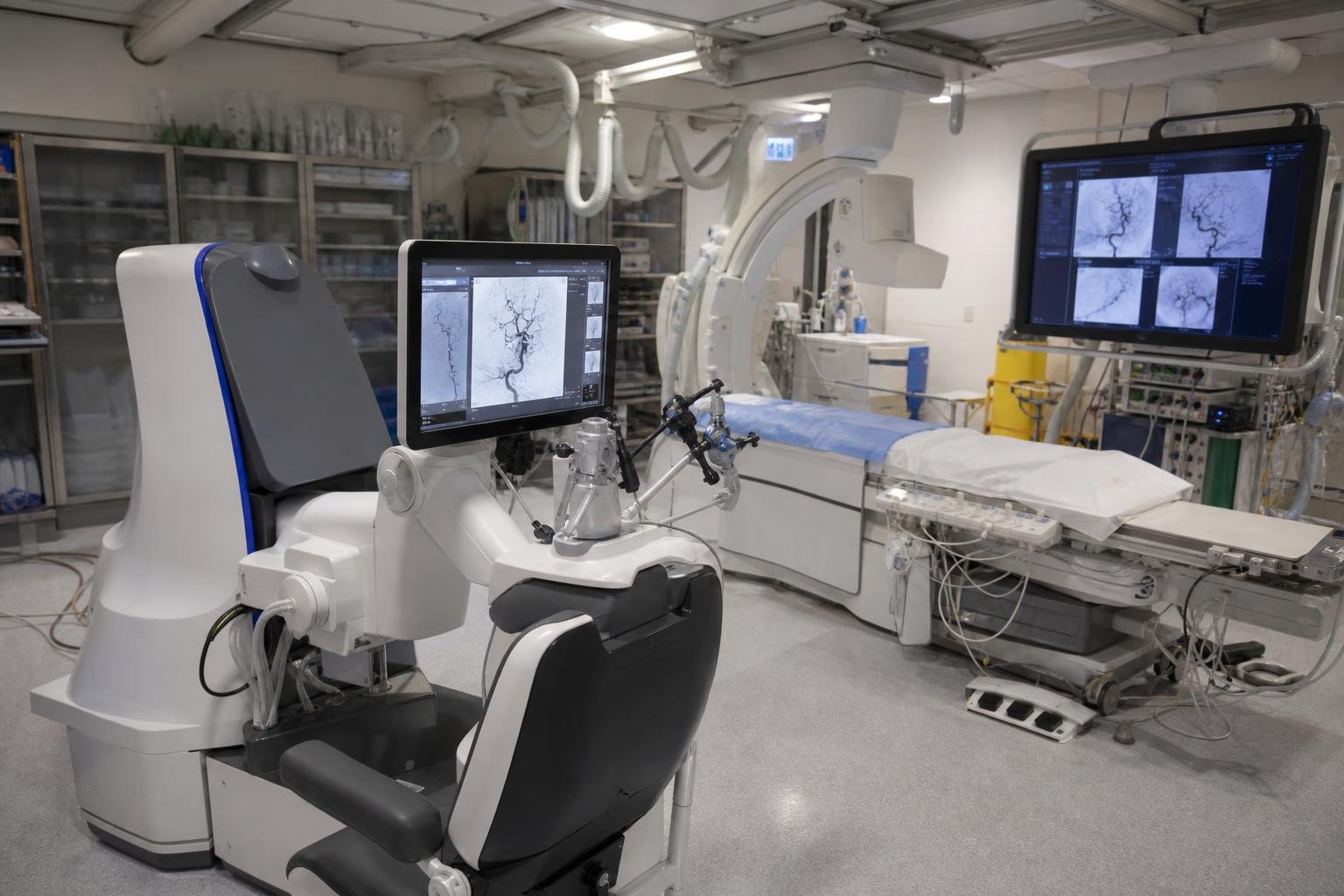
Siemens Healthineers is set to receive up to $31.1 million from the Advanced Research Projects Agency for Health (ARPA-H) to develop a remote endovascular robotic system for mechanical thrombectomy, the procedure used to remove a blood clot from a blocked brain artery during certain ischemic strokes. The project combines medical imaging, robotics and artificial intelligence with the goal of extending access to treatment beyond the comprehensive stroke centers that currently concentrate much of the specialist expertise.[1]
The significance is less about placing a robot in a catheterization suite than about changing how scarce neurointerventional expertise could be deployed. If a trained specialist can safely supervise or conduct key parts of an intervention from a distance, smaller hospitals may eventually be able to connect to a networked stroke-care system rather than relying entirely on patient transfer. That remains a development objective, not a clinically proven service or a near-term replacement for stroke specialists.
By the numbers
- Up to $31.1 million: ARPA-H funding announced for the Siemens Healthineers development project.
- Three core technologies: imaging, robotics and artificial intelligence are identified as elements of the planned system.
- One procedure target: mechanical thrombectomy for time-sensitive ischemic stroke treatment.
A bid to make specialist care networked
Mechanical thrombectomy is an endovascular procedure. A clinician navigates devices through blood vessels to reach and remove a clot that is obstructing blood flow to the brain. It is among the most time-dependent interventions in modern medicine: delays can affect the amount of brain tissue that can be saved and, consequently, a patient’s likely recovery.
Yet the procedure requires specialized operators, advanced imaging, trained staff and an appropriately equipped clinical setting. Those requirements create a geographic problem. Large comprehensive stroke centers may have neurointerventional teams available, while hospitals in less densely served regions may need to stabilize a patient and arrange transfer. Transport and handoffs consume time, and specialist availability is not evenly distributed.
Siemens’ proposed platform addresses that bottleneck as an access and workflow problem. The intended model is not simply a more dexterous device in the hands of an on-site physician. It is a system designed to combine remote operation with imaging and AI support, potentially allowing experienced operators to serve patients at multiple connected facilities.[1]
That distinction matters commercially and clinically. A conventional robotic platform can improve ergonomics, precision or procedure consistency at an already capable center. A remote-capable intervention platform could instead change the location at which specialized expertise is applied. In the strongest version of that model, a regional hospital with the right infrastructure could call on an expert team located elsewhere while keeping an eligible patient closer to the point of presentation.
What the technology would need to do
The announced work centers on a remote endovascular robotic system. In practical terms, such a platform must translate an operator’s commands into controlled motion of catheters, guidewires and thrombectomy devices inside delicate blood vessels. It must also provide the clinician with sufficiently current imaging and procedural information to make decisions remotely.
Imaging is fundamental because the operator cannot directly see the vessels being traversed. Robotics may provide controlled device manipulation and potentially reduce radiation exposure for staff by moving the operator away from the imaging room. AI could support tasks such as image interpretation, procedure planning, device-position awareness, workflow coordination or alerts when measurements or movements fall outside expected ranges. The announcement does not establish which of those functions will be automated, what degree of operator oversight will be required, or whether AI will make clinical decisions independently.[1]
Those distinctions should not be treated as semantic. “Autonomous” can describe a broad range of capabilities, from software that automates a constrained navigation step to a system that acts independently during a procedure. Mechanical thrombectomy involves variable anatomy, clot characteristics and procedural complications. The development program should therefore be judged by the specific tasks it can perform reliably, the conditions under which it hands control back to a clinician, and the safeguards built around remote use—not by the label alone.
Why federal funding is central
ARPA-H was created to back high-impact health projects that may be too technically ambitious, cross-disciplinary or operationally difficult for conventional funding mechanisms. The up-to-$31.1-million award gives Siemens Healthineers resources to pursue an integrated system that spans medical imaging, robotic hardware, software, communications and clinical workflow design.[1]
The federal backing also reflects the unusually broad set of barriers involved. Developing a robot that can manipulate endovascular tools is only one component. A deployable remote-care model would also need reliable network performance, secure communications, compatibility with hospital imaging and procedure rooms, trained local teams, emergency escalation procedures, regulatory clearance and reimbursement pathways.
For Siemens Healthineers, the work aligns its imaging business with a higher-level care-delivery proposition. Rather than selling a discrete scanner, angiography system or software application, the company could ultimately participate in a connected procedure ecosystem. That is strategically attractive, but it also makes success dependent on hospital operations and clinical adoption rather than hardware performance alone.
Clinical and operational questions remain
The program has not yet established that remote robotic thrombectomy is safe, effective or practical at scale. A controlled laboratory demonstration and a real emergency procedure are separated by major requirements. Stroke cases are unpredictable, and the local hospital team must still manage patient preparation, anesthesia or sedation, vascular access, device setup, imaging, complications and any need to convert rapidly to direct on-site intervention.
Latency and resilience are equally important. A remote operator needs dependable, low-latency control and uninterrupted high-quality imaging. Systems will have to define what happens if a connection degrades, an imaging feed is interrupted or the robot encounters resistance. Cybersecurity is not an ancillary concern when a network connection links a physician to a device operating inside a patient’s arteries.
There are also questions of accountability and credentialing. Hospitals, operators, device makers, insurers and regulators will need clear rules governing who is responsible for the procedure, where the physician must be licensed, what local clinical capabilities are mandatory and which patients are appropriate for remote treatment. The eventual value proposition will depend not only on whether a robotic system works, but whether it can fit into stroke protocols without adding new sources of delay.
What success would look like
The most meaningful outcome would be a clinically validated model that helps eligible patients receive thrombectomy faster in hospitals that do not have a resident neurointerventional specialist. That does not necessarily mean fully unattended surgery. A more plausible early model is a specialist-led network in which local teams handle bedside care and a remote expert uses advanced imaging, robotic controls and decision-support tools to perform or guide defined procedural steps.
That approach could make expert capacity more elastic. One specialist team might support a wider region, and participating hospitals could gain a pathway to provide more advanced stroke treatment without building a complete round-the-clock neurointerventional service from scratch. But the economics will be demanding: facilities would still need capital equipment, trained staff, stroke protocols and sufficient case volume or network support to justify the investment.
The next meaningful milestones are therefore more concrete than the funding announcement: technical demonstrations under realistic network conditions, clarity on the system’s autonomous functions, clinical-study design, regulatory engagement and evidence that a remote workflow reduces time to treatment without compromising outcomes. Until those are public, Siemens’ project is best understood as a federally funded effort to test a potentially important redesign of specialist access—not as evidence that autonomous stroke intervention has arrived.
Editor’s Take
I see the strongest opportunity here in capacity sharing, not in the word “autonomous.” Stroke systems already know how to coordinate emergency imaging, triage and transfer; the missing resource is often the operator who can perform thrombectomy at the moment the patient needs it. If Siemens can make a remote specialist genuinely useful inside a capable regional hospital, it could address a more consequential constraint than operator ergonomics.
What I would watch first is the operating model around the robot: network failover, local-team responsibilities, imaging integration and the exact point at which AI is allowed to act versus advise. A robotic catheter system can be technically impressive and still fail to improve stroke care if it adds setup time or requires a level of local infrastructure that underserved hospitals cannot sustain. The $31.1 million award is a serious start, but it is funding for development. Clinical evidence, not the autonomy branding, will determine whether this becomes a durable stroke-care network.