
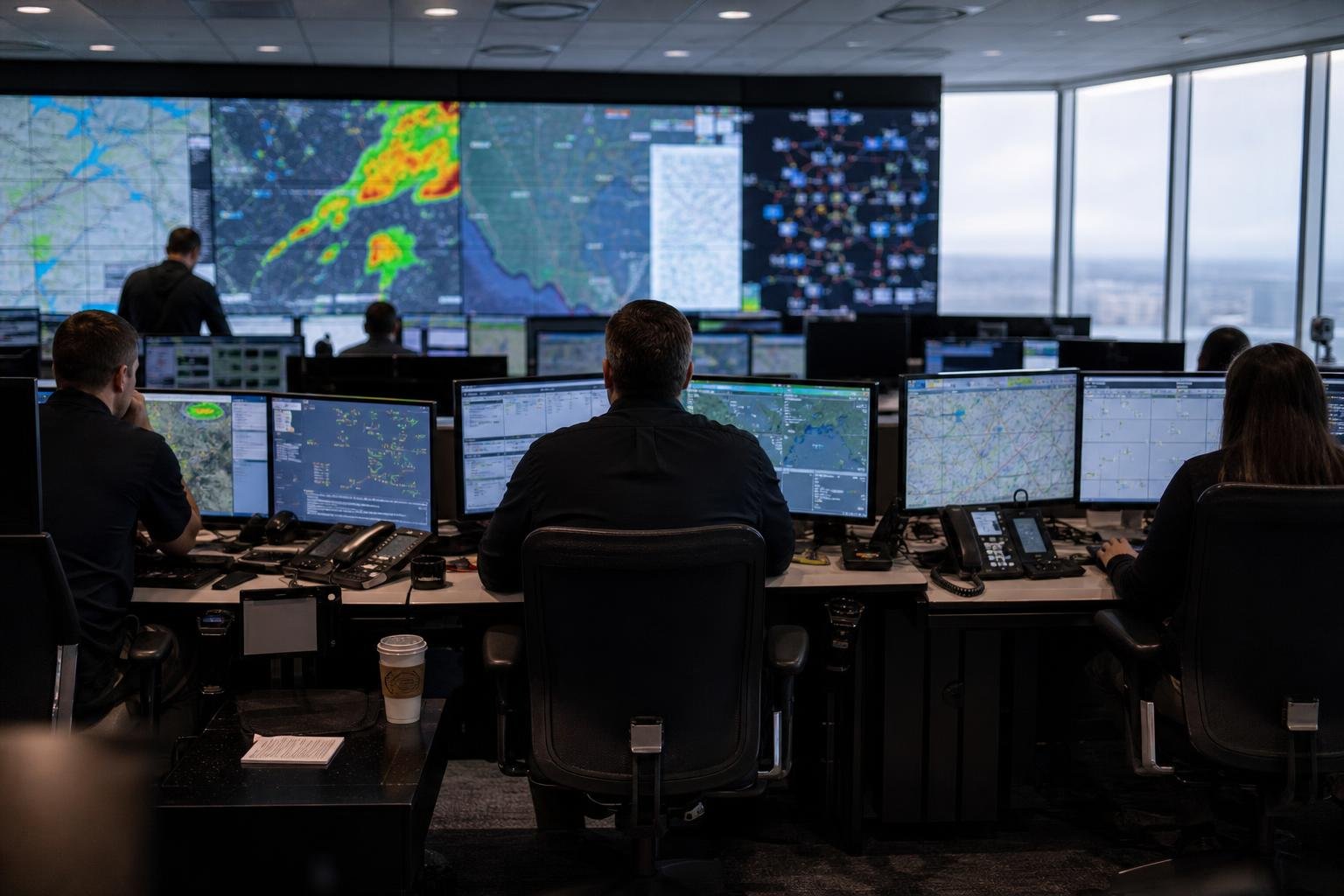
Jeppesen has activated 150 AI agents in ForeFlight Airflow, its airline operations platform, with early airline users applying the technology to crew scheduling and disruption recovery. The agents are intended to propose options when aircraft or crews are displaced, while airline operators retain responsibility for approving and executing the final decision.[1]
The announcement matters because irregular operations are a more demanding proving ground for agentic AI than customer-service chatbots or document assistants. A viable recovery recommendation must account simultaneously for crew legality, aircraft availability, operating rules, maintenance constraints, airport conditions, schedule priorities and the knock-on effects of each change. In that environment, the useful test is not whether an AI agent can generate a plausible answer, but whether it can surface operationally legal, economically defensible choices quickly enough for dispatchers to act on them.
By the numbers
- 150: AI agents Jeppesen said it has activated in ForeFlight Airflow.
- 2: Early operational applications cited: crew scheduling and disruption recovery.
- 1: Final decision-maker in the stated workflow: the airline operator, not the AI agent.

Why airline disruption management is a difficult AI problem
Airline operations control is a constraint-satisfaction and optimization problem with a rapidly changing input set. A delayed inbound aircraft can leave a crew out of position, break a connection for another flight, consume a maintenance window or push a crewmember beyond applicable duty limits. A solution that repairs one flight can worsen the network-wide outcome.
Crew recovery is particularly constrained. Airlines must determine whether a crewmember is qualified for a specific aircraft and role, available at the relevant location, within flight- and duty-time limits, and able to receive the required rest before the proposed assignment. Agreements, training currency, reserve rules and local operating procedures can add further restrictions. Aircraft recovery has its own rules: the substituted aircraft must be serviceable, appropriately configured and positioned, and its reassignment must not create a larger problem later in the day.
That is why an effective system cannot simply optimize for the next on-time departure. It needs to compare alternatives against multiple objectives, such as minimizing cancellations, protecting high-value rotations, preserving legal crew assignments, reducing passenger disruption and avoiding recovery actions that destabilize the following day’s schedule. The relative weight of those objectives is an airline business decision, not a purely technical one.
Jeppesen’s stated use of agents to propose options places the technology in the part of the workflow where it can be most immediately useful: narrowing a large decision space during a time-sensitive event. The company has not, in the announcement cited here, disclosed operational performance results such as minutes saved, cancellations avoided, recommendation acceptance rates or the number of airlines using the agents.[1]
Agentic AI is not the same as a chatbot
The term AI agent can describe software that takes a goal, retrieves relevant data, performs a sequence of tasks and returns a recommendation or triggers an approved action. In an airline-operations setting, that could mean identifying a disruption, checking affected aircraft and crew records, evaluating feasible reassignment options, ranking those options and presenting their consequences to a controller.
The important technical distinction is between natural-language interaction and optimization. A language model may help an operator ask questions, summarize disruption status or explain why a proposed action is infeasible. But a credible crew-and-aircraft recovery product also needs access to authoritative operational data and deterministic checks against hard constraints. Crew legality, aircraft status and rule compliance cannot safely be treated as suggestions generated from text.
A robust design therefore needs clear separation between components. Operational databases and rules engines should establish the current state and validate hard constraints. Optimization software should search feasible alternatives. AI agents can coordinate tasks, call approved tools, prioritize investigation and explain trade-offs. A human operator should be able to inspect the underlying facts, assumptions and expected downstream impact before approval.
Jeppesen’s decision to keep operators responsible for final decisions is consequential. It limits the immediate autonomy of the product, but it aligns with how airlines manage safety-critical and commercially sensitive operations. A dispatcher may know about a developing weather issue, a crew concern, an airport restriction or a customer commitment that is not fully represented in the software’s current data. Human approval provides a practical safeguard while the system earns trust through repeated use.

The human-in-the-loop model is the practical deployment path
For airlines, the first value of these systems may be speed and consistency rather than autonomous execution. During a severe disruption, operations teams can face many possible recovery moves while working across crew, flight dispatch, maintenance, airport and customer-service functions. An agent that quickly assembles feasible alternatives and makes the trade-offs visible can reduce the time spent finding an acceptable option.
Human-in-the-loop operation also creates an audit trail. Airlines need to be able to determine what data was used, what constraints were considered, why an option was recommended and who authorized it. Those records matter for internal review, labor relations, regulatory compliance and post-event analysis. They are also essential for improving the system: rejected recommendations can reveal missing data, incorrect constraints, poor objective weighting or a legitimate operational judgment that is difficult to encode.
The model does not eliminate responsibility. It makes the quality of the interface and the underlying data more important. If recommendations are opaque, flood controllers with low-quality alternatives or conceal constraint violations, operators may either waste time verifying them or develop unwarranted confidence in them. The strongest implementations will show not only the recommended action but also the affected flights, crews, constraints, assumptions, alternatives and projected network consequences.
What airlines and competitors will watch
Jeppesen enters this phase with a clear operational advantage: its products are used in airline planning and operational workflows, where data integration and user trust are often larger barriers than the AI model itself. ForeFlight Airflow gives the company a place to introduce agents into existing decision processes rather than asking airlines to adopt a separate AI console.[1]
For the market, the relevant measure is not the headline count of 150 agents. It is whether the agents improve measurable operating outcomes without increasing compliance or control risk. Airlines will look for evidence on recommendation quality, time to recovery, controller workload, acceptance rates, schedule stability and the ability to preserve decisions across shifts. They will also ask whether the system works during major weather events and other disruptions, when data changes most quickly and the cost of a poor recommendation is highest.
Several concerns remain. Airline operational data is fragmented, and the validity of any recommendation depends on timely, complete inputs. A system may also inherit questionable business priorities if its optimization goals are poorly configured. Labor groups and operations staff may scrutinize tools that affect assignments, reserve use and workload. Security and access controls are equally important: agents capable of reading or proposing changes across operational systems require carefully bounded permissions.
There is also a risk in treating a count of agents as a measure of capability. The announcement does not establish whether the 150 agents are distinct task-specific components, variations of a common workflow, or agents operating simultaneously. Nor does it establish how much autonomy they have or which actions they can take without review. Those details will determine whether the launch represents a meaningful operational platform shift or an early layer of assistance around established optimization tools.
From recommendations toward controlled automation
Airline disruption management is likely to adopt autonomy in stages. The near-term model is recommendation, explanation and human approval. Once airlines can demonstrate reliable performance in narrow, well-instrumented tasks, they may allow automation for bounded actions with clear guardrails, such as notifying affected teams, gathering data, initiating pre-approved searches or reserving resources subject to confirmation.
Fully autonomous recovery decisions are a more distant proposition because the operating environment is dynamic and because accountability remains with the airline. The more realistic long-term outcome is a tiered system: automation handles repetitive coordination and rapidly evaluates options; rules engines enforce non-negotiable requirements; experienced controllers make high-consequence choices and manage exceptions.
That framework makes Jeppesen’s launch a substantive test of agentic AI in a real operational setting. The technology will be judged less by conversational fluency than by whether it helps airlines make better decisions under pressure without weakening the discipline, traceability and human judgment required to run a complex transportation network.
Editor’s Take
I view the retained dispatcher authority as the most credible part of this launch, not as a temporary concession. Airline recovery is exactly the kind of domain where software should do the exhaustive searching and constraint checking while a skilled operator retains the right to choose among trade-offs the data cannot fully capture. A controller should spend less time assembling options and more time deciding which consequence the airline is willing to accept.
The next evidence worth watching is operational, not promotional: how often recommendations are accepted, how quickly teams recover after disruptions, and whether the system can explain every recommendation in terms a dispatcher can challenge. The hype would be claiming that 150 agents equals autonomous airline operations. The concrete opportunity is more valuable and nearer-term: making a notoriously difficult recovery workflow faster, more auditable and more resilient.
References
- Aviation International News – https://www.ainonline.com/aviation-news/air-transport/2026-10-06/jeppesen-launches-initial-foreflight-airflow-ai-agents


.jpg)
.jpg)