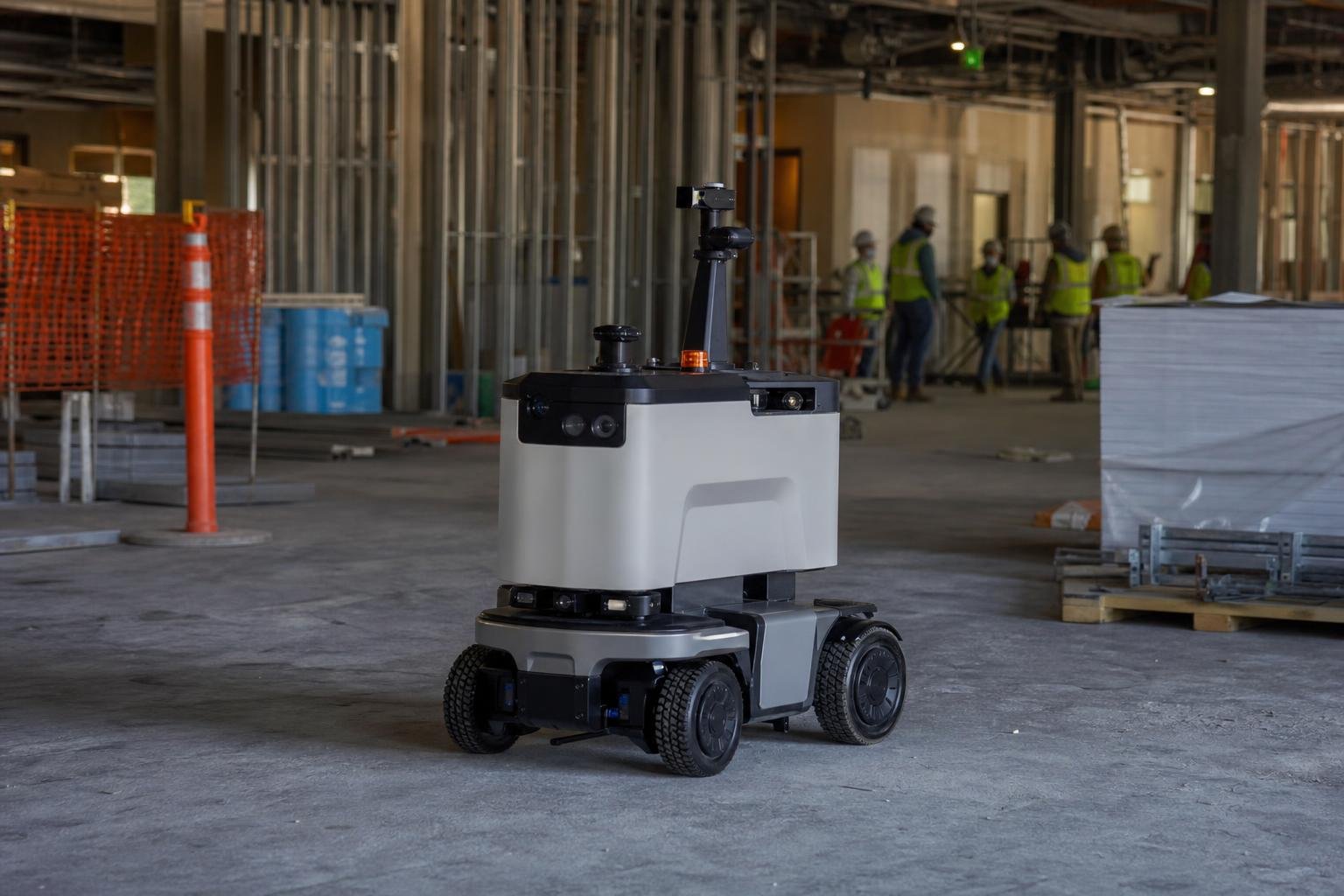
Researchers have introduced CORNAV, a navigation system designed to give robots a working understanding of active construction sites by connecting the documents used to plan a project with the physical environment a robot must traverse. The system combines 2D CAD drawings, 3D scene graphs, project schedules and an LLM-based safety module to decide where a robot can go, what it is likely to encounter and which areas it must avoid.
The central claim is significant because construction autonomy has often been framed primarily as a sensing and localization challenge. CORNAV instead treats site navigation as a problem of operational context. A robot needs more than a current map of walls, equipment and workers: it needs to know what the blueprint intends for a space, what stage the project has reached and whether the schedule makes that location an active hazard on a given day. In experiments spanning an indoor office and a real construction site, the researchers report that blueprint grounding raised task success from 13.0% to 72.2%, while schedule awareness eliminated hard-zone violations. [1]
By the numbers
- 72.2% — task-success rate with blueprint grounding in the reported evaluation
- 13.0% — task-success rate without that grounding
- 59.2 percentage points — reported improvement in task success
- 0 hard-zone violations — reported with schedule awareness enabled
- 2 environments — an indoor office and a real construction site
Why construction robots need document-level context
Construction sites are unusually difficult operating environments. Their geometry changes continually, access routes are obstructed by stored materials or equipment, and hazards are often temporary rather than permanent. A location that was accessible during one work phase may be restricted during concrete work, overhead lifting, demolition, electrical installation or another scheduled activity.
Conventional robot stacks generally build their decisions around on-board observations: cameras, lidar, inertial sensors, localization software and local obstacle avoidance. Those capabilities remain necessary, but they have an important limit. Sensors can observe that an area appears open; they cannot necessarily determine whether the area is about to become a work zone, lies within a planned exclusion boundary or is inconsistent with the intended state of the building.
CORNAV addresses that gap by treating construction records as machine-usable context. CAD drawings provide a project’s designed spatial structure. A 3D scene graph provides a semantic representation of the robot’s observed environment and the entities within it. The project schedule adds time-dependent information about planned work. The safety component then uses that combined context to reason about restrictions and route choices. [1]
This is a practical direction for the sector because those information sources are already central to construction management. Firms routinely generate design drawings, updated plans and schedules, though their consistency and accessibility vary widely from project to project. CORNAV’s contribution is not the creation of another construction document, but an architecture for translating existing documents into operational constraints for a mobile robot.
How the CORNAV architecture joins drawings, scenes and time
The system’s technical premise is that no single representation is sufficient. A 2D CAD drawing expresses design intent and room-level layout, but it does not fully capture the current, cluttered state of a jobsite. A 3D scene graph can represent objects and relationships in the current environment, but it does not inherently know what construction phase is underway. A schedule identifies planned activity over time, but it is not spatially actionable until its tasks are connected to locations in the plan.
CORNAV links those layers. Blueprint grounding associates the robot’s current spatial understanding with the plan drawing, allowing the system to use the drawing as a semantic guide rather than merely as a static reference. That can support decisions such as identifying intended passageways, locating project spaces and relating observed site features to planned areas.
The schedule-aware layer adds a temporal safety model. In principle, that changes a route planner’s question from “Is this route physically traversable now?” to “Is this route appropriate for the robot during this work phase?” A hard zone is a useful example: it may not always be marked by an impassable physical barrier, but a robot should still not enter it when scheduled work makes entry unsafe or disruptive.
The LLM-based safety module sits above these representations as a reasoning interface. It can use the available spatial and temporal evidence to interpret safety constraints and guide navigation decisions. The paper’s framing suggests that the language model is not being asked to replace geometric planning or perception. Instead, it functions as a contextual reasoning component inside a larger navigation system. That distinction matters: reliable construction autonomy still depends on deterministic mapping, localization, motion planning and fail-safe controls alongside higher-level reasoning. [1]
What the evaluation shows — and what it does not
The reported results are unusually direct. Blueprint grounding increased task success from 13.0% to 72.2%, a 59.2-percentage-point gain. That is evidence that access to design intent can materially improve a robot’s ability to complete navigation tasks in the evaluated settings. It also suggests that geometry and semantics from project drawings can solve failures that local perception alone does not address.
The schedule result is equally notable from a safety perspective. With schedule awareness, CORNAV recorded no hard-zone violations in the reported tests. The outcome supports the paper’s broader argument that time-aware restrictions must be part of the autonomy stack for active worksites. A robot that reaches its destination quickly but crosses an active work area has not navigated successfully in an operational sense.
Still, the results should be read as a research demonstration rather than a blanket claim of production readiness. The evaluation covered an indoor office and one real construction site, not a broad portfolio of projects, trades, weather conditions or regulatory regimes. The summary does not establish how the system performs when drawings are outdated, schedules slip, temporary conditions diverge from plans or site personnel create unplanned exclusions. Those cases are routine in construction and will determine whether this approach can move from controlled trials to deployment. [1]
Implications for construction robotics and project software
CORNAV points toward a more integrated construction-technology stack. The key players are likely to include robotics developers building inspection, delivery, surveying and security machines; general contractors and specialty contractors that control site access and workflows; and CAD, building-information-modeling and scheduling software providers that hold the underlying project data. The research team behind CORNAV is the immediate technical contributor, but broad adoption would depend on cooperation across all of those groups.
For robot vendors, the system offers a path to differentiation beyond better cameras or more capable obstacle avoidance. Robots that can consume site drawings and approved work plans could be more useful for recurring tasks such as material delivery, progress capture, inspection rounds and after-hours patrols. For contractors, the potential benefit is not simply automating movement. It is creating robots that respect the changing operating rules of a jobsite instead of forcing crews to build a separate, manually maintained map of every temporary restriction.
The industry case is strongest where data handoffs are dependable. A construction firm already using disciplined CAD, BIM and schedule-management practices is better positioned to feed accurate context to autonomous machines. Conversely, fragmented document control, stale drawings and informal schedule updates could sharply limit the value of the approach. Data governance therefore becomes a safety issue: the robot’s decision quality is constrained by whether its project information is current, authorized and correctly tied to physical locations.
Safety, reliability and deployment questions
The most important critique is that document awareness cannot substitute for real-time perception. A schedule may say a zone is clear, while a lift, pallet, worker or newly installed barrier makes it unsafe. The inverse can also occur: a schedule may preserve a restriction after conditions have changed. A deployable system needs conservative conflict handling when sensors, drawings and schedule data disagree.
LLM use creates an additional assurance challenge. Language models can be valuable for interpreting varied documents and expressing high-level policies, but they can also produce inconsistent outputs if their inputs are ambiguous or incomplete. In a safety-critical workflow, organizations will need clear boundaries around what the LLM may decide, what constraints are enforced by conventional software and when the machine must stop or request human approval. Audit logs, versioned project inputs, confidence thresholds and independently enforced geofences would be important controls.
There are also integration questions. CAD drawings are frequently revised, schedules are often re-sequenced and site layouts may change within hours. The useful measure of a system such as CORNAV will be less about whether it can ingest documents once and more about how quickly it can recognize revisions, validate them against the site and distribute safe updates to a robot fleet. The research establishes a promising architecture; operational deployment will require robust change management around it.
Even with those caveats, CORNAV offers a meaningful reframing of the construction-robotics problem. The strongest lesson is that jobsite autonomy depends on connecting physical intelligence with project intelligence. Robots need to understand not just the built environment in front of them, but the planned and evolving work that gives that environment its meaning.
Editor’s Take
I think the most valuable part of CORNAV is its refusal to treat a construction site as a generic indoor-navigation problem. The 72.2% versus 13.0% result makes the commercial point plainly: project documents can be operational data, not merely files stored for supervisors and subcontractors. A robot that understands a drawing and a work phase has a better chance of fitting into the site instead of becoming another moving hazard to manage.
The zero hard-zone result is promising, but that is the claim to pressure-test next. I would watch for trials across several live projects with late schedule changes, outdated drawings, temporary barriers and conflicting field conditions. The practical winner will not be the system with the most fluent safety explanation; it will be the one that reliably stops, escalates and records why when the plan and the physical site no longer agree.
References
- arXiv — https://arxiv.org/abs/2610.03622