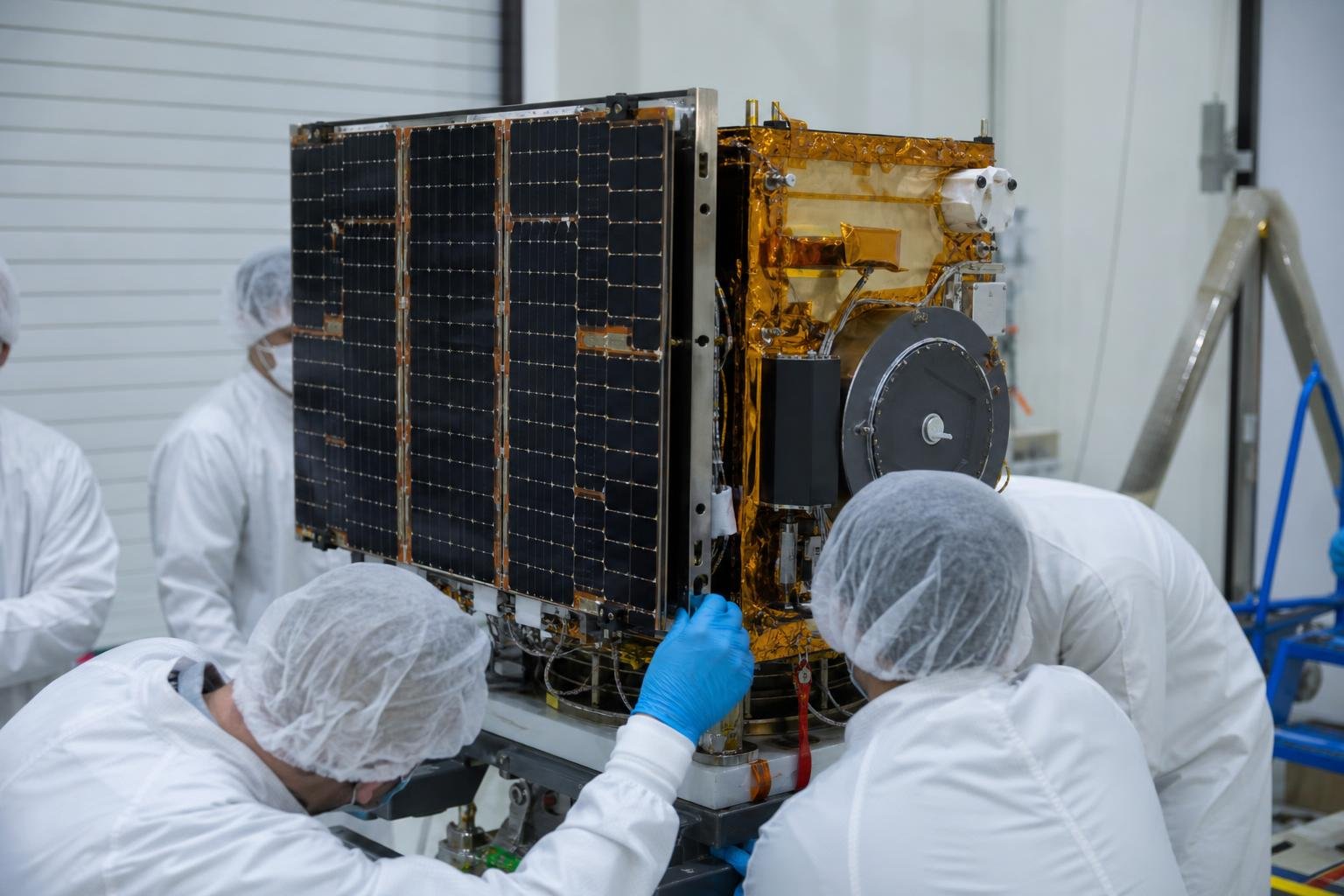
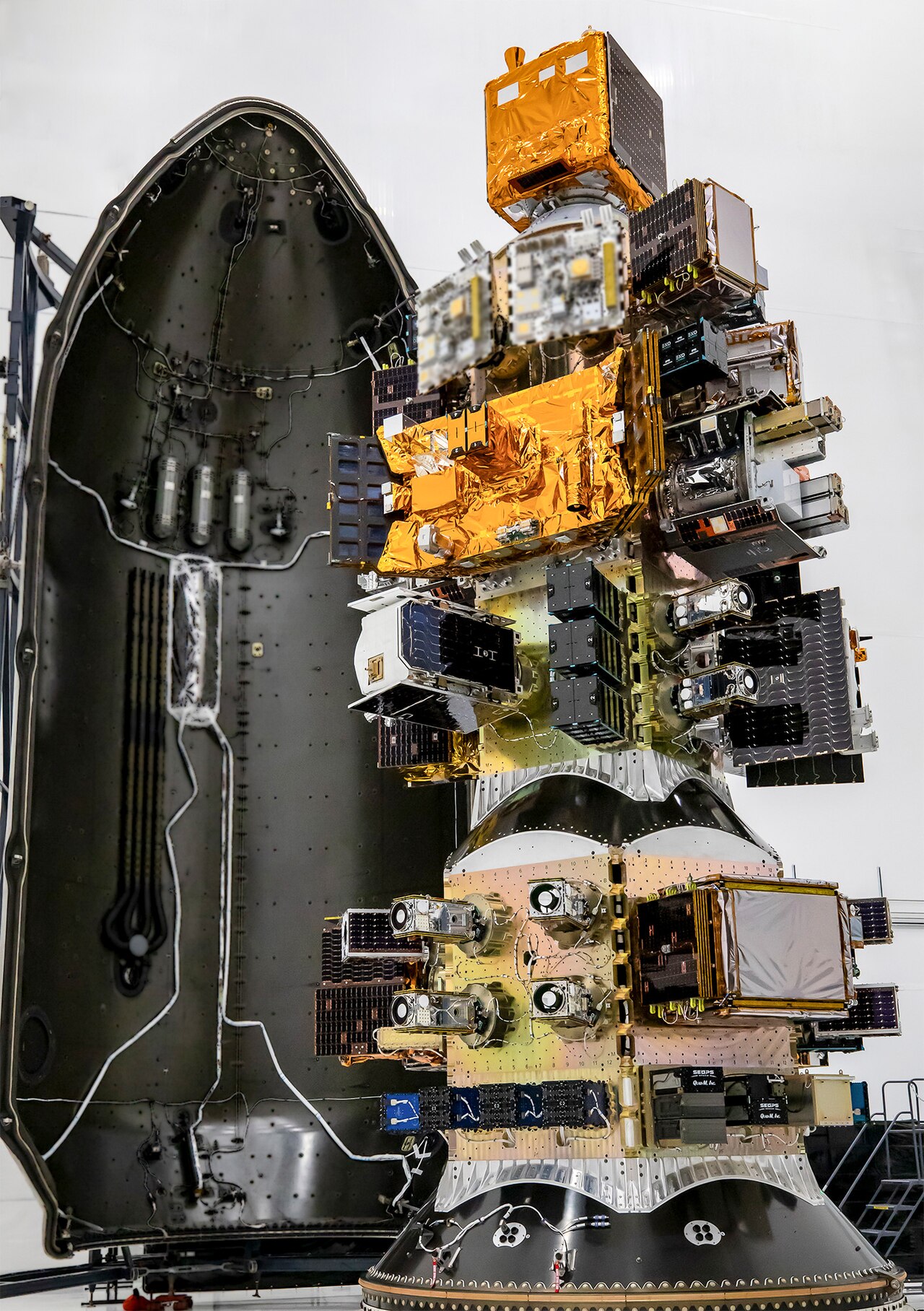
Google has confirmed that the first prototype satellite for Project Suncatcher is operating in orbit after launching on SpaceX’s Transporter-18 rideshare mission. Built with satellite operator Planet, the spacecraft has established contact with the ground and will test whether Google’s Tensor Processing Units, or TPUs, can operate reliably amid the radiation, temperature swings and other environmental stresses of low Earth orbit. [1]
The milestone matters because it turns space-based AI computing from an infrastructure proposal into a testable engineering program. Establishing contact does not demonstrate that an orbital data center is viable. It does, however, put specialized AI hardware into the environment that any such system would have to survive. The next results will be more consequential: whether the accelerator can maintain performance, avoid radiation-induced errors, manage heat and communicate useful results at an acceptable cost.
By the numbers
- 1: Project Suncatcher prototype satellite confirmed operating in orbit.
- 18: SpaceX Transporter mission carrying the prototype.
- 3: Organizations central to the mission: Google, Planet and SpaceX.
What Project Suncatcher is designed to test
Project Suncatcher is Google’s experiment in putting machine-learning compute infrastructure in space. The immediate objective is not to replace terrestrial cloud regions with satellites. It is to gather operational evidence about hardware that was principally designed for controlled data-center conditions, then evaluate how that hardware behaves in orbit.
Google’s TPUs are application-specific processors built to accelerate AI training and inference workloads. In a ground-based deployment, they sit within tightly managed racks supplied with stable electrical power, high-bandwidth networks, carefully engineered cooling, and technicians able to replace failed components. A satellite removes nearly all of those assumptions.
The prototype will expose TPU-related systems to radiation, thermal extremes and the wider operating conditions of space. Radiation is a central concern. Charged particles can cause transient bit flips, corrupt memory, trigger processor faults or gradually degrade semiconductor components. A successful orbital computer therefore needs not only capable chips but also error detection, redundancy, shielding, fault recovery and software able to preserve useful work when hardware behaves unpredictably.
Temperature is equally important. A spacecraft in sunlight absorbs solar energy; in eclipse it can cool rapidly. On Earth, high-performance accelerators shed heat through fans, liquid loops and large heat exchangers. In vacuum there is no convective cooling. Heat must be moved through conductive paths and emitted as infrared radiation through radiators. That constraint can limit how densely a spacecraft can pack compute hardware and how hard it can run it.
The mission also creates an opportunity to measure practical operations rather than only component survivability. Google can assess telemetry, power behavior, thermal margins, resets, data integrity and the effectiveness of ground control over a payload containing advanced compute hardware. Planet’s role is significant because operating a useful spacecraft involves far more than integrating a processor: it requires a satellite bus, attitude control, power systems, communications, operations procedures and flight-proven discipline.
Surviving orbit is necessary, not sufficient
The satellite’s successful contact establishes a basic but important fact: the spacecraft reached orbit and can communicate with operators. It does not yet establish that a TPU can deliver economically useful AI computation from space. That distinction will define how the project should be evaluated.
First, the payload must demonstrate stable operation over time. A short period of nominal telemetry is different from sustained accelerator workloads across sunlight, eclipse and changing orbital conditions. The relevant measurements include compute availability, error rates, performance consistency, energy use, thermal throttling and recovery from faults.
Second, an orbital AI system must solve the data-movement problem. AI accelerators are productive when data can reach them and outputs can leave them quickly. A satellite can process imagery or sensor data gathered in space, reducing the amount of raw information that needs to be downlinked. That is a plausible early use case, particularly for Earth observation. But training frontier AI models, or serving broad consumer AI demand, requires enormous data flows and close coordination among many accelerators. Space-to-ground links, ground-station availability, latency and inter-satellite networking could become harder constraints than chip performance.
Third, space does not eliminate power and cooling costs; it changes them. Solar arrays offer direct access to sunlight when a satellite is illuminated, but spacecraft still need energy storage for eclipse periods, power-conditioning hardware and sufficient radiator area to reject waste heat. Solar availability also varies by orbit and spacecraft orientation. Any comparison with terrestrial data centers must account for the mass and area of the power and thermal-control systems required to support each unit of compute.
Finally, hardware reliability has a different meaning in orbit. A failed server board on the ground can be replaced quickly. A failed component in a small satellite generally cannot. Future constellations may rely on redundancy and regular replenishment launches rather than repair, but that makes manufacturing yield, launch cadence, debris mitigation and end-of-life disposal core parts of the business model.
The strategic case: process data where it is collected
The strongest near-term rationale for orbital AI is not a generalized “data center in space.” It is edge computing for data that originates in orbit. Earth-observation satellites produce large quantities of imagery and sensor readings. Processing some of that data onboard could identify changes, filter unusable observations, prioritize urgent events and transmit compact findings rather than every raw frame.
That approach could benefit applications where time matters, including disaster assessment, maritime monitoring, agriculture, weather-related analysis and infrastructure inspection. It could also reduce pressure on limited downlink capacity. A spacecraft that can distinguish cloud cover from actionable imagery, for example, may use its communications window more efficiently than one that blindly sends every captured image to Earth.
Google has obvious interests in AI models, cloud infrastructure and large-scale data processing. Planet brings satellite development and Earth-imagery operations, while SpaceX provides the rideshare launch path. The partnership illustrates the converging capabilities required for orbital compute: silicon and software expertise, spacecraft engineering and access to launch.
For the broader satellite industry, Project Suncatcher is a signal that compute payloads may become more sophisticated. Satellites already perform onboard processing, but deploying advanced AI accelerators would raise the ambition from task-specific signal processing toward more flexible machine-learning workloads. The commercial value will depend on whether that flexibility produces results that justify the additional mass, power, thermal and reliability burden.
Economics and network design remain the larger test
Even if Google’s TPU hardware performs well, the economic case for large-scale orbital compute will remain unsettled. Launch costs have declined relative to earlier eras, and rideshare missions can offer smaller spacecraft a practical route to orbit. Yet every kilogram still competes with solar panels, batteries, antennas, radiators, propellant and structural hardware. Specialized radiation-tolerant designs and redundancy can further increase cost.
Orbital systems also face an efficiency trade-off that terrestrial data centers largely avoid. A ground facility can be connected to dense fiber networks, utility-scale generation and established cooling infrastructure. A satellite must carry or deploy nearly every subsystem it needs, and it must do so under strict mass and volume constraints. The relevant comparison is therefore not merely the cost of launch versus the cost of land. It is the delivered cost of dependable compute, including launch, spacecraft production, communications, power, thermal control, operations, insurance or risk tolerance, and replacement of failed assets.
Networking may be the decisive constraint for ambitious applications. A cluster of AI accelerators becomes more valuable when its processors can exchange data at high speed and synchronize efficiently. A distributed satellite constellation would need robust inter-satellite links and ground connectivity to resemble a compute cluster. Without that, the architecture may be better suited to independent, localized inference tasks than to tightly coupled training workloads.
There are also regulatory and operational issues. Operators must coordinate spectrum, prevent interference, comply with debris-mitigation rules and safely dispose of spacecraft at end of life. A future in which compute payloads become a large satellite category would increase scrutiny of orbital congestion, reentry practices and the environmental footprint of rapid constellation replacement.
What to watch after first contact
Google’s next disclosures will matter more than the launch announcement. The critical evidence will be operational: how long the TPU-related payload runs, what workloads it executes, how its performance changes across orbital conditions, and what errors or mitigations appear. Details on radiation effects, thermal control, power generation, memory integrity and data transfer rates would help determine whether the project is producing a credible path to a useful service rather than a successful technology demonstration.
It will also be important to learn how much of the system is representative of an eventual production design. A prototype can validate a component without proving that a constellation is manufacturable or economical. Conversely, a fault in an early payload may identify a solvable design issue rather than invalidate the underlying concept. The value of Project Suncatcher is that it can narrow those uncertainties with real flight data.
For now, Google has cleared the first threshold: it has put the question into orbit. The experiment is no longer whether advanced AI hardware could be flown. It is whether it can produce enough reliable, connected and affordable computation to justify building more of it. [1]
Editor’s Take
I see this as a sensible first step, not evidence that data centers are about to migrate off planet. The most credible commercial path is onboard inference for data already collected in orbit. If a satellite can decide which imagery is worth downlinking, detect an urgent event quickly or turn raw sensor readings into compact results, it can create value without pretending to compete with a fiber-connected terrestrial AI cluster.
What I will watch is the engineering ledger: sustained workload performance, radiation error handling, thermal headroom, energy available per useful computation and downlink economics. “The satellite works” is a milestone; “the accelerator produces reliable results through a full operating cycle” is the next one. The biggest hype gap is the assumption that abundant sunlight automatically means cheap AI compute. In space, every watt of processing creates a cooling, communications and reliability problem that has to fit inside a launchable spacecraft.