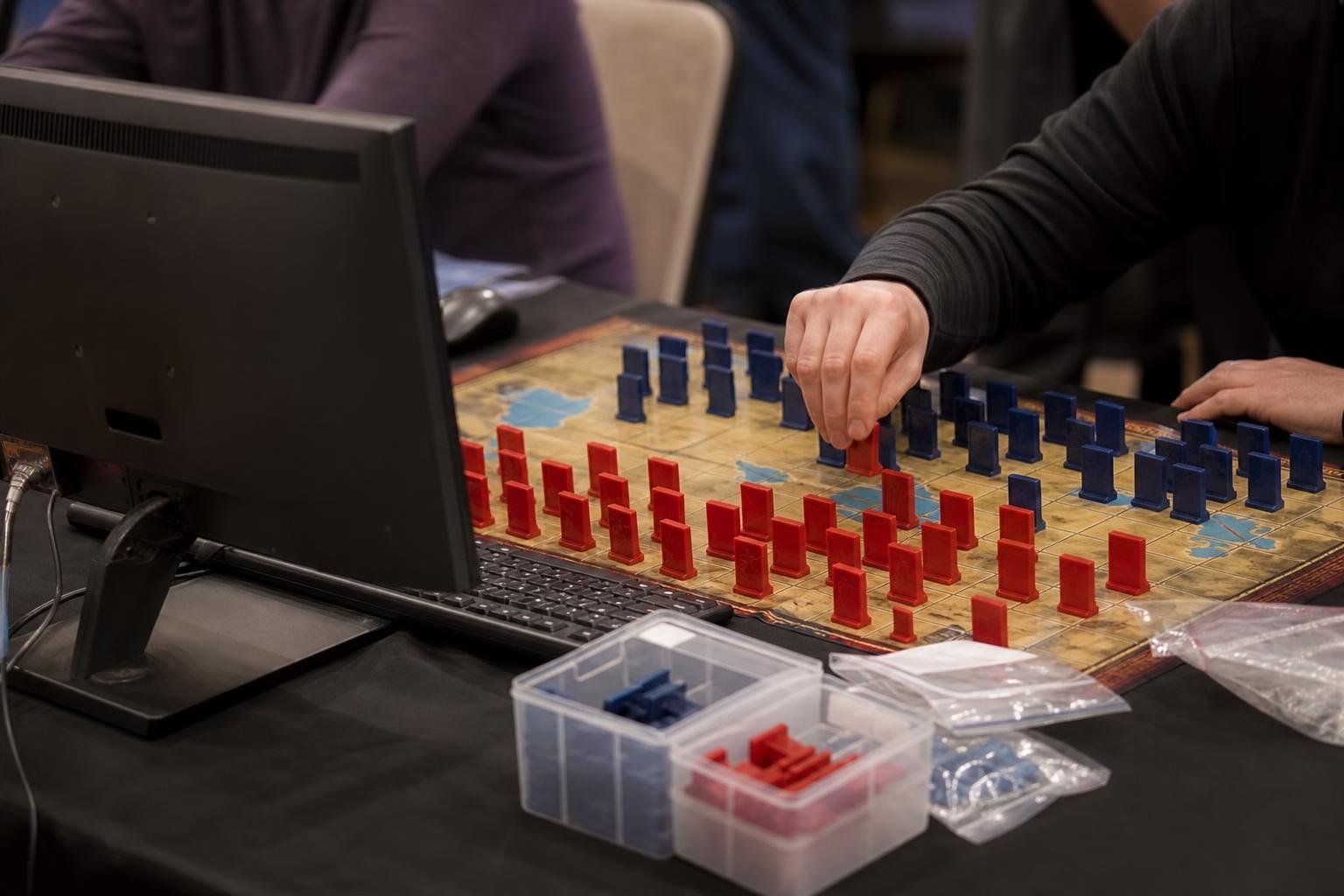
An AI system called Ataraxos has defeated elite Stratego player Pim Niemeijer in a 20-game match, winning 15 games, losing one, and drawing four. The result is notable not simply because another board-game benchmark has fallen, but because Stratego is built around concealed pieces, incomplete information, bluffing, and irreversible decisions. [1]
Developed by researchers associated with Carnegie Mellon University, MIT, NYU, and Stanford, Ataraxos reportedly trained using 16 GPUs for a total cost of only a few thousand dollars. That scale matters. It suggests that strong strategic behavior in some difficult decision environments may depend less on massive pretraining runs than on a well-matched combination of self-play, uncertainty-aware reasoning, and search performed when the system must make a move. [1]
By the numbers
- 15 wins: Ataraxos victories over Pim Niemeijer
- 1 loss: Ataraxos defeat in the reported match
- 4 draws: Tied games in the 20-game series
- 16 GPUs: Compute used for training
- A few thousand dollars: Reported training budget
Why Stratego is a harder test than perfect-information board games
Stratego differs fundamentally from chess, Go, and most other famous game-playing AI milestones. In those games, both players can see the entire board state. A system may still face an enormous number of possible moves, but it does not need to infer which pieces exist, what the opponent knows, or whether a move is intended to mislead it.
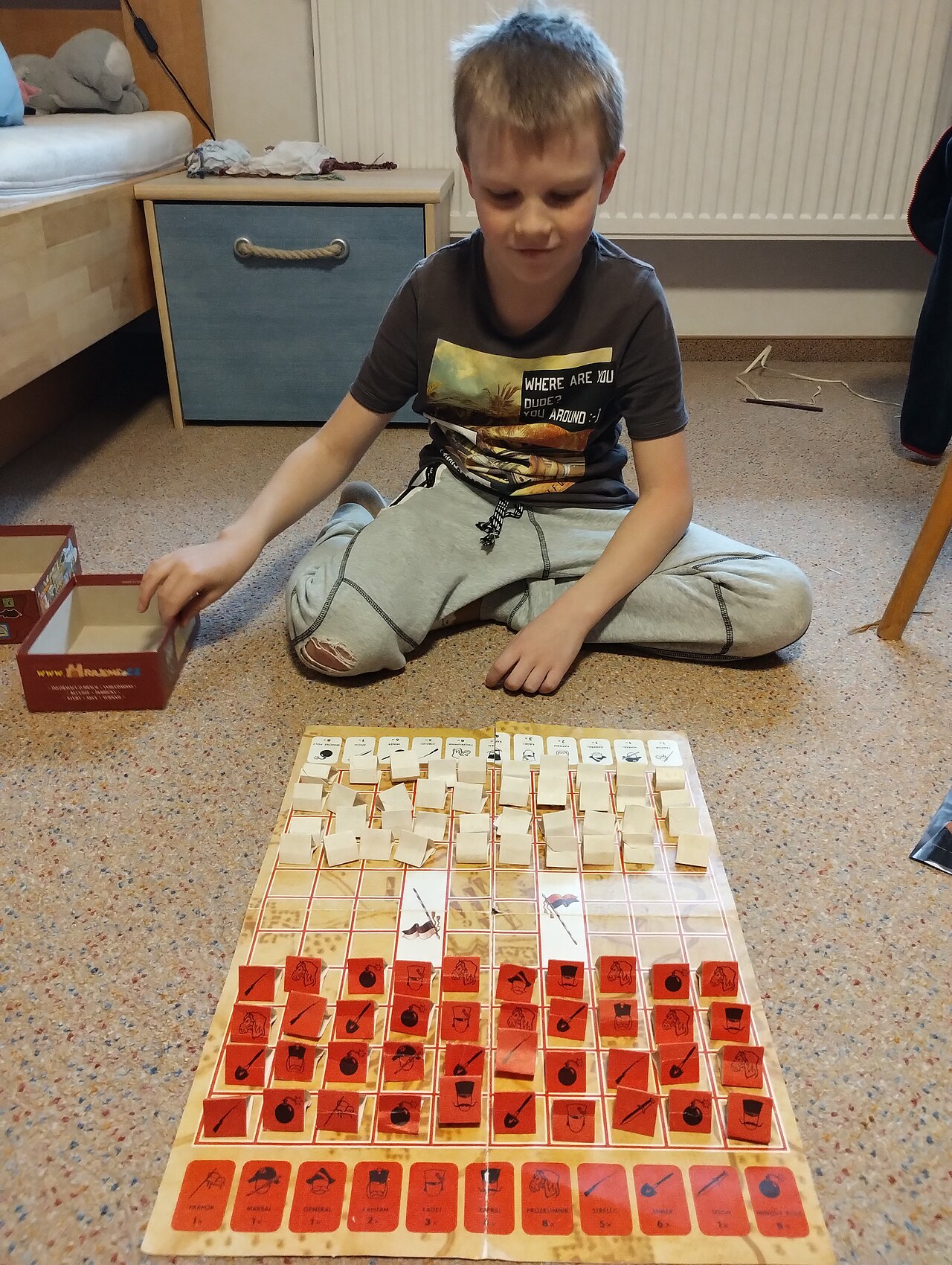
In Stratego, each player begins with pieces placed face down. The opponent sees their positions but not their ranks. A piece’s identity is normally revealed only after it attacks or is attacked. Players must therefore make decisions using an incomplete and changing picture of the game: they must estimate the probability that an unmoved piece is a bomb, a high-ranking officer, a scout, or the flag; decide when to preserve uncertainty; and recognize when an apparent weakness is a trap.
That structure makes the game a closer analogue to many real decision problems than a fully visible board game. Good play requires maintaining beliefs about hidden states, updating those beliefs after each observation, planning against multiple plausible opponent configurations, and deliberately shaping what the opponent can infer. A strong Stratego player is not only calculating tactics; the player is managing information.
The reported result against Niemeijer is consequently meaningful as an evaluation of strategic reasoning under uncertainty. It does not establish that the system can solve real-world intelligence, security, financial, or business decisions. Those domains have messier data, changing objectives, legal constraints, and consequences far beyond a game. But it does show that an AI can learn and execute sophisticated policies where deception and partial observability are central rather than incidental.
Self-play and test-time search appear to be the key design choices
According to Ars Technica’s report, Ataraxos relies on a design that combines self-play with search at decision time. The distinction is important. Self-play lets a system generate a large supply of strategically relevant training experience without requiring vast collections of human-recorded games. Test-time search, meanwhile, gives the trained model or policy additional computation when choosing a move, allowing it to evaluate alternatives in the specific position it faces. [1]
In a hidden-information game, the search problem is not merely “what move produces the best board position?” It includes questions such as: What hidden piece assignments are consistent with the moves seen so far? How likely is each assignment? Which move is robust across several plausible assignments? Which action reveals too much about a player’s own remaining pieces?
A useful system must account for the opponent as an adaptive agent rather than as a fixed puzzle. An opponent can observe movement patterns, test defenses, sacrifice pieces to discover ranks, and react differently depending on what it believes. That makes a policy trained solely to maximize short-term material exchanges vulnerable to stronger human tactics. The reported match score indicates that Ataraxos was able to do substantially more than choose locally favorable captures.
The practical lesson is not that search has suddenly replaced large models. Rather, the result reinforces a recurring pattern in AI: when a problem has a well-defined simulator, objective, and feedback loop, carefully targeted training plus inference-time computation can outperform a more generic, compute-heavy approach. The quality of the learning environment and the match between the algorithm and the problem often matter as much as headline GPU counts.
A small-budget result with broader engineering implications
The reported use of 16 GPUs and a training bill of only a few thousand dollars is one of the story’s most consequential details. Recent AI attention has been dominated by frontier models trained across clusters containing tens of thousands of accelerators, at costs accessible mainly to the largest technology companies and well-funded labs. Ataraxos is a reminder that not every important capability requires that scale.
For academic groups, startups, and enterprise AI teams, this points toward a more practical research agenda: build strong simulators or environments for the decision process at hand; define measurable goals; train policies through repeated interaction; and reserve expensive computation for decisions where deeper search materially improves quality. This approach is especially attractive in constrained operational settings, including scheduling, routing, inventory allocation, network control, and some forms of automated negotiation.
Those examples should not be treated as direct deployments of Stratego technology. A game has fixed rules and fast feedback, while industrial environments frequently contain delayed outcomes, incomplete records, nonstationary behavior, and safety requirements. Still, the architecture of the problem matters. Applications that involve repeated decisions, adversarial or strategic behavior, partial observability, and a credible simulator are more plausible candidates for similar techniques than open-ended text tasks are.
The work may also intensify interest in hybrid AI systems. Rather than asking one large general-purpose model to handle perception, planning, uncertainty estimation, and execution unaided, developers can pair learned components with explicit search, domain constraints, and simulation. Such systems can be less glamorous than a single general model, but they may be easier to evaluate and cheaper to operate in narrow, high-value workflows.
What the match does—and does not—prove
A 15-1 record with four draws against a leading human player is a decisive result, but it should be interpreted with appropriate limits. Match outcomes can depend on the number of games, starting conditions, opening rules, time controls, and whether a human has had meaningful opportunities to study the system’s tendencies. In a hidden-information game, the ability to exploit an unfamiliar opponent is itself strategically legitimate, but it can complicate comparisons with a long-established human competitive field.
Reproducibility is another central question. The most useful follow-up evidence would include independent matches against multiple elite players, analysis of performance under different time controls and opening conditions, ablation studies that isolate the value of self-play and search, and enough implementation detail for outside researchers to test the underlying claims. A low reported training cost is significant, but it is not a full accounting of research expense, engineering time, hardware access, or the cost of running search during play.
There is also a risk of overstating transfer. Stratego contains the type of uncertainty and opponent modeling that AI systems must eventually handle in many settings, but its rules are stable and its actions are precisely defined. Real organizations often lack an accurate simulator, and their goals cannot always be reduced to a single score. A system that excels at Stratego is evidence of progress in a technical class of problems, not proof of general strategic intelligence.
Even so, the achievement challenges a simplistic assumption that sophisticated strategy requires either human demonstrations at scale or frontier-lab budgets. It suggests that algorithmic discipline can be a powerful equalizer, particularly when researchers choose a problem where self-play supplies abundant feedback.
What comes next for strategic AI
The immediate next step is likely broader validation: more opponents, more game conditions, and closer inspection of the strategies Ataraxos developed. Researchers will also want to know whether its methods work across other partially observable, multi-agent settings rather than being tightly specialized to Stratego.
For industry, the most valuable downstream effect may be methodological rather than commercial. Teams building operational decision systems can look to this result as a case for investing in high-fidelity simulators, evaluation frameworks, and constrained planning systems—not only in ever-larger foundation-model training runs. The best opportunities may emerge where a company can model its environment well enough to let an AI practice safely at scale before it is permitted to influence real decisions.
Ataraxos therefore represents a useful counterweight to the industry’s current compute narrative. Scale remains important, particularly for broad language and multimodal capabilities. But this result argues that targeted self-play and well-designed test-time search can produce elite behavior at a fraction of the cost when the problem structure supports them.
Editor’s Take
I see the modest training budget as the more important headline than the win itself. Elite game performance is valuable evidence, but the commercial lesson is that teams should not assume a billion-parameter general model is the starting point for every difficult decision problem. If a business can build a credible simulator and a clear reward function, a smaller system that learns through interaction and searches carefully at runtime may deliver a better cost-to-performance ratio.
The next thing to watch is whether this approach survives outside a clean board-game environment. The meaningful test is not whether Ataraxos can collect more Stratego trophies; it is whether similar systems can improve bounded, auditable planning tasks where uncertainty is real but the environment can still be modeled. Hype would be claiming that this solves real-world strategy. The genuine opportunity is more specific: it offers a practical blueprint for strategic automation where simulation, constraints, and evaluation are available.