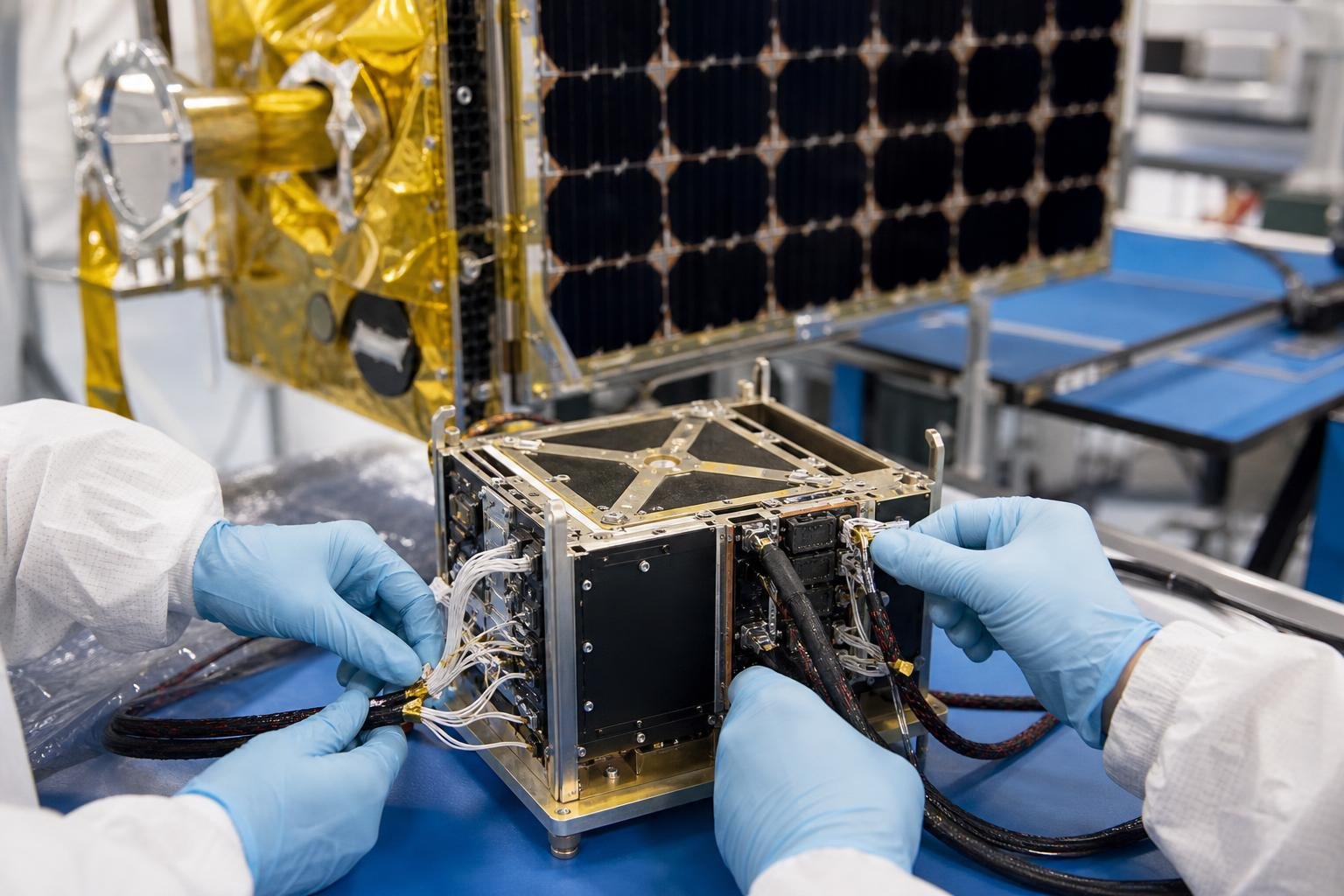
Satlyt and the University of Houston have completed a NASA-funded demonstration of a critical, less visible component of orbital computing: software that can decide where computational work should run as processing capacity and communications conditions change. The software ran on spacecraft hardware, evaluated simulated workloads across a network of computers, and sent its planning results back to Earth.[1]
The test is not evidence that satellites are already operating as a live, interconnected space data center. It did not perform distributed processing across multiple active spacecraft. Its significance is narrower, but important: it moves the decision-making layer for distributed orbital computing onto spacecraft hardware. That layer will be necessary if future constellations are to use compute, power and intermittent links efficiently rather than simply downlinking every task and every byte of data for processing on the ground.[1]
By the numbers
- 1: NASA-funded onboard planning demonstration reported by Satlyt and the University of Houston.
- 2: Organizations directly conducting the reported test: Satlyt and the University of Houston.
- 0: Live multi-spacecraft distributed-processing demonstrations reported in this experiment.
What the demonstration actually proved
The experiment concerned workload placement, sometimes called scheduling or orchestration. In a distributed system, an application can be broken into tasks that may run on different processors or machines. A planner determines which available node should receive a task, when it should run, and whether the data needed by that task can be moved to the selected location quickly and reliably enough.
On Earth, cloud platforms make similar decisions continuously. They consider available processor and memory capacity, network paths, hardware health, cost and service deadlines. Orbital networks add constraints that are more severe and less predictable. A satellite may move out of view of a partner spacecraft or ground station; a crosslink can be occupied or degraded; solar generation can change with illumination; batteries have finite charge; and radiation, thermal conditions or subsystem faults can reduce available computing resources.
Satlyt’s software was tested against changing compute and communications constraints while running onboard spacecraft hardware. It produced a plan for assigning simulated workloads across a network of computers, then returned that result to Earth. That distinction matters. The reported achievement validates onboard execution of the planning function; it does not validate end-to-end task dispatch, data movement, execution and result exchange among a fleet of operational satellites.[1]
The report does not establish a benchmark for planning speed, power consumption, solution quality, workload size or fault tolerance. Those measurements will be central in later demonstrations. Still, moving the planner from a ground-controlled workflow onto spacecraft hardware is meaningful because it reduces dependence on waiting for a ground contact before responding to a change in available resources.
Why scheduling is a core orbital-computing technology
Much of the discussion around space-based computing focuses on the most tangible inputs: launch costs, radiation-tolerant chips, solar arrays, thermal control and high-bandwidth optical links. All are necessary. None alone determines whether a collection of satellites can behave as a useful computing system.
A constellation needs a control plane that has a current view of its resources and can translate mission priorities into actions. If a spacecraft captures imagery that needs filtering, compression, object detection or other processing, the system must decide whether to process it locally, forward it to another spacecraft, queue it until a better link appears, or send it directly to the ground. The best answer can change minute by minute.
That is an optimization problem with competing objectives. Sending a workload to the most powerful processor may consume scarce link capacity. Processing locally may preserve bandwidth but drain a battery or delay a more urgent mission function. A planner may need to prioritize latency for time-sensitive data, conserve energy during orbital darkness, avoid a marginal node, or reserve communications capacity for command-and-control traffic.
Centralized planning from Earth can be sufficient for predictable missions and low-rate workloads. It becomes less attractive when satellites must react within short time windows, when contact opportunities are limited, or when a network has many nodes and changing routes. Onboard planning is therefore a prerequisite for meaningful operational autonomy, even if humans still set policy, mission priorities and safety limits.
The technical gap between a planner and a functioning space compute network
The next steps are substantial. A production-grade orbital scheduler must do more than generate a placement plan. It needs accurate telemetry about processor availability, memory, storage, battery state, temperature, link quality and network topology. It also needs a way to distribute the plan, start workloads, transfer input data, confirm completion and recover when a satellite or communications path becomes unavailable.
There are difficult design choices at each layer. A centralized planner can make globally informed decisions but can create a single point of delay or failure. Fully decentralized approaches can react locally and survive partitions, but different satellites may have incomplete or inconsistent views of the network. Hybrid designs are likely to be attractive: fleet-level policy and longer-horizon planning can be generated centrally or by designated nodes, while spacecraft make bounded local decisions when conditions diverge from plan.
Security is equally important. Remote workload deployment and coordination broaden the attack surface of a spacecraft network. Operators will need strong authentication, signed software, isolation between workloads, auditable scheduling policies and safe fallback modes. For government, defense and commercial missions alike, a scheduler must never allow noncritical processing to interfere with flight safety, attitude control, communications or protected mission data.
Verification is another challenge. Software that works against a simulated network must be shown to remain reliable when confronted with real propagation delays, packet loss, clock uncertainty, antenna handoffs, radiation-induced errors and constrained onboard operating environments. The value of the Satlyt test is that it takes one element out of a purely ground-based simulation. The remaining elements still require integrated testing.
Implications for satellite operators and the market
Near-term demand for distributed orbital computing is likely to come from missions where transmitting raw data is costly, delayed or impractical. Earth-observation systems can benefit by filtering low-value imagery before downlink, flagging events for priority transmission or compressing data closer to where it is collected. Communications constellations may use distributed processing for network management and adaptive service delivery. Scientific and national-security missions may also value faster local interpretation when ground access is constrained.
For satellite operators, the economic question is not whether every workload belongs in orbit. Ground data centers retain decisive advantages in power, cooling, hardware replacement and scale. The opportunity is to perform the subset of processing for which orbital execution reduces latency, avoids downlinking unneeded data, improves resilience or enables a mission that could not otherwise operate effectively.
That makes orchestration software a potentially important differentiator. Commodity processors and launch capacity do not automatically create a usable orbital compute service. An operator that can reliably assign work among spacecraft while respecting energy, network and mission constraints could extract more utility from the same constellation. Conversely, poor scheduling could waste scarce power and bandwidth, turning expensive onboard hardware into underused capacity.
The University of Houston partnership and NASA funding also illustrate the role of public research in reducing technical uncertainty before commercial deployment. The reported work positions Satlyt in an emerging layer of the space technology stack: software for managing distributed compute resources rather than the satellites, launches or chips themselves.[1]
What to watch in the next demonstrations
The most useful follow-on test would close the loop across real nodes: one spacecraft or hardware node should receive a task, execute it, pass data or results through a changing communications path, and trigger replanning when a node or link becomes unavailable. A credible operational demonstration should compare onboard decisions with a ground-directed baseline and publish measurements for latency, energy use, data transferred, task completion rate and recovery behavior.
It will also be important to see how the software handles policy. A scheduler optimized only for throughput may make choices that are unacceptable to a mission operator. Future systems need explicit priority rules: which workloads may move, which resources are reserved, when data may leave a spacecraft, and what happens when the optimization objective conflicts with safety or mission assurance.
Claims about “space data centers” should therefore be evaluated in layers. A successful onboard planner is real progress in the control layer. Live, reliable multi-spacecraft execution is the next systems test. Sustained commercial service, with repeatable economics and operational assurances, is the much higher bar after that.
Editor’s Take
I see this as a practical milestone, not a space-data-center breakthrough. The valuable part is that Satlyt has put the allocator where the uncertainty is: on the spacecraft. If a network has to wait for the ground to decide what runs where, it will leave much of the promised responsiveness and bandwidth savings on the table.
The next proof point should be deliberately unglamorous: real tasks moving among real nodes while a link disappears, power margins tighten and the system still meets a defined mission priority. That is where orchestration software earns its place. The hype gets ahead of the facts when it treats spare satellite compute as a cloud region in orbit; power, thermal limits, links and fault recovery make it a very different operating environment.