
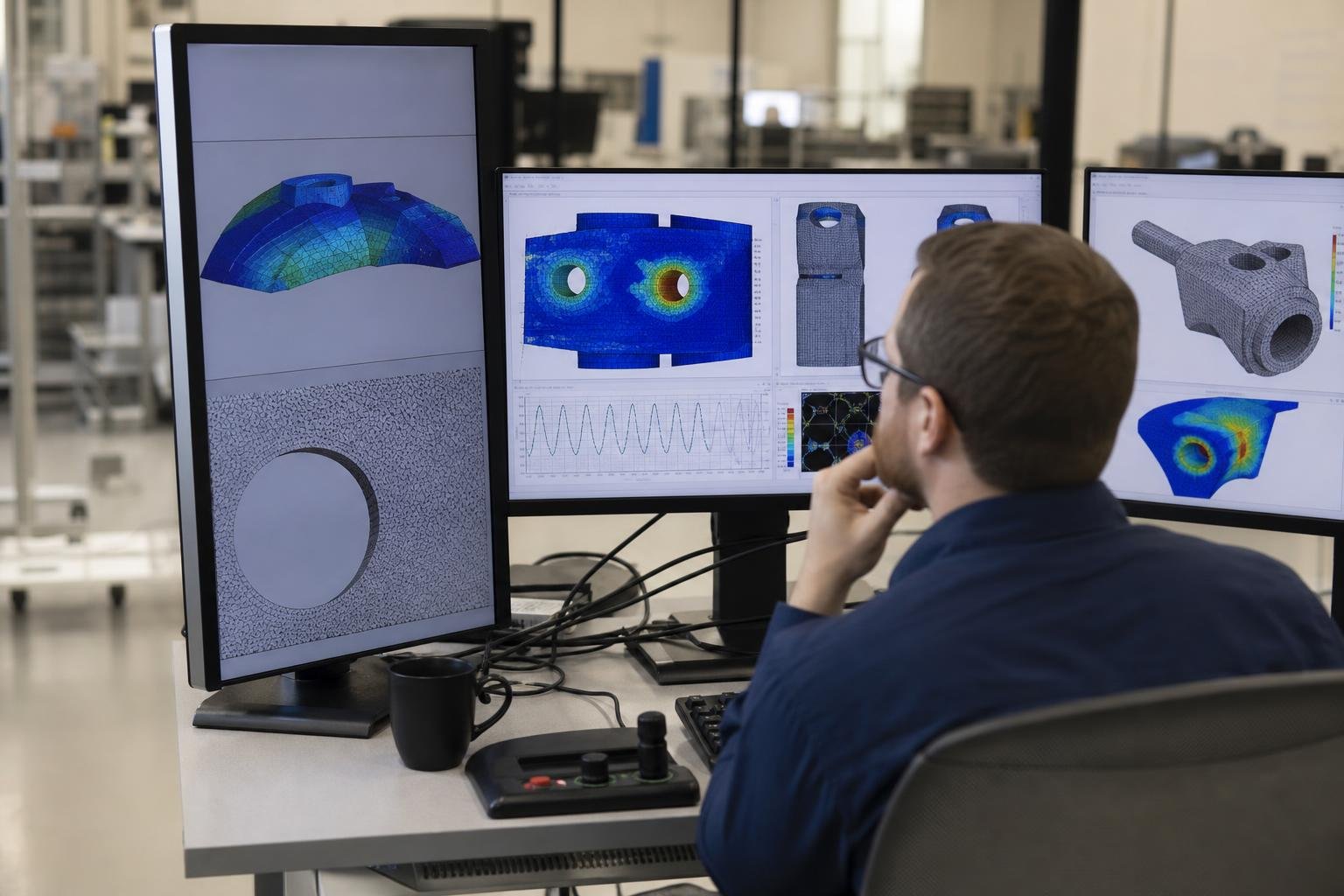
Researchers at Idaho National Laboratory (INL) have reported substantial gains in AI-assisted engineering simulation with MOOSEnger, a locally deployable assistant built around the Multiphysics Object-Oriented Simulation Environment (MOOSE). In the authors’ preprint, the system combines a language model with framework-specific retrieval, executable simulation checks, automated error diagnosis, and persistent memory rather than relying on a model to generate an input file in a single pass.
That workflow design is the central result. MOOSEnger paired with GPT-5.2 reached a reported 90% success rate across the study’s multiphysics tasks, compared with 76.5% for a Gemma4-based version. The non-agentic baselines reported by the authors scored 5% and 0%. The findings are preliminary and specific to the evaluated MOOSE workflow, but they offer unusually direct evidence that validation and iterative repair can matter more than raw code-generation ability when AI is applied to scientific computing.[1]
By the numbers
- 90%: reported success rate for MOOSEnger-GPT-5.2.
- 76.5%: reported success rate for MOOSEnger-Gemma4.
- 5%: reported success rate for one non-agentic baseline.
- 0%: reported success rate for the other non-agentic baseline.
Why the harness changes the result
MOOSE is an open-source finite-element simulation framework developed at INL and used for coupled physics problems. Its applications can span heat transfer, mechanics, fluid flow, materials behavior and other systems in which the physics interact. Such software is powerful, but its input decks are structured, domain-specific programs: a plausible-looking configuration can still be invalid, omit a required relationship, select an incompatible component, or produce a result that does not answer the engineering question.
That distinction exposes a weakness in conventional AI coding demonstrations. A model can produce text that resembles a valid simulation input file, yet an engineer ultimately needs a case that runs and is appropriately configured. In multiphysics work, passing a syntax check is not sufficient. Boundary conditions, materials, meshes, coupled variables, solver settings and post-processing choices must work together.
MOOSEnger is designed to close that gap through an agentic loop. Instead of treating the language model’s first response as the final deliverable, the system retrieves relevant MOOSE knowledge, generates or modifies simulation inputs, executes the simulation, interprets resulting errors, and attempts corrective actions. It also stores lessons in persistent memory, allowing prior resolutions and workflow knowledge to be brought into later tasks.[1]
The reported performance gap between the agentic systems and the non-agentic baselines is therefore more consequential than a simple model-versus-model comparison. The study frames reliability as a systems problem. Retrieval gives the model access to framework-relevant information; execution turns claims about correctness into testable outcomes; diagnosis provides a path from failure logs to repair; and memory can prevent the system from rediscovering the same operational detail repeatedly.
From generated input to an executable engineering workflow
The assistant’s local-deployment emphasis is also notable. Engineering and scientific organizations commonly work with proprietary geometries, material data, model assumptions and mission-specific requirements. A system that can be deployed locally may be easier to evaluate in controlled computing environments than a purely remote assistant, though local deployment does not by itself resolve governance, access-control or model-provenance requirements.
In practical terms, MOOSEnger treats simulation as an environment in which the AI can act and receive feedback. That is different from asking a chatbot, “Write a MOOSE input file,” and accepting the answer based on readability. The simulation executable becomes a validator. Error messages and runtime behavior become observations. Subsequent tool calls become opportunities to repair the work.
This architecture resembles a broader shift in AI for technical work: systems are being judged less by whether they can draft an answer and more by whether they can reliably operate within a constrained toolchain. Software engineering agents, data-analysis agents and laboratory-planning systems are increasingly built around this pattern. Their value depends on access to authoritative context, the ability to take bounded actions, and verifiable feedback from compilers, tests, databases, instruments or simulators.
For simulation teams, the immediate use case is not necessarily unsupervised model development. A more credible near-term role is reducing the time spent on repetitive setup, framework navigation and first-pass debugging. An assistant that can find relevant documentation, construct a candidate case, run it, identify a malformed block or missing parameter, and return a traceable revision could make experienced analysts faster while giving newer users a more structured path into complex tools.
What the comparison does—and does not—establish
The preprint’s results are striking: 90% and 76.5% for the two MOOSEnger configurations, versus 5% and 0% for the stated non-agentic baselines.[1] Yet those figures should be read as a measurement from a particular benchmark and workflow, not as proof that AI can autonomously engineer real-world systems.
First, the reported outcome measures task success in the authors’ evaluated set of multiphysics problems. Its meaning depends on task composition, scoring criteria, the degree to which execution success reflects physical correctness, and how closely the benchmark resembles production workloads. A case can run without representing reality adequately; conversely, an expert may make deliberate modeling choices that cannot be inferred from a prompt alone.
Second, the comparison tests an integrated agentic harness against non-agentic approaches. That is useful because it measures the system a practitioner might actually deploy, but it does not isolate every contribution within the harness. The preprint supports the proposition that the combined retrieval, execution, diagnosis and memory loop is effective in this setting. It does not, from the headline results alone, establish how much of the gain comes from each individual component or whether the same effect will transfer unchanged to other simulation frameworks.
Third, model identity remains relevant but is not the whole story. GPT-5.2 produced the highest reported score in the MOOSEnger setup, while Gemma4 also reached a substantially higher score than the non-agentic baselines. The latter result is especially important for organizations weighing local, cost, data-handling and deployment constraints: orchestration and verification may allow a capable model to contribute useful work without making the model itself the sole point of reliability.
Implications for engineering software and AI buyers
The commercial and institutional opportunity lies in workflow integration. Engineering software vendors, national laboratories, industrial research teams and specialist consultancies are under pressure to make sophisticated simulation tools more accessible without weakening review standards. A dependable assistant could lower the friction of using mature codes, preserve institutional knowledge, and shorten iteration cycles for routine studies.
Persistent memory could be particularly valuable in organizations where hard-won operational knowledge is scattered across documentation, old input files, issue trackers and a small number of senior practitioners. But that benefit creates a governance requirement: stored lessons need provenance, version awareness and review. A repair that worked for one MOOSE version, physics module or modeling convention should not be silently generalized to every future project.
The result also points to a more pragmatic procurement question than “Which model is smartest?” Buyers should ask whether an AI system can retrieve approved internal knowledge, execute in a sandbox, preserve logs, expose the changes it made, and route ambiguous or high-consequence decisions to an engineer. In regulated, safety-critical or high-value engineering contexts, auditability and reproducibility will likely be prerequisites for adoption.
That may favor tool builders that can connect models to existing simulation infrastructure while retaining strict permissions and reproducible run records. It may also favor narrow, domain-specific assistants over generic chat interfaces. The model is important, but the surrounding controls determine whether its outputs can participate in a serious engineering process.
What to watch next
The most important next test is independent replication on broader and more difficult task sets. Researchers and prospective users will want breakdowns by task type, failure mode and physics domain, along with evidence that successful runs satisfy appropriate scientific and engineering criteria rather than merely completing without an error. Ablation studies removing retrieval, execution, diagnosis or memory would help clarify which parts of the architecture drive the reported gains.
It will also be important to test robustness across MOOSE releases, hardware environments, incomplete prompts and deliberately misleading inputs. Production engineering work often begins with underspecified requirements, uncertain data and competing acceptable assumptions. An assistant must be able to identify when it lacks information, explain its assumptions, and stop rather than confidently automating a consequential but unjustified choice.
For now, the MOOSEnger work is best understood as promising evidence for an engineering principle: language models become more useful in scientific workflows when they are placed inside a feedback system that can check, challenge and revise their output. The preprint does not demonstrate general autonomous engineering, but it does show why the next advances may come as much from rigorous harness design as from the next model release.[1]
Editor’s Take
The 90% figure is attention-grabbing, but the more investable insight is the loop behind it. Engineering teams do not need another system that produces polished-looking input files; they need one that can prove whether a candidate runs, show what failed, and preserve the path to a repair. MOOSEnger’s reported gap over non-agentic baselines suggests that execution and diagnosis are not product polish—they are core reliability infrastructure.
I would watch for evidence beyond task completion before treating this as a production breakthrough. The next compelling demonstration would pair executable validation with expert review of physical validity, full run provenance, and clear escalation when modeling judgment is required. If that holds up across more frameworks, locally deployable agentic harnesses could become a practical layer around simulation software, helping engineers spend less time fighting configuration details and more time evaluating the science.
References
- arXiv — https://arxiv.org/abs/2608.15881

.jpg)