
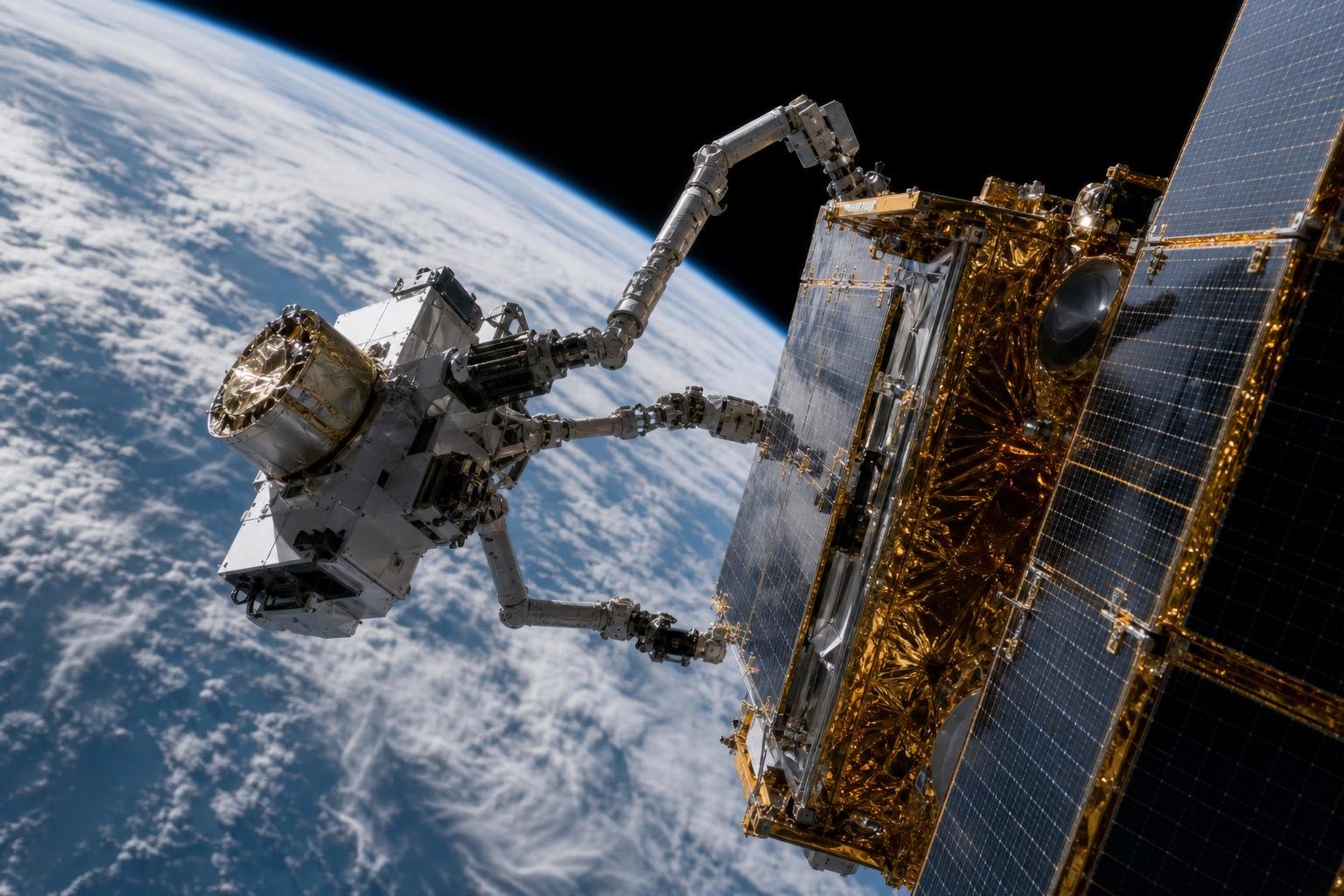
Northrop Grumman is developing a Mission Robotic Vehicle, or MRV, intended to inspect, repair, refuel and otherwise extend the useful lives of satellites already operating in orbit. The vehicle is designed to take on maintenance work that has traditionally been impossible once a satellite leaves Earth, leaving operators to replace an aging spacecraft or abandon it when a critical subsystem fails or its propellant runs low. [1]
The significance is larger than a single robotic spacecraft. Satellite operators are beginning to move from a replacement-based model toward one in which orbital hardware can be inspected, maintained and upgraded as an operating asset. If such servicing becomes dependable and economically viable, it could reduce replacement costs, preserve valuable orbital positions, limit the number of inactive spacecraft left in orbit and support a more durable space economy. The central technical challenge, however, is proving that robotic systems can repeatedly perform delicate work autonomously in a hostile, inaccessible environment.
From disposable spacecraft to maintainable infrastructure
For most of the space age, satellites have been designed as self-contained machines with finite lives. Engineers can build in redundancy, use radiation-tolerant components and carry extra propellant, but they cannot normally send a technician to diagnose a problem, replace a failed unit or top off a depleted tank. A satellite that remains mechanically and electrically sound can still become commercially useless if it exhausts the propellant needed to hold its assigned orbit or control its orientation.
That approach made sense when launches were rare and spacecraft were largely treated as singular, high-cost missions. It is becoming less attractive as commercial and government fleets grow, orbital slots become more valuable and launch remains only one part of the cost of replacing a satellite. A replacement program can involve years of spacecraft design, manufacturing, testing, insurance, launch integration and commissioning—not merely the price of putting mass into orbit.
Northrop’s MRV is aimed at changing the maintenance boundary. Rather than accepting that a satellite’s launch configuration defines the end of its practical service life, the company is pursuing a vehicle that can approach a client spacecraft and conduct work in orbit. The tasks described for the MRV—inspection, repair, refueling and life extension—address several of the most consequential reasons spacecraft are retired. [1]
What a robotic servicing vehicle must do
An orbital mechanic is not simply a robotic arm attached to a satellite. It requires a tightly integrated set of capabilities: navigation around another spacecraft, close-range sensing, robotic manipulation, propulsion and attitude control, communications with ground operators, and software capable of responding safely when conditions differ from a planned sequence.
Inspection is the least invasive service but can be highly valuable. Cameras and other sensors may allow operators to assess external damage, deployment anomalies, thermal hardware, antennas, solar arrays or debris impacts. Better diagnosis can help operators decide whether a spacecraft can continue its mission, needs intervention or should be moved out of an operational orbit.
Repair and refueling are more demanding. The servicing vehicle must establish a stable relative position while both vehicles travel at orbital velocity. It must manage the effects of even small contact forces, which can set an uncooperative satellite rotating. Robotic tools must also interact with hardware that may not have been designed for servicing, potentially after years of thermal cycling, radiation exposure and vacuum operation.
Refueling adds its own safety and standards problem. Propellant transfer requires compatible interfaces, secure connections and procedures that prevent leaks or contamination. Future satellites designed with standardized service ports, accessible components and robotic-grapple features could be substantially easier to support than legacy spacecraft. That means the long-term value of vehicles such as the MRV may depend as much on satellite design practices and customer agreements as on the robot itself.
The commercial case for keeping satellites working
Life extension can alter the economics of a satellite fleet. When a spacecraft still has functioning payloads and customer demand but lacks enough fuel for station-keeping or maneuvering, additional propulsion support or refueling could preserve revenue-producing capacity while deferring a replacement mission. Repair capabilities could also protect operators against certain failures that would otherwise end a mission early.
The service model could be particularly relevant where continuity matters. Communications, Earth observation, weather, navigation support and national-security missions often depend on sustained availability. Extending a spacecraft’s useful period can give an operator more time to deploy a successor, smooth capital spending or respond to a launch delay without immediately losing capacity.
There is also a market-structure implication. Servicing could create a specialized layer of orbital logistics companies, manufacturers and insurers. Satellite builders may increasingly compete on serviceability as well as payload performance and launch mass. Operators may weigh contracts for inspection, relocation, life extension or fuel delivery as part of fleet planning. The result would resemble a shift from selling isolated machines to supporting a maintained industrial base in orbit.
Northrop Grumman’s work therefore arrives in a sector where servicing is not a novelty for its own sake. It is an attempt to turn a technically difficult capability into an operational service. The critical commercial question is whether the cost, risk and schedule of a servicing mission compare favorably with launching replacement capacity. [1]
Durability and debris reduction depend on execution
Keeping a healthy satellite operational longer may reduce the pressure to replace functioning hardware before its payload has reached the end of its useful life. It can also help operators manage spacecraft that would otherwise become inactive simply because they can no longer maneuver effectively. That is important in increasingly crowded orbital regimes, where a dead or uncontrolled spacecraft can complicate operations for other missions.
Still, satellite servicing should not be portrayed as an automatic solution to orbital debris. A servicing vehicle must itself operate safely around expensive spacecraft. Rendezvous and proximity operations require careful coordination, accurate tracking and robust collision-avoidance procedures. A failed docking attempt or an unexpected tumble by a client satellite can create mission risk rather than reduce it.
There are policy and security considerations as well. The ability to approach, grasp, move or modify a satellite is inherently dual-use. A vehicle designed for maintenance can be viewed by other governments as having potential counterspace applications. Clear mission planning, licensing, operator coordination and internationally understood norms for proximity operations will be necessary if servicing missions become common.
At the engineering level, reliability remains the decisive proof point. Ground teams can supervise operations, but communications delays, limited visibility and the cost of real-time intervention mean the vehicle must handle many tasks with a high degree of autonomy. It must recognize when conditions are outside its safe operating envelope and retreat without damaging either spacecraft. Repetition matters: a compelling demonstration is useful, but a durable market requires consistent performance across different spacecraft configurations and mission conditions.
What to watch next
The MRV’s progress should be measured by operational milestones rather than by the visual appeal of a robot in space. The most meaningful evidence will be successful rendezvous, sustained inspection, reliable capture or docking, carefully controlled manipulation, and servicing tasks that produce measurable additional utility for a customer satellite.
Industry adoption will also depend on whether satellite owners choose to prepare spacecraft for future service. Purpose-built interfaces and modular components can lower complexity, but they require manufacturers and customers to agree on standards before launch. The larger opportunity is a feedback loop: as more satellites are designed to be serviceable, servicing missions become less risky and less expensive; as servicing becomes more available, serviceable design becomes easier to justify.
Northrop’s vehicle represents a practical test of whether the orbital economy can mature beyond a launch-and-replace cycle. The opportunity is real, but it will be earned through careful autonomous operations, compatible hardware and contracts that demonstrate that maintenance in orbit is cheaper and more reliable than premature replacement.
Editor’s Take
I see the MRV as more important for fleet economics than for robotics spectacle. A satellite that loses maneuvering margin or suffers a manageable external problem should not automatically become a write-off when its payload is still valuable. Inspection alone can improve decision-making; refueling and repair could make that decision economically consequential.
The claim to watch is not that a robot can reach another satellite—proximity operations are only the starting point. The real test is whether Northrop can deliver repeatable, low-risk servicing with clear customer value, especially on spacecraft not originally built for robotic maintenance. Until that is demonstrated routinely, talk of an orbital repair economy remains ahead of the evidence. But designing new satellites around serviceability now is a sensible bet: it gives operators options that disposable spacecraft do not have.




.jpg)