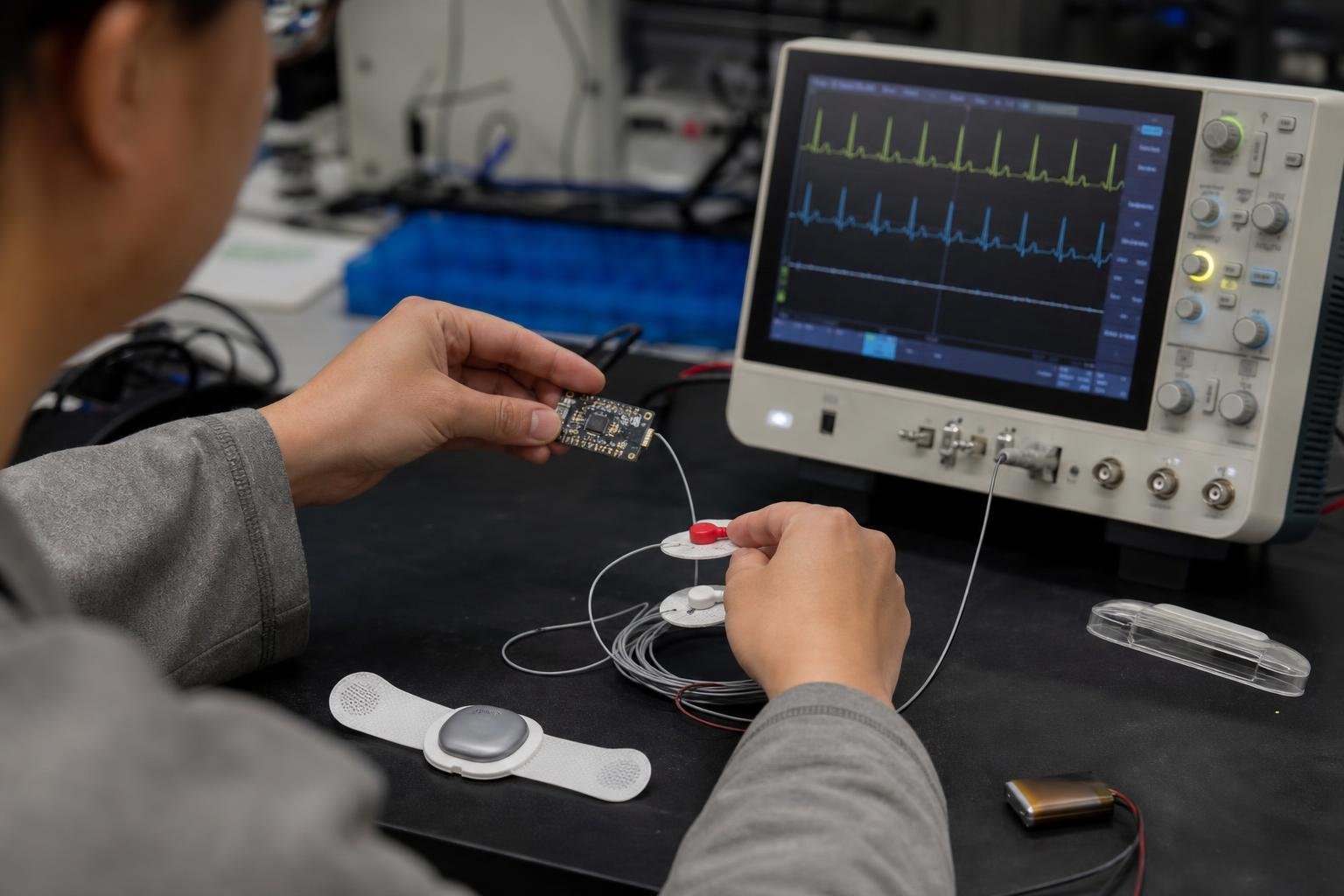
Researchers have developed a brain-inspired memtransistor device that detected irregular heartbeats in simulated electrocardiogram (ECG) tests while using roughly 10,000 times fewer calculations than a transformer-based baseline. The system achieved 98% accuracy and ran at more than twice the baseline speed, according to reporting on the work by Live Science. [1]
The significance is broader than a single arrhythmia-classification result. The chip is designed to prioritize change and surprise in an incoming signal rather than repeatedly processing routine data. That event-driven approach could be important for always-on health monitoring, where battery-powered devices must observe a largely predictable physiological stream for long periods while still responding quickly when something unusual occurs.
By the numbers
- 98%: reported accuracy in simulated ECG arrhythmia-detection tests.
- More than 2×: reported speed relative to a transformer baseline.
- About 10,000× fewer: calculations used compared with that baseline.
A computing model that focuses on deviations
Most digital AI systems process data in regular cycles. For a wearable ECG monitor, that can mean continually sampling, moving and analyzing segments of a heartbeat waveform, whether the rhythm is normal or not. Modern neural networks can be accurate, but repeated computation is expensive in energy, memory access and processing hardware—costs that matter far more on a wrist-worn, patch-based or implantable device than in a cloud data center.
The reported device takes a different route. It is inspired by the cerebellum, a brain region associated with rapid motor coordination and with detecting mismatches between expected and actual sensory information. Applied to a signal-processing task, the principle is straightforward: establish a response to expected input patterns, then devote attention to departures from that expectation.
In an ECG stream, a stable sequence of normal beats is highly repetitive. An irregular interval or altered waveform is the useful event. A system that suppresses routine information and accentuates deviations can potentially reduce the volume of work required before an alert or classification decision is made. The practical proposition is not that the chip ignores normal physiology; rather, it avoids giving every predictable sample the same computational weight.
This is a form of event-driven computing. Its closest conceptual relatives include neuromorphic processors and sensors that transmit information only when pixel intensity changes rather than delivering every image frame in full. In each case, efficiency comes from matching computation to the structure of the real-world signal. Physiological monitoring is a particularly appealing target because relevant abnormalities can be infrequent while observation must be continuous.
Why the memtransistor matters
The underlying component is a memtransistor: a transistor-like device with memory behavior. Conventional computing generally separates memory, which stores data, from processors, which calculate on it. Moving data back and forth between those functions consumes time and energy. Memtransistor and other in-memory-computing devices seek to combine aspects of storage and signal processing within the same physical element.
That characteristic makes such devices a natural fit for neuromorphic designs. Instead of representing every stage of a neural network as a sequence of conventional digital operations, a device can retain state and adjust its electrical response based on prior inputs. In this research, that stateful behavior supports a mechanism resembling the cerebellum’s ability to treat expected patterns differently from unexpected ones. [1]
The reported comparison with a transformer is consequential because transformers are widely used for sequence analysis, including biosignals. They are powerful but can require substantial arithmetic and memory traffic. A 10,000-fold reduction in calculations, if it translates to fabricated hardware operating under realistic conditions, would point to a much smaller energy budget for local inference. It would also reduce reliance on sending continuous raw health data to a phone or cloud service for analysis.
Calculations, however, are not the same as measured battery life. The final energy cost of a product depends on sensor electronics, analog-to-digital conversion, wireless transmission, memory, packaging, software and the manufacturing characteristics of the chip. The study’s result is best understood as a strong indication of algorithmic and architectural efficiency, not yet a complete power specification for a medical wearable.
The edge-health opportunity
Arrhythmia monitoring illustrates why edge AI is receiving attention. A device that can perform reliable local screening could preserve privacy by limiting the transmission of raw ECG data, extend operation between charges, and trigger targeted recording or remote review only when it finds a potentially meaningful event. It may also reduce latency, since the first-stage decision does not depend on a network connection.
For manufacturers of watches, adhesive ECG patches, Holter-style monitors and implantable cardiac devices, the appeal is clear: more capable continuous monitoring without simply scaling up batteries or offloading every workload to a smartphone. Health systems could also benefit if local triage reduces unnecessary uploads while preserving clinically relevant recordings for professionals to inspect.
Industry engineers will nevertheless evaluate this work on more than its headline accuracy. They will ask whether the device maintains its advantage across varied rhythms, noise levels, motion artifacts, electrode placements and patient populations. They will also need to know how easily the memtransistor can be fabricated consistently, how its state changes over time, and whether it can be integrated with the analog front ends and secure wireless hardware that a real monitoring product needs.
The approach may have uses beyond ECG classification. Many edge applications involve long periods of predictable data interrupted by meaningful changes: respiration monitoring, industrial vibration sensing, predictive maintenance and some motion-control systems. The cerebellar analogy is most useful where a device can learn a normal pattern and reserve heavier processing or communications for deviations.
Promising simulation, not a medical device
The central constraint is that the arrhythmia result was obtained in simulated ECG testing. That is an important research demonstration, but it is not equivalent to a deployable diagnostic chip or a clinically validated medical product. Simulations can show that a computational architecture classifies a defined dataset efficiently; they do not by themselves establish performance on messy real-world recordings, long-term reliability or clinical utility.
Accuracy also needs context. A single 98% figure does not reveal performance by arrhythmia type, false-positive and false-negative rates, robustness to noise, or results across demographic groups. In cardiac monitoring, missed dangerous events and excessive false alarms carry different consequences. A system intended to influence care would need rigorous validation against representative clinical data and review under the applicable medical-device rules.
Hardware claims require equivalent scrutiny. Novel memory devices can face challenges involving variability between devices, endurance, retention, calibration and yield. Event-driven systems also need a carefully designed fallback: if the definition of “unexpected” is too narrow, a clinically important but subtle pattern could be suppressed; if it is too broad, the device could lose much of its efficiency advantage by flagging too much ordinary variation.
Those are not reasons to dismiss the research. They define the work still required to turn a compelling computational result into a dependable product. The critical next evidence would include measurements from fabricated devices, end-to-end energy use, testing on ambulatory ECG recordings, comparison with specialized low-power digital chips as well as transformers, and clinical studies designed around safety-relevant error rates.
What changes if the approach scales
The longer-term value of brain-inspired hardware may lie in changing the economics of observation. Today, capable AI often assumes abundant computing resources and power. Event-driven architectures instead begin with the premise that most data are uneventful and that intelligence should be concentrated on novelty. For continuous sensors, that can be a more appropriate model than applying the same large network to every input window.
That shift could create a layered health-AI design: an ultra-low-power chip monitors continuously at the edge; suspicious events activate richer local analysis; and only selected data are sent to clinicians or cloud-based systems. Such a hierarchy would not eliminate the need for conventional processors or remote analysis. It could make their use more selective and more practical.
The research therefore matters less as a claim that one chip has solved cardiac diagnosis and more as evidence that hardware-level assumptions are becoming a major part of AI efficiency. For always-on sensing, the most useful intelligence may be the intelligence that knows when not to calculate.
Editor’s Take
I see the 10,000-times figure as a design signal, not a product specification. If a health monitor can genuinely reject routine ECG activity in hardware and wake more expensive processing only for suspicious beats, it could improve battery life, privacy and responsiveness at the same time. That is a better path to capable edge monitoring than endlessly shrinking a cloud-style model and hoping a wearable battery absorbs the cost.
The next milestone to watch is unglamorous but decisive: measured performance from fabricated chips running noisy, real ambulatory ECG data. The excitement should remain conditional until the researchers show energy per decision, false-alarm behavior, device-to-device consistency and clinical validation. The simulated result is promising; calling it a ready medical diagnostic would outrun the evidence.