
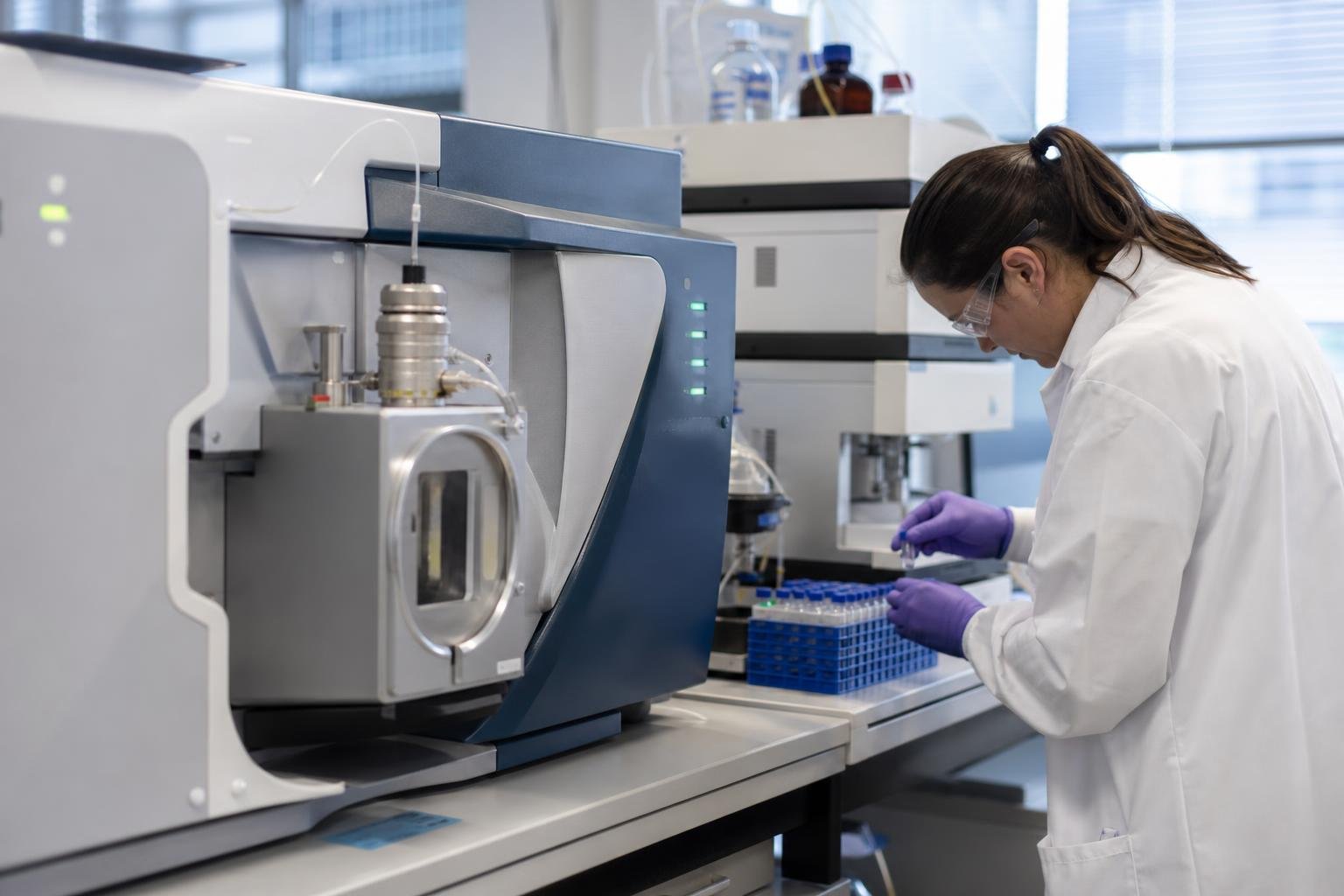
Researchers have published MassNet, an AI-ready proteomics corpus containing roughly 1.5 billion tandem mass spectra collected across 35 species. The accompanying study in Nature Methods also reports that a transformer model trained on the corpus improved de novo peptide-sequencing performance over existing methods, including a reported gain of up to 143.57% on human Astral data. [1]
The significance is less about a single AI model than about shared scientific infrastructure. Modern machine learning has advanced rapidly in fields that can assemble large, consistently structured training sets. Proteomics—where scientists identify and quantify proteins from mass-spectrometry measurements—has had valuable public data, but not necessarily a corpus built at this scale and format for broad AI training. MassNet could make the protein layer of biology more computationally searchable, provided its gains hold across instruments, laboratories and real-world biological samples.
MassNet at a glance
By the numbers
- 1.5 billion: approximate number of tandem mass spectra in the corpus.
- 35 species: biological coverage reported for MassNet.
- 143.57%: largest reported improvement in de novo peptide-sequencing performance on human Astral data.
MassNet is designed as a corpus rather than merely a benchmark: a collection intended to support model training, comparison and reuse. That distinction matters. A benchmark can measure whether a model is better on a defined task; a large corpus can enable the training of models that learn representations useful for several tasks, including peptide identification, spectrum interpretation and potentially transfer to new experimental contexts.
The work arrives as research groups and instrument users are increasingly applying transformer architectures to scientific data. In this case, the underlying records are tandem mass spectra, often abbreviated MS/MS: measurements generated after peptide molecules are fragmented in a mass spectrometer. The resulting pattern of fragment masses and intensities contains information about the peptide’s amino-acid sequence.
Why peptide sequencing remains a hard problem
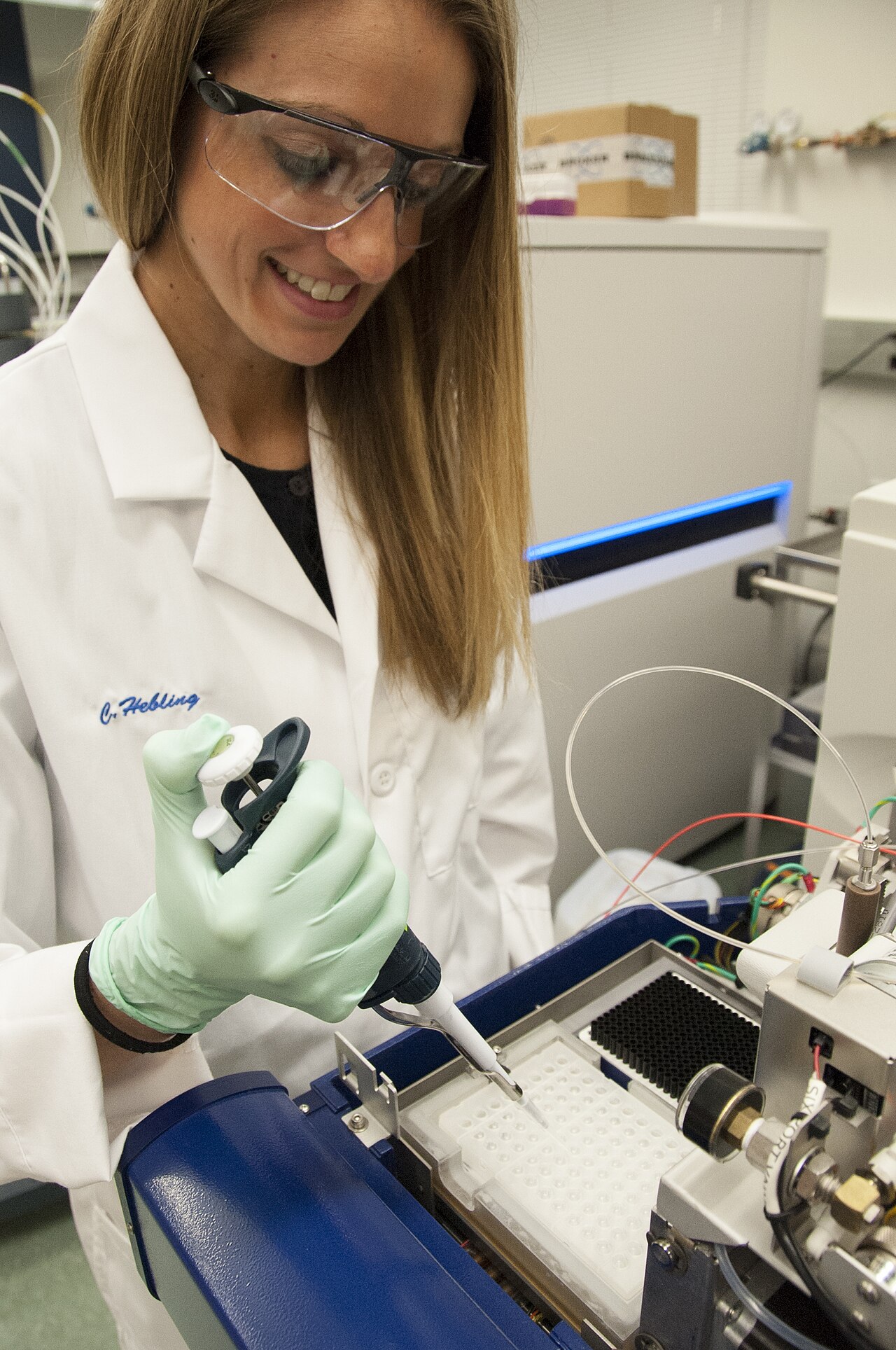
Proteins perform much of the cell’s practical work, from catalyzing reactions to transmitting signals and forming structures. Yet proteins are usually measured indirectly. In bottom-up proteomics, proteins are cut into peptides, peptides are separated and ionized, and mass spectrometers record precursor and fragmentation data. Software must then infer which peptide generated each spectrum and aggregate peptide-level evidence into protein-level findings.
Many conventional workflows rely on database searching: observed spectra are matched against theoretical spectra derived from a known protein database. This is highly effective when the relevant organism and expected protein sequences are well represented. It can be less complete when samples contain unexpected variants, unannotated proteins, noncanonical peptides, post-translational modifications or material from poorly characterized organisms.
De novo peptide sequencing addresses a different version of the problem. Instead of selecting the best match from a predefined list, it attempts to reconstruct a peptide sequence from the fragmentation pattern itself. The approach can expose evidence outside a reference database, but it is difficult because spectra can be incomplete, noisy or ambiguous. Fragmentation behavior also varies by peptide chemistry and instrument conditions.
That makes scale valuable. A transformer trained across a very large and diverse spectrum collection can, in principle, learn recurring relationships between spectral features and peptide sequences, rather than depend only on manually designed rules or a narrower training set. The MassNet authors report that this strategy improved de novo sequencing against existing approaches. [1]
From fragmented data to a reusable AI substrate
The core technical contribution is the combination of data scale, multispecies coverage and an AI-oriented corpus. The 35-species scope matters because peptide sequences and experimental distributions differ across organisms. A model exposed to broader biological diversity may learn patterns that are less tied to one species or a small number of familiar reference proteomes.
Transformers are particularly suited to inputs whose elements have meaningful relationships across a sequence or structured set. In proteomics, a model can be trained to associate features in a tandem spectrum with the ordered residues of a peptide. The model’s output must account for uncertainty: several plausible amino-acid sequences can explain portions of a spectrum, and small mass differences may be difficult to resolve. Stronger learned representations can improve the ranking and confidence of candidate sequences, but they do not remove the physical and statistical limits of an individual measurement.
The reported 143.57% gain on human Astral data is a striking benchmark result, but it needs careful interpretation. A percentage improvement is meaningful only alongside the exact metric, baseline performance, test-set construction and error definitions used in the study. A large relative gain from a low baseline can still leave substantial room for improvement in absolute sequence accuracy. The paper is therefore most useful not simply as evidence that one model won a comparison, but as evidence that proteomics can now support large-scale, standardized model development. [1]
The organizations that could benefit
The immediate beneficiaries are computational-proteomics researchers, academic mass-spectrometry facilities and developers building analysis pipelines around raw instrument data. A broadly usable corpus lowers the cost of training and evaluating models; teams no longer need to assemble every large-scale dataset independently before testing a new architecture.
Mass-spectrometer manufacturers, proteomics software suppliers and cloud-computing providers also have an incentive to follow the work closely. Better spectrum interpretation can add value to existing instruments by improving the number and reliability of peptide identifications extracted from a run. For pharmaceutical companies and biotechnology firms, more capable sequencing may help research teams study protein expression, signaling pathways, drug response and protein modifications with fewer unexplained measurements.
The market impact should not be confused with an immediate clinical breakthrough. Clinical proteomics requires more than a high-performing sequencing model: assays need analytical validation, reproducibility across sites, calibrated confidence thresholds, suitable reference materials, workflow integration and, where applicable, regulatory evidence. MassNet may accelerate the upstream discovery and analysis layer, but it does not by itself establish a diagnostic or treatment benefit.
From the perspective of laboratory operators, the important question is operational rather than architectural: does a model improve identifications on the samples they actually run, with traceable confidence scores and manageable compute costs? From the perspective of software builders, the opportunity is to create interoperable tools that can use a common corpus without locking laboratories into a proprietary data silo. Those are the tests that will determine whether this infrastructure becomes widely adopted.
What must be validated next
The study’s benchmark results require independent replication across laboratories, instrument types and sample classes. Performance on human Astral data is important, but a model intended as general infrastructure must be evaluated on samples that differ from its training distribution. Relevant stress tests include low-abundance peptides, heavily modified peptides, clinical specimens, environmental mixtures and organisms with limited reference proteomes.
Dataset scale can also conceal familiar machine-learning risks. Data leakage between training and test sets can overstate performance if closely related peptides, spectra or experimental runs appear in both. Species representation may be uneven, causing models to perform best on the organisms and acquisition conditions that dominate the corpus. The practical value of a prediction also depends on confidence calibration: researchers need to know not just what sequence a model proposes, but how likely it is to be correct and when the software should decline to make a call.
Accessibility will be another determinant of impact. The broadest benefit will come if the corpus, preprocessing details, splits, labels and evaluation protocols can be inspected and reused by independent groups. Transparent provenance and stable benchmarks help prevent progress from becoming a succession of difficult-to-compare model claims. The Nature Methods paper establishes a major data resource; its long-term influence will depend on whether the surrounding ecosystem treats it as a durable common layer. [1]
A foundation-model moment for protein measurement
Biology has increasingly been described through DNA and RNA because those molecules are comparatively straightforward to sequence at scale. Proteins are closer to many cellular functions, but their diversity, chemical modifications and measurement complexity make them harder to catalog. A large AI-ready MS/MS corpus could help narrow that gap by making more spectra interpretable and by providing a common starting point for algorithms that can generalize across datasets.
The likely near-term outcome is better research tooling rather than a standalone product. De novo sequencing can assist discovery of unexpected peptides and improve the handling of spectra that conventional database searches leave unidentified. Over time, models trained on resources such as MassNet could be incorporated into end-to-end pipelines that combine sequence inference, modification detection, quantitative analysis and biological interpretation.
The central promise is therefore concrete but bounded: more useful information extracted from experiments already being performed. Turning that into clinical utility will require evidence that improved computational identification changes a decision, improves an outcome or makes a validated test meaningfully more reliable.
Editor’s Take
I see MassNet as a more consequential development than another conversational interface for biology. The bottleneck in proteomics is often not a lack of clever model ideas; it is the absence of sufficiently large, clean and comparable data on which many teams can build. A 1.5-billion-spectrum resource gives the field a chance to compete on methods and products instead of repeatedly rebuilding the data foundation.
The number to watch is not only the reported 143.57% benchmark gain. The practical signals will be external validation on difficult samples, well-calibrated error reporting, and whether software teams can deploy these models inside ordinary laboratory workflows without unreasonable compute or integration burdens. If those pieces arrive, better peptide sequencing could become a compounding improvement across research and drug-development pipelines. Until then, it is infrastructure with strong potential—not proof of clinical transformation.
References
- Nature Methods — https://www.nature.com/articles/s41592-026-03247-y

_6487_(8755005115).jpg)
