
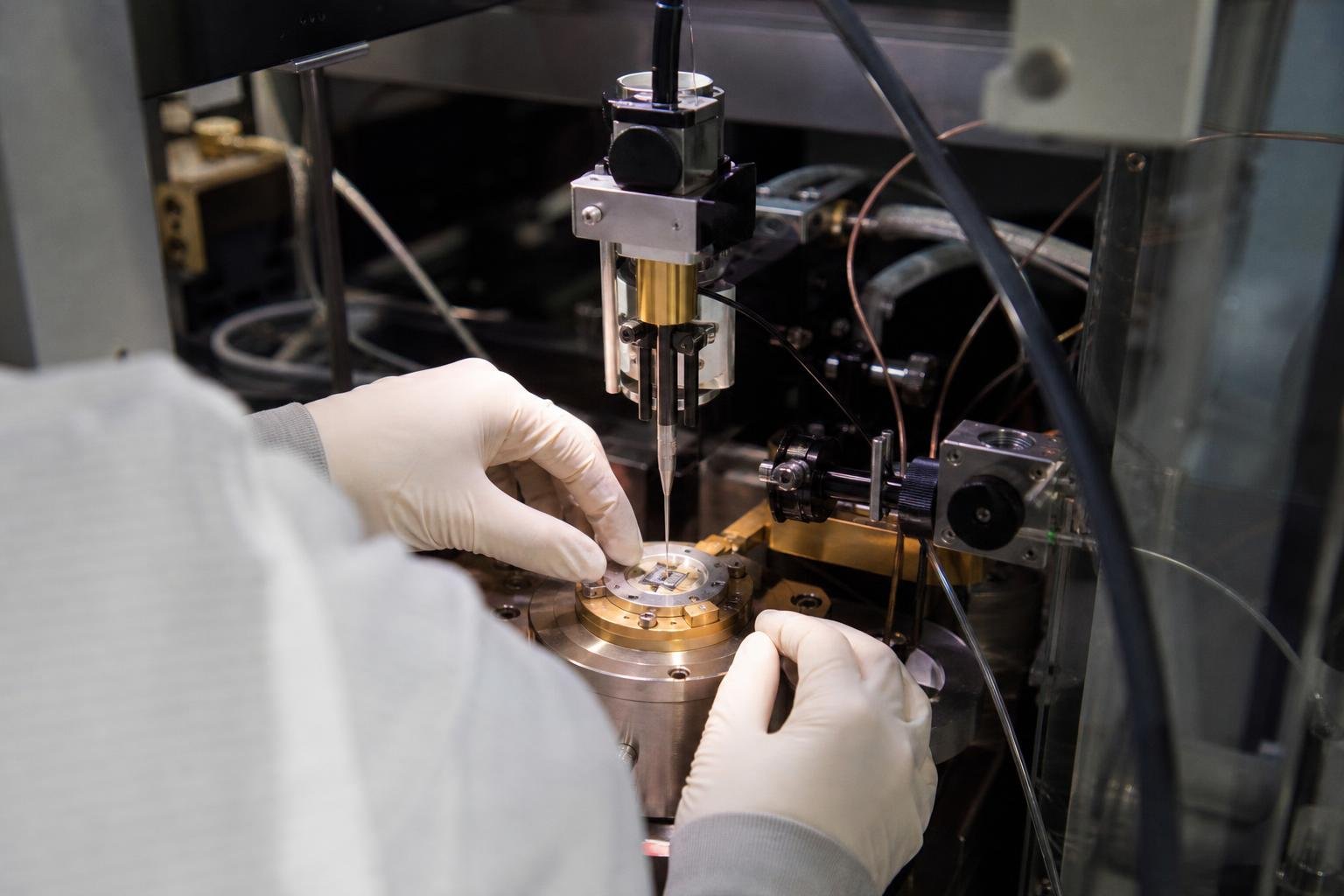
Researchers at the University of Vienna and collaborating institutions have developed a physics-guided machine-learning method that reconstructs magnetic patterns inside ultrathin materials using measurements collected outside the sample. The technique also estimates the separation between the magnetic sensor and the material, a practical variable that can strongly affect interpretation of nanoscale magnetic data.
The work, reported in Physical Review Letters and accompanied by openly released software, addresses a central experimental problem in magnetism: instruments often measure only the magnetic field that leaks out of a material, not the internal arrangement of spins that produced it. By treating artificial intelligence as a constrained scientific reconstruction tool rather than a general-purpose text system, the researchers aim to turn incomplete measurements into a more useful view of structures that are difficult to observe directly.[1]
By the numbers
- 1 material system: The reported demonstration is limited to one material system.
- 1 experimental configuration: The method has so far been shown in one measurement setup.
- 2 reconstructed quantities: Internal magnetic patterns and the sensor-to-sample distance.

An inverse problem at the heart of magnetic imaging
Ultrathin magnetic materials are important research platforms because their behavior can be dominated by interfaces, reduced dimensionality and small changes in composition or applied fields. Their magnetic states can form domains, walls and other nonuniform patterns at scales that are challenging to measure directly. These patterns matter because they influence how a material stores, switches and transports magnetic information.
Many magnetic probes do not image those internal patterns in a direct, complete way. Instead, they detect magnetic stray fields above a sample. Recovering the underlying magnetization from those fields is an inverse problem: researchers start with an observed effect and attempt to infer its cause.
Inverse problems are intrinsically difficult. Different internal magnetic configurations can, under some conditions, produce similar fields outside the material. Measurement noise, finite sensor resolution and uncertainty about the sensor height can further blur the result. A conventional reconstruction can therefore be sensitive to assumptions made before analysis begins.
The Vienna-led approach is intended to narrow that ambiguity by combining measured data with physical constraints. Rather than asking a model to generate a visually plausible pattern, the system is designed to seek magnetic configurations compatible with both the measurements and the governing physics described by the researchers.
Why physics-guided machine learning changes the calculation
Machine learning has increasingly been used in microscopy, spectroscopy and materials modeling, but a purely data-driven model can fail when experimental conditions differ from its training examples. That risk is particularly relevant in laboratory science, where datasets may be small, instruments vary and the answer must obey known physical rules.
Physics-guided AI takes a different route. It embeds prior scientific knowledge into the learning or reconstruction process. In this case, the central task is to identify an internal magnetic pattern whose external field agrees with the sensor measurement while satisfying the physical conditions applied by the method. The result is not simply an image-enhancement exercise; it is a constrained inference procedure.
A notable part of the reported system is its ability to estimate the distance between sensor and sample at the same time as it reconstructs the magnetic structure. That parameter is more than a calibration detail. Magnetic fields decay and change spatially with distance, so an incorrect height assumption can lead to an incorrect interpretation of the underlying magnetization. Jointly solving for the pattern and the measurement geometry could reduce a recurring source of experimental uncertainty.
The work fits a broader shift in scientific AI: the most useful systems are often those that help researchers extract reliable information from imperfect instruments, rather than those that replace scientific measurement. Their value depends on whether they improve reproducibility, quantify uncertainty and remain robust when confronted with samples beyond a controlled demonstration.
Open software could matter as much as the model
The researchers released the software alongside the study. For a method aimed at experimental science, that decision can be consequential. Open code gives other groups a path to test the approach against their own measurements, inspect the assumptions behind a reconstruction and identify failure modes that may not be visible in a single laboratory.
It can also make comparisons more meaningful. Magnetic-imaging groups often use different instruments, sample geometries and analysis pipelines. Shared software does not eliminate those differences, but it can provide a common starting point for benchmarking reconstruction quality and determining where additional calibration is required.
For materials discovery, faster interpretation may be the immediate benefit. If external-field measurements can yield a dependable estimate of internal structure, researchers may be able to screen candidate magnetic materials and device concepts with less reliance on specialized direct-imaging workflows. That is especially relevant for ultrathin systems, where fabrication time and access to advanced characterization equipment can constrain experimental iteration.
Open availability is not a substitute for validation. The code will need clear documentation, representative data and tests across instruments if it is to become a durable research tool. But publication of the implementation makes independent scrutiny possible from the beginning.
What the demonstration does—and does not—establish
The reported result is an advance in methodology, not yet a universal magnetic-imaging solution. According to the available description, the technique has been demonstrated on one material system and in one experimental configuration. That leaves open important questions about generalization.
- Material diversity: Magnetic materials can differ substantially in thickness, anisotropy, disorder, texture and response to fields. Performance on other classes of samples remains to be established.
- Instrument transferability: Different sensors introduce different noise levels, spatial resolutions and calibration errors. A method that works in one setup may require adaptation elsewhere.
- Ambiguity and uncertainty: A reconstructed pattern should be accompanied by a clear account of how uniquely the data support it, especially when several configurations could fit a measurement.
- Operational speed: The practical value for live experiments will depend on computational cost, workflow integration and the amount of tuning required for new samples.
Those caveats are typical for early demonstrations of AI-enabled experimental methods. They do not diminish the significance of the result; they define the next stage of evidence required before broad deployment in materials laboratories.
From a research method to a laboratory instrument
The long-term opportunity is to make magnetic characterization more informative without requiring every laboratory to build a new imaging platform. If the approach holds up across material families and measurement conditions, it could become part of an analysis layer attached to existing sensors: a way to infer hidden structure, estimate geometry and flag measurements that are inconsistent with the assumed physics.
That direction also has implications for spintronics and magnetic-device research. Engineers developing memory, sensing or logic technologies need to understand magnetic configurations that may be unstable, nanoscale or buried beneath layers. Better reconstruction from accessible measurements could shorten the feedback loop between fabrication, characterization and redesign.
The key test will be whether the method produces results that experimentalists can trust when conditions are messy rather than ideal. In scientific AI, accuracy on a benchmark is only the beginning. The stronger standard is whether independent teams can use the method to discover something new, verify it with complementary measurements and reproduce the result.
Editor’s Take
I see the sensor-distance estimate as one of the most practical parts of this result. Inverse reconstructions often look impressive until a small calibration error changes the answer. A tool that treats sample geometry as part of the inference problem, rather than as a fixed assumption, is closer to what working experimental teams actually need.
The open software is the right move, but the market and research value will depend on what happens after publication: validation on different magnetic materials, support for multiple sensor types and honest uncertainty reporting. The hype would be claiming that AI now “sees” every hidden magnetic state. The real opportunity is more useful and more credible: making existing magnetic measurements yield better, faster evidence for materials decisions.

.jpg)