Researchers from AGIBOT, NVIDIA, Princeton University, the University of Texas at Austin and the University of Toronto have introduced WorldOracle, an evaluation benchmark designed to test whether robot world models predict what a physical machine will actually do—not merely whether their generated videos look believable. The project releases paired predicted and real-world robot executions, evaluation code, data and a public leaderboard. [1]
The distinction is commercially important. A world model that can synthesize a convincing clip of a robot grasping an object may still fail at the task that matters: accurately forecasting the object’s pose, the contact event, the robot’s trajectory and the downstream result after an action is executed. WorldOracle shifts the test from visual plausibility to execution-grounded correctness, an approach that could help establish whether learned predictive models are ready to support reliable robot planning outside tightly scripted demonstrations.
By the numbers
- 5 institutions: AGIBOT, NVIDIA, Princeton, UT Austin and the University of Toronto are represented among the contributors.
- 4 evaluation dimensions: physical-state correctness, spatial alignment, interaction fidelity and multi-view action coherence.
- Paired executions: each predicted rollout is evaluated against a corresponding real-world robot outcome.
- 3 public resources: the project reports releases of data, code and a leaderboard.
Why video realism is not enough
World models are predictive systems that attempt to estimate how an environment will change after an agent takes an action. In robotics, they can be used to simulate possible futures before a machine moves: whether a gripper will make contact, whether an item will slide or topple, whether an opening path is clear, or whether a proposed trajectory leads to a useful final state.
Recent advances in generative video have made it easier to create impressive-looking rollouts: short visual forecasts of a robot and its surroundings. But visual quality can be a misleading proxy for operational accuracy. A predicted scene may preserve broad object appearance while getting the position wrong by an amount that makes a grasp fail. It may show a plausible hand-object interaction without correctly representing contact, force-driven motion or occlusion. It may also look reasonable from one camera while contradicting the same action from another viewpoint.
Those gaps matter less in a demonstration video than in a warehouse, factory, laboratory or home. Robots operate through geometry, timing, contact and uncertainty. A planner choosing between actions needs an estimate of the consequences that is consistent enough to avoid collisions, recover from errors and complete work repeatedly. The central premise of WorldOracle is that a robot world model should therefore be judged against the physical outcome of the same commanded behavior.
How WorldOracle evaluates predicted rollouts
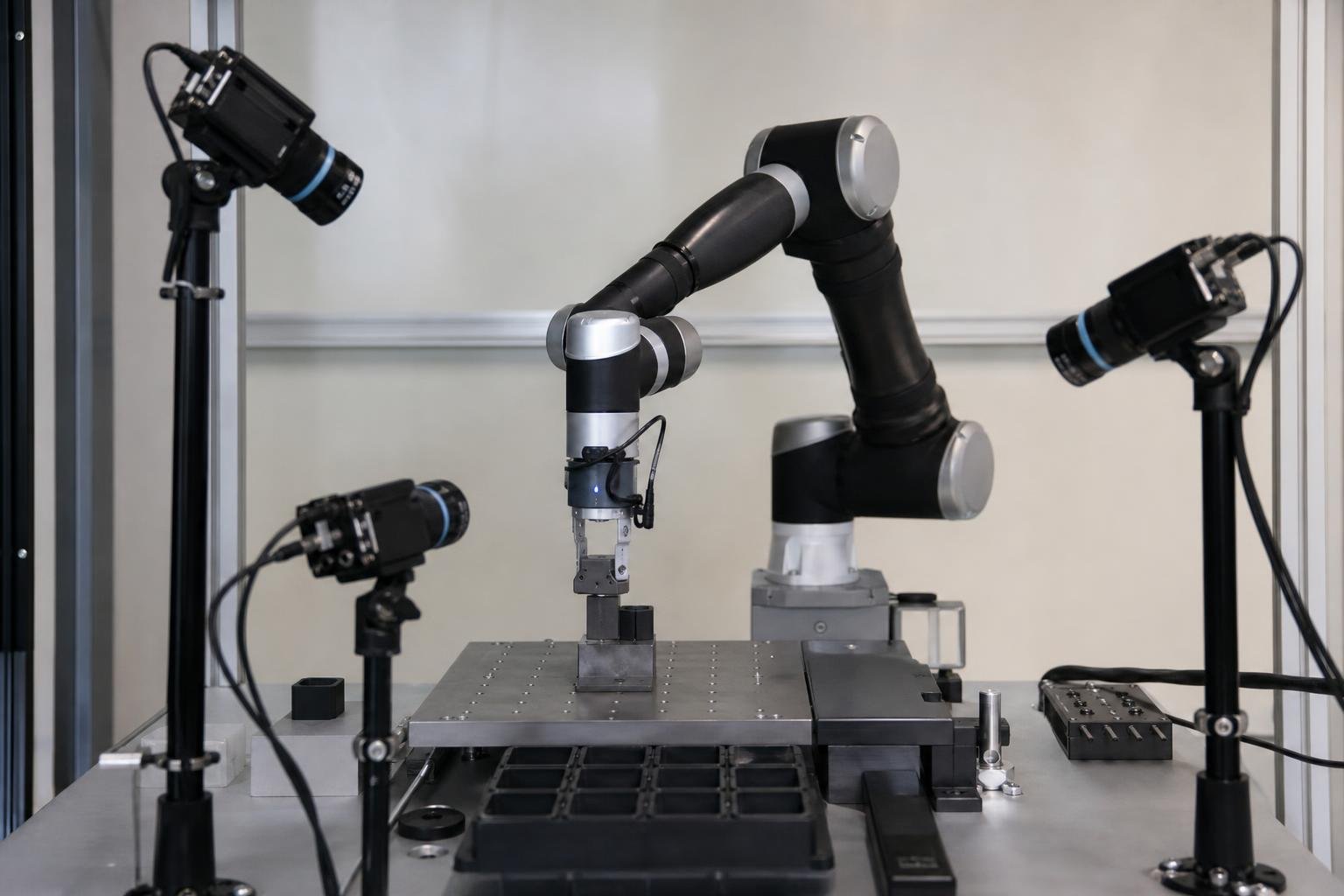
WorldOracle compares a model’s predicted rollout with its paired real-world execution. Rather than relying on one aggregate image-quality score, the benchmark separates the problem into four dimensions that map more closely to what a robot must understand.
- Physical-state correctness: whether the prediction captures the relevant state of the robot and objects as the action unfolds and ends.
- Spatial alignment: whether predicted positions, layouts and relative geometry agree with the physical scene.
- Interaction fidelity: whether the model represents the result of contact and manipulation faithfully, rather than simply rendering an object sequence that appears natural.
- Multi-view action coherence: whether an action remains consistent across observations from different camera views.
This structure addresses a recurring evaluation problem in embodied AI: a single score can hide a model’s practical failure mode. A model could preserve visual appearance but drift spatially. Another could predict an object’s final location while missing the interaction that gets it there. A third could appear strong from a primary camera but fail to maintain a coherent 3D account of the scene. Reporting distinct dimensions makes those weaknesses more visible to researchers and prospective users.
Multi-view evaluation is particularly significant. Industrial robot cells and mobile manipulation systems commonly depend on more than one sensor perspective, while a world model used for planning must ultimately be compatible with the three-dimensional consequences of an action. A forecast that changes depending on the camera angle is not a reliable simulation of the task.
A common measurement layer for robot learning
Robotics has long relied on benchmarks, from perception datasets to standardized manipulation tasks, but world-model evaluation has been harder to settle. Physical experiments are expensive, hardware setups differ, and many learning systems can be assessed with attractive visual outputs before they are tested in closed-loop operation. That has made comparisons across models difficult and has encouraged metrics that are easier to compute than to connect to task success.
WorldOracle’s paired-execution design is an attempt to make the reference point less ambiguous. The relevant question is not only whether a model can generate a likely-looking future; it is whether that future matches the execution recorded when the robot performed the action in the real environment. If broadly adopted, the benchmark could give teams a common way to compare progress on predictive accuracy before integrating models into planning and control stacks.
The release of data, code and a leaderboard is consequential for that reason. Public evaluation infrastructure can make methods easier to reproduce, expose trade-offs between architectures and reduce the tendency for each lab to report results on a private task distribution. It also creates a more direct incentive to optimize for physical correspondence rather than presentation quality. The project’s multi-institution contributor list—spanning a robot company, a major AI hardware and software supplier, and academic robotics groups—suggests that the problem is relevant across both research and deployment-oriented organizations. [1]
What it could mean for commercial robotics
For developers of manipulation systems, a useful world model could reduce the number of physical trials needed to choose an action, identify risky moves before execution and improve recovery when the environment differs from expectation. Those benefits are especially attractive in settings where collecting failures is costly: handling fragile goods, operating around people, working with variable inventory or deploying in facilities that cannot be repeatedly interrupted for data collection.
But those gains depend on a model being accurate in the ways the application needs. A logistics robot may need dependable estimates of box motion and occlusion. A laboratory robot may need fine spatial precision around instruments. A domestic robot may face highly varied objects, lighting and surfaces. WorldOracle does not itself solve those deployment problems; it provides a way to test whether predictive systems are closing the gap between simulated futures and realized ones.
That distinction should matter to buyers and operators. Robot vendors increasingly present learned models as a route to more adaptable behavior, yet claims of generality are difficult to assess when measurements are not shared. Execution-grounded benchmarks can give procurement teams, integrators and safety reviewers a clearer set of questions: What kinds of actions were tested? How closely did predicted states align with measured outcomes? Which interaction failures remain? Does performance hold across views and scene conditions?
A leaderboard will not substitute for site-specific validation. A strong score on benchmark tasks cannot prove that a system will cope with a customer’s lighting, clutter, tools, materials, cycle-time requirements or safety rules. Still, common tests can make it harder to confuse polished model outputs with robust physical understanding.
Limits and questions the benchmark will need to answer
The practical value of any benchmark depends on its coverage. Models can perform well on the distributions represented in a dataset while failing on unseen objects, contacts, sensors or disturbances. The decisive follow-up questions for WorldOracle will include the diversity of its tasks and scenes, how it handles stochastic physical outcomes, whether its metrics correlate with downstream task completion, and how difficult it is to improve scores without improving real-world utility.
There is also a potential risk of benchmark optimization. Once a leaderboard becomes influential, developers may tailor systems to its specific camera arrangements, action formats and object categories. The remedy is not to avoid standardized measurement, but to keep expanding evaluation settings, report component-level failures and combine offline scores with closed-loop robot tests.
Finally, prediction is only one element of a deployable robotics stack. A system also needs perception, calibration, control, safety mechanisms, hardware reliability and operational monitoring. A world model that accurately forecasts an action still must be connected to a controller that can execute safely when the prediction is uncertain. WorldOracle is best understood as a measurement foundation for one critical capability, not as proof that general-purpose robots have arrived.
From compelling demos to accountable forecasts
The near-term importance of WorldOracle is methodological. It frames world-model progress around a concrete operational test: when a robot takes an action, did the model foresee what happened? That can help focus research on the failure cases with direct consequences for manipulation and planning, including spatial drift, incorrect contact dynamics and inconsistent representations across cameras.
Over time, a mature ecosystem of execution-grounded benchmarks could influence how robot models are trained and sold. Developers may place greater emphasis on uncertainty estimates, physical consistency and predictive performance under distribution shift. Customers may ask for evidence tied to comparable tasks rather than relying on edited demonstrations. Researchers may also use benchmark breakdowns to determine whether progress comes from stronger data, better architectures, explicit geometric representations or tighter links between prediction and control.
For a field seeking to move from controlled pilots to repeatable operations, that is a useful change in emphasis. Robots do not earn trust because their imagined futures are cinematic. They earn it when those futures are accurate enough to guide successful actions in the physical world.
Editor’s Take
I see WorldOracle as a necessary correction to a common robotics blind spot: treating an attractive rollout as evidence of useful prediction. For a system that will choose where to move a gripper or how to handle an object, a small geometric mistake or an invented contact event is not cosmetic. It is the difference between a completed pick and a failed cycle.
The most valuable next signal will be whether leaderboard improvements translate into better closed-loop task completion, fewer physical trials and more graceful recovery from surprises. If they do, this kind of benchmark can become part of the due diligence for robot deployments. If scores rise while real machines remain brittle, the field will have learned something equally valuable: which measurements still fail to capture the hard parts of embodiment.