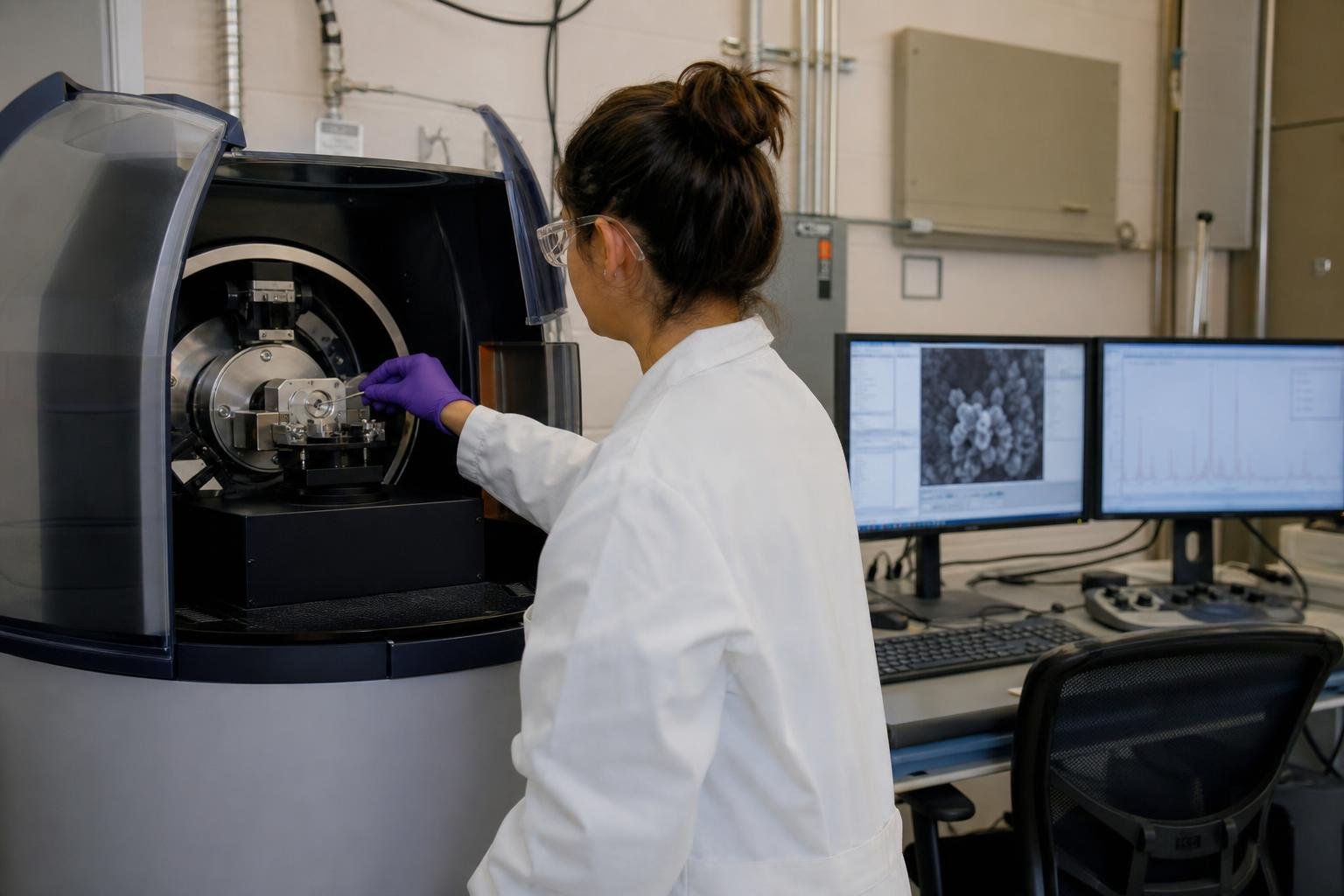
Researchers report that a broad pretrained machine-learned force field can be adapted to nickel oxide using roughly 170 higher-fidelity reference calculations, rather than training a specialized model from scratch on a large new dataset. The adapted DPA-4 model achieved about 0.5 meV-per-atom energy error and 30 meV-per-angstrom force error, while reproducing the correct ordering of relevant nickel oxide phases.[1]
The result matters because it advances a potentially practical workflow for computational materials science: upgrade an existing foundation model where accuracy is needed, rather than rebuild a force field for every compound, electronic-structure method, or research question. If that workflow holds across more systems, expensive first-principles calculations could be concentrated on a small, strategically chosen correction set—making high-accuracy atomistic simulation more attainable for smaller academic and industrial teams.
By the numbers
- ~170 labels: higher-fidelity reference calculations used for adaptation.
- ~0.5 meV/atom: reported energy error of the adapted model.
- ~30 meV/Å: reported force error.
- Correct phase ordering: a thermodynamic test beyond aggregate fitting errors.
From bespoke force fields to model upgrades
Machine-learned interatomic potentials, often called machine-learned force fields, aim to approximate the potential-energy surface that governs how atoms arrange and move. Once trained, they can evaluate energies and forces far more quickly than direct higher-level electronic-structure calculations, enabling longer molecular-dynamics runs, larger supercells, and broader searches over defects, surfaces, temperatures, and compositions.
The bottleneck has traditionally been data creation. A useful potential must see enough representative structures—near equilibrium and far from it—to remain accurate when atoms are distorted, defects form, interfaces evolve, or a material changes phase. Generating those labels with a high-fidelity method is computationally costly. The conventional response is a bespoke data-and-training campaign for each material and target level of theory.
The new preprint instead treats DPA-4 as a transferable starting point. The pretrained model supplies a broad prior: learned representations of local atomic environments and a baseline for atomic interactions. The nickel oxide work then fine-tunes or otherwise adapts that starting point using a small set of calculations at the desired higher-fidelity level.[1] In effect, the new labels teach the model the correction that matters for this chemistry and accuracy target, rather than forcing it to relearn basic structural regularities from zero.
That distinction is central. A foundation-model strategy does not eliminate the need for trustworthy reference calculations. It changes their role. The computational budget shifts from producing a large general-purpose training corpus to selecting a compact set of high-value labels that anchor an already capable model to a more demanding target.
Why nickel oxide is a meaningful proving ground
Nickel oxide is not merely a convenient test material. Transition-metal oxides are challenging for electronic-structure methods and for atomistic models because their chemistry can involve strongly correlated electrons, magnetism, multiple structural states, and small energy differences between competing configurations. Those small differences are exactly where a model can appear accurate in an average-error table yet still make the wrong materials prediction.
The paper’s reported energy error of roughly 0.5 meV per atom is therefore important, but it is not sufficient on its own. Root-mean-square or mean absolute errors combine many configurations into one number. A model can score well by fitting common configurations while missing the rare or closely competing states that determine what phase is stable.
Recovering the correct phase ordering is a more scientifically demanding validation. Phase ordering asks whether the model ranks candidate structures in the same energetic sequence as the higher-fidelity reference. That determines whether a simulation predicts the right ground state and whether it can reliably assess structural transformations or relative stability. For studies of oxide synthesis, degradation, thermal behavior, catalytic surfaces, and defect thermodynamics, a wrong rank order can be more damaging than a modest average numerical error.
The reported force error—about 30 meV/Å—addresses the other half of the problem. Forces drive geometry optimization and molecular dynamics. Low energy error with poor forces can yield incorrect relaxed structures or unreliable atomic trajectories. The combination of low reported energy and force errors, plus the phase-ordering result, makes a stronger case for the adapted model than any single metric would.[1]

What the approach could change for laboratories and industry
The immediate value is economic and operational. Higher-fidelity labels are often the scarce resource in materials modeling, particularly when a target method is too expensive to apply across thousands of structures. If around 170 carefully selected labels can adapt a pretrained model to a difficult oxide system, a lab may be able to reserve expensive calculations for calibration and validation, then use the learned potential for the large-scale exploration that would otherwise be out of reach.
That could benefit research groups working on battery materials, catalysts, corrosion-resistant coatings, electronic oxides, and high-temperature ceramics. These fields frequently need to screen structural variants or simulate defect-rich environments where direct calculations become costly. The likely commercial effect is not that simulation replaces experiments; it is that more candidate structures can be rejected, prioritized, or explained before experimental resources are committed.
The approach also points toward a more modular software market. Instead of every organization maintaining an isolated model-training pipeline, providers and open research projects could distribute broad pretrained potentials, while users supply modest private datasets to adapt them for proprietary compositions, process conditions, or chosen electronic-structure targets. That could lower the entry barrier for companies that need simulation capability but lack the compute budget and specialist staff to build full training corpora.
For the method to become a dependable industrial tool, however, the cost calculation must include more than the number of labels. Teams will need robust data-selection procedures, reproducible adaptation recipes, uncertainty estimates, and validation suites that test the conditions encountered in production workflows. A small label count is valuable only if it does not conceal a large burden of manual curation and expert intervention.
Field interpretation: a promising result, not universal transfer
The preprint is evidence for transfer learning in a specific, demanding setting, not proof that a fixed number of labels will work for all materials. Transfer performance depends on how close a target system is to the pretraining distribution, the reference method used for adaptation, the diversity of the selected structures, and the phenomena a simulation must capture. A model adapted around bulk-like nickel oxide configurations may require additional labels for extreme pressures, liquid states, highly reconstructed surfaces, unusual charge states, or chemical reactions.
There is also a crucial distinction between matching a reference method and establishing physical truth. A force field is trained to reproduce labels from a chosen electronic-structure level. If that reference level has known limitations for a particular observable, the adapted model can efficiently inherit those limitations. The paper’s phase-ordering result is valuable because it tests a consequential prediction against its target reference, but further comparison with experiment and alternative high-level methods remains important for applications where absolute phase stability is decisive.
Another concern is out-of-distribution behavior. Foundation models can make a small adaptation set unusually effective, but they can also appear confident in environments poorly represented during pretraining or fine-tuning. In practical deployments, researchers will need active-learning loops or other mechanisms to identify when new high-fidelity labels are necessary. The most credible version of the upgrade-not-rebuild model is therefore iterative: begin from a pretrained potential, adapt with targeted labels, test on scientifically meaningful holdouts, add data where the model is weak, and retain independent validation.
What to watch next
The next tests are breadth, reproducibility, and total cost. Researchers will want to know whether similarly small adaptation sets work for other correlated oxides, multicomponent materials, surfaces and interfaces, and conditions far from equilibrium. They will also want ablation studies showing how accuracy changes with the number and composition of high-fidelity labels, and comparisons against training a smaller specialized model from scratch.
Equally important is whether the workflow produces reliable uncertainty signals. A model that knows when it is extrapolating can request an additional expensive calculation before it produces a misleading conclusion. That capability would make transfer learning much more useful in autonomous and high-throughput materials workflows, where human review cannot inspect every predicted structure.
For now, the nickel oxide result is best viewed as a concrete demonstration that pretrained atomistic models may substantially compress the expensive portion of a high-accuracy simulation project. Its strongest contribution is methodological: it frames high-fidelity materials modeling as a targeted upgrade problem, with phase stability used as a substantive scientific check rather than a decorative benchmark.
Editor’s Take
I see the approximately 170-label result as the practical number to watch, more than the “foundation model” label. The useful proposition is that a group can spend its scarce high-fidelity compute budget on the correction that differentiates its problem, instead of duplicating a giant baseline training effort. That is a credible route to making advanced simulations usable by more labs and engineering teams.
The phase-ordering result is what keeps this from being just another favorable error report. If a model gets forces and average energies right but selects the wrong stable structure, it can send a materials program in the wrong direction. The next milestone should be repeated demonstrations on surfaces, defects, reactive configurations, and chemically broader systems, with clear signals for when the compact adaptation dataset is no longer enough. The hype would be claiming that 170 calculations replaces validation; the opportunity is that it may make rigorous validation affordable.
References
- arXiv — https://arxiv.org/abs/2608.11812