Vivodyne, a biotech startup developing automated human-tissue experimentation systems, says its HIVE robotic laboratory platform can grow 20 types of human tissue, administer drug candidates autonomously, and monitor the biological response. The company’s central argument is not that artificial intelligence can independently cure disease, but that AI drug-design systems need a far better source of experimental evidence: rapid, repeatable and human-relevant data from living tissue. [1]
That distinction matters. Generative models, protein-structure tools and chemistry models can propose compounds at unprecedented scale, but a proposed molecule remains only a hypothesis until it is tested. If Vivodyne can make complex human-tissue experiments substantially more automated and scalable, it could address a less visible constraint on AI drug discovery: the slow experimental feedback loop that determines whether a model’s predictions survive contact with biology.
By the numbers
- 20: Types of human tissue Vivodyne says its HIVE platform can grow.
- 1: Integrated robotic workflow combining tissue growth, autonomous dosing and response monitoring.
- 2026: The year Vivodyne’s platform and its AI-data thesis were highlighted by TechCrunch.
The bottleneck is experimental feedback, not just model capability
Drug discovery is frequently presented as a prediction problem. Researchers want to identify a biological target, find a molecule that changes it in the desired way, and anticipate safety and efficacy before committing to expensive animal studies and clinical trials. AI can help at several of those stages: identifying patterns in biomedical literature and datasets, predicting molecular properties, designing protein binders, prioritizing targets and generating candidate compounds.
But prediction systems are bounded by the evidence used to train and evaluate them. Much biomedical data is indirect. It may come from isolated proteins in biochemical assays, cultured cell lines that do not reflect normal human tissue, animal models with different physiology, or observational patient datasets in which many variables change at once. Each source is useful, but none fully recreates a drug perturbing a functioning human tissue system.
Vivodyne’s proposition is that robotic tissue experimentation can generate a different class of dataset: controlled interventions in human-derived tissue, measured repeatedly at scale. A system that applies a specified compound, concentration and dosing schedule to an engineered tissue and then records defined biological changes can produce causal evidence in a narrow but meaningful sense. The intervention is known; the response is measured; and conditions can be replicated across controls and candidate molecules.
That does not mean the resulting data will predict clinical outcomes on its own. A tissue model is still a model. Yet it could offer a more relevant intermediate test than many conventional assays, especially for questions involving toxicity, tissue-specific efficacy, cellular interactions or dose response.
What Vivodyne says HIVE can do
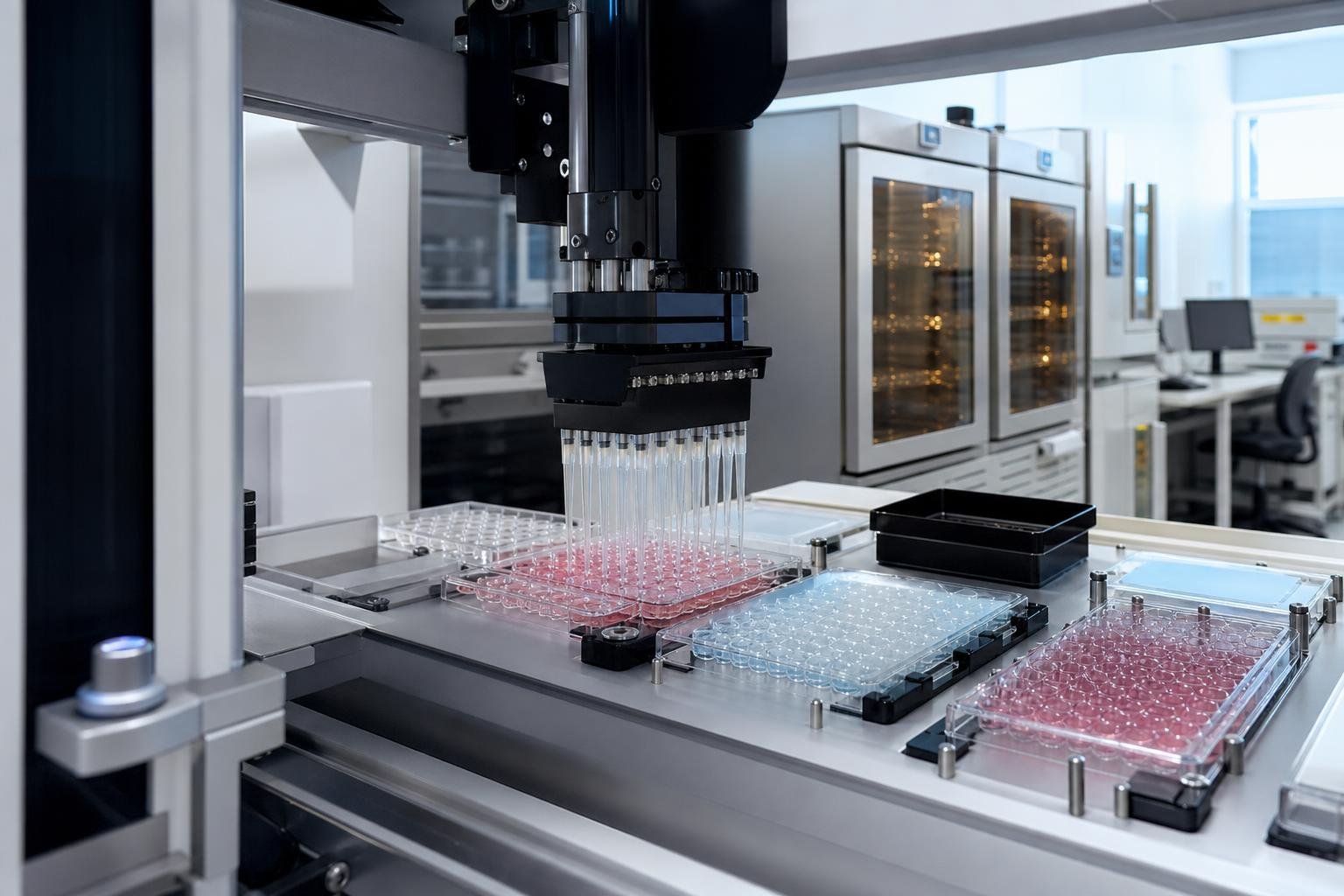
According to TechCrunch’s report, Vivodyne’s HIVE robotic labs are designed to grow 20 categories of human tissue, dose those tissues autonomously and monitor the resulting effects. [1] The significance is the integration of those functions into an automated laboratory workflow rather than any single component in isolation.
Human tissue culture, liquid handling and automated imaging are established fields. The difficult engineering task is making them work together reliably over long experiments. Living tissues are variable. They require carefully controlled media, temperature, gas exchange, handling and timing. Drug dosing needs to be accurate and traceable. Monitoring systems must capture changes that are biologically meaningful, whether through imaging, molecular readouts, tissue function or other assays. Finally, the resulting data needs to be associated with the correct tissue batch, compound, dose, schedule and control condition.
Automation can improve this process in several ways. Robots can standardize repetitive handling steps, execute more precise dosing schedules, reduce manual throughput limits and create richer metadata around every experiment. That metadata is particularly important for AI development. A model trained on measurements without reliable experimental context can learn artifacts. A model trained on well-labeled perturbation data has a better chance of learning relationships that generalize to future compounds.
The company’s stated platform capability should nevertheless be separated from a therapeutic claim. Growing and testing tissues is not equivalent to proving that a drug will work in patients. The available report describes Vivodyne’s experimental infrastructure and thesis for supplying AI systems with better data; it does not establish that a HIVE-derived discovery has produced a validated medicine, improved clinical-trial success rates or cured cancer. [1]
Why human tissue could matter more than a larger training set
Drug-development datasets are not interchangeable. A large collection of weakly relevant measurements may be less useful than a smaller collection of experiments that capture the biology a developer actually needs to predict. This is the case for many drug problems where the challenge is not finding a molecule that binds a target, but determining what happens after that interaction inside a tissue.
For example, a candidate may appear promising in an isolated target assay but fail because it cannot reach the relevant cells, causes unintended effects in another cell type, triggers compensatory biology, or harms the tissue it is meant to treat. More physiologically relevant tissue models can potentially expose some of those issues earlier. They may also make it possible to compare large numbers of candidate molecules under consistent conditions, giving a design model sharper feedback on which molecular changes improved or worsened a measured outcome.
That feedback loop resembles the relationship between software and automated testing. Faster tests do not eliminate the need for production monitoring, but they allow developers to discard bad changes sooner and iterate on promising ones more often. In drug discovery, the equivalent loop is much more expensive and biologically uncertain. Vivodyne is attempting to make an important portion of it programmable.
The potential benefit is not simply speed. It is the combination of speed, reproducibility and relevance. Faster experiments that use poor models can generate poor decisions faster. Conversely, more human-relevant systems that remain artisanal and low-throughput may be too expensive to guide an iterative AI design process. The commercial opportunity for robotic tissue labs lies in balancing both constraints.
The validation questions Vivodyne must answer
The hardest question is whether HIVE results predict decisions that matter downstream. Prospective validation will carry more weight than demonstrations of automation alone. Drug developers will want evidence that tissue-derived findings correlate with known human biology, identify toxicity or lack of efficacy earlier than existing assays, and improve the quality of candidates selected for animal studies or clinical development.
Several technical issues will determine the platform’s value:
- Biological fidelity: Different tissues require different structures, cell populations and environmental conditions. A model’s usefulness depends on whether it preserves the disease-relevant features of native human tissue.
- Reproducibility: Automated systems must demonstrate consistent results across batches, donors, operators, instruments and time. Standardization is essential if data is to train or evaluate machine-learning models.
- Readout quality: Imaging or molecular measurements need to connect to meaningful biological outcomes, not merely generate large volumes of data.
- Experimental design: Causal inference depends on controls, replication, dose ranges, timing and pre-specified analysis. Robotics can execute experiments consistently, but cannot compensate for a poorly designed study.
- Economic fit: The platform must produce useful results quickly enough and cheaply enough to change a pharmaceutical program’s decision-making, rather than becoming an additional premium assay.
There are also limits inherent to tissue systems. Many diseases involve interactions among multiple organs, the immune system, metabolism and whole-body drug exposure. Engineered tissue cannot fully represent every aspect of a living person. Animal studies and clinical trials are therefore unlikely to disappear. The more realistic near-term role is to make preclinical evidence more informative, reduce avoidable failures and direct expensive in vivo work toward stronger candidates.
Competitive and market implications
Vivodyne sits at the intersection of several fast-growing markets: laboratory automation, human-cell and tissue models, organ-on-chip systems, high-content biological measurement and AI-enabled drug discovery. These sectors are increasingly converging because AI companies need proprietary, well-structured experimental datasets, while experimental-platform companies need software to extract value from the data they generate.
The strategic issue for pharmaceutical companies is data ownership. Public chemical and biological databases have helped establish modern AI drug discovery, but differentiated models increasingly depend on proprietary datasets created under controlled experimental conditions. A platform capable of running repeatable human-tissue perturbation studies could become more than a contract-research tool. It could become a data supplier, a development partner or a vertically integrated discovery engine.
That possibility raises a familiar question for AI-biotech businesses: is the durable asset the model, the laboratory, or the closed loop between them? Vivodyne’s thesis favors the loop. A model can propose candidates, the robotic system can test them, and the measurements can be returned to the model to guide the next design cycle. If the loop generates data that competitors cannot readily obtain, it may create a more defensible advantage than software trained on broadly available information.
Still, the market will demand proof in operational terms. Pharmaceutical customers will care about turnaround time, cost per decision, assay validity, quality controls, regulatory acceptability and whether the platform changes go/no-go choices. The strongest evidence would be prospective case studies showing that HIVE-based experiments identified a candidate’s problem or promise earlier than conventional approaches, followed by independent downstream confirmation.
From automation claims to therapeutic evidence
Vivodyne’s message is a useful correction to the tendency to treat biological AI as a purely computational race. Better algorithms can improve hypothesis generation, but biology remains the arbiter. If experimental validation remains scarce, slow and only loosely connected to human physiology, model improvements eventually face diminishing returns.
Robotic human-tissue labs could change that equation if they produce data that is both scientifically credible and operationally abundant. The company has described meaningful platform capabilities: tissue growth across 20 types, autonomous dosing and monitoring in an integrated robotic environment. [1] The remaining leap—from a capable experimental platform to better medicines—requires rigorous benchmarking, external validation and clinical correlation.
For now, Vivodyne is best understood as a company trying to industrialize an important layer of biological evidence. Its success will depend less on how convincingly it invokes AI than on whether its experiments consistently help drug teams make better decisions before they spend years and vast sums testing the wrong molecules.
Editor’s Take
I think Vivodyne is pursuing one of the more practical AI-biotech opportunities: improving the measurement system rather than assuming a larger model will solve biology. In a real development workflow, a faster and more reliable answer to “what did this molecule do in human tissue?” can be more valuable than another thousand generated candidates. Candidate generation is becoming cheaper; trustworthy experimental feedback is not.
What I would watch next is not a headline about autonomous labs, but prospective evidence. Can HIVE correctly rank compounds against established human outcomes? Can it reveal toxicity or tissue-specific failure modes that conventional assays miss? Can a pharmaceutical team point to a decision that became faster, cheaper or more accurate because of the platform? Those are the milestones that would turn an impressive robotics system into a consequential drug-discovery business. The hype outruns the facts if tissue models are presented as replacements for clinical trials; the opportunity is compelling precisely because they could make the path to those trials substantially smarter.