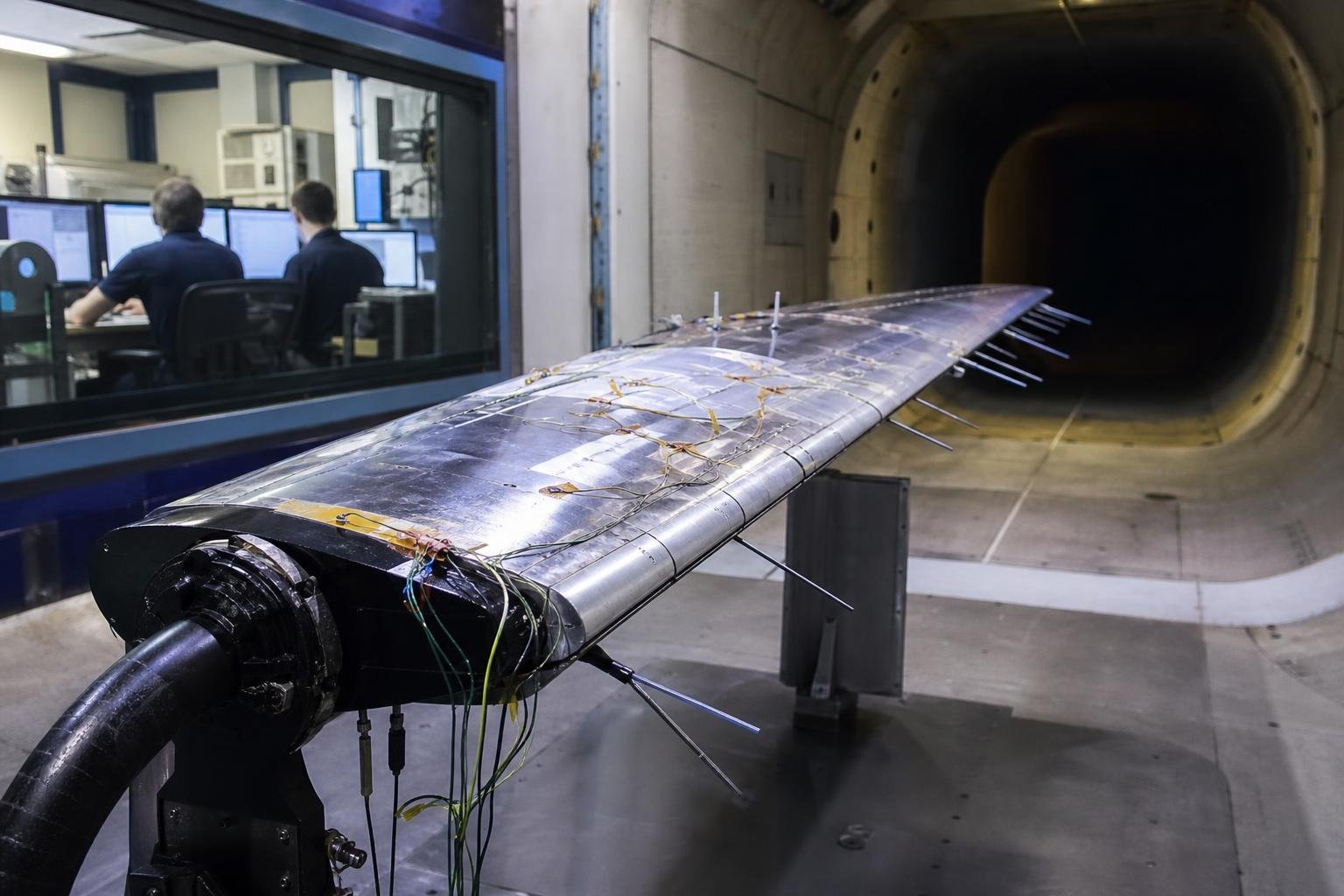
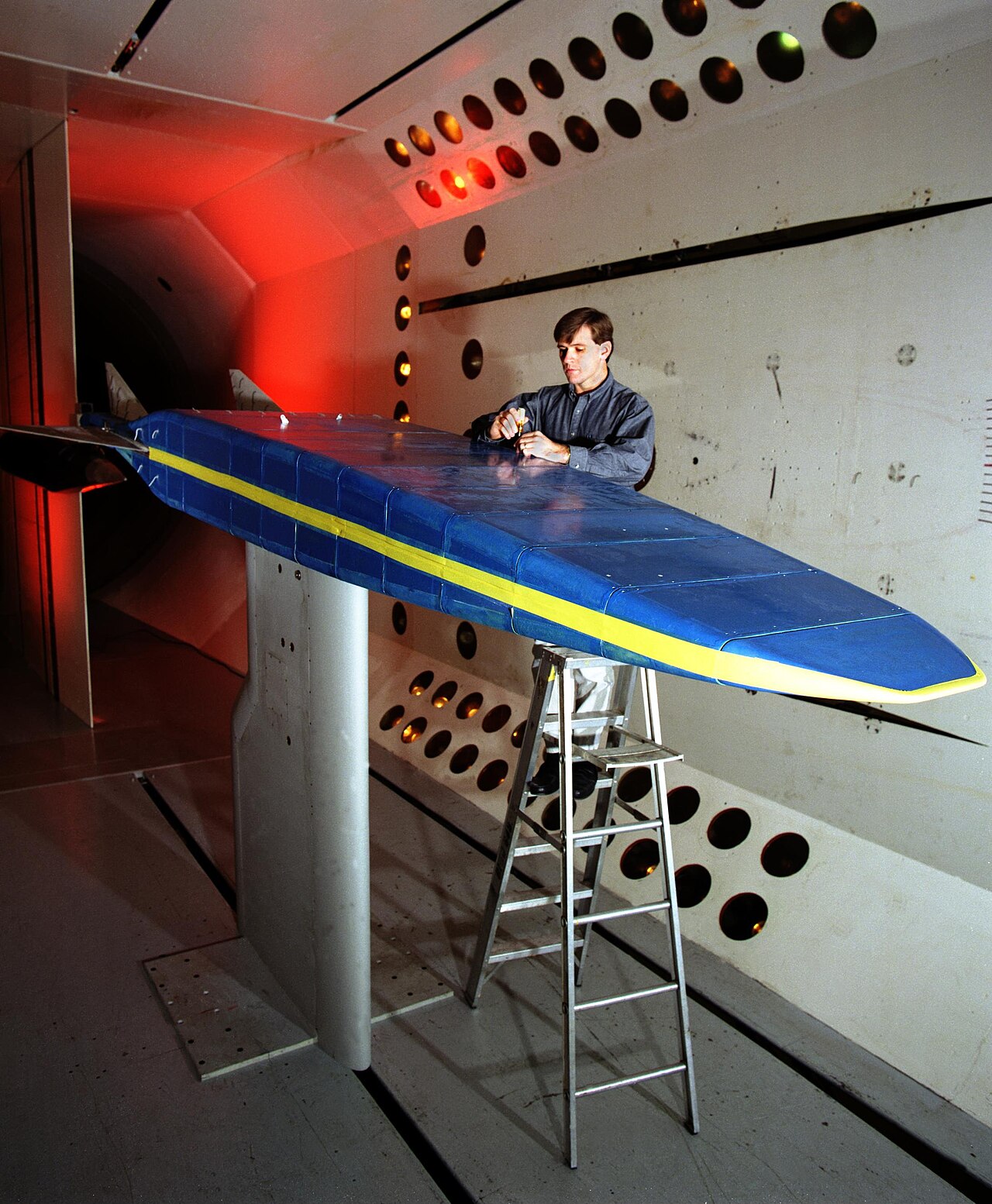
Researchers have introduced HydroGym, an open platform for reinforcement-learning-based fluid control containing more than 60 validated environments. In its initial demonstration, the team trained a control policy in a comparatively inexpensive surrogate environment and transferred it to a three-dimensional wing-section simulation, where it reduced local skin friction by 38%.
The result matters less as a one-off drag-reduction claim than as a response to reinforcement learning’s central fluid-mechanics problem: exploration is expensive. Training an agent normally requires it to test vast numbers of actions, while high-fidelity turbulent-flow simulations can be computationally punishing. HydroGym’s surrogate-training approach cut exploration costs by four orders of magnitude in the reported proof of concept, suggesting a route toward reusable control-development workflows for aerospace, energy and industrial-flow systems. It does not, however, amount to a flight-ready aerodynamic controller. [1]
By the numbers
- 60+ validated environments available in HydroGym
- 38% reduction in local skin friction in the three-dimensional wing-section transfer test
- 4 orders of magnitude reduction in exploration cost reported for surrogate-based learning
- 3D wing-section simulation used as the higher-fidelity transfer target
A platform for a difficult control problem
Turbulence control has long been an important and difficult engineering objective. Near a wing, turbine blade, pipe wall or vehicle surface, the thin region of fluid affected by the surface is known as the boundary layer. Turbulence in that layer can increase wall shear stress, commonly described in aerodynamic applications as skin friction. Reducing it can lower drag and, depending on the system, reduce energy use, heat-transfer losses or component wear.
Engineers have studied active flow control for decades using approaches such as suction and blowing, moving surfaces, synthetic jets and feedback control. The practical challenge is to decide how and when to actuate a flow that is nonlinear, rapidly changing and difficult to measure completely. A controller may need to react to pressure, velocity or shear-related signals while accounting for the energy consumed by its own actuators.
Reinforcement learning is attractive because it can learn a policy through trial and error: it observes a state, selects an action and receives a reward based on an objective such as lower drag. But conventional reinforcement-learning training is especially ill suited to expensive computational fluid dynamics. Each exploratory action can require another simulated flow evolution, and turbulent three-dimensional simulations are far costlier than simplified models. Direct training at the target fidelity can therefore turn a potentially useful control method into a research exercise limited by computing budgets.
HydroGym is intended to make that work more systematic. The open platform supplies a collection of validated fluid-control environments rather than requiring every research group to build its own tasks, interfaces and benchmarks. Validation is important in this setting: an agent can achieve impressive rewards in a poorly designed simulation without learning behavior that reflects physically meaningful flow control. Shared environments also make it easier to compare algorithms, sensing choices, actuation schemes and reward definitions under common conditions. [1]
Why surrogate transfer is the central advance
The key demonstration is a form of transfer learning. Instead of allowing a reinforcement-learning agent to conduct its most costly exploration in the high-fidelity three-dimensional wing simulation, the researchers trained it in a cheaper surrogate environment. The learned policy was then deployed in the more demanding target case.
A useful surrogate is not simply a lower-resolution version of a simulation. It must preserve enough of the decision-relevant physics that the controller learns actions which remain effective after transfer. If the simplified environment has the wrong flow structures, sensor behavior, actuator response or time scales, a policy can exploit artifacts that vanish in the target simulation. The reported 38% reduction in local skin friction indicates that, in this case, the learned control behavior retained value in the three-dimensional wing-section setting.
The four-orders-of-magnitude reduction in exploration cost is therefore the more consequential result. It changes the economic logic of the workflow. High-fidelity simulation remains necessary for validation and refinement, but it no longer has to absorb every unsuccessful exploratory decision made during policy training. In principle, teams can use inexpensive environments to search broadly, then reserve expensive computational resources for transfer tests, robustness studies and design verification.
That separation resembles established engineering practice. Designers routinely use reduced-order models, wind-tunnel experiments and high-fidelity computational fluid dynamics for different stages of development. HydroGym applies the same layered logic to data-hungry learning systems, with the additional requirement that a policy—not just a design parameter—must cross the gap between models.
Potential uses in aerospace, energy and industry
For aerospace, the immediate research opportunity is adaptive boundary-layer control around wing sections and other aerodynamic surfaces. A policy that can respond to changing conditions could eventually complement fixed geometric design measures. The largest potential benefits would depend on whether the total system can deliver a net gain after accounting for sensors, actuators, power, mass, reliability and maintenance.
Wind turbines present another plausible target. Their blades operate in changing inflow conditions and can experience separation, turbulence and surface contamination that undermine designed aerodynamic performance. Turbomachinery, cooling passages, chemical processes and pipelines also contain flows where wall friction, mixing, pressure losses or heat transfer are valuable control objectives. A reusable environment suite could let specialists focus on their device physics and hardware constraints instead of repeatedly building reinforcement-learning infrastructure from scratch.
The platform may also be useful to companies and laboratories evaluating whether reinforcement learning is appropriate at all. Standardized tasks can expose where a simpler controller delivers comparable results with lower computational and operational burden. For industrial users, that comparison is as important as a high headline performance number. A controller that saves friction in simulation but requires dense sensing, fast actuation and substantial auxiliary power may have little commercial value.
Nature’s publication gives the work visibility, while the platform’s open design could matter more over time. Common benchmarks often shape a technical field by enabling reproducible results and making progress easier to audit. For suppliers of simulation software, high-performance computing, sensors and flow-control hardware, a shared set of environments could establish clearer performance targets and shorten early-stage experimentation. [1]
What the result does not establish
The reported test is a proof of concept in simulation, not evidence that an aircraft can now use a reinforcement-learning controller in flight. A three-dimensional wing section is an important step beyond an idealized low-cost surrogate, but a full vehicle introduces additional conditions: complex geometry, changing altitude and speed, atmospheric disturbances, structural motion, sensor noise, actuator limits and safety-critical failure modes.
Several technical questions remain. The study’s local skin-friction metric is not the same as an aircraft-level fuel-burn result. Engineers would need to measure total drag and net energy use, including the power required to drive any active control mechanism. They would also need to show that performance persists across operating conditions rather than being concentrated in one simulated regime.
Sim-to-real transfer is another substantial barrier. Numerical models necessarily simplify real flows and actuator hardware. A practical system must tolerate modeling error, delayed or noisy sensors, actuator degradation and off-nominal states. It must also satisfy verification, certification and explainability requirements that are much stricter for flight controls than for an offline simulation benchmark.
There are methodological cautions as well. “Validated environments” improves confidence in the benchmark suite, but validation has a scope: agreement with the physical behavior relevant to one task does not automatically validate every control objective or every future configuration. Independent replication, comparison against established control methods and release of sufficient implementation detail will determine whether the claimed cost-performance trade-off generalizes.
From isolated demonstrations to an engineering workflow
The next tests should be designed around transfer boundaries. Researchers will need to vary geometry, Reynolds-number regimes, incoming turbulence, sensor layouts and actuator characteristics, then report when a policy succeeds, degrades or fails. They should compare surrogate-trained policies with policies trained directly at high fidelity, with model-based controllers and with simpler feedback baselines. Reporting computational cost, actuator energy and robustness alongside drag-related metrics will be essential.
If the approach holds up, the likely near-term outcome is not autonomous aircraft control. It is a more efficient engineering loop: train broadly in lower-cost environments, test promising policies in high-fidelity computation, then move to controlled experimental rigs. That could make reinforcement learning a practical addition to the toolkit for fluid-control researchers and engineering teams rather than a method reserved for unusually large computing allocations.
HydroGym’s contribution is thus infrastructural as much as algorithmic. By providing a common, validated environment library and demonstrating transfer to a more realistic aerodynamic case, the work attacks the cost bottleneck that has limited experimentation. The path to hardware remains long, but making learning cheaper and more comparable is a necessary step toward useful deployment. [1]
Editor’s Take
I see the four-orders-of-magnitude exploration-cost result as the number to watch, not the 38% skin-friction result in isolation. Plenty of control ideas look promising in a carefully selected simulation. The economically important question is whether an engineering team can afford to search, test and reject enough policies to find one that survives more realistic conditions. HydroGym makes that process look more plausible.
I would not treat this as a near-term route to AI-managed flight surfaces. The next credible milestones are tougher transfer tests, actuator-power accounting and wind-tunnel or hardware results with noisy sensors. If policies keep working as those constraints accumulate, a shared benchmark platform could become valuable infrastructure for turbine, aerospace and process-industry development.