
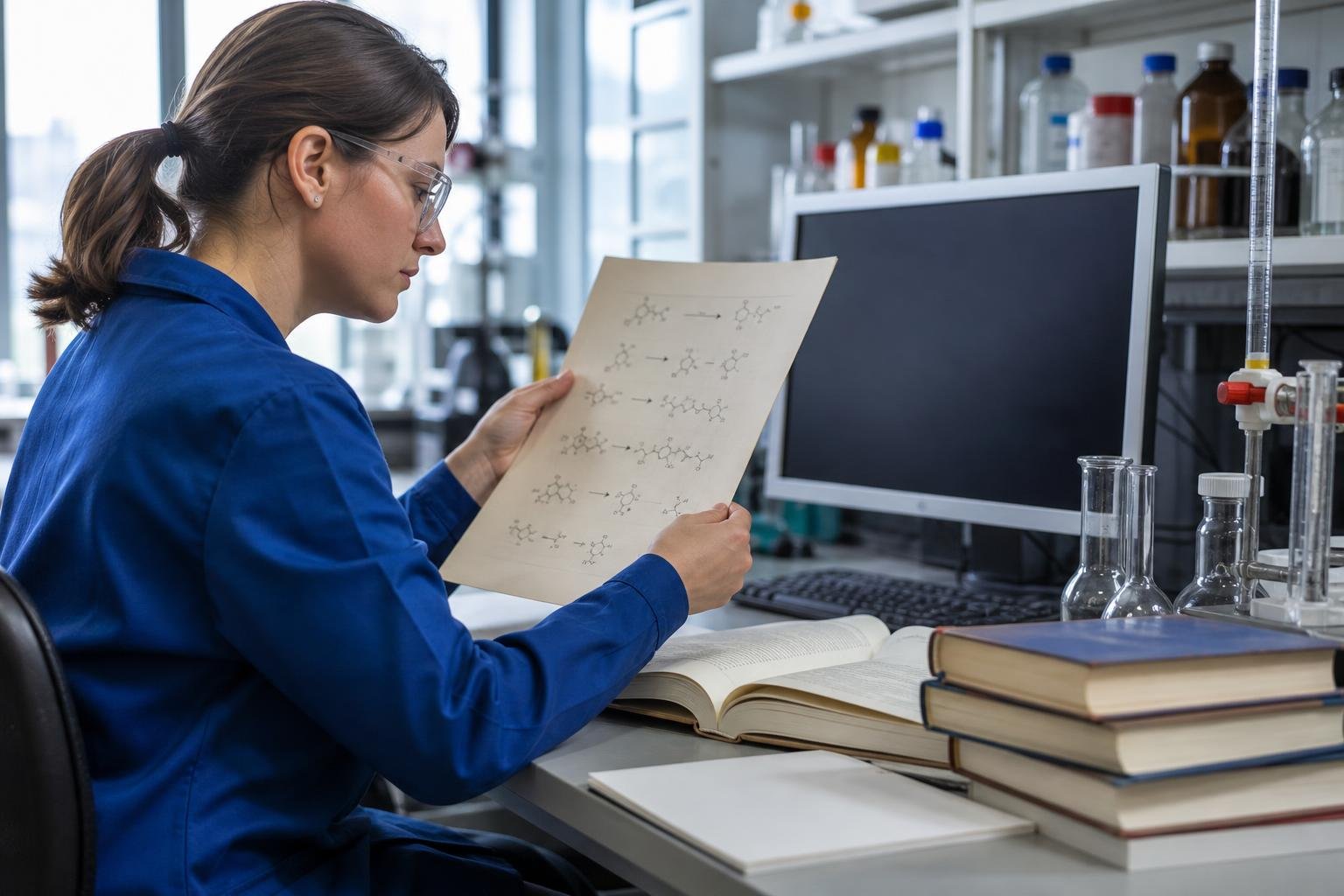
Elsevier is integrating a chemistry-focused vision model from LG AI Research into Reaxys, its scientific information platform for chemistry. The system is intended to identify and extract molecules, chemical structures and reaction diagrams embedded in images across patents and scientific literature, then bring that material into Elsevier’s production content-extraction and curation workflows.[1]
The significance is less about giving chemists another conversational interface than improving the evidence layer beneath chemistry software. A large share of useful experimental knowledge is presented as figures, scanned pages, scheme images and patent diagrams rather than as clean, machine-readable records. If those visual elements can be extracted accurately, normalized and linked to source documents, they can become searchable inputs for chemists, drug-discovery groups and materials researchers before any generative AI system is asked to propose a molecule or synthesis route.
Why scientific images remain a major data bottleneck
Scientific publishing has long produced a mismatch between what humans can read and what software can retrieve. Text-search systems can index article abstracts, captions and patent prose. But a reaction scheme may contain the most important information on a page: starting materials, reagents, arrows, products, reaction conditions, yields, stereochemical notation and multi-step transformations. In older papers or patent archives, that information may exist only as a raster image or a low-quality scan.
Conventional optical character recognition is useful for typed words and numbers, but chemical notation is a substantially harder target. A system must distinguish bond lines from arrows, ring structures from labels, superscripts and subscripts from atom counts, and stereochemical marks from image noise. It also needs to understand the layout of a reaction diagram: which structures are reactants, which are products, which text identifies reagents or conditions, and whether a figure contains one reaction or several alternatives.
That makes chemistry image extraction an infrastructure problem, not merely a document-digitization task. An incorrect character in ordinary text may be tolerable in some searches. An incorrect bond, charge, stereocenter or atom label can change the identity of a chemical compound. For a research database, extraction quality must therefore be tied to chemical validation, provenance and review processes rather than treated as a generic image-recognition exercise.
What the Reaxys integration is designed to do
Elsevier said the LG AI Research model will be used to extract molecules, reaction diagrams and chemical structures from images in patents and scientific papers. The company is integrating the technology into its production extraction and curation process, with validation against Reaxys benchmarks.[1]
That wording matters. The announced project is not simply a feature that lets an end user upload a picture and receive an unverified structure. It places the model within a pipeline that must turn image-derived candidates into content suitable for a curated chemistry database. In practice, such a pipeline normally involves several distinct tasks:
- Image segmentation: locating chemical diagrams, labels, tables and other relevant regions within a page.
- Structure recognition: converting a molecular drawing into a machine-readable chemical representation.
- Reaction interpretation: separating reactants, products, agents and conditions while preserving the relationships implied by arrows and diagram layout.
- Chemical validation: checking whether the output is chemically coherent and whether it conforms to database rules for structures and reactions.
- Source linking and curation: retaining a connection between the extracted record and the originating paper or patent, while routing uncertain cases for review.
Neither Elsevier’s announcement nor its Reaxys product material specifies the model architecture, accuracy rates, error distribution or the share of extracted records that require human correction. Those details will be important for assessing the deployment. A benchmark can demonstrate progress, but its value depends on whether it covers the difficult cases that dominate real-world scientific archives: degraded scans, dense patent layouts, uncommon elements, polymeric structures, hand-drawn figures and complex stereochemistry.
Reaxys is positioned as a platform combining chemical reactions, substances, literature and related data for research workflows.[2] The LG AI Research work could expand the universe of material available to such a platform, rather than merely improve the interface to records it already holds.
Better inputs can matter more than a more fluent model
Generative chemistry systems have attracted substantial attention for molecule design, retrosynthesis planning and literature question-answering. Those applications are useful only to the extent that their underlying records are complete, correctly structured and traceable. A model can produce a plausible answer from incomplete evidence; it cannot recover a reaction diagram that was never digitized or a structure that remains locked in an image.
For medicinal chemistry teams, broader extraction could make it easier to find prior art, known analogues, reaction precedents and reported conditions. That can reduce duplicated work and help scientists frame more informed design questions. For process and synthesis groups, searchable reaction schemes may surface practical transformations that are poorly described in abstracts but clearly documented in figures. In materials research, image-level extraction could help connect structures and formulations disclosed across a fragmented literature and patent record.
The benefit is also organizational. Research teams increasingly use a mix of electronic laboratory notebooks, compound-registration systems, internal knowledge graphs and external databases. Machine-readable data with a reliable source reference can be integrated into those systems. A PDF image that only a human can interpret remains difficult to compare, audit or reuse at scale.
Industry demand is clear, but independent validation is still needed
Elsevier’s Reaxys materials cite customers and users across industry and academia, including Sygnature Discovery, WuXi AppTec and universities.[2] Their presence illustrates the broad range of organizations that depend on searchable chemistry evidence: contract research providers need rapid access to synthetic precedent, pharmaceutical services groups need to assess patent and literature landscapes, and academic teams need to navigate dispersed research records.
Those testimonials should not, however, be interpreted as independent evaluations of the LG AI Research model or this specific integration. The cited customer examples are vendor-selected product material, and the announcement does not publish comparative testing against other optical chemical-structure-recognition systems. The relevant question is not whether more content can be extracted in principle; it is how much usable, chemically correct and provenance-preserving content the workflow adds relative to existing methods.
For buyers, the most useful future disclosures would include structure-level and reaction-level accuracy on representative patent and journal-image sets; performance by image quality and chemistry type; confidence thresholds used for automated ingestion; rates of expert correction; and evidence that extracted records improve retrieval in realistic research tasks. An aggregate benchmark score alone can conceal consequential weaknesses, particularly around stereochemistry and multi-component reactions.
Commercial and competitive implications
The move underscores a shift underway in scientific-information products. Publishers and database providers are no longer competing only on the size of their licensed document collections. They are competing on their ability to transform unstructured and semi-structured scientific material into connected, queryable data.
That is commercially significant because high-quality curation is difficult to reproduce. A generic multimodal model may be able to describe an image, but a chemistry platform must produce a structure that supports exact and substructure search, identify reaction participants correctly, and preserve a defensible trail back to the original disclosure. Integrating specialist vision technology into an established curation operation could strengthen a database provider’s advantage if it improves coverage without weakening trust.
The collaboration also gives LG AI Research an enterprise route for a domain-specific model: not as a standalone demonstration, but as a component in a production scientific workflow. More such partnerships are likely as foundation-model developers seek domains where specialized evaluation, proprietary content pipelines and human review create barriers to entry.
Limits, rights and the human-review question
More automated extraction also raises practical concerns. Patent documents vary widely in quality, and their diagrams often contain deliberately broad claims, Markush-style structural definitions and contextual qualifiers that are challenging to reduce to a single conventional molecular record. Scientific papers can contain illustrations intended to explain a concept rather than report an experimentally verified compound. Treating all image-derived structures as equally certain would create risks for downstream users.
Copyright, licensing and database terms will also shape how extracted information can be indexed and reused. The announcement addresses Elsevier’s own production workflows, not a universal right to mine or redistribute content from every scientific source. Researchers using any extracted record will still need to understand the underlying access terms and consult the source document when a decision depends on fine experimental detail.
The appropriate model is therefore augmentation rather than blind automation. Vision systems can prioritize pages, recover candidate structures and expand coverage. Chemical rules, benchmark validation and expert curators remain necessary to decide what enters a trusted reference database. The value of the integration will depend on how well Elsevier exposes confidence, provenance and corrections to users over time.
What to watch next
The immediate milestone is operational: whether the model materially increases the quantity and quality of Reaxys records drawn from image-heavy content. The more meaningful long-term measure is retrieval quality. If a chemist can find a previously inaccessible reaction, inspect its original source and use it to make a faster experimental decision, then the extraction layer has created tangible value.
The broader trend is toward scientific AI systems built on richer evidence rather than only more capable language models. In chemistry, that means connecting text, images, reaction records, experimental conditions and source provenance. The most durable advances may be quiet ones: less manual transcription, fewer unsearchable diagrams and more of the scientific record available for rigorous computational use.
Editor’s Take
I think this is the right kind of chemistry AI investment. The industry does not primarily lack models that can generate plausible molecular ideas; it lacks clean, searchable and attributable evidence from the enormous archive of published chemistry. Recovering reaction schemes from documents is unglamorous compared with launching a design copilot, but it can improve every downstream workflow that relies on Reaxys data.
The next thing I would watch is not a headline benchmark score. I would want to see how the system handles stereochemistry, bad patent scans, complex multi-step schemes and ambiguous structures, and how clearly Reaxys signals confidence and source provenance. If Elsevier can increase coverage while keeping those controls strong, this becomes a meaningful data-quality advantage. If it merely converts images into superficially plausible records, the hype will outrun the utility very quickly.
References
- Elsevier – Elsevier and LG AI Research unlock more chemistry hidden in scientific images
- Elsevier Reaxys – Reaxys product information


_(14775062124).jpg)